PIK3CA-Related Overgrowth Spectrum: Understanding Rare Genetic Overgrowth

Updated: 3 days ago
Medically reviewed by Dr. Baraa Alnahhal, MD · Last reviewed: October 2026
PIK3CA-related overgrowth spectrum (PROS) is a rare group of genetic conditions caused by non-inherited mutations in the PIK3CA gene. This gene normally controls cell growth and division; however, when mutated, it signals cells to grow excessively, leading to asymmetrical overgrowth of tissues, bones, and organs. Treatment varies based on the severity and specific areas affected, ranging from targeted medications like PIK3CA inhibitors to surgical interventions.
Quick Answer
PIK3CA-related overgrowth spectrum (PROS) is a group of conditions in which a somatic mutation in the PIK3CA gene makes the PI3K enzyme overactive, causing parts of the body to grow too much. It can affect muscles, bones, fat and blood vessels, causing asymmetry. Diagnosis uses biopsy and genetic testing, and management includes specialized inhibitors and surgery. [1]
What the research says
In a real-world study, alpelisib shrank target lesions in about 4 in 10 evaluable patients. EPIK-P1 reviewed the records of 57 people aged 2 years and older with severe PROS who were treated with alpelisib. At 24 weeks, 12 of 32 patients (37.5%) with complete records had at least a 20% reduction in target lesion volume. Side effects occurred in 82.5% of patients (38.6% were judged treatment-related), most often high blood sugar (12.3%) and mouth ulcers (10.5%), and no deaths occurred (Canaud et al., Genet Med, 2023).
The FDA’s own review found a measurable response in about 1 in 4 treated patients, often lasting a year or more. Among 37 patients in the efficacy analysis, 27% (95% CI, 14–44%) had a radiologic response at week 24, and 60% of responders kept that response for at least 12 months. The most common adverse reactions were diarrhea, mouth inflammation (stomatitis), and high blood sugar (Singh et al., Clin Cancer Res, 2024).
PROS is rare—about 14 births per million—and alpelisib needs careful safety monitoring. A clinical review notes that alpelisib received FDA accelerated approval on April 5, 2022 for patients 2 years and older who need systemic therapy, and that clinicians should watch for hypersensitivity, severe skin reactions, high blood sugar, pneumonitis, diarrhea, and embryo-fetal toxicity (Nadjkovic & Lonabaugh, J Pediatr Pharmacol Ther, 2023).
Research summaries are based on article abstracts retrieved from PubMed.
What is PIK3CA?
The PIK3CA gene is a critical biological blueprint that provides instructions for creating the p110 alpha protein, a vital component of the PI3K enzyme. This enzyme acts as a master controller for how cells grow, divide, and survive. In a typical development cycle, this gene ensures that cells reproduce in a controlled and balanced manner. [1]
When a somatic mutation occurs—a change that happens spontaneously during fetal development rather than being inherited—the PI3K enzyme can become hyperactive. This “always-on” state sends continuous signals for cells to multiply, leading to the diverse group of conditions known as PIK3CA-Related Overgrowth Spectrum (PROS). While these mutations are also found in some cancers, having a PROS condition does not mean an individual has cancer or is at an increased risk for developing it. [1]

What is PIK3CA-related overgrowth spectrum (PROS)?
Because the PIK3CA mutation only affects some cells, the resulting overgrowth is often asymmetrical, appearing on only one side of the body or in specific localized areas. Healthcare providers are increasingly using the general term “PROS” to describe these symptoms, though many specific syndromes fall under this umbrella. [1]
Condition Name | Primary Characteristics | Affected Tissues |
CLOVES syndrome | Trunk swelling, limb overgrowth, and vascular malformations. | Fat, blood vessels, limbs. |
Klippel-Trenaunay syndrome (KTS) | Port wine stains and significant soft tissue overgrowth. | Skin, bone, blood vessels. |
Macrodactyly | Disproportionate enlargement of specific fingers or toes. | Bone, soft tissue. |
Fibro-adipose vascular anomaly (FAVA) | Painful masses of fatty tissue within the muscles. | Muscle, fat, vessels. |
Facial infiltrating lipomatosis (FIL) | Facial asymmetry involving the tongue, teeth, and bone. | Face, bone, fat. |
Lipomatosis of nerve (LON) | Fatty tissue overgrowth around nerve bundles causing pain. | Nerves, fat. |
Beyond visible physical changes, PROS can also affect internal organs, leading to brain enlargement (megalencephaly), heart issues, or liver enlargement. Brain-related variants can result in seizures and intellectual disabilities due to the impact on neural development. [1]
What are the symptoms of PIK3CA-related overgrowth, and how is it diagnosed?
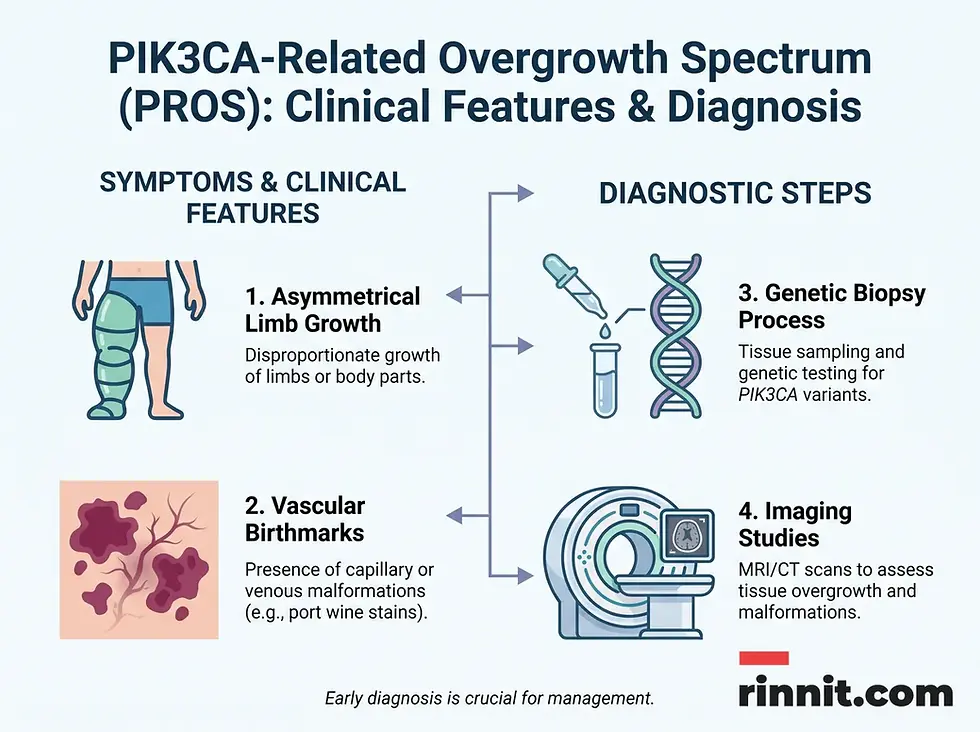
The signs of PIK3CA-related conditions are highly variable, depending on which cells carry the mutation and where they are located in the body. Common indicators include birthmarks like port wine stains, bone malformations such as scoliosis, and enlarged blood or lymph vessels that may not function correctly. [1]
The Diagnostic Process
Diagnosis is a precise process that often requires a multidisciplinary team of specialists:
Clinical Evaluation: A thorough physical exam to identify areas of overgrowth and vascular abnormalities.
Tissue Biopsy: The most definitive test involves taking a small sample of the affected tissue to look for the specific PIK3CA gene variant.
Imaging Studies: MRI, CT scans, and ultrasounds are used to map the extent of the overgrowth in bones, muscles, and internal organs.
Prenatal Screening: In some instances, growth abnormalities may be detected via advanced prenatal ultrasound during pregnancy. [1]
How is PIK3CA-related overgrowth spectrum managed and treated?
Treatment for PROS is highly individualized and focuses on managing symptoms, reducing pain, and slowing the progression of overgrowth. In 2022, the FDA approved alpelisib, a targeted PIK3CA inhibitor, for adults and children aged two and older with severe PROS conditions. This medication works by directly slowing down the overactive PI3K enzyme. [1]
Comprehensive Care Options
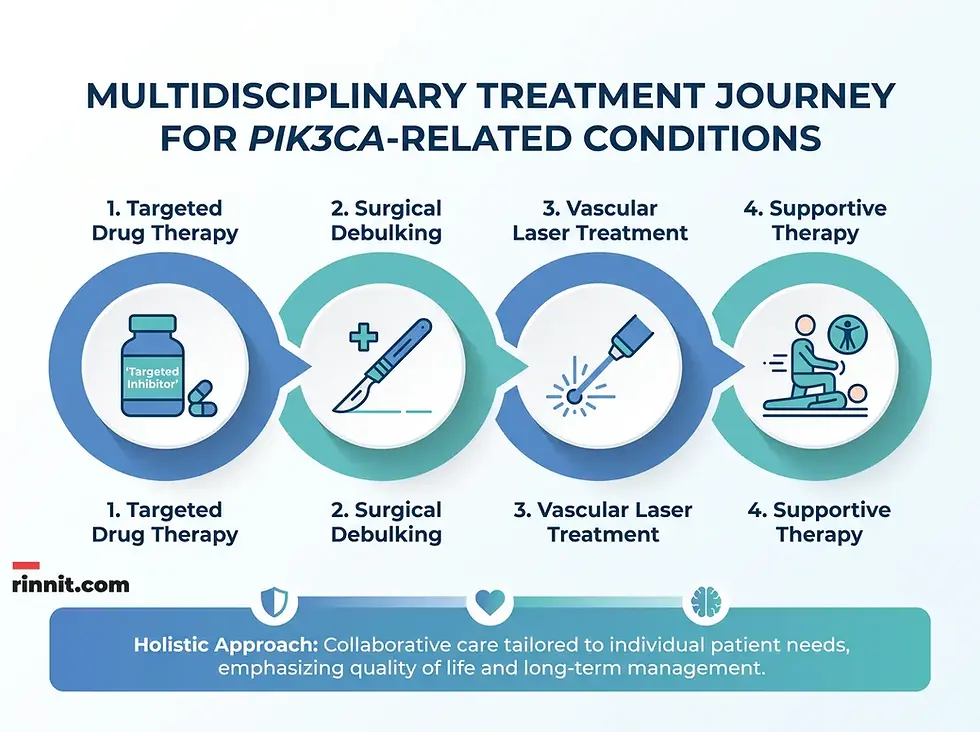
Targeted Medicine: PIK3CA inhibitors like alpelisib to control enzyme activity.
Surgical Interventions: Debulking surgery to remove large growths or epiphysiodesis to manage bony overgrowth in limbs.
Vascular Treatments: Laser ablation for birthmarks and sclerotherapy or embolization for blood vessel malformations.
Supportive Therapies: Compression garments to manage swelling, anticoagulation to prevent blood clots, and physical or occupational therapy to maintain mobility. [1]
Conclusion
PIK3CA-related overgrowth spectrum represents a complex set of rare conditions that require specialized, lifelong care. While the terminology and genetic science behind PROS can be overwhelming, recent advancements in targeted therapies have significantly improved the outlook for many patients. By working closely with geneticists, surgeons, and therapists, individuals with PROS can manage their symptoms and maintain a high quality of life.
Frequently Asked Questions
Is PIK3CA-related overgrowth inherited from parents?
No. These conditions are caused by somatic mutations that occur randomly during development in the womb. They are not passed down from biological parents.
Is PROS a form of cancer?
No. While the PIK3CA gene is involved in some cancers, PROS is a separate overgrowth condition. Having PROS does not mean you have cancer.
Can PROS be detected before a baby is born?
Sometimes. Growth abnormalities or vascular issues may be visible on high-resolution prenatal ultrasounds, leading to further testing.
What is the most common symptom of PROS?
Asymmetrical overgrowth—where one limb or one side of the face is larger than the other—is the hallmark sign of the spectrum.
How does alpelisib work?
Alpelisib is a PIK3CA inhibitor that specifically targets and slows down the overactive PI3K enzyme, helping to reduce the “grow” signals sent to cells.
Will my child need surgery?
Surgery depends on the severity. Some children need debulking surgery to improve mobility or manage large growths, while others may only need medical management.
Are port wine stains always a sign of PIK3CA conditions?
Not always. While port wine stains are common in PROS conditions like KTS or CLAPO, they can also occur independently or as part of other syndromes.
Does PROS affect life expectancy?
The outlook varies. Those with mild symptoms often have a typical life expectancy, while severe cases involving major organs may face long-term complications.
What kind of doctor treats PIK3CA conditions?
Patients usually see a multidisciplinary team including geneticists, dermatologists, vascular specialists, and orthopedic surgeons.
What test confirms PIK3CA-related overgrowth?
A small tissue sample (biopsy) from the affected area is usually tested for the PIK3CA change. A blood test can miss it, because the change is often present only in some cells. Imaging such as MRI shows how far the overgrowth reaches.
Related Reading
Klippel-Trenaunay Syndrome: Symptoms, Causes, and Treatment Guide explains one of the main conditions within the PIK3CA spectrum.
Port-Wine Stain: Clinical Characteristics, Risks, and Management covers the birthmark often seen with PIK3CA overgrowth conditions.
Hemimegalencephaly: Understanding One-Sided Brain Overgrowth explains one-sided brain overgrowth that can be linked to PIK3CA changes.
Beckwith-Wiedemann Syndrome: The Overgrowth Condition That Makes Babies Larger at Birth — and How Care Keeps Most Children Healthy for Life describes a different genetic overgrowth condition in babies.
References
Cleveland Clinic. PIK3CA. Cleveland Clinic Health Library. Last updated December 19, 2025. https://my.clevelandclinic.org/health/diseases/pik3ca
Canaud G, Lopez Gutierrez JC, Irvine AD, et al. Alpelisib for treatment of patients with PIK3CA-related overgrowth spectrum (PROS). Genet Med. 2023;25(12):100969. PMID: 37634128. DOI: 10.1016/j.gim.2023.100969
Singh S, Bradford D, Li X, et al. FDA Approval Summary: Alpelisib for PIK3CA-Related Overgrowth Spectrum. Clin Cancer Res. 2024;30(1):23-28. PMID: 37624421. DOI: 10.1158/1078-0432.CCR-23-1270
Nadjkovic K, Lonabaugh K. Alpelisib: A Novel Agent for PIK3CA-Related Overgrowth Spectrum. J Pediatr Pharmacol Ther. 2023;28(7):590-594. PMID: 38025143. DOI: 10.5863/1551-6776-28.7.590
Medical disclaimer
This article is for informational purposes only and is not a substitute for professional medical advice, diagnosis, or treatment. Always seek the advice of your physician or other qualified health provider with any questions you may have about a medical condition.



Comments