
Persistent Depressive Disorder (Dysthymia): Signs, Causes, and Treatment Explained

Updated: 2 days ago
Medically reviewed by Dr. Baraa Alnahhal, MD · Last reviewed: September 2026
TL;DR
Persistent depressive disorder — often called dysthymia — is a continuous, long-term form of depression. You may feel sad and empty, lose interest in daily activities, struggle to get things done, and deal with low self-esteem and hopelessness. These feelings last for years and can interfere with relationships, school, work and daily life. The key diagnostic marker is duration: in adults, depressed mood occurs most of the day for two or more years; in children, depressed mood or irritability lasts at least one year. It is not as severe as major depression, but it is still a real, treatable condition — a combination of talk therapy and medicine can be effective, and daily self-care steps help keep symptoms under control.
Quick Answer
What is persistent depressive disorder? A continuous, long-term form of depression with lasting sadness, emptiness, low energy and low self-esteem that persists for years and interferes with daily life.
How is it diagnosed? For adults, depressed mood most of the day for two or more years; for children, depressed mood or irritability for at least one year. Diagnosis involves a physical exam, lab tests (such as checking for hypothyroidism), and a psychological evaluation.
What causes it? The exact cause is unknown, but it likely involves brain chemistry changes, physical brain differences, inherited traits, and triggering life events such as loss, financial stress, or trauma.
How is it treated? Talk therapy (such as cognitive behavioral therapy) and antidepressant medicines (SSRIs, SNRIs, TCAs), often long term, supported by self-care: routine, exercise, sleep, social connection, and avoiding alcohol.
Can it be prevented? There is no sure way to prevent it, but controlling stress, building resilience, reaching out to family and friends, and getting early treatment can reduce symptoms and prevent relapse.
What is persistent depressive disorder?
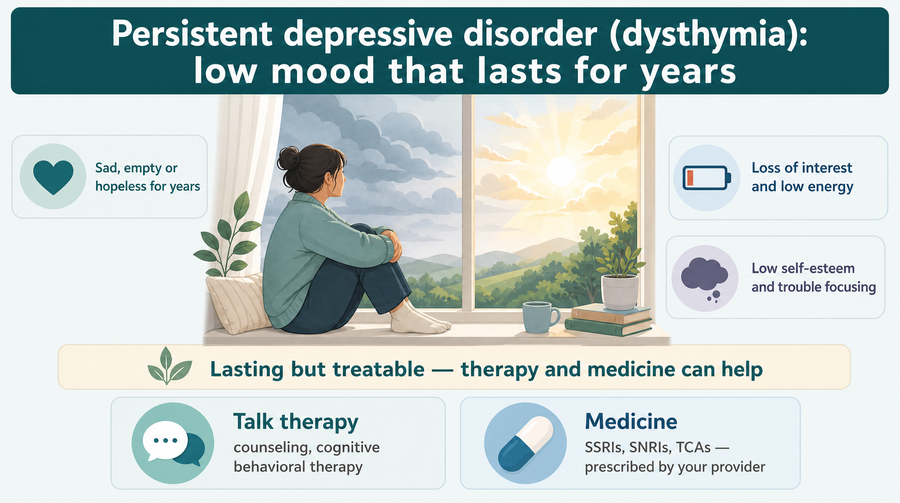
Persistent depressive disorder is a continuous, long-term form of depression. You may feel sad and empty, lose interest in daily activities and have trouble getting things done. You may also have low self-esteem, feel like a failure and feel hopeless.
These feelings last for years and may interfere with your relationships, school, work and daily activities.
If you have persistent depressive disorder, you may find it hard to be upbeat even on happy occasions. You may be described as having a gloomy personality, constantly complaining or not being able to have fun.
It is important to know the severity context: persistent depressive disorder is not as severe as major depression, but your current depressed mood may be mild, moderate or severe. Because it is long term, coping with depression symptoms can be challenging — but a combination of talk therapy and medicine can be effective in treating this condition.
Persistent depressive disorder symptoms
Symptoms usually come and go over a period of years. The intensity of symptoms can change over time, but symptoms usually don't disappear for more than two months at a time. Major depression episodes may also occur before or during persistent depressive disorder.
Symptoms can cause major problems in your life and may include:
Sadness, emptiness or feeling down
Loss of interest in daily activities
Tiredness and lack of energy
Low self-esteem, self-criticism or feeling you're not capable
Trouble focusing clearly and trouble making decisions
Problems getting things done well and on time
Quickly becoming annoyed, impatient or angry
Avoidance of social activities
Feelings of guilt and worries over the past
Poor appetite or overeating
Sleep problems
Hopelessness
In children, symptoms may include depressed mood and being irritable — easily becoming annoyed, impatient or angry.
When to see a doctor
If these feelings have been going on for a long time, you may think they'll always be part of your life. But if you have any symptoms of persistent depressive disorder, seek medical help.
Talk to your health care provider about your symptoms or seek help from a mental health professional. Or reach out to someone else who may be able to guide you to treatment — a friend or loved one, a teacher, a faith leader, or another person you trust.
If you think you may hurt yourself or attempt suicide: call 911 or your local emergency number immediately, or call or text 988 to reach the 988 Suicide & Crisis Lifeline — available 24 hours a day, seven days a week, free and confidential (Spanish language line: 888-628-9454). Online chat is also available.
What causes persistent depressive disorder?
The exact cause of persistent depressive disorder is not known. As with major depression, it may involve more than one cause.
Possible cause | What that means |
Biological differences | People with persistent depressive disorder may have physical changes in their brains; it's not yet clear how these changes affect the disorder |
Brain chemistry | Neurotransmitters are naturally occurring brain chemicals; research indicates that changes in neurotransmitters may play a large part in depression and its treatment |
Inherited traits | The condition appears more common in people whose blood relatives also have it; researchers are working to find genes that may be involved |
Life events | Traumatic events — such as the loss of a loved one, financial problems or a high level of stress — can trigger the disorder in some people |
Risk factors
Persistent depressive disorder often begins early — in childhood, the teen years or young adult life — and continues for a long time. Certain factors appear to increase the risk of developing it:
Having a first-degree blood relative (parent or sibling) with major depressive disorder or another depressive disorder
Traumatic or stressful life events, such as the loss of a loved one or major financial problems
Personality traits that include negativity, such as low self-esteem, being too dependent or self-critical, or always expecting the worst
History of other mental health disorders, such as a personality disorder

Complications
If left untreated, persistent depressive disorder can be linked with several other conditions:
Lower quality of life
Major depression, anxiety disorders and other mood disorders
Substance misuse
Relationship difficulties and family conflicts
School or work problems and trouble getting things done
Continuing pain and general medical illnesses
Suicidal thoughts or behavior
Personality disorders or other mental health disorders
Prevention
There is no sure way to prevent persistent depressive disorder. Because it often starts in childhood or during the teenage years, identifying children at risk of the condition may help them get early treatment.
Strategies that may help reduce or prevent symptoms include taking steps to control stress and increase your resilience — your ability to recover from problems — while boosting self-esteem; reaching out to family and friends, especially in times of crisis; getting treatment at the earliest sign of a problem; and considering long-term treatment to help prevent a relapse of symptoms.
How persistent depressive disorder is diagnosed
If your health care provider thinks you may have persistent depressive disorder, exams and tests may include three components.
Physical exam. Your provider may do a physical exam and ask in-depth questions about your health to determine what may be causing your depression. In some cases, it may be linked to an underlying physical health problem.
Lab tests. Your provider may recommend lab tests to rule out other medical conditions that may cause depressive symptoms — for example, a blood test to check whether your thyroid is not making enough thyroid hormone, a condition called hypothyroidism.
Psychological evaluation. This includes talking about your thoughts, feelings and behavior, and may include completing a questionnaire. The evaluation can help determine whether you have persistent depressive disorder or another condition that can affect mood, such as major depression, bipolar disorder or seasonal affective disorder.
The main diagnostic indication differs by age:
Age group | Main diagnostic indication |
Adults | Depressed mood occurs most of the day for two or more years |
Children | Depressed mood or irritability occurs most of the day for at least one year |
Symptoms can vary from person to person. When persistent depressive disorder starts before age 21, it's called early onset. If it starts at age 21 or older, it's called late onset.
Treatment options
The two main treatments for persistent depressive disorder are medicines and talk therapy. What your health care provider recommends depends on how severe your symptoms are, your desire to explore emotional or other issues, previous treatment methods, your ability to tolerate medicines, other emotional problems you may have, and what type of treatment you prefer.
Talk therapy may be the first option suggested for children and teenagers, but that depends on the individual — sometimes antidepressants are also needed.
Medicines
The types of antidepressants most commonly used to treat persistent depressive disorder include:
SSRIs — selective serotonin reuptake inhibitors
TCAs — tricyclic antidepressants
SNRIs — serotonin and norepinephrine reuptake inhibitors
Talk with your health care provider or pharmacist about possible side effects.
Finding the right medicine takes patience. You may need to try several medicines or a combination before you find one that works. Some medicines take several weeks or longer for full effect, and it can take this long for side effects to ease as your body adjusts.
Don't stop taking an antidepressant without talking to your health care provider — your provider can help you gradually and safely decrease your dose. Stopping suddenly or missing several doses may cause withdrawal-like symptoms, and quitting suddenly may cause depression to quickly get worse. When you have persistent depressive disorder, you may need to take antidepressants long term to keep symptoms under control.
Antidepressants and pregnancy. If you're pregnant or breastfeeding, some antidepressants may pose an increased health risk to your unborn baby or nursing child. Talk to your health care provider if you become pregnant or are planning to become pregnant.
FDA warning on antidepressants. Antidepressants are generally safe when taken as directed, but the FDA requires all antidepressants to carry a warning: in some cases, children, teens and young adults under 25 may have an increase in suicidal thoughts or behavior when taking antidepressants — more of a risk in the first few weeks after starting or when the dose is changed. Watch closely for worsening depression or unusual behavior during these times. If suicidal thoughts occur while taking an antidepressant, contact a health care provider, mental health provider, or get emergency help immediately. Keep in mind that antidepressants are more likely to reduce suicide risk in the long term by improving mood.
Talk therapy
Talk therapy, also called psychotherapy, is a general term for treating depression by talking with a mental health provider about your thoughts, feelings, behavior, relationships and related issues. Different types of psychotherapy, such as cognitive behavioral therapy (CBT), can be effective for persistent depressive disorder. You and your therapist can discuss your goals and the length of treatment.
Talk therapy can help you adjust to a crisis or current difficulty; identify issues that contribute to your depression and change behaviors that make it worse; identify negative beliefs and replace them with healthy, positive ones; find better ways to cope with and solve problems; explore relationships and develop positive interactions with others; regain a sense of satisfaction and control; and learn to set realistic goals.

Lifestyle and home remedies
Persistent depressive disorder generally is not a condition that you can treat on your own. But along with professional treatment, these self-care steps can help:
Stick to your treatment plan. Don't skip therapy sessions or appointments. Even if you're feeling well, don't skip your medicine. Give yourself time to improve gradually.
Learn about persistent depressive disorder. Education about your condition can empower you and motivate you to follow your treatment plan. Encourage your family to learn about the disorder so they can understand and support you.
Pay attention to warning signs. Work with your health care provider or therapist to learn what might trigger your symptoms, and make a plan for what to do if symptoms get worse or return. Consider involving family members or friends to watch for warning signs.
Take care of yourself. Eat a healthy diet, be physically active and get plenty of sleep. Walking, jogging, swimming, gardening or another activity you enjoy all count. Sleeping well is important for both physical and mental well-being — if you're having trouble sleeping, ask your provider what you can do.
Avoid alcohol and recreational drugs. It may seem like alcohol or drugs lessen depression-related symptoms, but over time they generally worsen depression and make it harder to treat. Talk with your provider or therapist if you need help dealing with alcohol or drug use.
A note on alternative medicine
Make sure you understand the risks as well as the possible benefits if you decide to use alternative or complementary therapy. Avoid replacing conventional medical treatment or talk therapy with alternative medicine — when it comes to depression, alternative treatments are not a substitute for medical care.
For example, the herbal supplement St. John's wort is not approved by the FDA to treat depression in the U.S., though it is available. It may help improve mild or moderate depression, but the overall evidence is not conclusive. It can interfere with blood-thinning drugs, birth control pills, chemotherapy, HIV/AIDS medicines and drugs to prevent organ rejection after a transplant. Avoid taking St. John's wort while taking antidepressants, as the combination can cause serious side effects.
Note also that the FDA does not monitor dietary supplements the way it monitors medicines — you can't always be certain of what you're getting or whether it's safe. Talk to your health care provider before taking any supplements.
Coping and support
Persistent depressive disorder makes it hard to engage in the very activities that can help you feel better. In addition to treatments recommended by your doctor or therapist, these tips may help:
Focus on your goals. Set reasonable goals and stay motivated by keeping them in mind — but give yourself permission to do less when you feel down.
Simplify your life. Cut back on obligations when possible, structure your time by planning your day, and use daily task lists, sticky notes or a planner to stay organized.
Write in a journal. Journaling as part of your treatment may improve mood by letting you express pain, anger, fear or other emotions.
Read reputable self-help books and websites. Ask your doctor or therapist to recommend books or websites to read.
Stay connected. Don't become isolated. Participate in social activities and get together with family or friends regularly. Support groups for people with depression can help you connect with others facing similar challenges.
Learn ways to relax and manage stress. Meditation, progressive muscle relaxation, yoga and tai chi are examples.
Don't make important decisions when you're down. You may not be thinking clearly when feeling depressed — avoid major decision-making during those times.
Preparing for your appointment
You may schedule an appointment with your primary health care provider, or see a mental health provider such as a psychiatrist or psychologist. Consider taking a family member or friend along to help you remember things you might miss or forget.
What you can do. Prepare by making a list of any symptoms you've had (including ones that may seem unrelated), key personal information such as major stresses or recent life changes, all medicines, vitamins, supplements or herbal preparations you're taking with doses, and your questions.
Questions worth asking include: why can't I get over this depression on my own, how is this type of depression treated, will talk therapy help, is there a medicine that might help, how long will I need to take it, what are the side effects, how often will we meet, how long will treatment take, what can I do to help myself, and what books or websites are recommended.
What to expect from your doctor. Expect questions about when you first noticed symptoms, how daily life is affected, previous treatments, what you've tried on your own, what makes you feel worse, whether relatives have had depression or another mental health disorder, and what you hope to gain from treatment. Your provider will ask follow-up questions based on your responses, symptoms and needs — preparing and anticipating questions helps you make the most of your appointment time.
Bottom line
Persistent depressive disorder is depression that has put down roots — low mood, low energy, low self-esteem and hopelessness that stretch across years and blur into what can feel like simply "who I am." But it is a recognized medical condition, not a personality trait, and it is treatable.
The duration is what defines it: two or more years of low mood for adults, at least one year for children. Diagnosis starts with ruling out physical causes like thyroid problems, then a psychological evaluation. Treatment rests on two proven pillars — talk therapy such as cognitive behavioral therapy, and antidepressant medicines, which may take weeks to work and may be needed long term. Daily habits — staying connected, moving your body, sleeping well, journaling and avoiding alcohol — keep the treatment working.
What stops most people from getting better is waiting too long. If your low mood has been a years-long companion, that itself is the signal to act.
Your next step: Book an appointment with your primary health care provider or a mental health professional, and bring a list of your symptoms and how long they've been going on. If you think you may hurt yourself, call or text 988 for the Suicide & Crisis Lifeline or 911 immediately. In the meantime, write in a journal tonight, tell one person you trust how you've been feeling, and give yourself credit for taking the first step — asking the question.
FAQ
What is persistent depressive disorder (dysthymia)?
Persistent depressive disorder, often called dysthymia, is a continuous, long-term form of depression. You may feel sad and empty, lose interest in daily activities, have low self-esteem and feel hopeless. These feelings last for years and may interfere with relationships, school, work and daily activities. It is not as severe as major depression, but it is a real, treatable condition.
How long do symptoms need to last for a diagnosis?
For an adult, the main indication is depressed mood occurring most of the day for two or more years. For a child, it's depressed mood or irritability most of the day for at least one year. Symptoms come and go over the years and may change in intensity, but they usually don't disappear for more than two months at a time.
How is dysthymia different from major depression?
Persistent depressive disorder is not as severe as major depression, but your current depressed mood may be mild, moderate or severe. Major depression episodes may also occur before or during persistent depressive disorder, and the two conditions often overlap. Both deserve professional treatment.
Can you get over persistent depression on your own?
It generally is not a condition that you can treat on your own. But alongside professional treatment — talk therapy and possibly antidepressants — self-care steps genuinely help: sticking to your treatment plan, learning about the condition, exercising, sleeping well, journaling, staying socially connected, and avoiding alcohol and recreational drugs.
What medicines treat dysthymia?
The most commonly used antidepressants are selective serotonin reuptake inhibitors (SSRIs), tricyclic antidepressants (TCAs) and serotonin and norepinephrine reuptake inhibitors (SNRIs). Finding the right medicine may take several weeks or longer, and you may need to try more than one before finding what works. Never stop an antidepressant suddenly — your provider can taper your dose safely, and with this condition you may need medication long term.
Does talk therapy work for long-term depression?
Yes — different types of psychotherapy, such as cognitive behavioral therapy, can be effective. Talk therapy can help you adjust to crises, replace negative beliefs with healthier ones, find better ways to cope, develop positive interactions, regain a sense of satisfaction and control, and learn to set realistic goals. For children and teenagers, talk therapy may even be the first treatment option suggested.
When should I get urgent help?
If you think you may hurt yourself or attempt suicide, call 911 or your local emergency number immediately, or call or text 988 to reach the 988 Suicide & Crisis Lifeline, available 24/7, free and confidential (Spanish: 888-628-9454). Also note: antidepressants carry an FDA warning for children, teens and young adults under 25 — watch closely for suicidal thoughts or worsening depression, especially in the first weeks after starting or changing a dose, and get emergency help if they occur.
Sources
Health information, not medical advice. This article is for general education and is not a substitute for professional diagnosis or treatment. Always consult a qualified healthcare provider about your own health, and seek emergency care for urgent symptoms.
Comments