Non-Ossifying Fibroma: Symptoms, Diagnosis, and Treatment Options

Updated: 3 days ago
Medically reviewed by Dr. Baraa Alnahhal, MD · Last reviewed: October 2026
Quick Answer: What is a Non-Ossifying Fibroma?
A non-ossifying fibroma (NOF) is a benign, non-cancerous growth of fibrous tissue that develops on a child's bone for unknown reasons and does not turn into bone. It is most frequent in children aged 10 to 15 and twice as common in boys. Most are found accidentally on imaging for unrelated injuries and typically heal naturally by the early twenties. [5]
What the research says
Fracture risk clustered in one growth stage. In a series of 87 patients with 103 NOFs, six of the ten patients with symptoms had a pathological fracture. All of those fractures occurred in stage B lesions averaging 44 mm long, and none occurred in the other three stages (Herget et al., BMC Musculoskelet Disord, 2016). [1]
No recurrences after surgery in one large cohort. Among 329 surgical procedures for benign bone tumors at one center, 42 recurrences (12.8%) were found, but none occurred in non-ossifying fibroma (Melvin et al., Iowa Orthop J, 2026). [2]
There are no formal follow-up guidelines yet. A case series of five patients from one UK hospital noted that no guidelines currently exist for following up NOFs, so monitoring is decided case by case (Rammanohar et al., Cureus, 2021). [3]
Key Takeaways: Non-Ossifying Fibroma at a Glance
Feature | Details |
Nature | Benign (non-cancerous), fibrous tissue growth. |
Prevalence | Affects 20% to 40% of healthy children. |
Common Locations | Thighbone (femur) or shinbone (tibia) near the knee. |
Peak Age | 10 to 15 years old; usually resolves by age 25. |
Primary Symptom | Often asymptomatic; discovered accidentally. |
Treatment | Observation via X-ray; surgery only for large/painful tumors. |
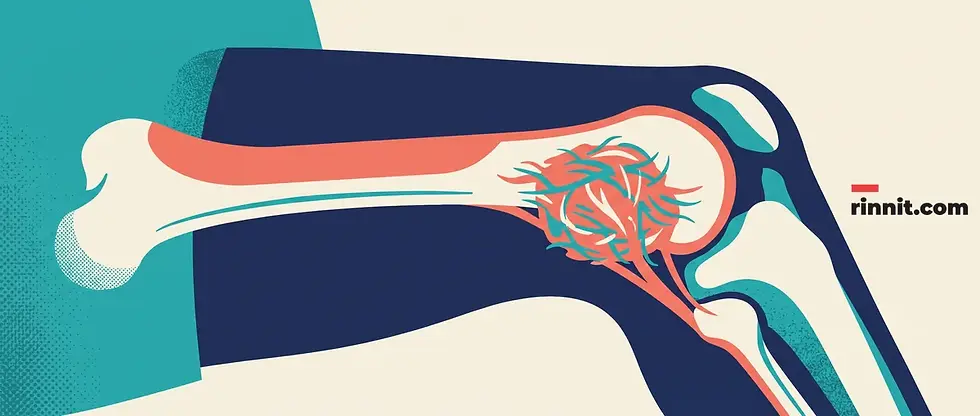
How does bone development relate to non-ossifying fibroma (NOF)?
During childhood and adolescence, bones are in a constant state of growth and remodeling. A non-ossifying fibroma occurs when a small clump of fibrous cells grows on the surface of a long bone. Unlike "ossifying" fibromas, which create new bone tissue, a non-ossifying fibroma remains fibrous. As the skeleton matures and the child stops growing, these fibrous areas are naturally filled in by surrounding bone cells, effectively "healing" the site.
What are the symptoms and signs of non-ossifying fibroma?
For the vast majority of children, a non-ossifying fibroma causes no pain or discomfort. Because they are asymptomatic, many people live with them without ever knowing they exist. [5]
When Symptoms Do Occur
If a fibroma grows particularly large (typically between 3 and 7 centimeters), it may cause:
Local Swelling: A hard lump may be felt under the skin. [5]
Tenderness: The area may become sensitive during physical activity. [5]
Fracture Risk: In rare instances, a large tumor can weaken the bone structure, leading to a "pathologic fracture." If a child experiences dull, constant pain at the site, it is often a sign of a micro-fracture rather than the tumor itself. [5]
Who is Most at Risk?
Non-ossifying fibromas are most common in boys and typically appear during the rapid growth years of early adolescence. While solitary growths are the norm, multiple fibromas can occur, though this is very rare and sometimes associated with specific conditions like neurofibromatosis. [5]
Group | Prevalence & Characteristics |
Boys | Twice as likely as girls to develop NOF. |
Adolescents | Peak incidence between ages 10 and 15. |
Young Adults | Most tumors recede naturally by age 25. |

How is non-ossifying fibroma diagnosed with imaging?
Because they rarely cause symptoms, NOFs are frequently found "by accident" on X-rays taken for other reasons, such as a sports injury.
X-rays: On an X-ray, a non-ossifying fibroma appears as a dark, oval mass with a distinct white edge.
Advanced Imaging: If the tumor is large or the bone appears weakened, a healthcare provider may order a CT scan or MRI to better assess the structural integrity of the bone. [5]
How is non-ossifying fibroma managed and treated?
Most non-ossifying fibromas require no intervention other than occasional monitoring. [5]
Observation
A healthcare provider will typically recommend periodic X-rays to ensure the tumor is not growing rapidly or significantly weakening the bone. Once skeletal growth is complete, the tumor will usually disappear on its own. [5]
Surgical Intervention (Curettage)
Surgery is only recommended if the tumor is large enough to cause a high risk of fracture or if it is causing persistent pain. The standard procedure, known as curettage, involves:
Removal: The surgeon scrapes the fibrous tissue out of the bone. [5]
Grafting: The resulting cavity is filled with a bone graft, which can come from the patient's own body, a donor, or a synthetic replacement material. [5]
Recovery: Most children return to full physical activity within three to six months following the procedure. [5]

Conclusion
A diagnosis of non-ossifying fibroma is rarely a cause for alarm. As a benign and temporary part of childhood bone development, most NOFs heal without any medical treatment. By maintaining regular check-ups and monitoring for any unusual pain or swelling, parents can ensure their child's skeletal health remains on track through their growing years.
Frequently Asked Questions
What is a non-ossifying fibroma?
It is a common, non-cancerous bone tumor made of fibrous tissue found in children.
Is it cancer?
No, non-ossifying fibromas are benign and do not turn into cancer.
How common is NOF?
It affects up to 40% of healthy children, making it very common.
Does it cause pain?
Usually not; pain is only felt if the bone becomes weakened or fractured.
Where are they usually found?
On long bones, most commonly the femur (thigh) or tibia (shin) near the knee.
How is it discovered?
Often by accident on an X-ray taken for a different reason.
Do I need to see a specialist?
An orthopaedic specialist is often consulted to monitor the growth.
What age do they appear?
They are most frequent between the ages of 10 and 15.
When do they go away?
They usually heal on their own by the early twenties.
Why are they called "non-ossifying"?
Because the growth itself does not turn into bone tissue.
Can my child still play sports?
In most cases, yes, unless the tumor is large enough to risk a fracture.
What causes NOF?
The exact cause is unknown; there are no known genetic or lifestyle links.
Is surgery always necessary?
No, most NOFs require no treatment at all.
What is curettage?
A surgical procedure where the tumor is scraped out of the bone.
What is a bone graft?
Material used to fill the hole left after a tumor is removed.
How long is the recovery after surgery?
Typically three to six months for a full return to activities.
Can a fibroma grow back?
It is very rare for a non-ossifying fibroma to recur after surgery.
Are boys more affected than girls?
Yes, they are twice as common in boys.
What does it look like on an X-ray?
A dark mass with a clear, white border.
Can it spread to other bones?
No, it is a localized growth and does not spread.
What is Jaffe-Campanacci Syndrome?
A rare condition associated with multiple non-ossifying fibromas.
Does it affect height?
No, it does not typically interfere with a child's overall growth or height.
Is it a permanent condition?
No, it is temporary and resolves once the skeleton is fully grown.
Can it be seen without an X-ray?
Only if it is large enough to cause visible swelling under the skin.
What is a pathologic fracture?
A break that happens because a bone has been weakened by a condition like NOF.
Are there any medications for NOF?
No, there are no drugs that can shrink or remove these tumors.
Should I be worried if my child has two?
Multiple NOFs are rare but usually managed the same way as single ones.
Does diet affect NOF?
No, there is no evidence that diet plays a role in its development or healing.
How often are follow-up X-rays needed?
Your doctor will decide, but usually every six months to a year.
What is a "benign" tumor?
A growth that is not cancerous and does not invade surrounding tissues.
Can adults get NOF?
It is very rare in adults, as most heal by age 25.
What color is the tumor tissue?
It is typically yellow or tan and fleshy.
Does NOF affect the arms?
Yes, it can occur in the long bones of the arms, though legs are more common.
What is the "white edge" on the X-ray?
It is a layer of dense bone the body builds around the tumor.
Is it a birth defect?
No, it develops during childhood growth.
Can it be caused by a fall?
No, though a fall might lead to the X-ray that discovers it.
What is the difference between NOF and a cyst?
NOF is made of solid fibrous tissue, while a cyst is usually fluid-filled.
Will it leave a scar?
Only if surgery is performed.
Is it related to neurofibromatosis?
Multiple NOFs are sometimes a sign of neurofibromatosis type 1.
How large can they get?
Most are small, but large ones can reach about 7 centimeters.
Does it affect bone density?
Only at the specific site of the tumor.
Can it be diagnosed with a blood test?
No, imaging is the only way to diagnose NOF.
What is a bone replacement material?
A synthetic substance used instead of a natural bone graft.
Why does it peak at age 10-15?
This is the period of most rapid skeletal growth.
Can it be painful during a "growth spurt"?
The tumor itself isn't, but the bone may be more sensitive.
What is the success rate of surgery?
Excellent; bones in children heal very effectively.
Does it affect joint movement?
Usually not, unless it is very large and near the joint surface.
Is NOF a type of "growing pain"?
No, growing pains are different and not related to bone tumors.
Can it be prevented?
No, since the cause is unknown, there are no preventive measures.
What is the best way to monitor it?
Regular visits to an orthopaedic specialist and periodic imaging.
Related Reading
Benign Bone Tumors: The Noncancerous Bone Growths That Most Often Show Up in Kids and Teens — and Why the Outlook Is Usually Excellent reviews the noncancerous bone growths most common in children and teens.
Unicameral Bone Cyst: Understanding Solitary Bone Cysts in Children explains this fluid-filled bone cyst that often shows up in growing children.
Fibrous Dysplasia: Understanding Bone Weakness and Fibrous Tissue Replacement describes another benign bone condition that can look similar on X-rays.
Pathologic Fracture: Understanding Bone Breaks Caused by Underlying Conditions explains why bones weakened by lesions can break more easily.
References
Herget GW, Mauer D, Krauß T, et al. Non-ossifying fibroma: natural history with an emphasis on a stage-related growth, fracture risk and the need for follow-up. BMC Musculoskelet Disord. 2016;17:147. PMID 27044378. https://doi.org/10.1186/s12891-016-1004-0
Melvin BR, Gao Y, Grothe A, Miller BJ. Patterns and timing of local recurrence in benign bone tumors. Iowa Orthop J. 2026;46(1):73-80. PMID: 42516348. https://pubmed.ncbi.nlm.nih.gov/42516348/
Rammanohar J, Zhang C, Thahir A, Krkovic M. Imaging of non-ossifying fibromas: a case series. Cureus. 2021;13(3):e14102. PMID 33927919. https://doi.org/10.7759/cureus.14102
American Academy of Orthopaedic Surgeons. Nonossifying fibroma. OrthoInfo. Accessed October 30, 2026. https://www.orthoinfo.org/diseases--conditions/nonossifying-fibroma
Cleveland Clinic. Non-ossifying fibroma. Cleveland Clinic. Last updated October 10, 2021. https://my.clevelandclinic.org/health/diseases/21984-non-ossifying-fibroma
Disclaimer
The information provided in this article is for educational purposes only and should not be considered medical advice. Always consult with a qualified healthcare professional for diagnosis and treatment of any medical condition.



Comments