Benign Bone Tumors: The Noncancerous Bone Growths That Most Often Show Up in Kids and Teens — and Why the Outlook Is Usually Excellent

Updated: 3 days ago
Medically reviewed by Dr. Baraa Alnahhal, MD · Last reviewed: October 2026
Quick answer
A benign bone tumor is a noncancerous growth that can form in any bone and will not spread. People under 30 are most affected, especially children, and many tumors stop growing once the skeleton matures. Most cause no symptoms and are found by accident on X-rays [7]. Treatment ranges from watchful waiting to surgery, and the outlook is excellent.
What the research says
According to PubMed:
Most bone and soft tissue tumors in children are benign. A review of pediatric musculoskeletal tumors states that the overwhelming majority are benign, and that malignant ones (sarcomas) occur only rarely and need careful, specialized management. (Singla & Geller, Pediatr Clin North Am, 2020) [2].
Radiofrequency ablation relieved pain from spinal osteoid osteoma. In a systematic review of 14 studies and 354 patients, pain fell by about 6.85 points on a 10-point scale at 12–24 months and 7.29 points beyond 24 months. Local tumor progression occurred in 23 patients (6.5%) and was successfully re-treated, and minor complications occurred in 4 patients (1.1%); no serious (Grade III–V) complications were reported. Most studies were retrospective. (Sagoo et al., Surg Oncol, 2022) [3].
Doxycycline injections successfully treated most aneurysmal and unicameral bone cysts. In a single-center retrospective review of 77 cysts in the limbs and pelvis, 76 (99%) were treated successfully; 12 (16%) came back but resolved with more doxycycline, and 1 needed surgery. Of 383 treatments, 17 had adverse events, only 1 of them Grade 3. (Wong et al., J Vasc Interv Radiol, 2024) [4].
Study details are from PubMed abstracts.
What are benign bone tumors?
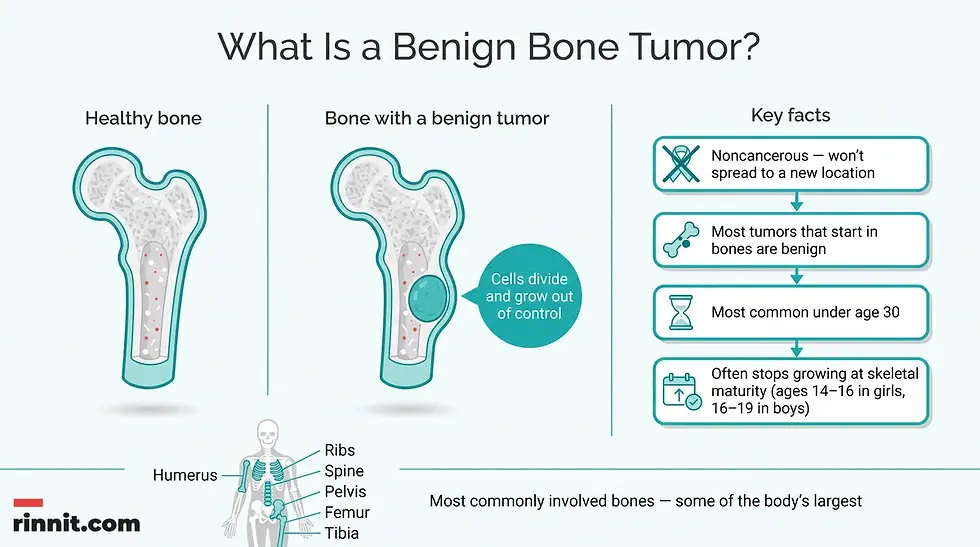
Benign bone tumors are bone tumors that are not cancerous. In fact, most tumors that start in your bones are benign [7] — and because they are not cancer, they will not spread from their original site to a new location.
Tumors can form in any of the bones of your skeletal system and in any part of the bone. In general, the most common bones involved are also some of the largest: the femur, tibia, humerus, pelvis, spine, and ribs.
Some types of tumors are most common in specific locations, such as the spine or near the growth plates in your hip, knee, or shoulder.
These tumors may cause pain that gets worse and not better, and some may need treatment to stop them from destroying bone. Others may require no treatment at all. These tumors often affect younger people.
Who is most likely to get benign bone tumors?
Benign bone tumors are most common in people who are under 30 years old. A large portion of benign bone tumors are found in children while their skeletons are still growing.
Many benign tumors actually stop growing once a child reaches skeletal maturity — the term used to describe the time at which bones stop growing in length. Skeletal maturity usually happens between the ages of 14 to 16 in girls and between the ages of 16 to 19 in boys.
What are the types of benign bone tumors?
Benign bone tumors come in twelve common types, which differ in what they are made of, where they grow and how aggressively they behave. They vary in what they are made of, where they grow, and how aggressively they behave.
Type | Where it grows | Key facts |
Enchondroma | Inside the bone, in the marrow space | Starts in the cartilage |
Osteochondroma | Outside the bone | Made of cartilage and bone; can get bigger while the skeleton is growing |
Non-ossifying fibroma | Any bone; often found incidentally | The most common bone tumor found in children; often goes away on its own; most commonly discovered by accident on X-rays after an injury |
Chondroblastoma | Near joints; found in children | Usually removed because its growth affects nearby joints; can cause significant pain |
Osteoid osteoma | Long bones of the body | More common in males; can cause significant pain at nighttime due to hormone interaction; relieved with nonsteroidal anti-inflammatory medications (NSAIDs) |
Osteoblastoma | — | More common in males; treatment is almost always surgery |
Periosteal chondroma | Surface of a bone | Made of cartilage; treatment is almost always surgery |
Giant cell tumor | — | Rare, but grows aggressively; females are slightly more likely to develop them; treatment is almost always surgery |
Chondromyxoid fibroma | Bone marrow | Very rare; treatment is almost always surgery |
Aneurysmal bone cyst (ABC) | — | Can grow very large; treatment with repeated sclerotherapy medication injections or surgery is commonly needed; the medication helps the space fill in |
Unicameral (simple) bone cyst (UBC) | Near growth plates | Often found when the tumor weakens the bone enough to cause a fracture; treatment is usually surgery with a bone graft or sclerotherapy medication |
Fibrous dysplasia | Single or multiple bones | A common bone tumor that can appear in one bone or several; generally doesn't need surgery unless the bone becomes weakened by the tumor's size |
What causes benign bone tumors?
Bone tumors form when bone cells divide and grow out of control, forming a lump or a mass of cells. We don't know why this happens in most cases.
What are the symptoms of benign bone tumors?
Symptoms of benign bone tumors include an obvious swelling or lump, pain that is possibly severe and increases in intensity, and breaks or fractures due to bones made weaker by a growing bone tumor [6] [7].
It may hurt even when you're resting. And in most cases, these tumors have no symptoms at all — they are incidentally discovered on an X-ray obtained for an injury [7].

How are benign bone tumors diagnosed?
If you're concerned about a lump or swelling on a bone, first make an appointment with your healthcare provider. They will start with a complete physical examination and are likely to order tests, such as imaging tests, including X-rays, computed tomography (CT) scans, and magnetic resonance imaging (MRI) scans, plus a bone scan [7].
It's rare that your provider will order blood or urine tests to diagnose a benign bone tumor. A bone tumor specialist will likely order a bone scan, CT scan, MRI scan, or biopsy.
The appropriate first step is an initial evaluation and X-rays [7]. Your pediatrician or primary care provider can order these first tests.
How are benign bone tumors treated?
Benign bone tumors have no single treatment, and options range from watching and waiting to medication, biopsy or surgical removal. Treating a benign bone tumor depends on things like the specific type of tumor, its size, its location, and the effect it has on bone strength.
In many cases, your provider may suggest just watching and waiting (observation). In other cases, your provider may suggest medication, specialized imaging, a biopsy, or removing the tumor surgically [7].
What is the chance the tumor comes back?
Most benign tumors respond well to surgical removal. In many cases, the likelihood that the tumor will come back is low — usually less than 5%. Some benign bone tumors, like giant cell tumors of bone, have a higher rate of return, but there are good methods to treat these tumors if they do come back.
What does surgery involve?
Treating benign bone tumors using surgery calls for removing the tumor as well as promoting the growth of new healthy bone at the site of the tumor. The surgeon caring for these tumors should try to remove the tumor with the least amount of trauma to surrounding normal bone tissue.
Surgeons should also have experience with proper stabilization of the bone with orthopedic hardware and bone grafting — as necessary. The combination of these techniques allows people with benign bone tumors, especially young people, to be able to return to full and unlimited activities after treatment.
Are there nonsurgical options?
Yes — other treatments can be used for certain types of bone tumors. One treatment for osteoid osteoma may include radiofrequency ablation [6] or thermal necrosis. These procedures require anesthesia, are often done as a combined approach, and involve orthopedic surgeons and radiologists.
Aneurysmal bone cysts (ABCs) can be treated with serial (repeated) injections of a medication called doxycycline and have a good chance of resolving without an open surgery [4].

What are the risks of surgery?
It's unusual to have major problems with these surgeries because they are mostly straightforward. However, rare (but possible) risks include nerve injury, infection, bleeding, stiffness, and an inability to return to a high level of sport.
What's the outlook?
The outlook for people with benign bone tumors is excellent. Treatment is possible and provides pain relief. The condition is almost never fatal. Benign bone tumors rarely become cancerous — the chance is far less than 1%.
Can benign bone tumors be prevented?
As far as researchers know, there's no way to prevent benign bone tumors from forming.
How can people live well with benign bone tumors?
People living with benign bone tumors should call their provider about any concerns, especially a lump or swelling near a bone or pain that keeps getting worse.
When should I contact my healthcare provider?
You should always feel that you're able to contact your healthcare provider with any concerns. If you notice a lump or swelling near your bone, or if you have pain that gets worse and not better, call your provider.
What's the bottom line?
Benign bone tumors are noncancerous growths that form inside any bone of the skeleton, and most tumors that start in bones turn out to be this harmless kind — meaning they will not spread from their original site. They strike most often in people under 30, including many children whose skeletons are still growing, and frequently show up in the body's largest bones: the femur, tibia, humerus, pelvis, spine, and ribs. Most cause no symptoms and are discovered by accident on an X-ray taken after an injury [7]. When they do speak up, it's with a visible lump, pain that intensifies and doesn't let up even at rest, or a fracture from bone weakened by the growing tumor. There is no way to prevent them, but diagnosis is straightforward — a physical exam followed by imaging, usually starting with X-rays your pediatrician or primary care provider can order — and treatment runs the gamut from simple watchful waiting to medication, radiofrequency ablation, or surgery. The outlook is excellent: treatment provides pain relief, the condition is almost never fatal, and the chance of a benign bone tumor ever becoming cancerous is far less than 1%. If you or your child has a lump, swelling, or pain that keeps getting worse, call your provider — early diagnosis and treatment is best.
When should you seek care for a benign bone tumor?
Call your provider if you notice a lump or swelling near your bone, or pain that gets worse and not better — even pain at rest. If you or your child has symptoms that include a lump and/or swelling and pain that worsens even when resting, don't wait it out. Early diagnosis and treatment is best, even though the tumor may turn out to be benign.
Explore Rinnit.com's library of clear, practical health guides to understand your symptoms and start the right conversation with your healthcare provider.
Frequently asked questions
What is a benign bone tumor?
It's a bone tumor that is not cancerous. Most tumors that start in bones are benign, and they will not spread from their original site to a new location.
Are benign bone tumors cancer?
No. Benign means noncancerous. They don't spread the way cancer does, and the chance of one ever becoming cancerous is far less than 1%.
Who gets benign bone tumors?
People under 30 are most affected, and a large portion are found in children while their skeletons are still growing.
Do benign bone tumors stop growing?
Many actually stop growing once a child reaches skeletal maturity — the point when bones stop growing in length, usually around 14–16 in girls and 16–19 in boys.
Where do benign bone tumors usually form?
They can form in any bone, but the most commonly involved bones are some of the largest: the femur, tibia, humerus, pelvis, spine, and ribs. Some types favor specific locations like the spine or near the growth plates of the hip, knee, or shoulder.
What are the most common types?
Enchondroma, osteochondroma, non-ossifying fibroma (the most common bone tumor in children), chondroblastoma, osteoid osteoma, osteoblastoma, periosteal chondroma, giant cell tumor, chondromyxoid fibroma, aneurysmal bone cyst, unicameral bone cyst, and fibrous dysplasia.
What is a non-ossifying fibroma?
It's the most common bone tumor found in children. It often goes away on its own and is most commonly discovered by accident on X-rays taken after an injury.
What are the symptoms?
An obvious swelling or lump; pain, possibly severe, that increases in intensity and may hurt even at rest; and breaks or fractures due to bone weakened by the tumor. In most cases, however, there are no symptoms at all.
How are they diagnosed?
With a complete physical examination followed by imaging tests — X-rays, CT scans, MRI scans, or a bone scan. Blood and urine tests are rarely needed. The appropriate first step is an initial evaluation and X-rays.
Do I need to see a specialist?
Your pediatrician or primary care provider can order the first tests. A bone tumor specialist will likely order a bone scan, CT scan, MRI scan, or biopsy if needed.
Do benign bone tumors always need treatment?
No. There is no single treatment — it depends on the tumor's type, size, location, and effect on bone strength. Some need no treatment at all; others are managed with observation, medication, or surgery.
What does surgery involve?
Removing the tumor while promoting new healthy bone growth at the site, with minimal trauma to surrounding bone, plus stabilization with orthopedic hardware and bone grafting as necessary — allowing a return to full and unlimited activities.
Can the tumor come back after surgery?
Most respond well to surgical removal, with a recurrence likelihood usually under 5%. Giant cell tumors of bone have a higher rate of return, but good treatment methods exist if they do.
Are there treatments besides surgery?
Yes — radiofrequency ablation or thermal necrosis for osteoid osteoma, and serial doxycycline injections for aneurysmal bone cysts, which often resolve without open surgery.
Can I prevent benign bone tumors?
As far as researchers know, there's no way to prevent them from forming. The best move is to contact your provider if you notice a lump, swelling, or pain that gets worse and doesn't improve.
Related reading
Osteoid Osteoma: Symptoms, Causes and Treatment Guide — why the pain peaks at night and how NSAIDs relieve it
The information in this article is for general informational purposes only and is not intended as professional medical advice, diagnosis, or treatment. Always seek the advice of your physician or other qualified health provider with any questions you may have regarding a medical condition. Never disregard professional medical advice or delay in seeking it because of something you have read here.
References
Cleveland Clinic. Benign Bone Tumors. Cleveland Clinic. Updated July 12, 2021. https://my.clevelandclinic.org/health/diseases/16775-benign-bone-tumors
Singla A, et al. Musculoskeletal Tumors. Pediatr Clin North Am. 2020;67(1):227-245. PMID 31779834. https://doi.org/10.1016/j.pcl.2019.09.014
Sagoo NS, et al. Radiofrequency ablation for spinal osteoid osteoma: A systematic review of safety and treatment outcomes. Surg Oncol. 2022;41:101747. PMID 35358911. https://doi.org/10.1016/j.suronc.2022.101747
Wong MN, et al. Doxycycline Sclerotherapy of Aneurysmal and Unicameral Bone Cysts in the Appendicular Skeleton and Pelvis: Single-Center 14-Year Experience. J Vasc Interv Radiol. 2024;35(12):1785-1792.e5. PMID 39265785. https://doi.org/10.1016/j.jvir.2024.09.001
Subramanian S, et al. Lytic Bone Lesions. In: StatPearls [Internet]. StatPearls Publishing. Last updated September 10, 2024. PMID 30969659. https://www.ncbi.nlm.nih.gov/books/NBK539837/
Nystrom LM. Noncancerous Bone Tumors. Merck Manual Consumer Version. Updated November 2025. https://www.merckmanuals.com/home/cancer/bone-and-joint-tumors/noncancerous-bone-tumors
Templeton KJ. Bone Tumor - Types and Treatments. OrthoInfo. Accessed October 14, 2026. https://www.orthoinfo.org/diseases--conditions/bone-tumor



Comments