NDRIs: Uses, Examples and Side Effects

Updated: 2 days ago
Written and medically reviewed by Dr. Baraa Alnahhal, MD · Last reviewed: November 2026 · How we review
Quick Answer
NDRIs (norepinephrine and dopamine reuptake inhibitors) are medicines that increase norepinephrine and dopamine, two brain chemicals that help control mood and attention. They're used for depression, seasonal affective disorder, ADHD, narcolepsy and quitting smoking. The most common is bupropion (Wellbutrin). They usually start working in two to four weeks. Don't stop taking them without talking to your provider.
What the research says
Bupropion helped smokers quit safely: in the EAGLES trial of 8,144 smokers, bupropion roughly doubled the odds of quitting at weeks 9 to 12 compared with placebo without a significant rise in serious mental health side effects; insomnia was its most common side effect (12%) (Anthenelli RM et al., Lancet, 2016) [2]
Bupropion raised long-term quit rates: a Cochrane review of 50 trials with 18,577 people found bupropion raised long-term quit rates by 60% compared with placebo, but more people stopped it because of side effects (Hajizadeh A et al., Cochrane Database of Systematic Reviews, 2023) [3]
Key takeaways
NDRIs raise norepinephrine and dopamine in the brain.
They treat depression, ADHD and other conditions and help people quit smoking.
Bupropion is the most common NDRI.
They usually work within two to four weeks.
Don't stop them without your provider's OK.
What are NDRIs?
NDRIs are a type of antidepressant. Norepinephrine and dopamine help different areas of your brain communicate and play roles in mood and attention. Sources: [1]
What they treat
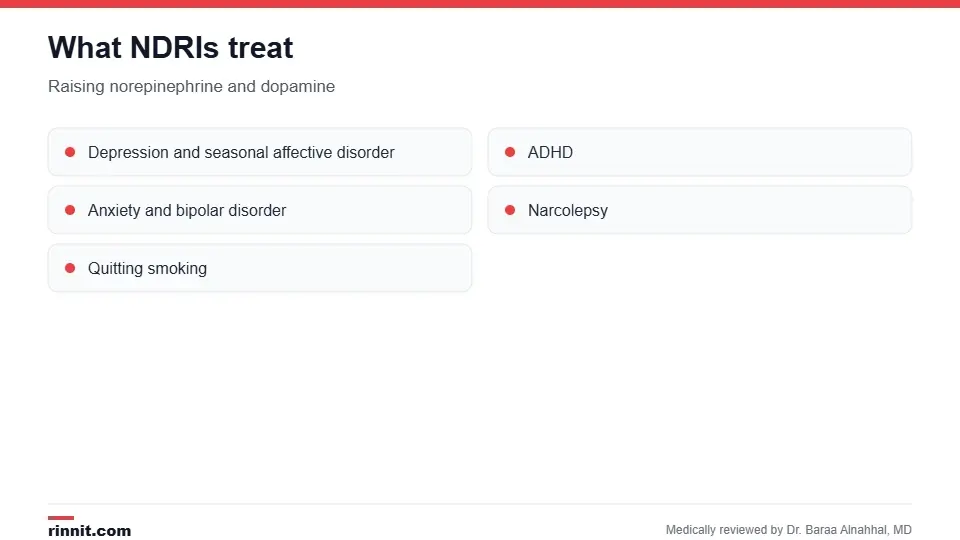
They may help regulate mood, attention and stress.
ADHD.
Tobacco use disorder. Sources: [1]
Common NDRIs

Your provider chooses the right medicine and dose for you.
Medicine | Brand names |
Bupropion | Wellbutrin |
Methylphenidate | Ritalin, Concerta |
Dexmethylphenidate | Focalin |
Sources: [1]
How to take them
Your provider discusses risks before you start.
Take your medicine exactly as directed.
Your dose may be adjusted over time.
Don't stop without your provider's approval; your dose may need to be lowered slowly. Sources: [1]
Side effects

Methylphenidate and dexmethylphenidate are controlled stimulants that can be misused. Bupropion isn't considered addictive.
Type | Examples |
Common | Trouble sleeping, dizziness, dry mouth, fatigue, headache, loss of appetite |
Serious (get care right away) | Allergic reaction with face or throat swelling, confusion, hallucinations, irregular heartbeat, seizure, new or worse depression, suicidal thoughts, unusual mood changes |
Important safety warning: Bupropion carries a warning about suicidal thoughts in people under 25, especially in the first months or after a dose change. Get help right away for new or worsening depression, suicidal thoughts, agitation or unusual mood changes. Don't take bupropion if you have a seizure disorder or an eating disorder such as bulimia or anorexia, are suddenly stopping alcohol or sedatives, or have taken an MAOI in the past 2 weeks. People with bipolar disorder need close monitoring because NDRIs can trigger mania, and NDRIs aren't a treatment for anxiety.
Stimulant NDRIs can be misused, so your provider will monitor how you respond. Bupropion isn't considered addictive. Sources: [1, 2]
Results
NDRIs usually start working within two to four weeks, though the full benefit can take longer. Some people feel calmer, have a better mood, or focus better and fidget less. For quitting smoking, studies show bupropion improves quit rates. Sources: [1, 2, 3]
When to call your provider
Any side effect from your medicine.
Get immediate care for an allergic reaction, confusion, hallucinations, irregular heartbeat, a seizure, new or worse depression, suicidal thoughts or unusual changes in mood or behavior. Sources: [1]
Conclusion
NDRIs can lift mood, sharpen focus and help people quit smoking by boosting two key brain chemicals. Taking them as prescribed and reporting side effects help you get the most benefit safely.
Keep learning: read about antidepressants and ADHD medications.
Frequently asked questions
What are NDRIs?
Medicines that increase norepinephrine and dopamine in the brain.
What do NDRIs treat?
Depression, ADHD, anxiety, narcolepsy and more, and they help people quit smoking.
What is the most common NDRI?
Bupropion (Wellbutrin).
How long do NDRIs take to work?
Usually two to four weeks.
What are the side effects?
Trouble sleeping, dry mouth, headache, dizziness and less appetite.
Are NDRIs addictive?
Methylphenidate and dexmethylphenidate can be misused; bupropion isn't considered addictive.
Can bupropion help me quit smoking?
Yes. Studies show it improves quit rates.
Can I stop taking an NDRI on my own?
No. Talk to your provider first.
What serious side effects need urgent care?
Allergic reactions, confusion, hallucinations, irregular heartbeat, seizure, or new suicidal thoughts or mood changes.
Do NDRIs help with focus?
Some people find they focus better and fidget less.
Related Reading
Antidepressants: Understanding Mental Health Medications an overview of antidepressants.
ADHD Medication: Types, Benefits, and Management medicines for ADHD.
SNRIs Explained: Uses, Side Effects, and How Long They Take to Work another antidepressant class.
Nicotine Replacement Therapy (NRT): A Guide to Quitting Smoking another way to quit smoking.
What Is Clinical Depression (Major Depressive Disorder)? Symptoms, Causes, Diagnosis and Treatment understanding depression.
References
Cleveland Clinic. NDRIs (Norepinephrine and Dopamine Reuptake Inhibitors). Cleveland Clinic. Last updated November 26, 2024. https://my.clevelandclinic.org/health/treatments/ndri
Anthenelli RM, Benowitz NL, West R, et al. Neuropsychiatric safety and efficacy of varenicline, bupropion, and nicotine patch in smokers with and without psychiatric disorders (EAGLES): a double-blind, randomised, placebo-controlled clinical trial. Lancet. 2016;387(10037):2507-2520. PMID 27116918. https://doi.org/10.1016/S0140-6736(16)30272-0
Hajizadeh A, Howes S, Theodoulou A, et al. Antidepressants for smoking cessation. Cochrane Database of Systematic Reviews. 2023;5(5):CD000031. PMID 37230961. https://doi.org/10.1002/14651858.CD000031.pub6
Medical disclaimer
This article is for general education only and does not replace advice from a qualified healthcare professional. Talk to your doctor about your own diagnosis and treatment, and seek emergency care right away for severe or sudden symptoms.



Comments