Nasal Endoscopy: Why It's Done, What to Expect, Recovery and Results

Updated: 2 days ago
Written and medically reviewed by Dr. Baraa Alnahhal, MD · Last reviewed: November 2026 · How we review
Quick Answer
A nasal endoscopy is a quick office exam in which an ENT provider passes a thin tube with a light and camera into the nose to look at the nasal passages and sinus openings. It's used for long-lasting congestion, loss of smell, facial pain, nosebleeds and nasal polyps. You stay awake, and the exam takes about 1–5 minutes.
What the research says
Endoscopy is sensitive but not the whole story: a 2026 meta-analysis of nine diagnostic datasets found nasal endoscopy detected chronic rhinosinusitis and nasal polyps with 87% sensitivity but 63% specificity compared with CT, while MRI had 71% sensitivity and 88% specificity, so endoscopy and imaging are often combined (Lu Y et al., The Journal of Laryngology and Otology, 2026) [2]
Symptoms alone are not enough: a systematic review found that a symptom-based diagnosis of chronic rhinosinusitis was correct only 62% of the time when nasal endoscopy was used as the reference standard (Macdonald KI et al., The Laryngoscope, 2016) [3]
Key takeaways
A thin flexible or rigid camera shows the inside of your nose, sinus openings and sometimes the back of the throat.
No sedation: a decongestant and numbing spray are used, and you stay awake.
Takes about 1–5 minutes; you feel pressure, not pain.
Avoid eating or drinking for about 1 hour afterward because the numbing can reach your throat.
Mild soreness or a small nosebleed can occur for a day or two.
What is a nasal endoscopy?
Also called rhinoscopy or nasoendoscopy, nasal endoscopy lets your provider see structures a simple look with a light cannot reach, including the openings that drain the sinuses. The camera's view appears on a screen, so your provider can examine the lining, spot swelling, pus, polyps or growths, and take a tissue sample if needed. Sources: [1]

Nasal endoscopy takes only a few minutes in the office.
Why is it done?
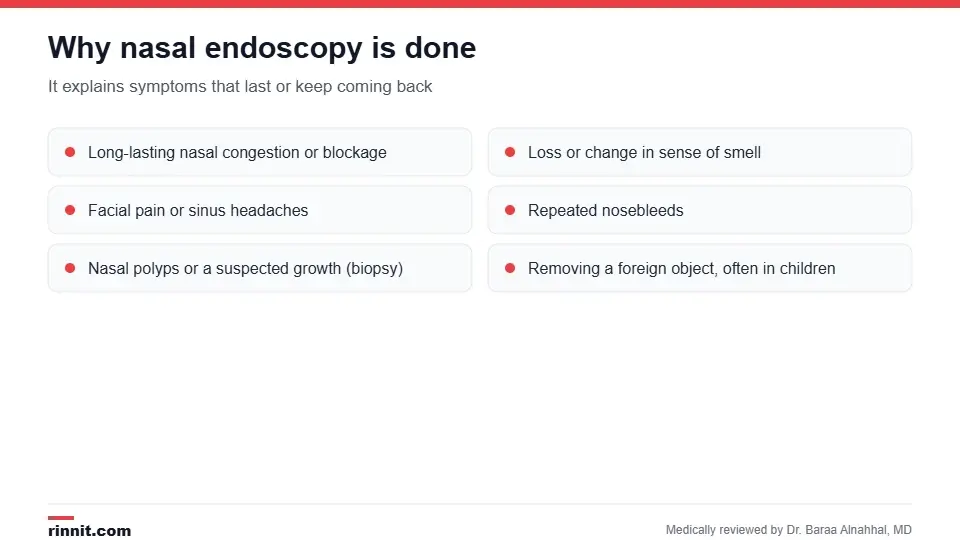
Nasal endoscopy explains symptoms that last or keep coming back.
Nasal congestion or blockage that doesn't go away.
Loss of or change in the sense of smell (anosmia).
Facial pain or pressure, especially above the eyes, and sinus headaches.
Repeated nosebleeds.
Checking for nasal polyps or a growth, and taking a biopsy.
Guiding or following up functional endoscopic sinus surgery (FESS).
Removing a foreign object, often from a child's nose. Sources: [1]
How do I prepare?
Usually no preparation is needed. Tell your provider if you take blood thinners; occasionally they may be paused. Mention any allergies to anesthetics or decongestants. Sources: [1]
What happens during the procedure?
You sit upright in the exam chair.
A decongestant is sprayed into your nose to shrink swollen tissue.
A numbing medicine is sprayed into your nose.
The provider gently inserts the endoscope into one nostril and examines the passages, sometimes advancing it to just above the voice box.
Any needed step, such as a biopsy, is done.
The process is repeated on the other side. Sources: [1]
The exam should not hurt, though you will feel pressure and may feel the urge to sneeze. It takes about 1–5 minutes. Sources: [1]
Flexible vs rigid endoscopes
Type | Typical use |
Flexible endoscope | Bends to follow the nasal passages; can be advanced to the throat and voice box |
Rigid endoscope | Straight, very clear view of the nasal cavity and sinus openings; often used for detailed sinus assessment and procedures |
Your provider chooses the scope based on what needs to be seen. Sources: [1]
Understanding your results
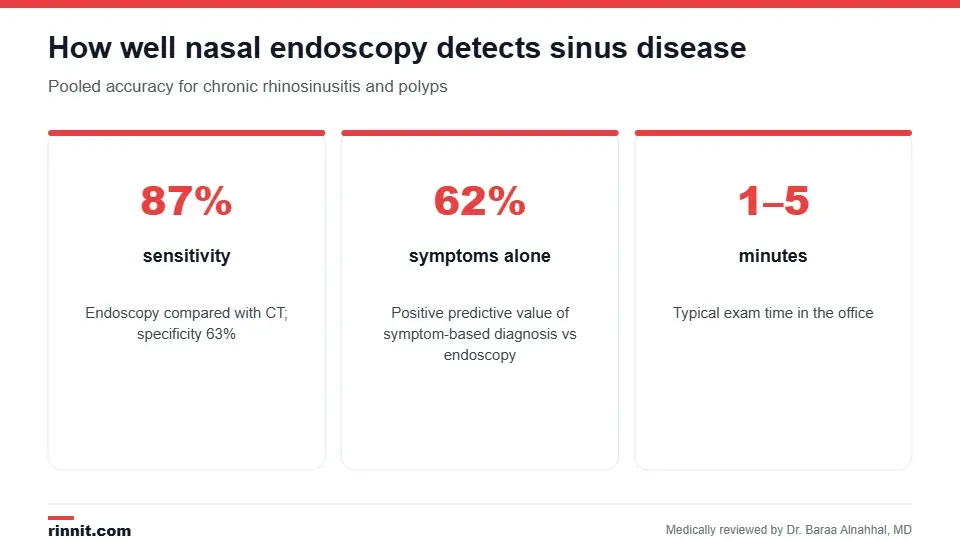
How nasal endoscopy performs for chronic sinus disease.
Results are usually reviewed immediately. Findings may include swollen lining, pus draining from sinus openings, polyps, a deviated septum, crusting, a source of bleeding or a growth. If a biopsy is taken, pathology results follow in several days. If more detail is needed, your provider may order a CT scan of the sinuses. Sources: [1]
Measured against CT, endoscopy is highly sensitive for chronic sinusitis and polyps (87%) but less specific (63%), and a symptom-based diagnosis alone matches endoscopy only 62% of the time, which is why the two are used together. Sources: [2, 3]
Recovery and risks
Mild nose and throat soreness and occasional small nosebleeds, usually gone within a couple of days.
Numbness in the mouth and throat for about 1 hour; wait before eating or drinking.
Rare complications: allergic reaction to the medicines, fainting, or infection.
Call your provider for pain, fever or other worrying symptoms afterward. Sources: [1]
Conclusion
Nasal endoscopy gives your ENT provider a direct, magnified look inside your nose in just a few minutes, without sedation. It is the key objective test for chronic sinus disease and polyps and is often paired with CT for planning treatment.
Keep learning: read our guides to acute sinusitis and allergic rhinitis.
Frequently asked questions
Does nasal endoscopy hurt?
No. A numbing spray is used, so most people feel pressure and a tickle, not pain.
How long does it take?
About 1–5 minutes for the exam itself.
Will I be sedated?
No. You stay awake and can usually drive and return to normal activities right away.
Why can't I eat right after?
The numbing spray can reach your throat and affect swallowing for about 1 hour.
What can nasal endoscopy find?
Swelling, infection, polyps, a deviated septum, bleeding sources, foreign objects and growths that may need a biopsy.
Is it the same as a CT scan of the sinuses?
No. Endoscopy shows the surface of the nasal lining; CT shows the deeper sinuses and bone. They are often used together.
How accurate is nasal endoscopy?
For chronic sinusitis and polyps, it is about 87% sensitive but 63% specific compared with CT.
Can children have a nasal endoscopy?
Yes. It is often used to find and remove foreign objects or check adenoids in children.
Are there side effects?
Mild soreness or a small nosebleed for a day or two; rarely an allergic reaction or fainting.
When will I get results?
Usually right away. Biopsy results take several days.
Related Reading
Chronic Sinusitis (Chronic Rhinosinusitis): Symptoms, Causes, and Treatment the most common condition nasal endoscopy is used to confirm.
Nasal Polyps: Complete Guide to Symptoms, Causes, and Treatment growths that endoscopy can see and sample.
Nosebleed (Epistaxis): Causes, Types, and Management how endoscopy helps find the source of repeated bleeding.
Anosmia (Loss of Sense of Smell): What It Is, Causes, Symptoms, and Treatment a symptom that often leads to endoscopy.
Acute Sinusitis (Sinus Infection): Symptoms, Causes & Treatment the short-term sinus infection that can become chronic.
References
Cleveland Clinic. Nasal Endoscopy: Procedure Details & Results. Cleveland Clinic. Last updated February 25, 2025. https://my.clevelandclinic.org/health/diagnostics/22156-nasal-endoscopy
Lu Y, Gao X, Wang X, et al. Diagnostic accuracy of nasal endoscopy, computed tomography and magnetic resonance imaging for chronic rhinosinusitis and sinonasal polyps: a systematic review and meta-analysis. The Journal of Laryngology and Otology. 2026;140(4):387-395. PMID 41693180. https://doi.org/10.1017/S002221512610437X
Macdonald KI, Kilty SJ, van Walraven C. Chronic rhinosinusitis identification in administrative databases and health surveys: a systematic review. The Laryngoscope. 2016;126(6):1303-1310. PMID 26649650. https://doi.org/10.1002/lary.25804
Medical disclaimer
This article is for general education only and does not replace advice from a qualified healthcare professional. Talk to your doctor about your own diagnosis and treatment, and seek emergency care right away for severe or sudden symptoms.



Comments