Mycoplasma pneumoniae Infection: Symptoms, Causes, Testing and Treatment

Updated: 3 days ago
Medically reviewed by *Dr. Baraa Alnahhal, MD* · Last reviewed: October 2026
Quick Answer
Mycoplasma pneumoniae is a bacterial infection of the lungs and airways that can cause mild respiratory illness or pneumonia, sometimes called walking pneumonia because it may resemble a cold. Most cases are not serious and improve on their own, but complications can occur. Seek emergency care for difficulty breathing or other severe symptoms. [1]

What the research says
*Symptoms alone cannot reliably identify M. pneumoniae. A Cochrane review of 7 studies (1,491 children with community-acquired pneumonia) concluded that M. pneumoniae* cannot be reliably diagnosed from clinical symptoms and signs; the absence of wheeze was statistically associated with it, but the effect was too weak to guide treatment (Wang et al., Cochrane Database Syst Rev, 2012). [2]
*Some children with M. pneumoniae pneumonia become sicker than expected. In a meta-analysis of 20 studies (5,289 patients), children with refractory M. pneumoniae* pneumonia had higher C-reactive protein and lactate dehydrogenase levels and a much higher chance of lung consolidation (odds ratio 14.29, 95% CI 4.52–45.12) than those without refractory disease (Huang et al., J Immunol Res, 2022). [3]
What is Mycoplasma pneumoniae?
Mycoplasma pneumoniae, also written as M. pneumoniae, is a type of bacteria that can cause infection in the lungs and airways. Sometimes, the infection causes pneumonia. [1]
The illness can be mild and resemble a cold, even when pneumonia is present. That is why some people refer to it as “walking pneumonia.” In other cases, symptoms progress to severe complications. [1]
Key point | What it means |
Cause | A bacterial infection caused by Mycoplasma pneumoniae. |
Main sites affected | The lungs and airways. |
Possible illness pattern | Mild, cold-like symptoms or pneumonia. |
Typical course | Many cases improve without antibiotics. |
More serious course | Pneumonia, worsening symptoms or complications may require medical treatment. |
What are the symptoms of Mycoplasma pneumoniae infection?
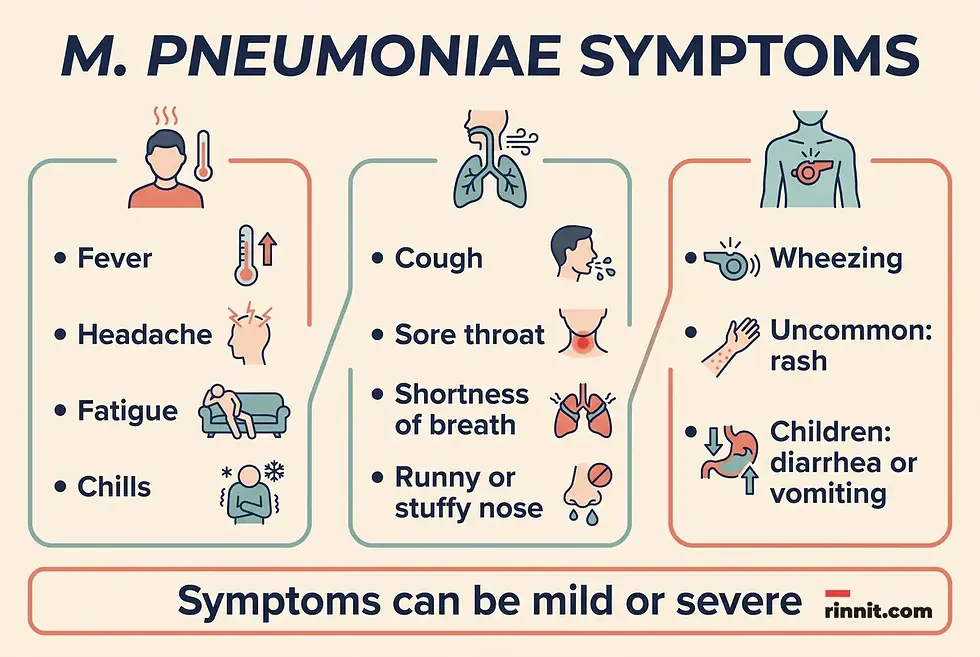
M. pneumoniae infections usually cause mild respiratory symptoms, but symptoms can become severe. Possible symptoms include fever, headache, fatigue, chills, cough, sore throat, shortness of breath, a runny or stuffy nose, wheezing and an uncommon rash. [1]
Children may also experience digestive symptoms such as diarrhea or vomiting. [1]
Symptom | How it may present |
Fever | An elevated body temperature. |
Headache | Head pain that may occur with the respiratory illness. |
Fatigue | Feeling unusually tired or low in energy. |
Chills | Feeling cold or shivery. |
Cough | A respiratory symptom that may occur with or without pneumonia. |
Sore throat | Throat discomfort or pain. |
Shortness of breath | Difficulty getting enough air. |
Runny or stuffy nose | Nasal drainage or congestion. |
Wheezing | A whistling sound when breathing. |
Rash | Uncommon skin involvement. |
Diarrhea or vomiting | Digestive symptoms that may also occur in children. |
Symptoms alone cannot confirm M. pneumoniae. A healthcare provider can assess the illness and decide whether testing or imaging is appropriate.
How does Mycoplasma pneumoniae spread?
Bacteria cause M. pneumoniae infections, which spread from person to person through coughing and sneezing. Usually, a person has to spend a lot of time around someone with the infection to become infected. [1]
Outbreaks can happen in places where people live close together. Examples include boarding schools, college dorms, hospitals, long-term care facilities, military bases and summer camps. [1]
Setting | Why it may support spread |
Boarding schools and college dorms | Many people share living and social spaces. |
Hospitals and long-term care facilities | People may spend extended time in shared-care environments. |
Military bases and summer camps | Close-contact group living can make exposure more likely. |
Close, prolonged exposure is important to transmission. This does not mean every cough or sneeze results in infection.
Who is more likely to get seriously ill?
M. pneumoniae infections are most common in young adults and school-aged children. The risk of serious illness is higher for people with a weakened immune system or with asthma, chronic obstructive pulmonary disease (COPD) or another chronic respiratory condition. [1]
Risk consideration | What to know |
Age group | Young adults and school-aged children are most likely to get the infection. |
Weakened immune system | Raises the risk of serious illness. |
Asthma | Raises the risk of serious illness. |
COPD or another chronic respiratory condition | Raises the risk of serious illness. |
A risk factor does not mean a person will develop severe disease. It means that signs of infection deserve timely attention from a healthcare provider.
What complications can Mycoplasma pneumoniae infection cause?
Complications are not common, but they can be serious. They may include blood-clotting problems such as disseminated intravascular coagulation, brain swelling called encephalitis, destruction of red blood cells called hemolytic anemia, Guillain-Barré syndrome, kidney problems, painful ulcers associated with Mycoplasma-induced rash and mucositis, severe lung infections, Stevens-Johnson syndrome and worsening or newly developing asthma symptoms. [1]
Complication | Plain-language description |
Blood-clotting issues | Problems such as disseminated intravascular coagulation. |
Brain swelling | Encephalitis. |
Red-blood-cell destruction | Hemolytic anemia. |
Nerve-related illness | Guillain-Barré syndrome. |
Kidney issues | Problems affecting the kidneys. |
Painful ulcers | Mycoplasma-induced rash and mucositis. |
Severe lung infection | A more serious infection involving the lungs. |
Stevens-Johnson syndrome | A serious skin and mucous-membrane reaction. |
Asthma changes | Worsening or development of asthma symptoms. |
These complications are not typical of every infection. Their possibility is one reason severe or worsening symptoms should not be ignored.
How is Mycoplasma pneumoniae diagnosed?
Healthcare providers do not regularly test for M. pneumoniae infections. When pneumonia is suspected, they can use a chest X-ray to look for it. A nose-and-throat swab may then help determine the cause, such as the specific bacterium or virus involved. [1]
Testing decisions depend on the person’s symptoms, examination and clinical situation. Self-diagnosis based on symptoms alone is not recommended.
Evaluation step | What it can show |
Clinical assessment | The provider reviews symptoms and health history. |
Chest X-ray | Can look for pneumonia. |
Nose-and-throat swab | Can help identify the cause of an infection, including a specific bacterium or virus. |
How is Mycoplasma pneumoniae infection treated and managed?
M. pneumoniae infections usually go away on their own. If a person has pneumonia or other severe symptoms, a healthcare provider may treat the infection with antibiotics. [1]
Macrolide antibiotics such as azithromycin are commonly used; doxycycline or certain other antibiotics may be used in some cases, such as when resistance is suspected. Treatment decisions should come from a qualified clinician who can consider the person’s symptoms and health history.
When should you see a healthcare provider?
Talk with a healthcare provider if you have a long-term health condition or a compromised immune system and you develop signs of an infection. Go to an emergency room if you have difficulty breathing or other severe symptoms. [1]
Situation | Recommended level of attention |
Signs of infection with a long-term health condition | Talk with a healthcare provider. |
Signs of infection with a compromised immune system | Talk with a healthcare provider. |
Difficulty breathing | Go to an emergency room. |
Other severe symptoms | Go to an emergency room. |
What are recovery and outlook like with Mycoplasma pneumoniae infection?
A mild M. pneumoniae infection should improve on its own within two to three weeks. If symptoms worsen or a person has other health conditions, antibiotics may be needed to get rid of the infection. [1]
Recovery time can differ from person to person. Worsening symptoms, difficulty breathing or severe illness should prompt medical attention rather than waiting for the usual mild course.
Can Mycoplasma pneumoniae be prevented?
You can reduce the risk of getting and spreading infections by washing your hands frequently, covering your mouth and nose when coughing or sneezing, disinfecting frequently touched surfaces and avoiding other people when you are sick. [1]
Frequently touched surfaces may include toys, phones, doorknobs and countertops. [1]

Prevention step | Practical example |
Wash hands frequently | Clean hands regularly. |
Cover coughs and sneezes | Cover your mouth and nose. |
Disinfect touched surfaces | Clean toys, phones, doorknobs and countertops. |
Avoid others when sick | Reduce close contact while ill. |
Is Mycoplasma pneumoniae always serious?
No. M. pneumoniae infections usually are not serious, and most cases improve on their own. However, like other respiratory infections, some cases can be serious. Difficulty breathing or other severe symptoms require prompt emergency evaluation. [1]
Conclusion: know the pattern, watch the severity
Mycoplasma pneumoniae can cause a mild, cold-like respiratory illness or pneumonia. Fever, cough, sore throat, fatigue, shortness of breath, congestion and wheezing are possible symptoms, while children may also have diarrhea or vomiting.
The infection spreads through coughing and sneezing, usually after spending significant time around someone who has it. Young adults and school-aged children are most likely to get it, while weakened immunity and chronic respiratory conditions increase the risk of serious illness.
Most mild infections improve within two to three weeks without antibiotics. Pneumonia or other severe symptoms may require antibiotics, and difficulty breathing or other severe symptoms should be evaluated in an emergency room.
If you or a child develops signs of respiratory infection, contact a qualified healthcare professional when symptoms are concerning, persistent or worsening. For more clear, compassionate health explainers, explore Rinnit.com’s health library.
Frequently Asked Questions
What is Mycoplasma pneumoniae?
Mycoplasma pneumoniae is a type of bacteria that can infect the lungs and airways and sometimes cause pneumonia.
Is Mycoplasma pneumoniae the same as pneumonia?
No. Mycoplasma pneumoniae is the bacterium that can cause an infection; pneumonia is one possible illness caused by that infection.
What is walking pneumonia?
The infection can cause mild, cold-like symptoms even when pneumonia is present. That is why it is sometimes called “walking pneumonia.”
What are common Mycoplasma pneumoniae symptoms?
Possible symptoms include fever, headache, fatigue, chills, cough, sore throat, shortness of breath, a runny or stuffy nose, wheezing and an uncommon rash.
Can children have different symptoms?
Children may also have digestive symptoms such as diarrhea or vomiting.
How does Mycoplasma pneumoniae spread?
The bacteria spread from person to person through coughing and sneezing. Usually, a person has to spend a lot of time around someone with the infection to become infected.
Who is more likely to get Mycoplasma pneumoniae?
Infections are most common in young adults and school-aged children.
Who is at higher risk for serious illness?
People with a weakened immune system, asthma, COPD or another chronic respiratory condition have a higher risk of serious illness.
What complications can occur?
Uncommon but serious complications can include severe lung infections, brain swelling, kidney issues, blood-clotting problems, hemolytic anemia, Guillain-Barré syndrome, painful ulcers, Stevens-Johnson syndrome and worsening or newly developing asthma symptoms.
How is Mycoplasma pneumoniae diagnosed?
A provider may use a chest X-ray to look for pneumonia and a nose-and-throat swab to help determine whether a specific bacterium or virus caused the infection. Providers do not regularly test for every M. pneumoniae infection.
Does Mycoplasma pneumoniae go away on its own?
Usually. A mild infection should improve within two to three weeks.
Does Mycoplasma pneumoniae require antibiotics?
Not always. If a person has pneumonia or other severe symptoms, a healthcare provider may treat the infection with antibiotics.
When should I seek emergency care?
Go to an emergency room if you have difficulty breathing or other severe symptoms.
How can I reduce the spread?
Wash your hands frequently, cover your mouth and nose when coughing or sneezing, disinfect frequently touched surfaces and avoid others when you are sick.
Related Reading
Pneumonia: Complete Guide to Symptoms, Causes, and Treatment explains the types of pneumonia, their symptoms and treatment.
Macrolides: Antibiotic List, Uses, Side Effects & Safety covers the antibiotic group often used for Mycoplasma infections.
Bronchitis: Symptoms, Causes, and Treatment explains the chest cold that Mycoplasma can also cause.
Chest X-Ray (CXR): What It Shows, How It's Done and What Results Mean describes the imaging test used to check the lungs for pneumonia.
References
Cleveland Clinic. Mycoplasma pneumoniae Infection: Causes, Symptoms & Treatment. Cleveland Clinic. Last updated September 15, 2025. https://my.clevelandclinic.org/health/diseases/mycoplasma-pneumoniae
Wang K, Gill P, Perera R, et al. Clinical symptoms and signs for the diagnosis of Mycoplasma pneumoniae in children and adolescents with community-acquired pneumonia. Cochrane Database Syst Rev. 2012;10(10):CD009175. PMID 23076954. https://doi.org/10.1002/14651858.CD009175.pub2
Huang W, Xu X, Zhao W, et al. Refractory Mycoplasma pneumonia in children: a systematic review and meta-analysis of laboratory features and predictors. J Immunol Res. 2022;2022:9227838. PMID 35795531. https://doi.org/10.1155/2022/9227838
Disclaimer
This article is for general educational purposes and is not a substitute for professional medical advice, diagnosis or treatment. Always seek the advice of a qualified healthcare professional with any questions about a medical condition or treatment.



Comments