Morton's Neuroma: What It Is, Symptoms, Causes, and How It's Treated

Updated: 2 days ago
Medically reviewed by Dr. Baraa Alnahhal, MD · Last reviewed: October 17, 2026
Morton's neuroma is a damaged, enlarged nerve in the ball of the foot, most often behind the third and fourth toes. It causes sharp or burning pain, a pebble-in-your-shoe feeling, and tingling or numbness in nearby toes, and most people improve with wider, lower-heeled shoes, padded inserts, and activity changes [1].
Quick Answer: What is Morton's neuroma?
Morton's neuroma is a damaged, enlarged nerve that causes burning or stabbing pain in the ball of the foot, usually behind the third and fourth toes, often like walking on a pebble. It is likely related to pressure from high heels, narrow shoes and high-impact activities. Treatment starts with wider shoes and padded inserts, with injections or surgery if needed. [1] [2]
What the research says
Ultrasound-guided injections probably work better than injections without imaging. A Cochrane review of six randomized trials (373 participants) found that ultrasound-guided corticosteroid plus local anesthetic injection probably reduced pain more than the same injection without ultrasound guidance (mean difference of -15.01 mm on a 100-mm scale) and improved function, while corticosteroid plus anesthetic compared with anesthetic alone showed little to no difference in pain; the certainty of the evidence was low to moderate (Matthews et al., Cochrane Database Syst Rev, 2024 [3]).
The two surgical approaches trade different problems. A meta-analysis of eight studies (237 neuromas removed through the bottom of the foot and 312 through the top) found scar tenderness in 16.7% after the plantar approach versus 6.2% after the dorsal approach, while reoperation (about 5% versus 6%) and overall complications were not clearly different (Lee et al., Foot Ankle Surg, 2024 [4]).
Many injected substances have given pain relief in published studies. A systematic review of injection therapy covering 25 studies and 2,243 cases found favorable pain relief and patient satisfaction across many different injected substances in many of the studies (Lorenzon et al., Acta Biomed, 2022 [5]).
Corticosteroid injections have the best non-surgical pain evidence, but there is no gold standard. A systematic review and meta-analysis of 25 studies (7 randomized trials and 18 case series) found that corticosteroid injection reduced pain more than control in a pooled analysis of two trials (weighted mean difference of -5.3 on a 100-point scale) and had higher odds of treatment success than footwear or padding alone (odds ratio 6.0), but high-quality evidence for a gold-standard treatment was lacking (Matthews et al., J Foot Ankle Res, 2019 [7]).
Surgery tends to give more complete pain relief than injections. A pooled analysis of 35 articles covering 2,998 patients found complete pain relief in 43% after injection, 68% after neurolysis, and 74% after neurectomy, with further surgery needed in 15% after injection versus 2% and 5%, while procedural complication rates did not differ between approaches (Lu et al., Acta Neurochir (Wien), 2021 [8]).
Radiofrequency ablation helps many people and has few complications. A meta-analysis of eight studies (237 patients) found complete pain relief in about 47.6% at final follow-up and no benefit in about 16.4%, with complications in 2.1% that mostly resolved without significant intervention (Llombart-Blanco et al., Am J Phys Med Rehabil, 2025 [9]).
What Is Morton's Neuroma?
Morton's neuroma is a damaged, enlarged nerve that causes pain on the bottom of the forefoot, usually in the area behind the third and fourth toes. The pain is usually sharp or burning, and pain, tingling, or numbness may spread into these toes. Despite the name, it is not a tumor, and it is also called an interdigital neuroma [1].
Some providers also call it an intermetatarsal neuroma. The existing nerve tissue swells and thickens rather than growing new tissue, and it does not cause cancer. If it is not treated, the neuroma can become larger and cause permanent nerve damage [6].
Experts estimate that around 1 in 3 people have a Morton's neuroma at some point in their lives [6].
Key fact | Detail |
What it is | A damaged, thickened nerve in the forefoot. |
Where it forms | Usually between the third and fourth toes. |
Also called | Interdigital neuroma. |
Likely driver | Pressure on the nerve in the forefoot. |
First-line care | Avoid activities that worsen symptoms, wear low heels and wide toe boxes, and use padded inserts. |

The nerve passes between the metatarsal bones of the forefoot and can be squeezed behind the third and fourth toes.
What are the symptoms of Morton's neuroma?
Morton's neuroma causes pain in the ball of the foot, the padded area of the bottom of the foot between the toes and the arch. The pain is usually in the area behind and between the third and fourth toes, though nerves between other bones of the forefoot can also be affected. The pain is often described as [1].
Stabbing, shooting, or burning pain in the ball of the foot [1].
A feeling as if you are walking on a marble or stone [1].
Pain that increases with activity [1].
Pain, a pins-and-needles feeling, tingling, or numbness in the two nearby toes [1].
Pain when stretching the toes [1].
A clicking sensation in the forefoot [1].
Pain is often relieved with rest or by removing your shoes [1].
Symptoms usually get worse over time. It may also feel as if a sock is bunched up in the shoe, and there may be swelling between the toes [6].
When to See a Doctor
It is best not to ignore any foot pain that lasts longer than a few days. See your healthcare professional if you have a burning pain in the ball of your foot that is not improving with a change in footwear or with changes to activities that put a strain on your feet [1].
What causes Morton's neuroma?
The exact cause of Morton's neuroma is not known, but pressure on the affected nerve may contribute to damage and enlargement of the nerve. The nerve runs through a space between the long bones of the forefoot, called the metatarsal bones, and the damaged nerve is usually found between the metatarsal bones that connect to the third and fourth toes, although nerves between other metatarsal bones may also be affected [1].
Two factors appear to worsen symptoms: high-heeled or narrow shoes, which put extra pressure on the toes and the ball of the foot, and walking, running, or other activities that put pressure on the ball of the foot [1].
What are the risk factors for Morton's neuroma?
Risk factor | Why it matters |
High heels | High-heeled or tight shoes place extra pressure on the toes and the ball of the foot. |
High-impact sports | Jogging or running subjects the feet to repetitive trauma. |
Tight sport shoes | Snow skiing or rock climbing shoes can put pressure on the toes. |
Foot deformities | People with bunions, hammertoes, high arches, or flatfeet are at higher risk. |
Related foot conditions can add to the problem. If you have bunions, hammertoes, or flat feet, it is worth asking about footwear that reduces pressure on the forefoot [1].
Racquet sports such as tennis, jobs that keep you on your feet all day and foot injuries may also raise the risk [6].
How can you prevent Morton's neuroma and care for it yourself?
Morton's neuroma has no guaranteed prevention, but reducing pressure on the nerve is the main way to ease symptoms and protect your feet. To help relieve the pain and allow the nerve to heal, consider [2].
Anti-inflammatory medicines: nonprescription NSAIDs such as ibuprofen (Advil, Motrin IB) and naproxen sodium (Aleve) may relieve pain [2].
Ice massage: freeze a water-filled paper or foam cup and roll the cold cup over the painful site [2].
Correctly fitted shoes: have your feet measured to be sure you buy the correct size and width, avoid high heels and tight shoes, and choose wide toe boxes [2].
An activity break: for a few weeks, reduce running, jumping, climbing, or dancing that subject the balls of your feet to high impact [2].
Wearing well-padded athletic shoes when you are active and choosing lower-impact exercise may also help prevent it [6].
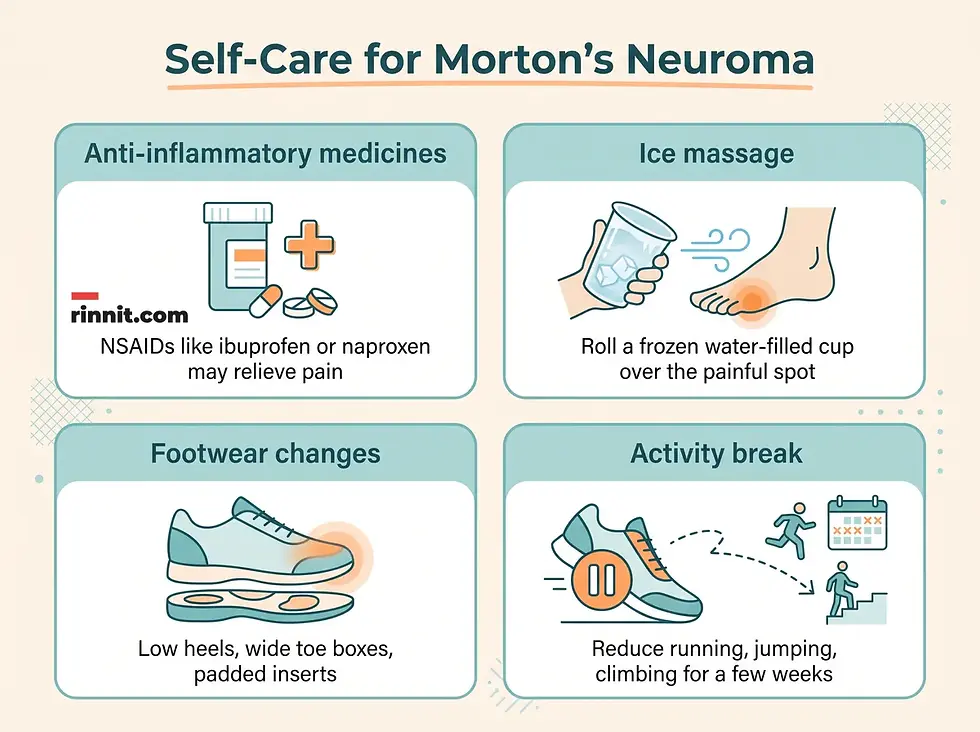
Self-care for Morton's neuroma: anti-inflammatory medicines, ice massage, better footwear, and a break from high-impact activity.
How is Morton's neuroma diagnosed?
During the exam, your healthcare professional will ask about your symptoms, general health, medical history, and typical activities, and will examine your foot [2].
Exam step | Purpose |
Pressure along the ball of the foot | Locates the exact site of pain. |
Squeezing the ball of the foot | Feels for a click between the metatarsal bones. |
Testing toe range of motion | Checks how the toes move. |
Checking the whole foot | Looks for other irregularities that may contribute to pain. |
Imaging Tests
Imaging may be used to confirm the diagnosis or rule out another cause of pain [2].
Test | What it shows |
X-ray | A standing foot X-ray can reveal a bone fracture or other bone irregularity. |
Ultrasound | May confirm Morton's neuroma or spot irregularities in the soft tissues of joints. |
MRI | Views soft tissues, and may be used to rule out other conditions or when symptoms are not typical. |
A foot X-ray will not show a neuroma, but it can help rule out stress fractures and arthritis. If an ultrasound does not give a clear answer, electromyography (EMG) can rule out nerve conditions that cause similar symptoms [6].

Diagnosis starts with a physical exam, and imaging is used to confirm it or rule out other causes of foot pain.
How is Morton's neuroma treated?
The first line of treatment is usually to avoid activities that worsen symptoms and to change footwear. Many people improve at this stage without needing injections or surgery [2].
Shoes and Inserts
Avoid high-heeled shoes, wear shoes with wide toe boxes that do not crowd the balls of the feet, and use a ready-made or custom-made shoe insert with padding that cushions and supports the forefoot [2].
A stretching device can widen shoes you already own. Do not take NSAIDs for more than 10 days in a row without talking to your provider, and wrap ice or a cold pack in a thin towel before using it [6].
Corticosteroid Injections
A corticosteroid may be injected into the nerve to treat pain. The injection is usually guided with an ultrasound device, and the corticosteroid may be combined with a local anesthetic that temporarily numbs the area. This is usually a single injection [2].
Surgery
If other treatments do not work, your healthcare professional may recommend surgery. Surgical removal of the damaged, enlarged portion of the nerve is called a neurectomy, and it is the most common procedure for treating Morton's neuroma. The surgery is usually successful, but there may be permanent numbness in the affected toes. Other procedures that have not been studied extensively may also be used, including procedures that disable the affected nerve without removing it and procedures that create more space for the nerve in the forefoot by cutting tissues that connect bones [2].
Other surgical techniques include cryogenic neuroablation, which uses extreme cold to destroy nerve cells, and radiofrequency ablation, which uses an electrical current to heat and destroy a small amount of nerve tissue. Most people do not need surgery [6].
Treatment | How it works | When it is used |
Footwear changes | Low heels, wide toe boxes, and padded inserts | First-line care for most people |
Activity changes | Avoid activities that press on the ball of the foot | First-line care alongside shoe changes |
Corticosteroid injection | A single, usually ultrasound-guided injection into the nerve, often with a local anesthetic | When shoe and activity changes are not enough |
Neurectomy | Surgical removal of the damaged, enlarged part of the nerve | The most common surgery if other treatments fail |
Nerve-sparing procedures | Disable the nerve without removing it, or create more space for it | Less-studied alternatives |
Morton's neuromas do not go away on their own, and symptoms can come back after treatment [6].
How should you prepare for a Morton's neuroma appointment?
You will likely see your primary healthcare professional first, who may refer you to a doctor or surgeon who specializes in foot conditions. Before your appointment, it helps to write down [2].
When your symptoms began and whether they started gradually or suddenly
The type of footwear you wear for work and recreation
Whether you play sports, and which ones
The medicines and supplements you take regularly
Your healthcare professional may ask how you would describe the pain, whether you feel tingling or numbness in your foot or toes, whether the pain is worse in certain shoes or with certain activities, what lessens the pain, what home remedies you have tried, and whether you have any other pain in your body.
What is the bottom line on Morton's neuroma?
Morton's neuroma is a thickened, irritated nerve in the ball of the foot that causes burning pain, a pebble-like sensation, and tingling in the toes near the third and fourth toes. It is closely tied to pressure on the nerve from high heels, tight shoes, and high-impact activities. Most people improve with simple changes: low-heeled shoes with wide toe boxes, padded inserts, ice massage, and short breaks from pounding activities. When those steps fall short, an ultrasound-guided corticosteroid injection or a neurectomy may help. If burning pain in the ball of your foot lasts more than a few days or does not improve with better footwear, talk to a healthcare professional about an evaluation.
Frequently Asked Questions
What is a Morton's neuroma?
A Morton's neuroma is a damaged, enlarged nerve that causes pain on the bottom of the forefoot, usually behind the third and fourth toes. It is not a true tumor but thickened, irritated nerve tissue, and it is also called an interdigital neuroma.
Is Morton's neuroma a tumor?
No. Despite the name, it is not a tumor. It is a damaged, thickened nerve that is likely related to pressure on the nerve, not a growth of abnormal cells.
What does Morton's neuroma feel like?
Morton's neuroma typically feels like stabbing, shooting, or burning pain in the ball of the foot, often described as walking on a marble or stone. Tingling, numbness, or a pins-and-needles feeling may spread into the two nearby toes, and a clicking sensation can occur in the forefoot.
Why does Morton's neuroma happen?
The exact cause is not known, but pressure on the nerve is the likely driver. High-heeled or narrow shoes increase pressure on the toes and ball of the foot, and walking, running, or other activities can worsen or trigger the pain.
Who is at risk for Morton's neuroma?
Risk factors include wearing high-heeled or tight shoes, high-impact sports such as jogging or running, sports with tight shoes such as snow skiing or rock climbing, and foot deformities such as bunions, hammertoes, high arches, or flatfeet.
How is Morton's neuroma diagnosed?
Diagnosis starts with a physical exam: pressure along the ball of the foot, squeezing the foot to feel for a click between the metatarsal bones, and testing toe motion. X-rays, ultrasound, or MRI may be used to confirm the diagnosis or rule out other causes.
Can Morton's neuroma improve without surgery?
Many people get relief by wearing shoes with low heels and wide toe boxes, using padded shoe inserts, and reducing high-impact activities. Pain is often relieved with rest or by removing your shoes, but a healthcare professional should confirm the diagnosis and guide treatment.
What is the best treatment for Morton's neuroma?
Treatment usually begins with avoiding activities that worsen symptoms and changing footwear, including padded inserts. If symptoms persist, a corticosteroid injection, usually guided by ultrasound, may be used. Surgery is considered if other treatments do not work.
What does Morton's neuroma surgery involve?
The most common surgery is a neurectomy, which removes the damaged, enlarged portion of the nerve. It is usually successful but may cause permanent numbness in the affected toes. Less-studied alternatives can disable the nerve without removing it or create more space for it.
Can Morton's neuroma be prevented?
There is no guaranteed way to prevent it, but reducing pressure on the forefoot helps. Wear correctly fitted shoes with wide toe boxes, avoid high heels and tight shoes, and take a break from high-impact activities if your feet are prone to forefoot pain.
Related Resources
Related reading on Rinnit:
External resources for deeper reading:
References
Mayo Clinic. Morton neuroma: Symptoms and causes. Mayo Clinic. November 3, 2025. https://www.mayoclinic.org/diseases-conditions/mortons-neuroma/symptoms-causes/syc-20351935
Mayo Clinic. Morton neuroma: Diagnosis and treatment. Mayo Clinic. November 3, 2025. https://www.mayoclinic.org/diseases-conditions/mortons-neuroma/diagnosis-treatment/drc-20351939
Matthews BG, Thomson CE, Harding MP, et al. Treatments for Morton's neuroma. Cochrane Database Syst Rev. 2024;2(2):CD014687. PMID 38334217. https://doi.org/10.1002/14651858.CD014687.pub2
Lee W, McDonald J, Azam M, et al. The comparison of postoperative outcomes in Morton's neuroma excision between plantar versus dorsal approach: a systematic review and meta-analysis. Foot Ankle Surg. 2024;30(8):621-629. PMID 38880729. https://doi.org/10.1016/j.fas.2024.05.018
Lorenzon P, Rettore C, Scalvi A. Infiltrative therapy of Morton's neuroma. Acta Biomed. 2022;92(S3):e2021556. PMID 35604266. https://doi.org/10.23750/abm.v92iS3.12545
Cleveland Clinic. Morton's Neuroma. Cleveland Clinic. May 21, 2023. https://my.clevelandclinic.org/health/diseases/15118-mortons-neuroma
Matthews BG, Hurn SE, Harding MP, et al. The effectiveness of non-surgical interventions for common plantar digital compressive neuropathy (Morton's neuroma): a systematic review and meta-analysis. J Foot Ankle Res. 2019;12:12. PMID 30809275. https://doi.org/10.1186/s13047-019-0320-7
Lu VM, Puffer RC, Everson MC, et al. Treating Morton's neuroma by injection, neurolysis, or neurectomy: a systematic review and meta-analysis of pain and satisfaction outcomes. Acta Neurochir (Wien). 2021;163(2):531-543. PMID 32056015. https://doi.org/10.1007/s00701-020-04241-9
Llombart-Blanco R, Mariscal G, Benlloch M, et al. Systematic review and meta-analysis of radiofrequency ablation for Morton's neuroma: outcomes and predictors of success. Am J Phys Med Rehabil. 2025;104(5):465-472. PMID 39642322. https://doi.org/10.1097/PHM.0000000000002668
Medical disclaimer
This article is for informational purposes only and is not a substitute for professional medical advice, diagnosis, or treatment. The clinical information in this guide reflects source material last reviewed in November 2025.



Comments