Hammertoe and Mallet Toe: What Causes the Curl, and What Actually Straightens It

Updated: 3 days ago
Medically reviewed by Dr. Baraa Alnahhal, MD · Last reviewed: October 2026
Quick Answer
A hammertoe bends at the toe's middle joint, while a mallet toe bends at the joint nearest the toenail. Both are linked to tight or high-heeled shoes, injuries and muscle imbalance, causing pain, stiffness and corns. Flexible toes often improve with roomier shoes, inserts, pads and exercises, while permanent bends may need surgery to straighten the toe.
What the research says
For lesser-toe deformities, footwear and non-surgical care come before surgery. An expert-opinion review of hammer, claw and mallet toes (evidence level V) describes footwear adaptation, physiotherapy and podiatric measures as first-line treatment and surgery as second line, and traces most cases to an imbalance between the foot's intrinsic and extrinsic muscles or to failure of the joint-capsule and ligament stabilizers (Darcel & Piclet-Legré, Orthop Traumatol Surg Res, 2022) [3].
Padding, insoles and the right shoes are the standard conservative tools. A review of forefoot disorders reports that a toe sleeve or padding over high-pressure areas and a metatarsal off-loading insole can ease symptoms of hammer, claw and mallet toes, and that people with these problems should avoid tight-fitting or high-heeled shoes (Park & Chang, Yeungnam Univ J Med, 2019) [4].
What Is Hammertoe and Mallet Toe?
Hammertoe and mallet toe are foot conditions that cause an unusual bend in one or more toes. They sound similar, but the bend sits in a different spot, and that matters for how the toe feels in shoes.
A hammertoe has a bend in the middle joint of the toe. A mallet toe has a bend in the joint nearest the toenail [1]. Both conditions usually occur in the second, third, or fourth toes [1]. Poorly fitting shoes, foot injuries, and certain illnesses such as diabetes can cause these conditions. Often, the cause isn't known at all [1].
Where the bend occurs: the middle joint of the toe (hammertoe) or the joint nearest the toenail (mallet toe) [1].
Toes usually affected (both): the second, third, or fourth toe [1].
Common triggers (both): tight or high-heeled shoes, injury, and muscle imbalance [1].
What often forms on top (both): corns and calluses from rubbing [1].
The good news: if the toe can still be straightened, changing footwear, wearing shoe inserts, and using other devices might relieve the pain and pressure [1]. If those treatments don't work, surgery can correct the condition and relieve the pressure [1].

Figure 1: A normal toe compared with a hammertoe (middle joint bend) and a mallet toe (bend at the joint nearest the toenail).
Symptoms: How to Spot a Curled Toe
The defining feature is the unusual bend in the joints of one or more toes. But the bend causes a chain of other problems, and those are usually what people notice first. Pain from wearing shoes is often the first sign, since the bent joint sticks up and rubs against the shoe. Because the bent toe rubs against shoes or against the ground, corns and calluses commonly grow over the raised joint [1].
Unusual toe bend: the middle joint is curled (hammertoe) or the joint near the toenail is curled (mallet toe) [1].
Pain from shoes: rubbing and pressure where the bent joint hits the shoe [1].
Trouble moving the toe: the affected toe won't move the way it should [1].
Toe stiffness: the joint feels rigid [1].
Skin color change and swelling: discoloration and puffiness around the bent joint [1].
Corns and calluses: thickened skin growing where the toe rubs shoes or the ground [1].
When to See a Doctor
See a healthcare professional if you have lasting foot pain that affects your ability to walk [1]. This matters because of timing. For a while, you still might be able to straighten the toe. But over time, the tendons and joints of a hammertoe or mallet toe might tighten, and the toe can stay bent for good [1]. Earlier care protects that window of flexibility.
Causes: Why Toes Start to Curl
Three things have been linked to hammertoe and mallet toe. In many cases, however, the exact cause isn't known [1].
Certain shoes. High-heeled shoes or footwear that is too tight in the toe crowd the toes so they can't lie flat. Over time, the toe might remain curled even when you're not wearing shoes at all [1].
Injury. A toe that has been stubbed, jammed, or broken might be more likely to develop hammertoe or mallet toe [1].
Toe muscles that are out of balance. If the muscles aren't balanced, they put pressure on the tendons and joints. This change in balance can lead to hammertoe and mallet toe over time [1].
Risk Factors
Some people are more likely to develop curled toes than others.
Complications: What Happens if the Curl Sets In
At first, the toe might still be flexible, so you can push it straight with your hand. But over time, the tendons and joints of a hammertoe or mallet toe might tighten, and the toe stays bent permanently [1]. Once the bend is fixed, shoes rub against the higher part of the bent toe, and the bent position puts excess pressure on the toe bones, which can cause painful corns or calluses [1]. This is the practical lesson of the condition: the earlier you act, the more non-surgical options stay on the table.
Diagnosis: Confirming a Curled Toe
Diagnosing hammertoe or mallet toe usually starts simple. A healthcare professional inspects the foot [2]. X-rays can help show the bones and joints of the feet and toes, but they're not always needed [2]. The physical exam often tells the story on its own.
Treatment: What Straightens a Curled Toe
Treatment depends on one key question: can the toe still be straightened?
For flexible toes, roomier footwear and shoe inserts, called orthotics, or shoe pads might give relief [2]. Inserts, pads, or taping can move the toe and ease pressure and pain [2]. Toe exercises are another tool. Your healthcare professional might suggest exercises to stretch and strengthen the toe muscles, such as using your toes to pick up marbles or scrunching a towel [2].
For fixed toes, when the bend won't release and other treatments don't help, surgery is the remaining option. The surgery can release the tendon that's keeping the toe curled up [2]. Sometimes, the surgeon also removes a piece of bone to straighten the toe [2].
Roomier footwear: reduces crowding and rubbing on the bent joint.
Shoe inserts (orthotics): support the foot and reduce pressure on the toe.
Shoe pads and taping: move the toe and ease pressure and pain [2].
Toe exercises: stretch and strengthen toe muscles (pick up marbles, scrunch a towel) [2].
Surgery: releases the tendon keeping the toe curled and may remove a piece of bone to straighten the toe [2].
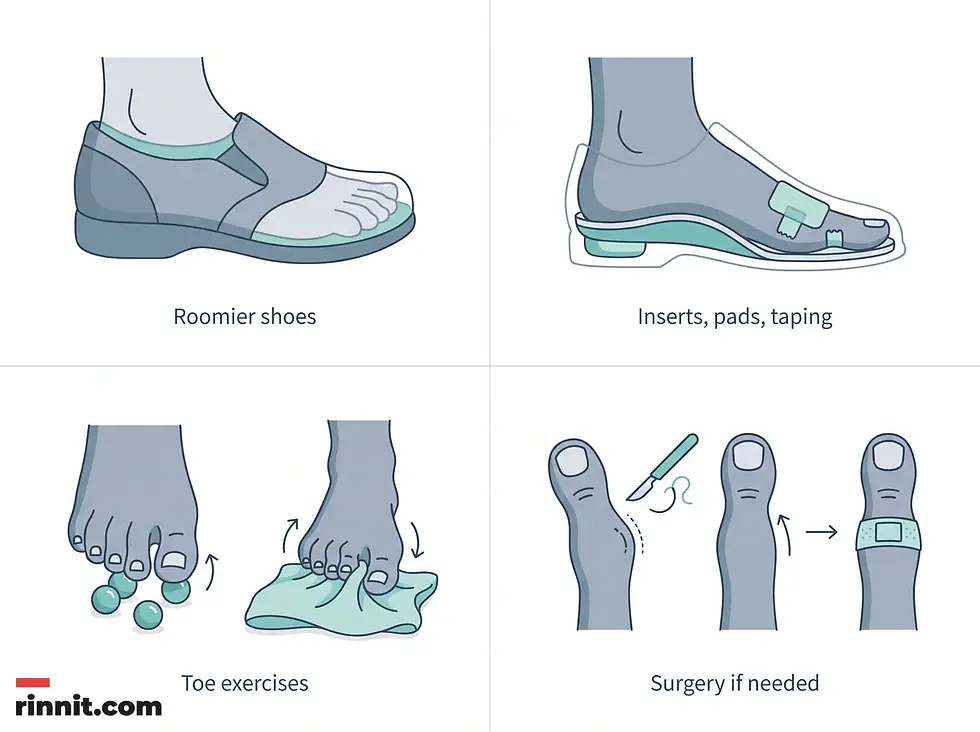
Figure 2: Treatment options for a curled toe, from roomier shoes and inserts to toe exercises and, if needed, surgery.
Home Care: The Half-Inch Rule
Good footwear alone can ease foot pain. Wear low-heeled shoes with a big toe box made of material that has some give to it [2]. Make sure there's a half-inch (1.27 centimeters) of space between your longest toe and the inside tip of the shoe [2]. Having enough space for your toes can help relieve pressure and pain.

Figure 3: A well-fitting shoe has a wide toe box and about half an inch of space beyond the longest toe.
Prevention: Buying Shoes That Protect Your Toes
Shoes that fit well can prevent many foot, heel, and ankle problems [1], including curled toes. Here's what to look for when buying shoes.
Enough toe room. Avoid shoes with pointed toes [1].
Low heels. Not wearing high heels can help prevent toe and back problems [1].
Shoes that adjust. Shoes with laces or straps are roomier and easier to make comfortable [1].
Shop at the end of the day, because feet swell as the day goes on [1].
Check your size, especially the width, which can change with age. Measure both feet and buy for the larger foot [1].
Buy shoes that fit right away. A shoe repair store might be able to stretch shoes in tight spots, but it's better to buy shoes that fit [1].
Conclusion: Catch the Curl While It's Still Flexible
Hammertoe and mallet toe start small: a bend in a toe joint, pain in tight shoes, a corn forming where the toe rubs. The conditions are usually linked to footwear, injury, and muscle imbalance, and women are more likely to develop them.
The crucial fact is timing. While the toe can still be straightened, roomier shoes, orthotic inserts, pads, taping, and simple exercises like picking up marbles or scrunching a towel can often relieve the pressure and pain without surgery. Once the tendons and joints tighten and the toe stays bent, surgery to release the tendon or remove a piece of bone becomes the main option. If lasting foot pain is affecting your ability to walk, don't wait. Start by scheduling a visit with your healthcare team.
Frequently Asked Questions
What is the difference between hammertoe and mallet toe?
A hammertoe has a bend in the middle joint of the toe, while a mallet toe has a bend in the joint nearest the toenail. Both usually occur in the second, third, or fourth toes and are linked to tight shoes, toe injuries, and muscle imbalance.
What causes hammertoe?
Three factors have been linked to hammertoe: certain shoes such as high heels or tight toe boxes that crowd the toes, injuries like a stubbed, jammed, or broken toe, and toe muscles that are out of balance. In many cases, the exact cause isn't known.
Can hammertoe be fixed without surgery?
Yes, if the toe can still be straightened. Roomier footwear, shoe inserts called orthotics, shoe pads, and taping can move the toe and ease pressure and pain. Exercises that stretch and strengthen toe muscles, such as picking up marbles or scrunching a towel, may also help.
Is hammertoe permanent?
Not at first. For a while, you might still be able to straighten the toe. But over time, the tendons and joints may tighten, and the toe can stay bent permanently. Once the bend is fixed, surgery to release the tendon or remove a piece of bone is typically the remaining option.
What are the symptoms of hammertoe?
The main sign is an unusual bend in one or more toe joints. Other symptoms include pain from wearing shoes, trouble moving the affected toe, stiffness, a change in skin color and swelling, and corns or calluses where the bent toe rubs against shoes or the ground.
Who is more likely to get hammertoe?
Women are more likely to develop hammertoe or mallet toe than men. Arthritis and diabetes can increase the risk of foot problems, and genes might also play a role.
What are the best shoes for hammertoe?
Low-heeled shoes with a big toe box made of material with some give. There should be a half-inch (1.27 centimeters) of space between your longest toe and the inside tip of the shoe. Avoid pointed toes, and choose shoes with laces or straps for a roomier, adjustable fit.
When should I see a doctor for a curled toe?
See a healthcare professional if you have lasting foot pain that affects your ability to walk. Seeing a doctor early matters because treatment works best while the toe can still be straightened, before the tendons and joints tighten and the bend becomes permanent.
What does hammertoe surgery involve?
Surgery can release the tendon that keeps the toe curled up. Sometimes the surgeon also removes a piece of bone to straighten the toe. It's generally considered when roomier shoes, inserts, pads, taping, and exercises don't relieve the condition.
Can toe exercises help a curled toe?
A healthcare professional might suggest exercises to stretch and strengthen the toe muscles, such as using your toes to pick up marbles or scrunching a towel. These are used for toes that can still be straightened, alongside footwear changes, inserts, pads, and taping.
Medical Disclaimer
The information in this article is for educational purposes only and is not a substitute for professional medical advice, diagnosis, or treatment. Always seek the advice of your physician or other qualified health provider with any questions you may have about a medical condition.
Source date: May 20, 2025.
References
Mayo Clinic Staff. Hammertoe and mallet toe - Symptoms and causes. Mayo Clinic. May 20, 2025. https://www.mayoclinic.org/diseases-conditions/hammertoe-and-mallet-toe/symptoms-causes/syc-20350839
Mayo Clinic Staff. Hammertoe and mallet toe - Diagnosis and treatment. Mayo Clinic. May 20, 2025. https://www.mayoclinic.org/diseases-conditions/hammertoe-and-mallet-toe/diagnosis-treatment/drc-20350845
Darcel V, Piclet-Legré B. Lesser-toe deformity. Orthop Traumatol Surg Res. 2022;109(1S):103464. PMID 36942795. https://doi.org/10.1016/j.otsr.2022.103464
Park CH, Chang MC. Forefoot disorders and conservative treatment. Yeungnam Univ J Med. 2019;36(2):92-98. PMID 31620619. https://doi.org/10.12701/yujm.2019.00185



Comments