Microvascular Decompression (MVD): Procedure, Success Rate, Risks and Recovery

Updated: 3 days ago
Written and medically reviewed by Dr. Baraa Alnahhal, MD · Last reviewed: November 2026 · How we review
Quick Answer: What is microvascular decompression?
Microvascular decompression (MVD) is surgery that relieves symptoms caused by a blood vessel pressing on a nerve as it leaves the brain. Through a small opening behind the ear, the surgeon moves the vessel off the nerve. It treats trigeminal neuralgia and hemifacial spasm. About 8 to 9 in 10 people feel better soon after surgery. [1]
What the research says
Most people with trigeminal neuralgia become pain free. A review of 26 studies with 6,847 patients found complete pain freedom in 83.5% over an average follow-up of about three years. Complications included facial numbness (9.1%), facial weakness (2.9%), hearing problems (1.9%), spinal fluid leak (1.6%) and wound infection (1.3%); mortality was 0.1%. (Xia et al., The Journal of Craniofacial Surgery, 2014) [2]
More than 9 in 10 people with hemifacial spasm are spasm free. In 39 studies covering 6,249 patients, 90.5% were spasm free at about 1.25 years. A first operation was about four times more likely to succeed than a repeat MVD (odds ratio 4.16). (Holste et al., World Neurosurgery, 2020) [3]
Relief is usually fast, but symptoms can return. A 2025 review reported that 80% to 90% of patients get immediate relief and 15% to 25% later have symptoms come back. Hearing loss occurred in 1% to 2% and spinal fluid leak in 2% to 4%. (Okon et al., BMC Surgery, 2025) [4]
Key takeaways
MVD treats facial pain or spasm caused by a blood vessel pressing on a cranial nerve as it exits the brain (neurovascular compression). [1]
The surgeon moves the vessel away and keeps it off the nerve, which eases symptoms while keeping the nerve safe. [1]
It's considered the gold-standard treatment for trigeminal neuralgia because it treats the cause of the pain, not just the symptoms. [1]
The operation takes two to three hours under general anesthesia, followed by one or two nights in the hospital. [1]
Most people return to their normal routine in about a month. [1]
What is microvascular decompression?
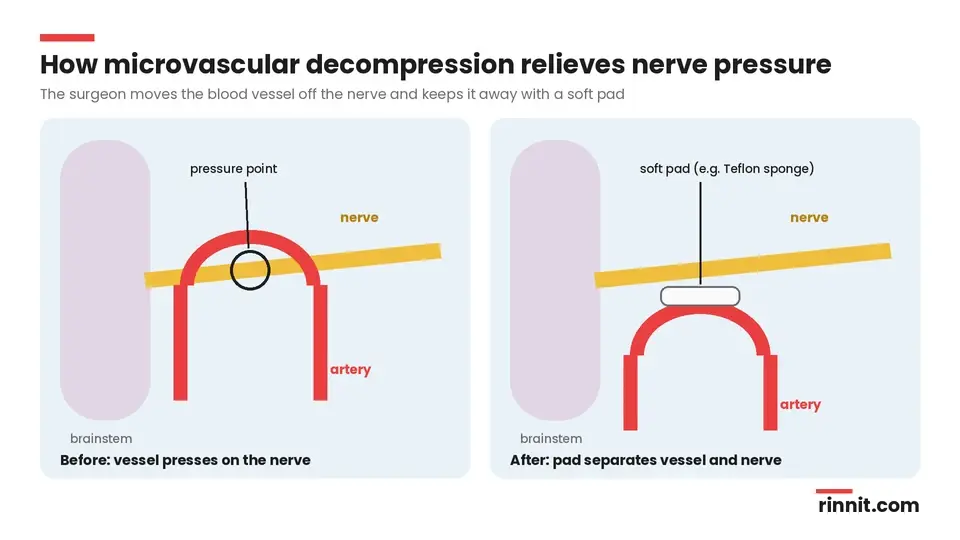
Microvascular decompression is a type of surgery that helps when a blood vessel presses on a nerve as it exits your brain. Doctors call this neurovascular compression. It can cause sudden, sharp bursts of facial pain that feel like electric shocks, and it may also lead to twitching or pulling of the muscles on one side of your face. [1]
During the procedure, your surgeon moves the artery or vein away from your nerve. Shifting the vessel takes the pressure off the nerve, which eases symptoms while keeping the nerve safe. [1]
What does microvascular decompression treat?
MVD may help with cranial nerve conditions, which affect the nerves that start in your skull, such as: [1]
Trigeminal neuralgia
Hemifacial spasm
Geniculate neuralgia
Glossopharyngeal neuralgia
Trigeminal neuralgia causes severe facial pain that comes and goes. It's often triggered by everyday things like touching your face, brushing your teeth, eating or talking. [1]
How do you prepare for microvascular decompression?
You'll meet with your surgeon before the procedure. Preparation usually includes: [1]
Imaging. An MRI and an MRA give the clearest pictures of the nerve and the blood vessels around it.
A physical exam. This makes sure you're healthy enough for surgery.
A medicine review. Your care team checks the medicines and supplements you take and may ask you to stop some, because certain medicines can cause side effects during surgery.
Day-of-surgery instructions. You may be allowed only clear liquids until a few hours before surgery, and you'll need a ride to and from the hospital.
If you have questions about the procedure or how to prepare, ask your care team before the day of surgery. [1]
What happens during microvascular decompression?
On the day of surgery you'll get general anesthesia, which puts you to sleep so you don't feel pain. Your care team clips a small area of hair behind your ear; it grows back after the site heals. [1]
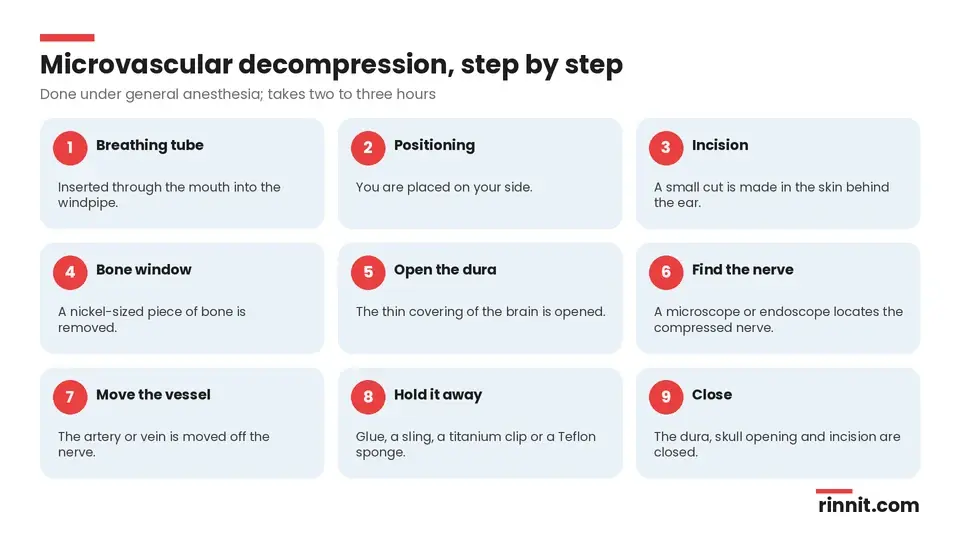
The steps vary a little depending on what your surgeon needs to do, but in general your surgeon and anesthesia team will: [1]
Insert a breathing tube through your mouth into your windpipe.
Position you on your side.
Make a small cut (incision) in the skin behind your ear.
Remove a small piece of bone, about the size of a nickel, behind your ear.
Open the dura, the thin covering around your brain and spinal cord.
Use a microscope or an endoscope to find the compressed nerve.
Move the blood vessel away from the nerve.
Hold the vessel away using biologic glue, a sling, a titanium clip or a tiny Teflon™ sponge (soft pad).
Close the dura, the skull opening and the incision.
When the anesthesia wears off, your care team removes the breathing tube and watches you closely to make sure you're recovering well. [1]
Microvascular decompression at a glance
Item | Typical detail |
Anesthesia | General (you're asleep) |
Surgical opening | A nickel-sized piece of bone removed behind the ear |
How the vessel is kept off the nerve | Biologic glue, a sling, a titanium clip or a Teflon sponge |
Operating time | Two to three hours |
Hospital stay | One or two nights |
Soreness | One to two weeks |
Back to normal routine | About a month |
Sources: [1]
How successful is microvascular decompression?
MVD is the gold-standard treatment for trigeminal neuralgia because it treats the cause of the pain, not just the symptoms. [1]
Studies show that about 8 to 9 out of every 10 people feel better soon after their procedure. Five years later, 7 to 8 out of every 10 people from the same study still had a successful result. After surgery, normal activities like chewing, talking and moving shouldn't cause pain. [1]
In some cases, trigeminal neuralgia symptoms return. One study found that pain came back for about 2 out of every 10 people within 10 years. [1]
What are the risks of microvascular decompression?
MVD is major surgery: your surgeon makes an opening in your skull, you're under general anesthesia and recovery takes time. Your care team will talk with you about the possible risks before surgery. These are rare, but may include: [1]
Blood vessel injury (stroke)
Cerebrospinal fluid (CSF) leak
Facial numbness
Hearing loss
Infection
What happens after microvascular decompression?
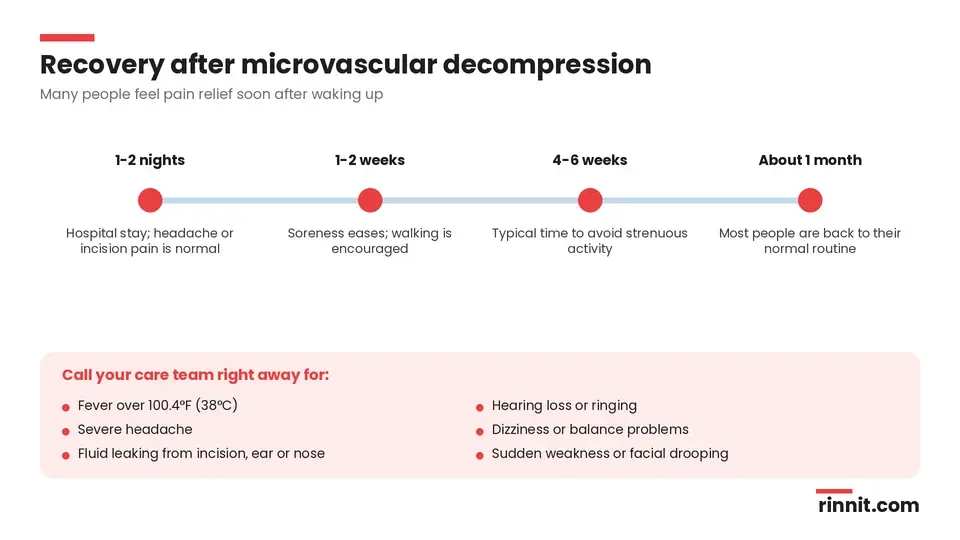
You'll stay in the hospital for one or two nights so your surgeon can check that you're recovering well and watch for problems. It's normal to have a headache or pain near the incision. [1]
Your care team will give you medicine to keep you comfortable. A combination of long-acting numbing medicine placed in the incision during surgery, regular doses of acetaminophen (Tylenol®), an anti-inflammatory (NSAID), magnesium and a muscle relaxer can control pain and reduce the need for opioid medicines. [1]
Before you go home, your providers check for complications, give you clear instructions for caring for yourself and explain how to manage pain at home. Once you're home, avoid heavy lifting and strenuous activity, but walking is encouraged. [1]
How long does it take to recover from microvascular decompression?
Many people feel pain relief right after surgery. Even when symptoms are gone, recovery takes time because your surgeon made an opening in your skull. [1]
You'll likely feel sore for one to two weeks.
Avoiding harder physical activity for four to six weeks is typical; your surgeon will tell you when it's safe.
You should be able to get back to your normal routine in about a month, though this varies.
If you take anti-seizure medicines for facial pain, your neurosurgeon will let your neurologist know when it's safe to start slowly reducing them. Lower these medicines only under your neurologist's direction, and don't stop them suddenly, because that can cause withdrawal symptoms. [1]
When should you call your doctor after microvascular decompression?
Contact your care team right away if you have any of these symptoms after surgery: [1]
Balance problems
Dizziness
Fever over 100.4°F (38°C)
Incision problems, such as severe pain, swelling, pus or bleeding
Fluid leaking from your incision, ear or nose
Hearing loss or ringing in your ears
Severe headache
Sudden weakness, numbness or facial drooping
Conclusion
Microvascular decompression treats the mechanical cause of trigeminal neuralgia, hemifacial spasm and related conditions by moving a blood vessel off a compressed cranial nerve. Most people feel better soon after the operation, and many stay pain free for years.
It's normal to feel nervous about an operation that involves a small opening in the skull. Healing takes rest and time, but most people notice steady improvement each day. Follow your care team's instructions, and tell them right away if something doesn't feel right.
Keep learning: Read our guides to trigeminal neuralgia and glossopharyngeal neuralgia. For more background, see the NINDS overview of trigeminal neuralgia.
FAQ
What is microvascular decompression?
It's surgery that moves a blood vessel off a cranial nerve where it leaves the brain, relieving pain or spasm while keeping the nerve intact.
What conditions does MVD treat?
It can treat trigeminal neuralgia, hemifacial spasm, geniculate neuralgia and glossopharyngeal neuralgia caused by a blood vessel pressing on a nerve.
Is microvascular decompression major surgery?
Yes. The surgeon removes a nickel-sized piece of bone behind the ear to reach the nerve, and you're under general anesthesia.
How long does microvascular decompression take?
The operation usually takes two to three hours.
How successful is MVD for trigeminal neuralgia?
About 8 to 9 out of 10 people feel better soon after surgery, and 7 to 8 out of 10 still have a good result five years later.
Can trigeminal neuralgia come back after MVD?
Yes. One study found that pain returned for about 2 out of every 10 people within 10 years.
What are the risks of microvascular decompression?
Risks are rare but include stroke from blood vessel injury, cerebrospinal fluid leak, facial numbness, hearing loss and infection.
How long is the hospital stay after MVD?
Most people stay in the hospital for one or two nights.
How long is recovery after microvascular decompression?
Soreness lasts one to two weeks, strenuous activity is usually avoided for four to six weeks, and most people return to normal routines in about a month.
When should I call my doctor after MVD?
Call right away for fever over 100.4°F, severe headache, fluid leaking from the incision, ear or nose, hearing loss, dizziness, or sudden weakness, numbness or facial drooping.
How do I prepare for microvascular decompression?
Preparation usually includes an MRI and MRA, a physical exam and a review of your medicines and supplements, some of which you may need to stop. You may be allowed only clear liquids until a few hours before surgery, and you will need a ride to and from the hospital [1].
Does microvascular decompression hurt, and what anesthesia is used?
You get general anesthesia, so you are asleep and do not feel pain during surgery. Afterward, a headache or pain near the incision is normal, and long-acting numbing medicine in the incision, acetaminophen, an NSAID, magnesium and a muscle relaxer can control pain and reduce the need for opioids [1].
Related Reading
Learn more in our guide to Trigeminal Neuralgia: What Causes the Facial Pain, and How Is It Treated?.
Learn more in our guide to Glossopharyngeal Neuralgia (GPN): What It Is, Why It Happens, and How It's Treated.
References
Cleveland Clinic. Microvascular Decompression: Procedure, Recovery & Risks. Cleveland Clinic. Last updated November 4, 2025. https://my.clevelandclinic.org/health/procedures/microvascular-decompression
Xia L, Zhong J, Zhu J, et al. Effectiveness and safety of microvascular decompression surgery for treatment of trigeminal neuralgia: a systematic review. J Craniofac Surg. 2014;25(4):1413-7. PMID 24978453. https://doi.org/10.1097/SCS.0000000000000984
Holste K, Sahyouni R, Teton Z, et al. Spasm Freedom Following Microvascular Decompression for Hemifacial Spasm: Systematic Review and Meta-Analysis. World Neurosurg. 2020;139:e383-e390. PMID 32305605. https://doi.org/10.1016/j.wneu.2020.04.001
Okon II, Menon SS, Osama M, et al. Microvascular decompression: a contemporary update. BMC Surg. 2025;25(1):20. PMID 39794712. https://doi.org/10.1186/s12893-025-02762-7
Medical disclaimer
This article is for general education only and does not replace advice from a qualified healthcare professional. Talk to your doctor about your own diagnosis and treatment, and seek emergency care right away for severe or sudden symptoms.



Comments