Understanding McCune-Albright Syndrome: Symptoms, Causes, and Care

Updated: 3 days ago
Medically reviewed by Dr. Baraa Alnahhal, MD · Last reviewed: October 2026
McCune-Albright syndrome (MAS) is a rare genetic condition that primarily affects the bones, skin, and endocrine system. It is characterized by fibrous dysplasia, café-au-lait skin spots, and hormonal irregularities such as early puberty. Caused by a spontaneous genetic mutation after conception, MAS is not inherited. While there is no cure, a variety of treatments, including medications for bone strength and hormone regulation, physical therapy, and surgery, can effectively manage symptoms and support a normal life expectancy [1].
Quick Answer: What is McCune-Albright syndrome?
McCune-Albright syndrome is a rare genetic disorder caused by a spontaneous mutation in the GNAS1 gene and is not inherited. It causes fibrous dysplasia in bones, café-au-lait skin patches and endocrine problems, often leading to early puberty. Management relieves symptoms with medications, physical therapy or surgery, and most people lead a full life with regular monitoring. [1]
What the research says
The condition is a spectrum, and evidence for care is limited. An international consortium consensus statement describes fibrous dysplasia/McCune-Albright syndrome as a wide spectrum of disease caused by somatic gain-of-function GNAS mutations, with features that vary in severity and age of onset; the authors note the lack of strong evidence to inform care, so the guidelines draw on the published literature and expert experience (Javaid et al., Orphanet J Rare Dis, 2019 [2]).
Antiresorptive drugs reduce bone turnover and pain in fibrous dysplasia. A meta-analysis of 21 studies (374 patients), mostly pamidronate and denosumab, found bone resorption markers fell by an average of 40.5% and pain fell by 32.7% after 6–12 months, and by 44.5% after a mean follow-up of 41.2 months (Bertin et al., Rev Endocr Metab Disord, 2023 [3]).
The diagnosis can be made clinically. A literature review accompanying a case report notes that the classic triad is fibrous dysplasia, café-au-lait skin macules, and hyperfunctioning endocrine disease, and that two of the three cardinal manifestations occurring together establish the diagnosis clinically (Nicolaides et al., Int J Mol Sci, 2023 [4]).
McCune-Albright syndrome (MAS) is a complex multisystem disorder that arises from a somatic mutation in the GNAS1 gene shortly after fertilization. This rare condition, occurring in approximately one in every 100,000 to 1,000,000 births, is not inherited but occurs sporadically. MAS is defined by a triad of symptoms: fibrous dysplasia of the bone, characteristic skin pigmentation, and hyperfunctioning endocrine tissues. Because the mutation occurs randomly during early development, the severity and specific symptoms can vary significantly between individuals [1].
What is the clinical triad of McCune-Albright syndrome?
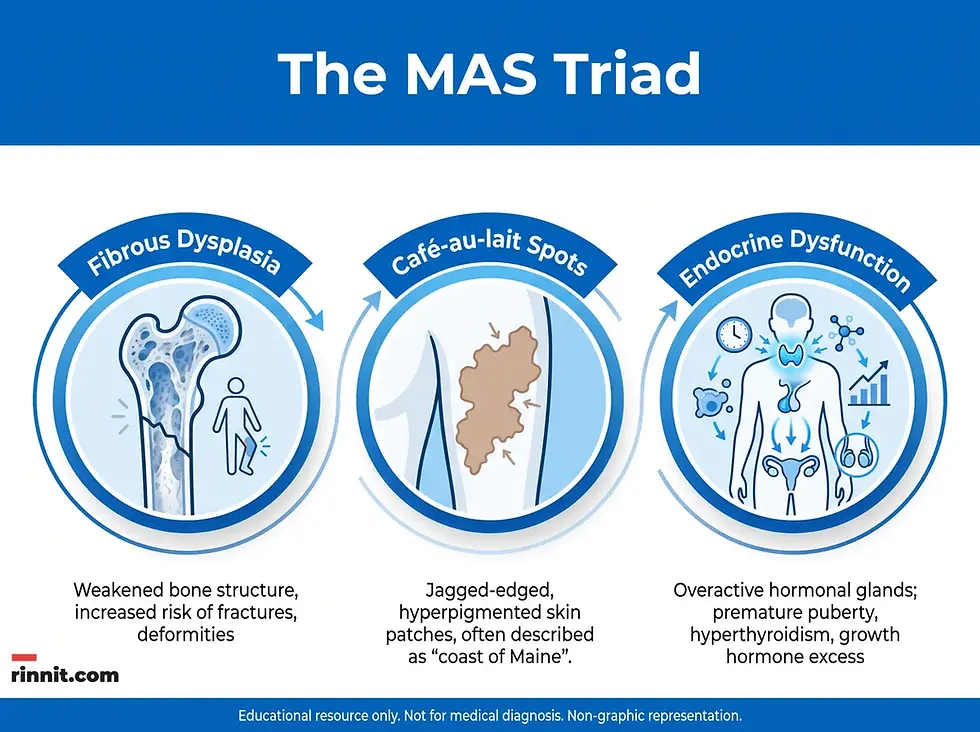
The hallmark features of MAS affect the skeletal system, the skin, and the glands that produce hormones. Understanding how these systems interact is essential for effective diagnosis and long-term management [1].
Affected system | Key symptom | Clinical significance |
Skeletal | Fibrous dysplasia | Scar tissue replaces bone, leading to fractures and deformities. |
Dermatological | Café-au-lait spots | Jagged-edged skin patches, often on one side of the body. |
Endocrine | Precocious puberty | Early onset of sexual development, especially in young girls. |
Endocrine | Hyperthyroidism | Overactive thyroid causing fast heart rate and weight loss. |
Skeletal and Skin Manifestations
Fibrous dysplasia is the most common skeletal symptom, where normal bone is replaced by fibrous scar tissue. This weakens the bone structure, potentially leading to pain, mobility loss, scoliosis, and recurrent fractures. In some cases, it can cause asymmetrical growth, particularly in the facial bones or legs. Complementing these skeletal changes are café-au-lait spots: light to dark brown skin patches with uneven borders, often described as having a "coast of Maine" appearance. These marks typically appear on one side of the body and may become more noticeable as the child grows [1].
What hormonal problems does McCune-Albright syndrome cause?
The GNAS1 mutation causes the body's growth-regulating glands to become overactive, leading to a variety of hormonal challenges. One of the most common signs is precocious puberty, where children begin developing sexually much earlier than their peers [1].
Common Endocrine Challenges
Early puberty: Young girls may begin menstruating as early as age two due to estrogen-producing ovarian cysts.
Thyroid dysfunction: Nearly half of those with MAS develop an enlarged thyroid, leading to hyperthyroidism symptoms like hypertension and excessive sweating.
Growth hormone excess: Pituitary involvement can result in acromegaly, characterized by large hands and feet and rounded facial features.
Adrenal overactivity: Excess cortisol production can lead to Cushing's syndrome, causing obesity and delayed growth.

How is McCune-Albright syndrome diagnosed and managed?
Diagnosis typically occurs in early childhood, often triggered by the appearance of café-au-lait spots or signs of early puberty. Healthcare providers use a combination of physical examinations, blood tests for endocrine function, X-rays to assess bone health, and genetic testing via tissue biopsy to confirm the GNAS1 mutation [1].
Treatment Options and Long-Term Care
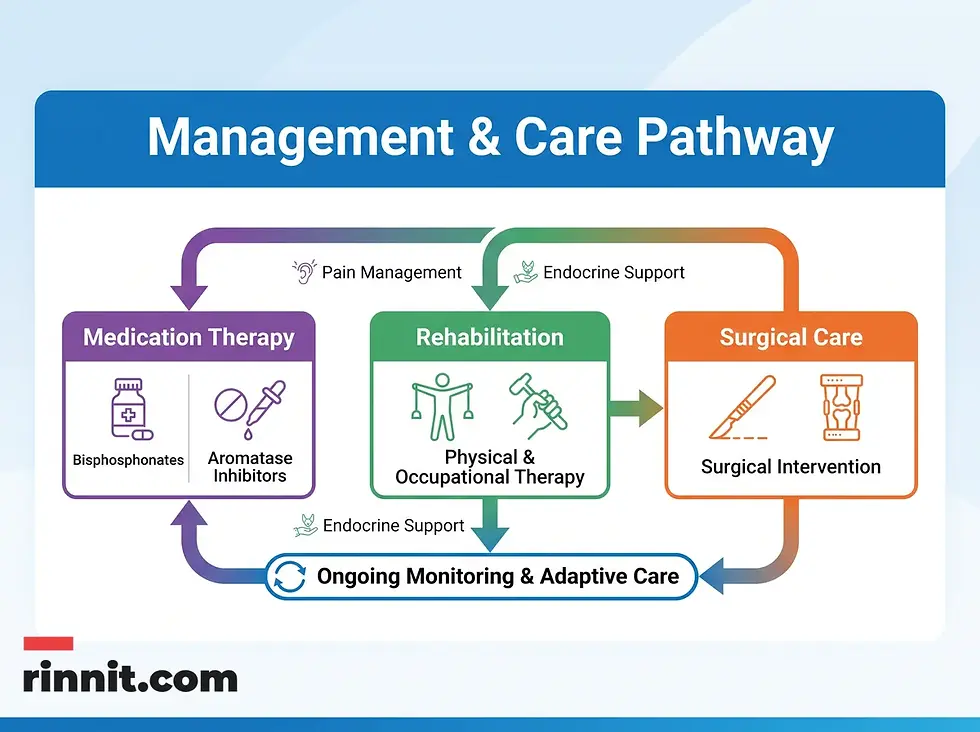
While MAS has no cure, treatment is tailored to the individual's specific symptoms to improve quality of life and prevent complications [1].
Treatment type | Target symptom | Common approaches |
Medication | Bone health | Bisphosphonates, mainly to ease bone pain; they have not been shown to heal lesions or prevent fractures. |
Medication | Early puberty | Aromatase inhibitors to manage hormonal development. |
Medication | Thyroid function | Antithyroid drugs to stabilize metabolism. |
Surgery | Bone deformity | Procedures to correct scoliosis or stabilize weak bones. |
Therapy | Mobility | Physical and occupational therapy to maintain independence. |
What is the bottom line on McCune-Albright syndrome?
McCune-Albright syndrome is a lifelong condition that requires specialized medical attention, but with proper management, most individuals lead a full and active life. Regular monitoring for bone health and endocrine function is essential to address symptoms as they evolve. Early intervention remains the most effective way to manage hormonal changes and protect skeletal integrity [1].
Frequently Asked Questions
Is McCune-Albright syndrome inherited?
No, it is caused by a random genetic mutation that occurs after conception and is not passed from parents to children.
What are café-au-lait spots?
Café-au-lait spots are light to dark brown skin patches with jagged borders that are a hallmark sign of McCune-Albright syndrome.
Can boys have McCune-Albright syndrome?
Yes, while early puberty is more frequently noticed in girls, the condition affects both boys and girls.
What causes fibrous dysplasia?
Fibrous dysplasia is caused by the overgrowth of fibrous scar tissue in place of normal bone, which is a key feature of MAS.
Is there a cure for McCune-Albright syndrome?
There is currently no cure, but symptoms can be effectively managed with medication, surgery, and therapy.
What is the life expectancy for someone with MAS?
Most people with McCune-Albright syndrome have a normal life expectancy with proper medical care.
Does MAS increase the risk of cancer?
There is a very small risk (less than 1%) of cancerous bone lesions and a potential increase in early breast cancer risk for women.
What are bisphosphonates?
Bisphosphonates are bone medicines that may ease bone pain in fibrous dysplasia; they have not been shown to heal the lesions or prevent fractures.
How is MAS diagnosed?
Diagnosis involves physical exams, blood tests for hormones, X-rays, and genetic testing through tissue biopsy.
What is acromegaly in MAS?
Acromegaly in MAS is a condition where the pituitary gland produces too much growth hormone, leading to large hands, feet, and facial changes.
Related Reading
Fibrous Dysplasia: Understanding Bone Weakness and Fibrous Tissue Replacement explains the bone condition that is a key feature of McCune-Albright syndrome.
Precocious Puberty: Complete Guide to Signs, Causes, and Treatment covers early puberty, a common hormone problem in this syndrome.
Acromegaly: Complete Guide to Symptoms, Causes, Diagnosis, and Treatment explains excess growth hormone, which can occur with McCune-Albright syndrome.
Hyperthyroidism: Symptoms, Causes & Treatment describes an overactive thyroid, another possible hormone problem in this syndrome.
References
Cleveland Clinic. McCune-Albright Syndrome. Cleveland Clinic. December 14, 2021. https://my.clevelandclinic.org/health/diseases/22171-mccune-albright-syndrome
Javaid MK, Boyce A, Appelman-Dijkstra N, et al. Best practice management guidelines for fibrous dysplasia/McCune-Albright syndrome: a consensus statement from the FD/MAS international consortium. Orphanet J Rare Dis. 2019;14(1):139. PMID 31196103. https://doi.org/10.1186/s13023-019-1102-9
Bertin H, Moussa MS, Komarova S. Efficacy of antiresorptive agents in fibrous dysplasia and McCune Albright syndrome, a systematic review and meta-analysis. Rev Endocr Metab Disord. 2023;24(6):1103-1119. PMID 37632645. https://doi.org/10.1007/s11154-023-09832-2
Nicolaides NC, Kontou M, Vasilakis IA, et al. McCune-Albright syndrome: a case report and review of literature. Int J Mol Sci. 2023;24(10):8464. PMID 37239810. https://doi.org/10.3390/ijms24108464
Medical disclaimer
This article is for informational purposes only and is not a substitute for professional medical advice, diagnosis, or treatment. The clinical information in this guide reflects source material last reviewed in December 2021.



Comments