Mastoidectomy: What It Is, Why It's Done, and What Recovery Looks Like

Updated: 6 days ago
Written and medically reviewed by Dr. Baraa Alnahhal, MD · Last reviewed: October 2026 · How we review
Quick Answer: What is a mastoidectomy?
A mastoidectomy is a surgery that removes diseased air cells from the mastoid, the honeycomb-shaped bone just behind the ear. It treats ear infections that have spread into the skull and cholesteatoma, and is often part of cochlear implant surgery. It is done under general anesthesia, takes two to three hours, and full recovery takes six to 12 weeks. [1]
What the research says
For cholesteatoma, adding mastoid obliteration lowered the chance of the growth coming back compared with canal-wall-up surgery. A meta-analysis of 12 studies with 2,379 patients found that canal-wall-down surgery with mastoid obliteration (filling in the surgical cavity) had significantly lower odds of cholesteatoma returning than canal-wall-up surgery (odds ratio 0.33; 95% CI 0.19–0.57). It also had less persistent ear drainage than canal-wall-down surgery alone (odds ratio 0.41; 95% CI 0.23–0.71). (Salem et al., Am J Otolaryngol, 2023) [2]
In children with cholesteatoma, canal-wall-up and canal-wall-down surgery had similar return rates, and hearing was better after canal-wall-up. Across 17 studies including 1,333 children followed for a mean of 5.9 years, there was no significant difference in recurrence (risk ratio 1.50; 95% CI 0.94–2.40) or residual disease (risk ratio 1.51; 95% CI 0.96–2.38). The mean air-bone gap, a measure of hearing loss, was 7.6 dB lower with canal-wall-up surgery. (Solis-Pazmino et al., Int J Pediatr Otorhinolaryngol, 2023) [3]
For chronic ear infections without cholesteatoma, adding a mastoidectomy to eardrum repair slightly lowered graft failure. In 27 studies comparing tympanoplasty alone (1,711 patients) with tympanoplasty plus mastoidectomy (1,186 patients), graft failure was 16.4% versus 14.2%, while hearing results were similar. The authors described the risk reduction as minimal. (Poupore et al., Otol Neurotol, 2022) [4]
Key takeaways
A mastoidectomy removes diseased air cells from the mastoid bone behind the ear. [1]
The main reasons are ear infections that have spread into the skull, cholesteatoma, and cochlear implant surgery. [1]
There are three main types: simple, canal-wall-up and canal-wall-down. [1]
Surgery usually takes two to three hours under general anesthesia. [1]
Most people return to routine activities in one to two weeks; full recovery takes six to 12 weeks. [1]
The main goal is to clear infection, not to restore hearing. [1]
What is a mastoidectomy?
A mastoidectomy is a surgery that removes diseased mastoid air cells. [1]
These air cells form in the hollow spaces inside your mastoid. The mastoid is a sponge-like, honeycomb-shaped part of your skull that sits just behind your ear. [1]

Mastoidectomy at a glance
Question | Short answer |
What it removes | Diseased air cells in the mastoid bone |
Where the mastoid is | Just behind the ear |
Main reasons | Ear infection spread to the skull, cholesteatoma, cochlear implant surgery |
Anesthesia | General (you are asleep) |
Surgery time | About 2 to 3 hours |
Back to work or school | About 1 to 2 weeks for most people |
Full recovery | About 6 to 12 weeks |
Main goal | Clear infection, not restore hearing |
Why is a mastoidectomy performed?
A mastoidectomy is needed when a middle ear infection (otitis media) spreads into the skull. [1]
The surgery also treats cholesteatoma. This is a noncancerous growth that forms behind the eardrum, often as a complication of chronic ear infections. [1]
In many cases, a mastoidectomy is done during cochlear implant surgery. [1]
If you have a ruptured eardrum, your surgeon will do a mastoidectomy with tympanoplasty. A tympanoplasty repairs the eardrum. The term also covers surgery behind the eardrum even when the eardrum itself doesn't need repair. [1]
Reason | What the surgery does |
Ear infection that has spread to the skull | Removes the infected air cells in the mastoid |
Cholesteatoma | Removes the growth behind the eardrum and diseased bone |
Cochlear implant surgery | Forms part of the implant procedure |
Ruptured eardrum | Combined with tympanoplasty to repair the eardrum |
What are the different types of mastoidectomy?
The three types of mastoidectomy differ in how much bone the surgeon removes, and the extent of surgery depends on your situation. [1]
Simple mastoidectomy. This treats disease inside the mastoid. Your ear canal and middle ear structures stay completely intact. [1]
Canal-wall-up mastoidectomy (tympanomastoidectomy). This removes more bone than a simple mastoidectomy. It gives your surgeon access to the middle ear space behind the eardrum, including the ossicles. The ossicles are the three tiny bones that carry sound waves inside your ear. Your ear canal stays completely intact. [1]
Canal-wall-down mastoidectomy (tympanomastoidectomy). This is done when disease has damaged the ear canal beyond repair, or when removing the canal wall is needed to remove all the disease. The ear canal and mastoid are joined into one large open space called a mastoid cavity, or mastoid bowl. The ear canal opening is usually enlarged so the cavity can be cleaned in the future. This surgery is sometimes called a radical or modified mastoidectomy. [1]
A canal-wall-down mastoidectomy is reserved for extensive disease, or for disease that keeps coming back after a more limited surgery has failed. [1]
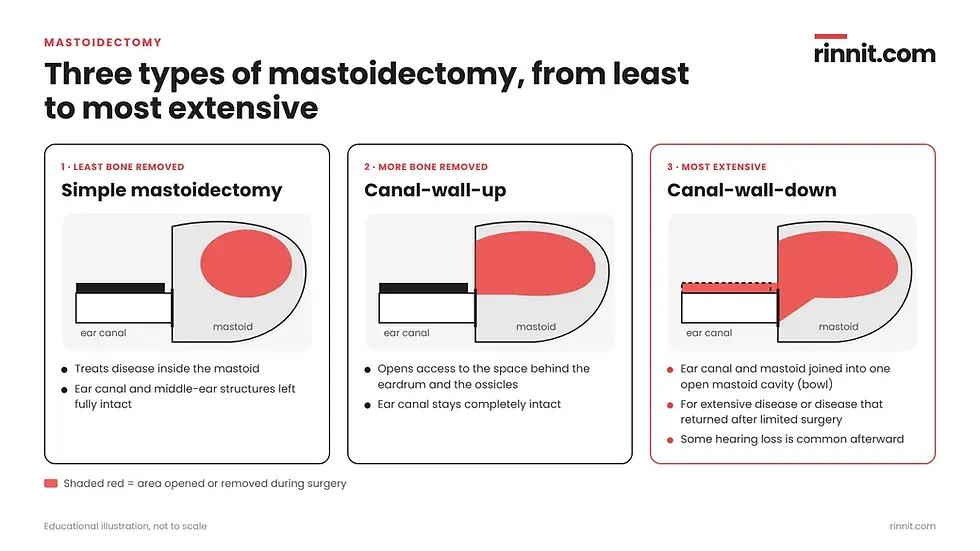
Type | Bone removed | Ear canal | Typically used for |
Simple | Least | Fully intact, with middle ear structures | Disease limited to the mastoid |
Canal-wall-up | More | Fully intact | Reaching the middle ear and ossicles behind the eardrum |
Canal-wall-down (radical or modified) | Most | Joined with the mastoid into one open cavity | Extensive disease, or disease that returned after limited surgery |
How do you prepare for a mastoidectomy?
Preparing for a mastoidectomy means closely following the preoperative instructions your healthcare provider gives you. [1]
What happens during a mastoidectomy?
During a mastoidectomy, you are under general anesthesia while the surgeon opens the mastoid bone and removes the infected air cells. [1]
Step | What your surgeon does |
1 | Makes an incision behind your ear, placed carefully to make the scar less noticeable |
2 | Uses specialized instruments to open the mastoid bone |
3 | Removes the infected air cells in the mastoid |
4 | Closes the surgical site with stitches |
5 | Covers the wound with gauze |
A mastoidectomy usually takes about two to three hours. [1]
Is a mastoidectomy painful?
A mastoidectomy is not painful during the operation, because you are asleep under general anesthesia. [1]
Like any surgery, it can cause some mild discomfort afterward. The incision behind your ear will likely be sore, and your ear may feel full or stuffy. [1]
You can usually manage these effects with over-the-counter pain relievers such as acetaminophen or ibuprofen. Your surgeon will also give you aftercare instructions to keep you comfortable while you heal. [1]
What happens after a mastoidectomy?
After a mastoidectomy, you wake up in a recovery area where your medical team monitors your progress. [1]
When you are ready, you can go home. Your surgeon will give you specific aftercare guidelines, and it's important to follow them closely. [1]
What are the benefits of a mastoidectomy?
A mastoidectomy can treat chronic ear infections and lower the chance that they return. [1]
It can also prevent serious complications of cholesteatoma, including: [1]
Hearing loss
Vertigo
Dizziness
Facial nerve damage
Labyrinthitis
Meningitis
Brain abscess
What are the risks of a mastoidectomy?
A mastoidectomy, like any surgery, carries possible risks and complications. [1]
Risk | What it means |
Inner ear hearing loss | Sensorineural hearing loss |
Facial nerve injury | Can cause facial weakness or paralysis |
Change in taste (dysgeusia) | Often lasts several months |
Ringing in the ear (tinnitus) | A sound in the ear with no outside source |
How long is recovery after a mastoidectomy?
Full recovery after a mastoidectomy takes about six to 12 weeks. [1]
Most people can return to work, school and other routine activities in about one to two weeks. [1]
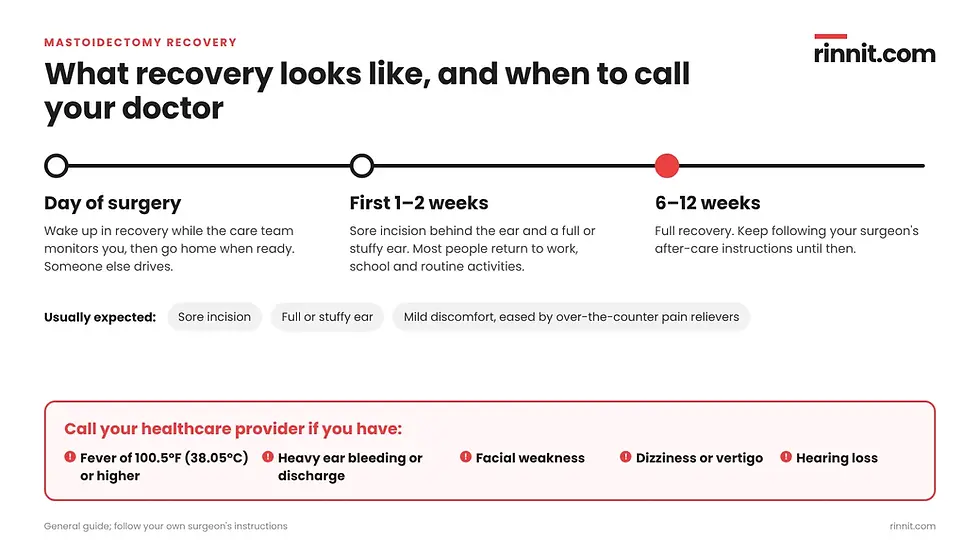
Time after surgery | What to expect |
Day of surgery | Wake in recovery, monitored by your team, then go home when ready |
First days | Sore incision behind the ear, full or stuffy ear, mild discomfort |
About 1 to 2 weeks | Most people return to work, school and routine activities |
About 6 to 12 weeks | Full recovery |
What is the outlook after a mastoidectomy?
A mastoidectomy is largely successful, but the outlook depends on why the surgery was done and which type was performed. [1]
The main goal of a mastoidectomy is to clear infection that could lead to further problems, not to restore hearing. Some hearing loss is common after a radical or canal-wall-down mastoidectomy. [1]
When should you call a doctor after a mastoidectomy?
After a mastoidectomy, call your healthcare provider if you notice any of these signs: [1]
A fever of 100.5°F (38.05°C) or higher
Heavy ear bleeding or discharge
Facial weakness
Dizziness or vertigo
Hearing loss
Conclusion
A mastoidectomy clears diseased air cells from the honeycomb-shaped bone behind the ear. It is used when an ear infection spreads into the skull, to treat cholesteatoma, and as part of cochlear implant surgery. The type you need, simple, canal-wall-up or canal-wall-down, depends on how far the disease has spread. Most people are back to their routine within one to two weeks and fully recovered by 12 weeks. The surgery's purpose is to clear infection and protect against serious complications, so knowing the warning signs after surgery matters as much as the operation itself.
Facing ear surgery, or caring for someone who is? Bring this guide to your ENT appointment and ask which type of mastoidectomy is planned, what it means for your hearing, and what your recovery should look like. To understand the conditions behind the surgery, read our guides to cholesteatoma and mastoiditis. Clinicians who explain ear procedures to patients can also build clear handouts with our infographic templates.
FAQ
What is a mastoidectomy?
A mastoidectomy is a surgery that removes diseased air cells from the mastoid, the honeycomb-shaped part of the skull just behind the ear. It is often used to treat cholesteatoma and ear infections that have spread into the skull.
Why would someone need a mastoidectomy?
A mastoidectomy is needed when an ear infection spreads into the skull or to treat cholesteatoma, a noncancerous growth behind the eardrum. It is also often done during cochlear implant surgery.
How long does mastoidectomy surgery take?
Mastoidectomy surgery usually takes about two to three hours. It is done under general anesthesia, so you will need someone to drive you home.
Is a mastoidectomy a major surgery?
The extent of a mastoidectomy depends on your situation. A simple mastoidectomy leaves the ear canal and middle ear intact, while a canal-wall-down mastoidectomy is reserved for extensive or returning disease.
Does a mastoidectomy hurt?
A mastoidectomy does not hurt during the operation because you are under general anesthesia. Afterward, the incision may be sore and your ear may feel full, which over-the-counter pain relievers such as acetaminophen or ibuprofen can usually ease.
How long is recovery after a mastoidectomy?
Full recovery after a mastoidectomy takes about six to 12 weeks. Most people return to work, school and routine activities in about one to two weeks.
Will a mastoidectomy restore my hearing?
A mastoidectomy is not mainly meant to restore hearing; its goal is to clear infection that could cause further problems. Some hearing loss is common after a radical or canal-wall-down mastoidectomy.
When should I call my doctor after a mastoidectomy?
Call your doctor after a mastoidectomy if you have a fever of 100.5°F (38.05°C) or higher, heavy ear bleeding or discharge, facial weakness, dizziness or vertigo, or hearing loss.
What are the types of mastoidectomy?
The three main types are simple, canal-wall-up and canal-wall-down mastoidectomy. They differ in how much bone the surgeon removes, which depends on how far the disease has spread.
Can I get my ear wet after a mastoidectomy?
Keep the ear and incision dry until your surgeon says it is safe. Ask how to shower and wash your hair without getting water in the ear.
Related reading
Trusted external resources
References
Cleveland Clinic. Mastoidectomy: Definition, Surgery & Recovery. Cleveland Clinic. Last updated March 23, 2022. https://my.clevelandclinic.org/health/treatments/22593-mastoidectomy
Salem J, Bakundukize J, Milinis K, et al. Mastoid obliteration versus canal wall down or canal wall up mastoidectomy for cholesteatoma: Systematic review and meta-analysis. Am J Otolaryngol. 2023;44(2):103751. PMID 36586321. https://doi.org/10.1016/j.amjoto.2022.103751
Solis-Pazmino P, Siepmann T, Scheffler P, et al. Canal wall up versus canal wall down mastoidectomy techniques in the pediatric population with cholesteatoma: A systematic review and meta-analysis of comparative studies. Int J Pediatr Otorhinolaryngol. 2023;173:111658. PMID 37666040. https://doi.org/10.1016/j.ijporl.2023.111658
Poupore NS, Gordis TM, Nguyen SA, et al. Tympanoplasty With and Without Mastoidectomy for Chronic Otitis Media Without Cholesteatoma: A Systematic Review and Meta-analysis. Otol Neurotol. 2022;43(8):864-873. PMID 35970151. https://doi.org/10.1097/MAO.0000000000003631
Medical disclaimer
This article is for general education only and does not replace advice from your doctor or ENT surgeon. Always talk to a qualified healthcare professional about your symptoms and treatment options, and follow your own surgeon's aftercare instructions. Never ignore professional medical advice or delay seeking it because of something you read here.



Comments