Liver Hemangioma: Why Most People Never Need Treatment, and When They Do

Updated: 3 days ago
Medically reviewed by Dr. Baraa Alnahhal, MD · Last reviewed: October 2026
Quick answer: What is a liver hemangioma and is it dangerous?
A liver hemangioma is a noncancerous mass in the liver made up of a tangle of blood vessels. It is very common, affecting around 20% of the population, and is usually found by accident during tests for something else. It rarely causes symptoms, usually does not grow and is not known to lead to cancer, so treatment is rarely needed.
What the research says
Many liver hemangiomas stayed the same size or shrank over time. Among 211 adults followed for more than three years with repeat ultrasound, hemangioma size decreased in 38.9%, did not change in 31.3% and increased in 29.8%, and the authors concluded most patients can be safely managed by observation (Maruyama et al., Journal of Clinical Medicine, 2023 [2]).
Small and medium-sized hemangiomas rarely changed over time. In a prospective study of 123 adults with 158 hemangiomas followed for 12 to 60 months, only one hemangioma changed in shape and size and no complications occurred; the only patients with symptoms at the start were eight with giant hemangiomas (Gandolfi et al., Gut, 1991 [3]).
What is a liver hemangioma?
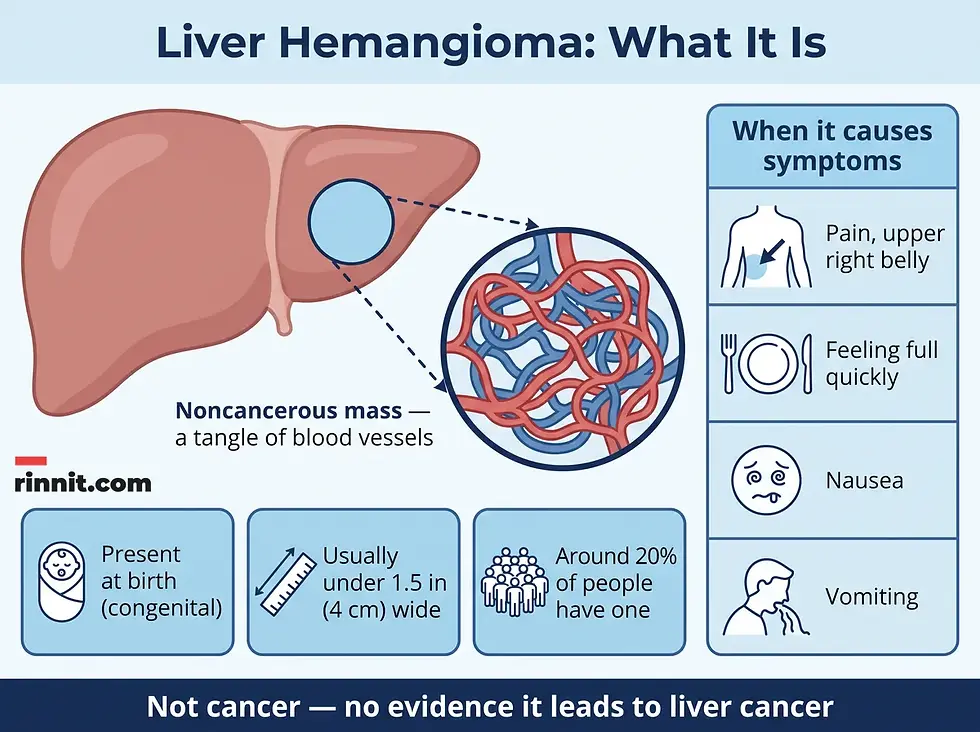
A liver hemangioma (say he-man-jee-O-muh) is a noncancerous mass in the liver made up of a tangle of blood vessels. It is sometimes called a hepatic hemangioma or a cavernous hemangioma.
It sounds alarming to hear the word "mass," but a liver hemangioma is not cancer. These liver masses are common. Around 20% of the population is thought to have them.
Most liver hemangiomas are found during a test done for another condition. People who have one rarely have symptoms and typically don't need treatment.
It is understandable to worry when you learn there is a mass in your liver. However, there is no evidence that an untreated liver hemangioma can lead to liver cancer.
What are the 4 symptoms a liver hemangioma may cause?
In most cases, a liver hemangioma doesn't cause any symptoms. When it does, the symptoms relate to the mass pressing on structures in the upper abdomen.
Symptom | What it looks like |
Pain in the upper right belly area | Aching or pressure beneath the ribs on the right side |
Feeling full after eating only a small amount of food | Early fullness during a meal |
Nausea | Feeling sick to your stomach |
Vomiting | Actually throwing up |
An important caution: these symptoms are typically due to something else. If you experience any of them, the likely cause is a different condition, not a hemangioma. That is exactly why new or ongoing symptoms should be evaluated rather than assumed.
Make an appointment with your healthcare team if you have any ongoing symptoms that worry you.
The liver is your largest internal organ. About the size of a football, it sits mainly in the upper right portion of your abdomen — beneath the diaphragm and above your stomach, with a small portion extending into the upper left quadrant.
How does a liver hemangioma form?
The cause of a liver hemangioma is not clear, though it typically forms as a single collection of tangled blood vessels. Healthcare professionals believe that liver hemangiomas are present at birth — meaning they are congenital.
A liver hemangioma usually grows as a single collection of tangled blood vessels and is typically less than about 1.5 inches (about 4 centimeters) wide. Sometimes liver hemangiomas can be larger or occur in multiples.
Large hemangiomas can grow in young children, but this is rare.
In most people, liver hemangiomas do not grow or cause any symptoms. But in a small number of people, they grow to cause symptoms and require treatment. It is not clear why this happens.
What are the 4 factors that increase liver hemangioma risk?
Four factors can increase the risk of a liver hemangioma, and estrogen is the suspected driver behind them.
Risk factor | Why it matters |
Age | Can be diagnosed at any age, but most often diagnosed in people ages 30 to 50 |
Being female | Women are more likely to be diagnosed than men |
Pregnancy | Women who have been pregnant are more likely to develop one than women who never have; the hormone estrogen, which rises during pregnancy, may play a role in growth |
Hormone replacement therapy | Women who use hormone replacement therapy for menopausal symptoms may be more likely to develop one than women who do not |
The pattern across these factors points to one suspected driver: estrogen. The hormone rises during pregnancy and is present in hormone replacement therapy, and both factors are tied to hemangioma development and growth.
What happens with a liver hemangioma if you are pregnant or plan to be?
Women who have been diagnosed with liver hemangiomas have a higher risk of complications if they become pregnant. The hormone estrogen, which increases during pregnancy, is believed to cause some liver hemangiomas to grow larger.
Very rarely, a growing hemangioma can cause symptoms that may require treatment, including pain in the upper right corner of the belly area, stomach bloating, or nausea.
Having a liver hemangioma doesn't mean you can't become pregnant. However, talking about the possible complications with your healthcare team can help you make a more informed choice.
How is a liver hemangioma diagnosed?
Most liver hemangiomas are discovered during a test or procedure for something else. The imaging tests used to diagnose them create pictures of the liver so providers can identify the characteristic tangle of blood vessels.
Test | How it works |
Ultrasound | An imaging method that uses sound waves to produce images of the liver |
CT scan | Combines a series of X-ray images taken from different angles around the body and uses computer processing to create images of the liver |
MRI scan | Uses a magnetic field and radio waves to create detailed images of the liver |
Other tests may be used depending on your situation.

Why do most people with a liver hemangioma need no treatment?
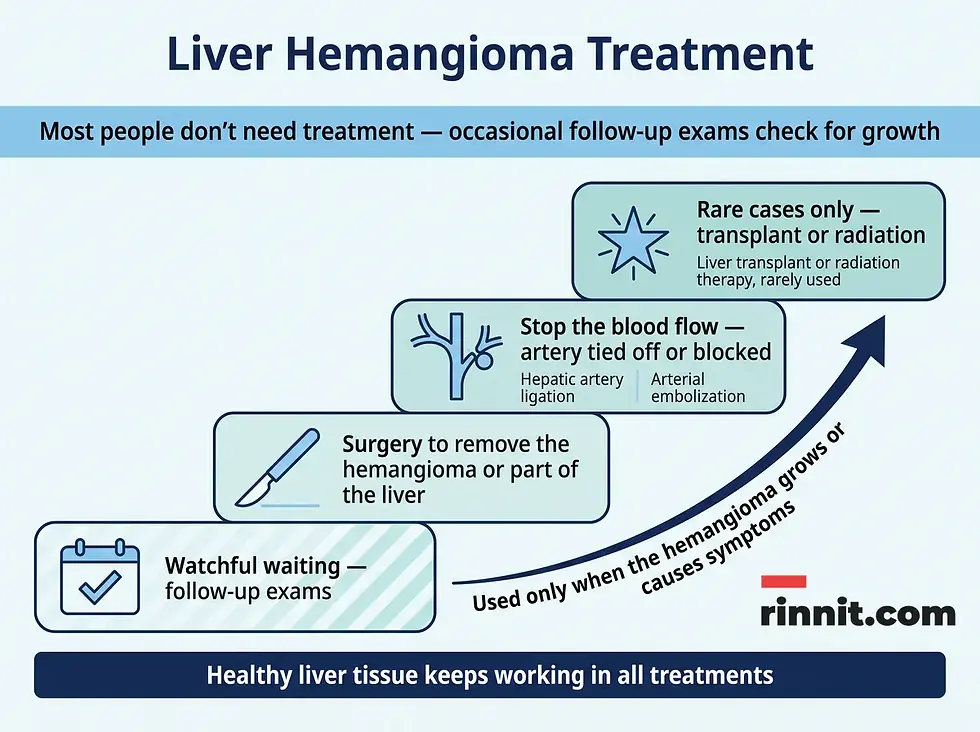
If your liver hemangioma is small and doesn't cause any symptoms, you likely won't need treatment. In most people, liver hemangiomas do not grow or cause symptoms. You may be scheduled for occasional follow-up exams to see if your hemangioma is growing.
When treatment is considered, it depends on the location and size of the hemangioma, whether you have more than one, your overall health, and your preferences.
Treatment option | What it involves | When it's used |
Surgery to remove the hemangioma | The mass is removed if it can be easily separated from the liver | When the hemangioma can be cleanly separated from liver tissue |
Surgery to remove part of the liver | A portion of the liver is removed along with the hemangioma | When the hemangioma can't be separated easily |
Procedures to stop blood flow | Hepatic artery ligation (tying off the main artery) or arterial embolization (injecting medicine into the artery to block it) | Without blood supply, the hemangioma may stop growing or shrink; healthy liver tissue is not harmed because it draws blood from other nearby vessels |
Liver transplant surgery | The liver is replaced | Rare event: a large hemangioma or multiple hemangiomas that can't be treated any other way |
Radiation therapy | Powerful energy beams, such as X-rays, damage the cells of the hemangioma | Rarely used because there are safer and more effective treatments |
The two blood-flow procedures deserve a closer look. Hepatic artery ligation ties off the main artery supplying the hemangioma. Arterial embolization injects medicine into the artery to block it. In both procedures, healthy liver tissue is not harmed because it can draw blood from other nearby vessels.
How should you prepare for a liver hemangioma appointment?
Most liver hemangiomas are discovered during a test or procedure for something else. If your care team thinks you have a liver mass, you may be referred to a doctor who specializes in the digestive system, called a gastroenterologist, or one who specializes in the liver, called a hepatologist. A little preparation makes the visit more productive.
What you can do
Step | Why it helps |
Be aware of anything you need to do ahead of time | At the time you make the appointment, ask if there's anything you need to do in advance, such as restricting your diet |
Write down symptoms you have | Include any that may not seem related to the reason you scheduled the appointment |
Write down important personal information | Include major stresses or recent life changes |
Make a list of all medicines, vitamins, and supplements | Include the doses you're taking |
Take a family member or friend along | Someone with you may remember something you missed or forgot |
Write down questions to ask | Your time is limited; rank questions from most to least important in case time runs out |
Questions worth asking
Questions to ask your healthcare team include: What is the size of my liver hemangioma? Do I have one or multiple? Is my hemangioma growing? What other tests do I need? Do I need treatment? Are there brochures or other printed material I can take with me? What websites do you recommend? Should I plan for a follow-up visit? Are there medicines that may worsen my hemangioma? Are my symptoms from the hemangioma?
What to expect from your doctor
Be prepared to answer questions such as: Have you had pain, nausea, loss of appetite, or feelings of fullness after eating little? Have you been pregnant? Have you used hormone replacement therapy?
Don't hesitate to ask other questions.
Conclusion: Common, benign, and usually nothing to do
A liver hemangioma is one of the least alarming "mass" findings in medicine. It is present at birth, common (around 20% of people), rarely symptomatic, usually stable, and not linked to liver cancer. The practical path for most people is simple: confirm the diagnosis with imaging, then let your provider monitor it with occasional follow-up exams.
Treatment enters the picture only when a hemangioma grows or causes symptoms — and even then, options range from relatively straightforward surgery to blood-flow blocking procedures that leave healthy liver tissue untouched. If you have been told you have a liver hemangioma, the most useful thing you can do is keep the follow-up plan and raise any new symptoms with your team.
Frequently asked questions
What is a liver hemangioma?
A liver hemangioma is a noncancerous mass in the liver made up of a tangle of blood vessels. It is present at birth, common (around 20% of the population is thought to have one), and rarely causes symptoms or requires treatment.
How common are liver hemangiomas?
Around 20% of the population is thought to have a liver hemangioma. Most are found by accident during a test done for another condition.
Is a liver hemangioma cancer?
No. A liver hemangioma is a noncancerous (benign) mass made of tangled blood vessels. There is no evidence that an untreated liver hemangioma can lead to liver cancer.
What are the symptoms of a liver hemangioma?
Most cause no symptoms. When they do, symptoms may include pain in the upper right belly area, feeling full after eating only a small amount of food, nausea, and vomiting — though these symptoms are typically due to something else.
How big do liver hemangiomas get?
A liver hemangioma usually forms as a single collection of tangled blood vessels and is typically less than about 1.5 inches (about 4 centimeters) wide, though sometimes they can be larger or occur in multiples.
Do liver hemangiomas grow?
In most people, no — liver hemangiomas do not grow or cause symptoms. In a small number of people, they grow to cause symptoms and require treatment. It is not clear why this happens.
How is a liver hemangioma diagnosed?
Through imaging tests: ultrasound (sound waves), CT scan (X-ray images combined with computer processing), and MRI (magnetic field and radio waves). Other tests may be used depending on your situation.
When does a liver hemangioma need treatment?
When it is large, growing, or causing symptoms. Treatment depends on the location and size of the hemangioma, whether you have more than one, your overall health, and your preferences.
Can pregnancy affect a liver hemangioma?
Yes. Women with diagnosed liver hemangiomas have a higher risk of complications if they become pregnant, because estrogen — which increases during pregnancy — is believed to cause some hemangiomas to grow larger. It is still possible to become pregnant; discuss the possible complications with your healthcare team.
What are the treatment options for a liver hemangioma?
Surgery to remove the hemangioma or part of the liver, procedures to stop blood flow to it (hepatic artery ligation or arterial embolization), liver transplant in rare untreatable cases, and radiation therapy, which is rarely used because safer and more effective treatments exist.
Authoritative resources
For further authoritative guidance, consult:
American Liver Foundation. Benign Liver Tumors. American Liver Foundation. Last updated September 22, 2026. https://liverfoundation.org/liver-diseases/complications-of-liver-disease/benign-liver-tumors/ — patient-oriented guidance on benign liver masses including hemangiomas
Radiological Society of North America. Benign hemangioma of the liver. RadiologyInfo.org. Accessed October 30, 2026. https://www.radiologyinfo.org/en/gallery/image/321 — radiology society perspective on imaging diagnosis of liver hemangiomas
Related Reading
Focal Nodular Hyperplasia: Symptoms, Causes, Diagnosis, Treatment and Outlook explains another common benign liver lesion found on imaging.
Liver Lesions: A Guide to Benign and Malignant Growths covers how doctors tell harmless liver spots from cancerous ones.
Liver Cysts: Understanding the Causes, Symptoms, and Treatment describes fluid-filled liver growths and when they need treatment.
What Is a Hemangioma? Symptoms, Treatment & When to Worry explains hemangiomas in general and when they need attention.
Sources
Mayo Clinic Staff. Liver hemangioma - Symptoms and causes. Mayo Clinic. Sept. 19, 2025. https://www.mayoclinic.org/diseases-conditions/liver-hemangioma/symptoms-causes/syc-20354234
Maruyama S, Matono T, Koda M. The natural history and management of hepatic hemangioma. Journal of Clinical Medicine. 2023;12(17):5703. PMID 37685768. https://doi.org/10.3390/jcm12175703
Gandolfi L, Leo P, Solmi L, et al. Natural history of hepatic haemangiomas: clinical and ultrasound study. Gut. 1991;32(6):677-680. PMID 2060877. https://doi.org/10.1136/gut.32.6.677
Medical disclaimer
The information provided in this article is for educational purposes only and should not be used as a substitute for professional medical advice, diagnosis, or treatment. Always seek the advice of your physician or other qualified health provider with any questions you may have regarding a medical condition.



Comments