Lateral Internal Sphincterotomy: A Definitive Guide to Healing Chronic Fissures

Updated: 2 days ago
Medically reviewed by Dr. Baraa Alnahhal, MD · Last reviewed: October 2026
A lateral internal sphincterotomy is a surgical procedure used to treat chronic anal fissures that fail to heal with conservative measures. By making a small incision in the internal anal sphincter muscle, surgeons relieve excess tension and spasms that prevent the wound from healing. This outpatient procedure takes approximately 30 minutes and boasts a 95% success rate. Most patients return to normal activities within two weeks, achieving complete relief from chronic pain.
Quick Answer: What is a lateral internal sphincterotomy?
Lateral internal sphincterotomy is a surgery that treats chronic anal fissures by making a small incision in the internal anal sphincter to stop spasms and improve blood flow. The 30-minute outpatient procedure lets the tear heal permanently, with a 95% success rate. Recovery involves a few days of manageable discomfort and a full return to activities within two weeks. [1]
What the research says
For chronic fissures in adults, surgery works far better than medical therapy. A Cochrane review of 75 randomized trials (5,031 participants) found that no medical therapy came close to the efficacy of surgical sphincterotomy, although none of the medical therapies carried a risk of incontinence; glyceryl trinitrate ointment healed 48.9% of fissures versus 35.5% with placebo, but late recurrence was common, in the range of 50% of those initially cured (Nelson et al., Cochrane Database Syst Rev, 2012 [2]).
Long-term continence problems are mostly minor but not negligible. A systematic review and meta-analysis of 22 studies (4,512 patients) with mean follow-up of 24 to 124 months found an overall continence disturbance rate of 14% (95% CI 9 to 20%), mostly flatus incontinence (9%) and soilage (6%), while incontinence to solid stool occurred in 0.83% of patients (Garg et al., Colorectal Dis, 2013 [3]).
What is a lateral internal sphincterotomy?
A lateral internal sphincterotomy (LIS) is a specialized surgical procedure performed on the internal anal sphincter, the ring of involuntary smooth muscle surrounding the anal canal. It is classified as a myotomy, a procedure where a surgeon makes a small cut into a muscle to relieve excessive tension. This tension is often the primary obstacle preventing chronic wounds in the area from healing naturally [1].
Chronic anal fissures—painful tears in the lining of the anal canal that persist for eight weeks or longer—are the most common reason for this surgery. When a fissure exposes the underlying muscle, it can trigger uncontrollable spasms. These spasms pull the wound apart and restrict blood flow, creating a cycle of pain and failed healing. LIS breaks this cycle by permanently relaxing the muscle, allowing the body to complete the repair process.
What happens during a lateral internal sphincterotomy?
Lateral internal sphincterotomy is typically performed as an outpatient procedure under general anesthesia. The surgery itself is brief, often taking about 30 minutes, though the entire appointment may last two to three hours.
Feature | Details |
|---|---|
Anesthesia | Usually general; other options available upon discussion. |
Duration | Approximately 30 minutes for the surgical steps. |
Setting | Outpatient (home the same day). |
Technique | Small lateral incision into the internal sphincter directly under the fissure. |
Goal | Reduce muscle pressure by 20% to 50% to stop spasms. |
During the operation, the surgeon uses an anoscope to locate the fissure and a scalpel or electrocautery tool to perform the precise cut. Because the procedure involves anesthesia, patients must arrange for a driver to take them home.

Anatomy of the anal canal showing the internal and external sphincters, the fissure, and the lateral incision site in the internal sphincter.
What are recovery and long-term outlook like after a lateral internal sphincterotomy?
Recovery from a sphincterotomy is generally rapid, with most patients reporting that the surgical discomfort is significantly less intense than the pain caused by the chronic fissure itself. While complete healing of the anal canal takes approximately six weeks, most individuals return to their normal daily routines within one to two weeks [1].
Post-Operative Management
Effective recovery involves managing minor symptoms and ensuring bowel movements are as gentle as possible.
Pain Management: Post-operative pain usually lasts only a few days and is manageable with prescribed or over-the-counter medications.
Hygiene: Using a bidet, shower head, or baby wipes instead of toilet paper can prevent irritation of the surgical site.
Comfort Measures: Sitting in a warm sitz bath after bowel movements can soothe the area and promote blood flow.
Stool Consistency: Stool softeners and increased fiber intake help prevent constipation, which can be caused by anesthesia and pain medications.

Home care after surgery: warm sitz baths, fiber, fluids and stool softeners, and gentle cleaning with wipes or a bidet.
Success and Risks
Lateral internal sphincterotomy is considered the “gold standard” for treating chronic fissures due to its exceptional 95% success rate. While complications are rare, it is important to be aware of potential short-term effects.
Potential Complication | Frequency/Nature |
|---|---|
Minor Leakage | Short-term leakage of gas or stool; resolves for most during recovery. |
Urinary Retention | Short-term difficulty peeing; usually resolves on its own. |
Infection | Rare; signaled by fever, redness, or foul discharge. |
Recurrence | Rare; can happen if the wound does not heal properly or another underlying condition is involved. |
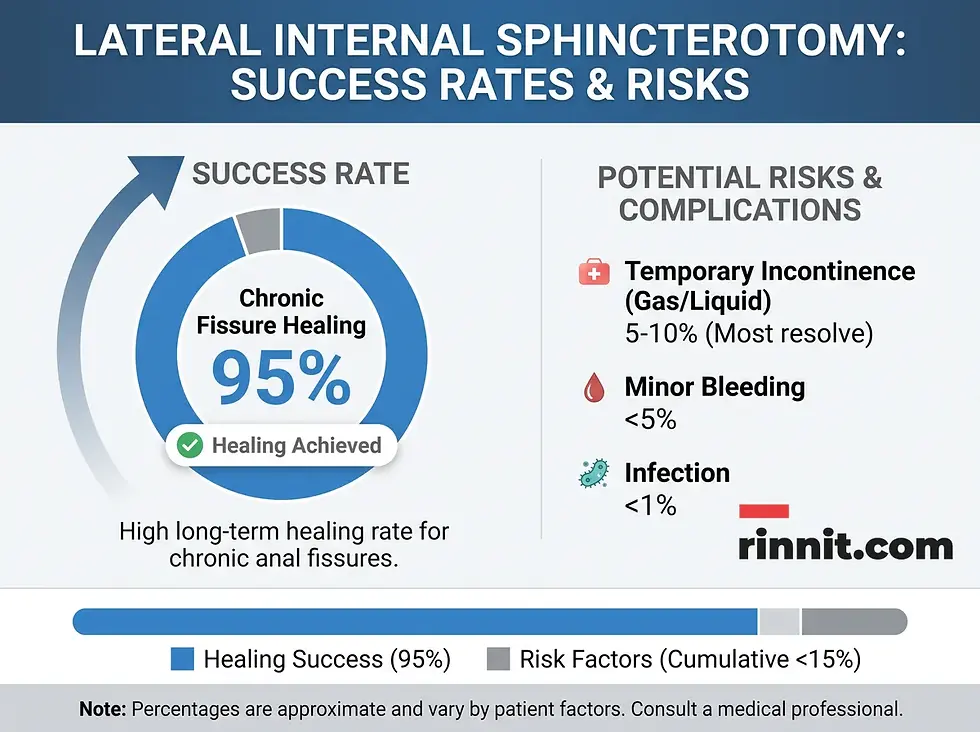
Lateral internal sphincterotomy cures about 95% of chronic anal fissures, and most complications are short-term.
Conclusion
Lateral internal sphincterotomy remains a highly effective and definitive solution for individuals suffering from the debilitating pain of chronic anal fissures. By addressing the root cause of the non-healing wound—excessive muscle tension—the procedure provides a clear path to recovery and long-term comfort. If you have been struggling with a fissure for more than eight weeks, consult with a colorectal specialist to determine if this gold-standard treatment is appropriate for you.
Frequently Asked Questions
How does a sphincterotomy differ from a fissurectomy?
A sphincterotomy involves cutting the sphincter muscle to relieve tension, while a fissurectomy involves cutting out the scar tissue of the fissure itself without necessarily cutting the muscle.
Is a sphincterotomy considered major surgery?
A sphincterotomy is a surgical procedure but is typically performed as a minor outpatient operation, allowing patients to return home the same day.
What is the success rate for this procedure?
Lateral internal sphincterotomy has a very high success rate, with approximately 95% of patients achieving a complete cure of their chronic fissure.
How long does the surgery take?
The procedure itself usually takes about 30 minutes, although the total time spent at the surgical center is typically two to three hours.
When can I return to work after surgery?
Most patients can return to work and normal activities within one to two weeks, depending on the physical nature of their job.
Will I experience incontinence after the procedure?
Minor short-term leakage of gas or stool can occur during recovery. Long-term changes are usually mild, such as trouble holding gas or slight soiling; in one large review about 14% had some change, but loss of control of solid stool affected under 1%.
How do I manage pain after a sphincterotomy?
Post-operative pain is usually managed with prescribed pain relievers, sitz baths, and stool softeners to ensure easy bowel movements.
Is the procedure performed under general anesthesia?
Most patients receive general anesthesia, though other options like local or regional anesthesia can be discussed with the healthcare provider.
What are the signs of infection to watch for?
Contact your doctor if you experience fever, excessive redness, swelling, or foul-smelling discharge from the surgical site.
Can a fissure come back after surgery?
Recurrence is rare but can happen if the wound does not heal properly or if there are other underlying digestive conditions.
How do I prepare for a lateral internal sphincterotomy?
It's an outpatient procedure, so you can go home the same day, but you'll need someone else to drive you. [1] The anesthesia used during surgery makes it unsafe for you to drive; most people have general anesthesia, though you can discuss other options with your provider. [1]
When should I call my doctor after a lateral internal sphincterotomy?
Contact your provider if you have signs of infection, such as fever, redness or swelling, or excessive rectal bleeding or foul discharge like pus. [1] Also call for anal pain that medicine doesn't relieve, or difficulty peeing (urinary retention). [1]
Related Reading
Sitz Bath: How to Take One, Benefits and Uses explains how a warm sitz bath eases pain and helps healing.
References
Cleveland Clinic. Lateral Internal Sphincterotomy. Cleveland Clinic. January 10, 2024. https://my.clevelandclinic.org/health/procedures/lateral-internal-sphincterotomy
Nelson RL, Thomas K, Morgan J, et al. Non surgical therapy for anal fissure. Cochrane Database Syst Rev. 2012;(2):CD003431. PMID: 22336789. DOI: https://doi.org/10.1002/14651858.CD003431.pub3
Garg P, Garg M, Menon GR. Long-term continence disturbance after lateral internal sphincterotomy for chronic anal fissure: a systematic review and meta-analysis. Colorectal Dis. 2013;15(3):e104-e117. PMID: 23320551. DOI: https://doi.org/10.1111/codi.12108
Medical disclaimer
This article is for informational purposes only and is not a substitute for professional medical advice, diagnosis, or treatment. The clinical information in this guide reflects source material last reviewed in January 2024.



Comments