Knee Brace: Types, Uses and How to Wear One

Updated: 2 days ago
Written and medically reviewed by Dr. Baraa Alnahhal, MD · Last reviewed: November 2026 · How we review
Quick Answer
A knee brace is a medical device that stabilizes and supports the knee, often after an injury or surgery. Braces are used for knee sprains, ligament injuries, kneecap problems, tendinitis and knee arthritis. A brace should feel snug but not tight and shouldn't hurt. See a provider first so you get the right type.
What the research says
Soft braces eased knee arthritis pain: a meta-analysis of 11 studies in knee osteoarthritis found wearing a soft brace gave a moderate improvement in pain compared with standard care and a small to moderate gain in function (Cudejko T et al., Archives of Physical Medicine and Rehabilitation, 2018) [2]
Bracing after ACL surgery didn't add much: a meta-analysis of 11 studies with 785 patients after ACL reconstruction found wearing a brace didn't significantly improve knee function, pain or stability (Lin Q et al., Knee Surgery, Sports Traumatology, Arthroscopy, 2025) [3]
Key takeaways
A knee brace stabilizes and supports the knee.
Types include unloader, patellofemoral, immobilizer, functional, prophylactic and sleeves.
Unloader braces are most common for arthritis.
A brace should feel snug, not painful.
See a provider to choose the right brace.
What is a knee brace?
Knee braces are also called orthoses. Most are made of stiff plastic or metal with cushions and straps. Some are sold over the counter, others need a prescription, and some are custom-fitted. Knee sleeves are sometimes called compression sleeves, but they aren't true braces. Sources: [1]
Why they're used
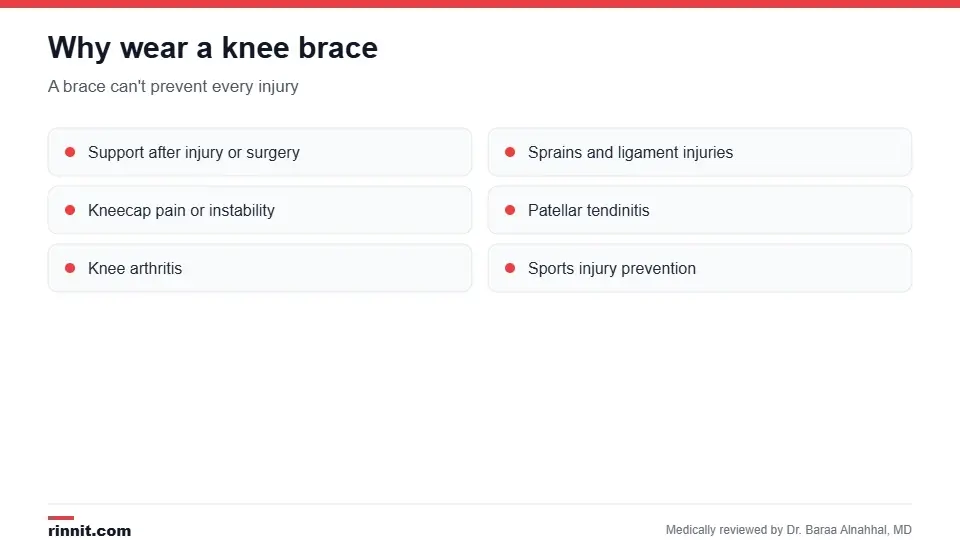
A brace can't prevent every injury.
Support after injury or surgery.
Knee sprains or ligament injuries, such as an ACL tear.
Joint hypermobility or Ehlers-Danlos syndrome.
Lowering the risk of sports injuries. Sources: [1]
Types of knee braces
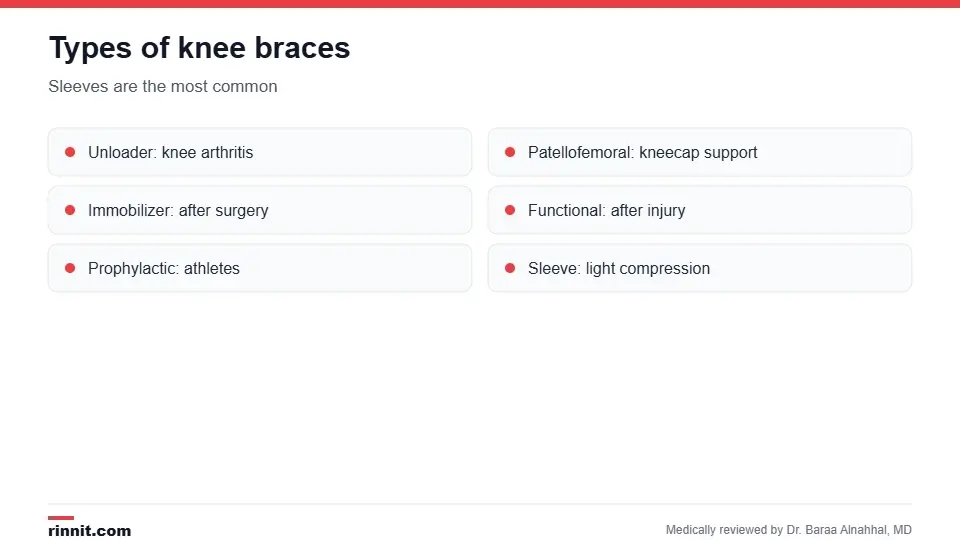
Knee sleeves are the most common type people wear.
Type | Used for |
Unloader | Knee arthritis; shifts pressure off the knee |
Patellofemoral | Supports the kneecap and front of the knee |
Knee immobilizer | Surgical recovery; limits movement |
Functional | After injury; limits sudden movement |
Prophylactic | Athletes, especially in contact sports |
Knee sleeve | Light compression; the most common type worn |
Sources: [1]
How to wear a knee brace
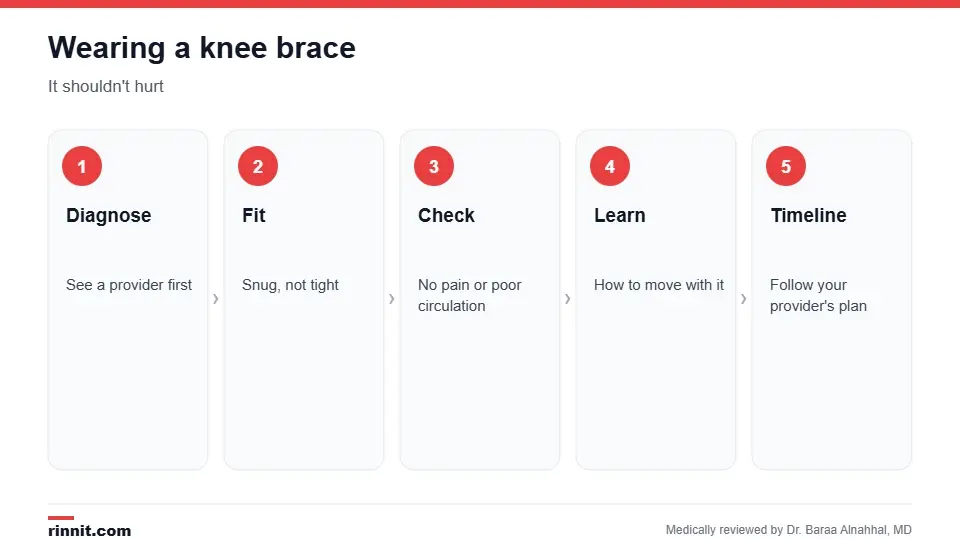
It may feel strange at first, but it shouldn't hurt.
See a provider before buying one so your injury is diagnosed.
Fasten the straps snug but not tight.
It shouldn't hurt or cut off circulation.
Ask your provider or physical therapist how to put it on and move with it.
It may feel strange at first, but pain shouldn't start or get worse. Sources: [1]
How long to wear it
It depends on why you need it. Some people wear a brace only during activity or sports; others wear it all the time. Your provider will tell you when it's safe to go without. Sources: [1, 3]
Risks
Skin irritation.
Pressure sores.
Nerve compression. Sources: [1]
These are rare. A brace can't prevent every injury. Sources: [1]
Benefits
A knee brace may relieve pain and stiffness, help your knee heal safely and boost your confidence. Many people with knee arthritis report relief. Sources: [1, 2]
When to call your provider
Severe pain or new or worsening knee pain.
Worsening swelling.
Discoloration or bruising.
Tingling or numbness.
You can't move your knee or leg. Sources: [1]
Conclusion
The right knee brace can support healing, ease arthritis pain and help you stay active. Getting a diagnosis first ensures you choose a brace that fits your needs.
Keep learning: read about knee osteoarthritis and knee pain.
Frequently asked questions
What is a knee brace?
A device that stabilizes and supports the knee.
What types of knee braces are there?
Unloader, patellofemoral, immobilizer, functional, prophylactic and sleeves.
Which brace is best for knee arthritis?
Unloader braces are most common for arthritis.
Is a knee sleeve a brace?
Not exactly; it gives light compression.
How tight should a knee brace be?
Snug but not tight.
Should a knee brace hurt?
No.
How long should I wear a knee brace?
Your provider will give you a timeline.
Can a knee brace prevent injuries?
It may lower risk but can't prevent every injury.
Do I need a brace after ACL surgery?
Studies show bracing after ACL surgery adds little benefit.
What are the risks?
Rarely, skin irritation, pressure sores or nerve compression.
Related Reading
What is Knee Osteoarthritis? a common reason for knee braces.
Knee Pain: Symptoms, Causes, Diagnosis, and Treatment Guide causes of knee pain.
ACL Tear: What It Is, How It Happens, and How It Is Treated a knee ligament injury.
Patellar Instability: Symptoms, Causes, and Treatment an unstable kneecap.
The Knee Joint: Anatomy, Function, and Common Injuries how the knee works.
References
Cleveland Clinic. Knee Braces, Sleeves & Support: Types & How To Use. Cleveland Clinic. Last updated August 1, 2025. https://my.clevelandclinic.org/health/treatments/21034-knee-brace
Cudejko T, van der Esch M, van der Leeden M, et al. Effect of soft braces on pain and physical function in patients with knee osteoarthritis: systematic review with meta-analyses. Arch Phys Med Rehabil. 2018;99(1):153-163. PMID 28687317. https://doi.org/10.1016/j.apmr.2017.04.029
Lin Q, Li Z, Li M, et al. Effects of postoperative knee bracing on knee function and stability after anterior cruciate ligament reconstruction: a systematic review and meta-analysis. Knee Surg Sports Traumatol Arthrosc. 2025;33(12):4398-4411. PMID 41144771. https://doi.org/10.1002/ksa.70098
Medical disclaimer
This article is for general education only and does not replace advice from a qualified healthcare professional. Talk to your doctor about your own diagnosis and treatment, and seek emergency care right away for severe or sudden symptoms.



Comments