Patellar Tendinitis (Jumper's Knee): Symptoms, Causes, and Treatment Options

Updated: 3 days ago
Medically reviewed by Dr. Baraa Alnahhal, MD · Last reviewed: October 2026
Patellar tendinitis, also called jumper's knee, is an overuse injury of the tendon that connects the kneecap to the shinbone. It is most common in athletes in jumping sports such as basketball and volleyball, but anyone can get it. Pain starts below the kneecap during jumping or after hard workouts and can worsen until it affects daily activities like climbing stairs. Treatment usually starts with physical therapy, ice, rest from painful activities, and over-the-counter pain relievers, and surgery is rarely needed [1] [2].
Quick Answer
Patellar tendinitis, or jumper's knee, is caused by repeated stress on the patellar tendon that creates tiny tears faster than it can recover. It causes pain just below the kneecap, first during jumping and later with everyday movement. Most people recover with physical therapy, ice, activity changes and pain relievers. See a professional if pain worsens. [1] [2]
What the research says
Progressive tendon loading beat eccentric exercise in a randomized trial. In 76 patients with ultrasound-confirmed patellar tendinopathy, VISA-P scores improved by 28 points with progressive tendon-loading exercises versus 18 points with eccentric exercises at 24 weeks (adjusted difference 9 points, 95% CI 1-16); return-to-sport rates were 43% versus 27%, a difference that was not statistically significant (Breda et al., Br J Sports Med, 2021).
Exercise with load management helps pain, function, and strength. A systematic review of 12 clinical trials concluded that therapeutic exercise combined with load monitoring significantly improved function, pain, and strength, with benefits that lasted over time, although all studies carried a moderate risk of bias (Núñez-Martínez & Hernández-Guillen, J Sport Rehabil, 2022).
Evidence for platelet-rich plasma (PRP) is still early. In a randomized trial of 33 athletes, both PRP alone and PRP plus shockwave therapy improved pain and function over 12 months, and the combination reduced pain faster at 1 month; the trial compared two PRP approaches and had no non-PRP comparison group (Jhan et al., Knee Surg Relat Res, 2024).
Research summaries are based on article abstracts retrieved from PubMed.
What Is Patellar Tendinitis?
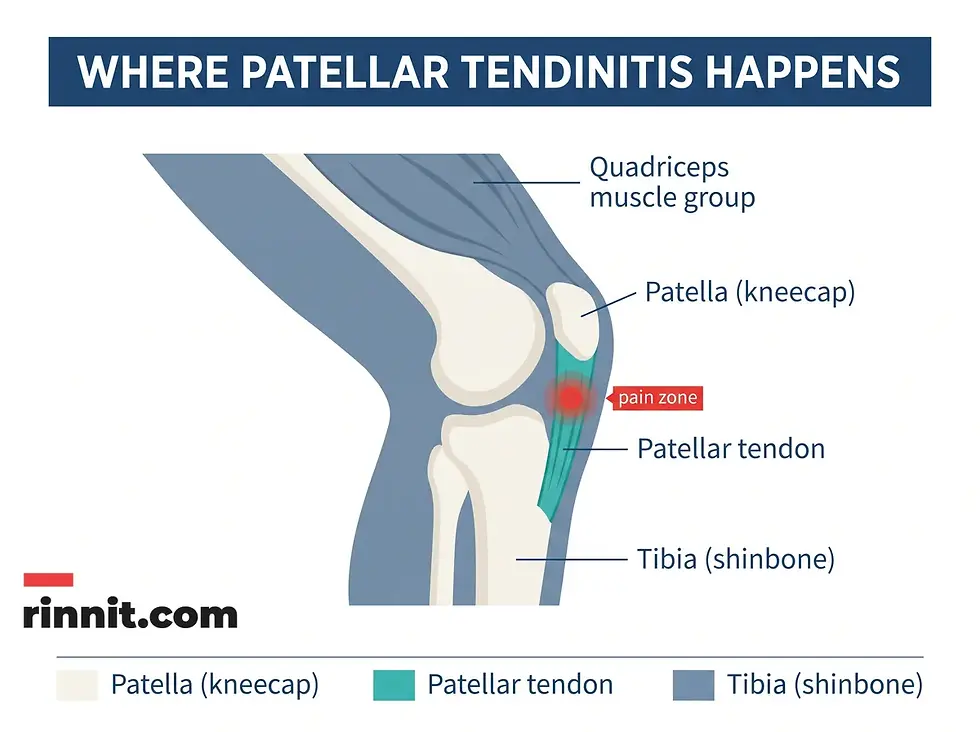
Patellar tendinitis is an injury to the tendon that joins the kneecap (patella) to the shinbone (tibia). The patellar tendon works with the muscles at the front of the thigh to straighten the knee. The condition is also called jumper's knee because it is most common in athletes whose sports involve a lot of jumping, but people who do not play jumping sports can get it too. For most people, treatment begins with physical therapy to strengthen the quadriceps muscles that straighten the knee [1].
What are the symptoms of patellar tendinitis (jumper's knee)?
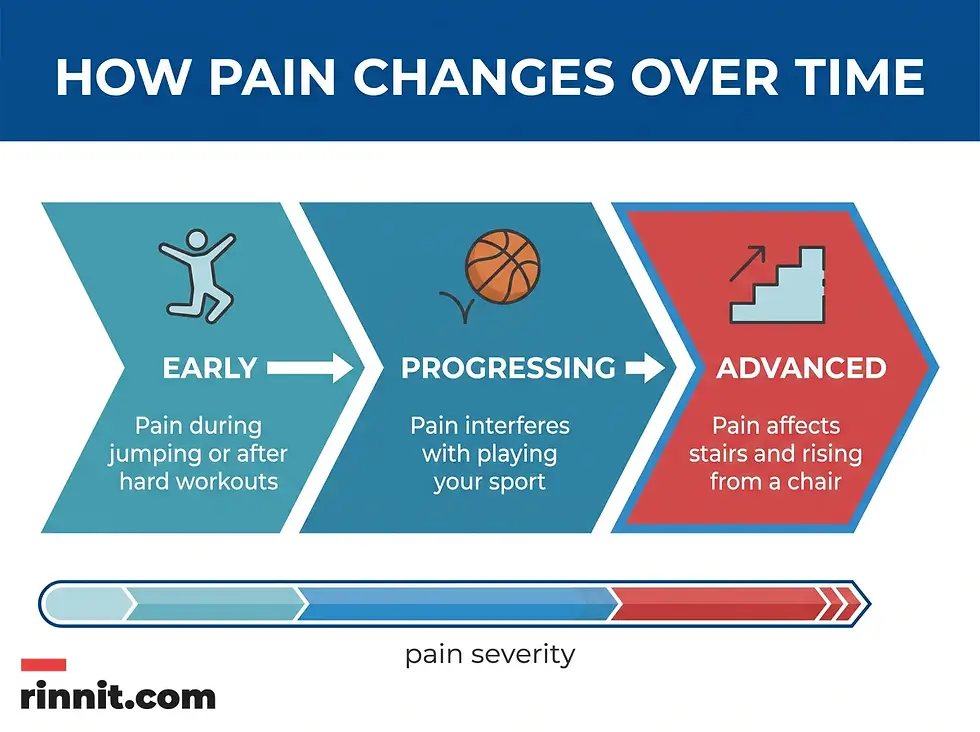
Pain is the first symptom, and it is usually located between the kneecap and the point where the tendon attaches to the tibia. At first you may feel it when jumping, as you start an activity, or just after a hard workout. Over time it can get in the way of your sport and eventually affect daily movements such as climbing stairs or rising from a chair [1].
Stage | What You Feel |
Early | Pain during jumping, when starting an activity, or just after a hard workout |
Progressing | Pain worsens and begins to interfere with playing your sport |
Advanced | Pain affects daily movements like climbing stairs or rising from a chair |
When to See a Doctor
For knee pain, try self-care first: ice the area and reduce or avoid the activities that cause your symptoms for a time. Call your healthcare professional if your pain:
Continues or gets worse.
Keeps you from doing your daily activities.
Is linked to swelling or redness around the knee joint.
What Causes Patellar Tendinitis?
Patellar tendinitis is a common overuse injury. Repeated stress on the patellar tendon creates tiny tears. If the tendon does not get enough time to recover, it weakens, and the body's attempt to heal the damage thickens the tendon [1]. This is why both rest and gradual strengthening matter: the tendon needs time to heal and needs to be rebuilt stronger than before.
Who Is at Risk?
Several factors can combine to cause patellar tendinitis [1]:
Risk Factor | Details |
Male sex | People assigned male at birth are more likely to develop the condition |
High-impact training | More than 20 hours a week of running or jumping, or sudden increases in intensity or frequency |
Tight thigh muscles | Tight quadriceps or hamstrings increase strain on the tendon |
Muscle imbalance | Much stronger muscles on one side pull unevenly on the tendon |
Chronic illness | Kidney failure, lupus, rheumatoid arthritis, and diabetes can reduce blood flow to the knee and weaken the tendon |
Can It Cause Complications?
Working through the pain can cause more and larger tears in the tendon, and rarely the tendon can rupture. Patellar tendinitis can also keep athletes from returning to their sport, which is why early treatment matters [1].
How Is Patellar Tendinitis Diagnosed?
Patellar tendinitis is diagnosed with a physical exam in which a healthcare professional presses on parts of the knee to find where it hurts. The pain is often on the front of the knee, just below the kneecap. Imaging is not always needed, but one or more of these tests may be suggested [2]:
Test | What It Shows |
Physical exam | Pain location, usually the front of the knee below the kneecap |
X-ray | Helps rule out other bone problems that can cause knee pain |
Ultrasound | Sound waves can show tears in the patellar tendon |
MRI | Detailed images that can show small changes in the patellar tendon |
What are the treatment options for patellar tendinitis?
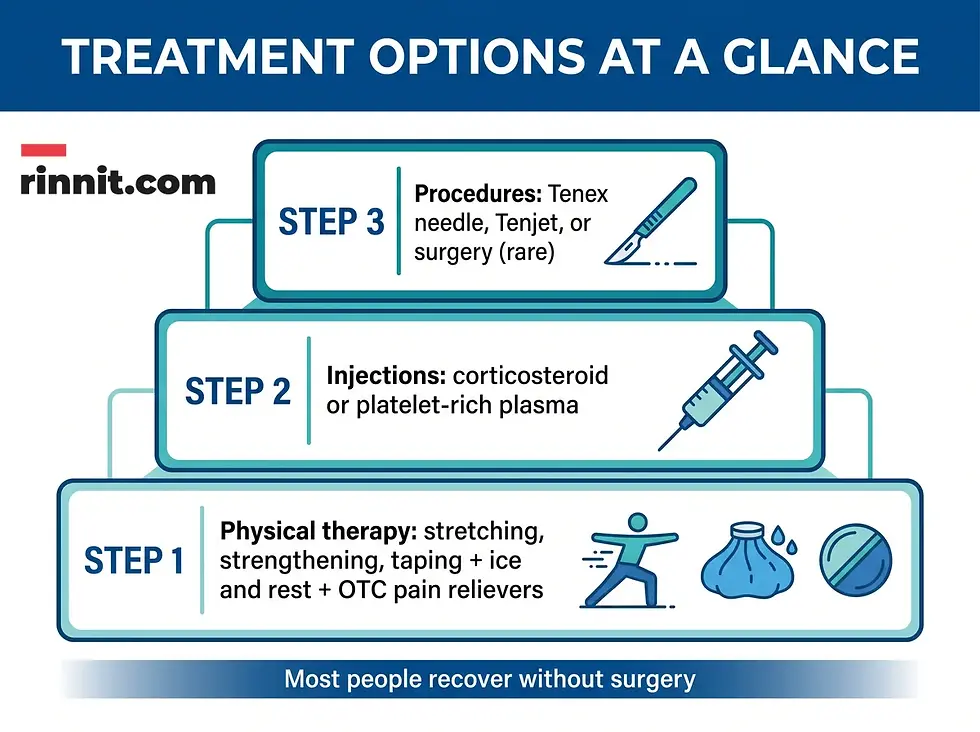
Patellar tendinitis rarely needs surgery, and physical therapy is the cornerstone of treatment. Treatment often starts with limiting the activities that cause pain, combined with some of the following [2]:
Treatment | What It Involves | When It Is Used |
Medicines | Ibuprofen or naproxen sodium | Short-term pain relief |
Stretching | Regular, steady quadriceps stretching | Lengthens the muscle and tendon |
Strengthening | Gradually increasing load on the tendon | Builds strength to protect the tendon |
Strapping or taping | Tape applied over the tendon | Takes pressure off the tendon and may relieve pain |
Iontophoresis | A steroid pushed through the skin with a low electrical charge | Part of physical therapy |
Corticosteroid shot | Injection into the sheath around the tendon, sometimes ultrasound-guided | When other treatments fail; used with care because it can weaken tendons |
Platelet-rich plasma (PRP) | An injection tried in chronic cases | Studies are ongoing |
Tenex or Tenjet | An oscillating needle or water jet removes damaged tissue in an outpatient procedure | Both need more study but results have shown promise |
Surgery | Debridement, which removes damaged tissue from the tendon | Rarely, if other treatments fail |
Physical therapy is the cornerstone of treatment. Stretching lengthens the muscle and tendon, while exercises that increase the load on the tendon little by little build the strength to protect it [2] [3].
Which self-care steps help patellar tendinitis at home?
Self-care for patellar tendinitis at home includes over-the-counter pain relievers, avoiding movements that cause pain and applying ice after painful activity.
Pain relievers: over-the-counter ibuprofen or naproxen sodium can give short-term relief, and creams or gels applied to the skin can work as well with fewer side effects [2].
Avoid movements that cause pain: practice your sport less often or switch to a lower-impact sport for a time. Working through the pain can cause more damage to the tendon [2].
Ice: apply ice after activity that causes pain. Wrap a bag of ice in a towel, or try an ice massage by freezing water in a plastic foam cup and holding the cup against your skin [2].
How can patellar tendinitis be prevented?
Prevention Step | How It Helps |
Do not play through pain | As soon as knee pain appears, rest and ice the area and avoid stressing the tendon until it is pain-free |
Strengthen your muscles | Strong front-of-the-thigh muscles handle stress better; an example is slowly lowering a straight leg to a bent knee position while seated |
Improve your form | Good technique reduces unnecessary strain; get help from a professional when starting a new sport or using new equipment |
These steps follow Mayo Clinic's prevention advice [1].
How should you prepare for a patellar tendinitis appointment?
See a healthcare professional about patellar tendinitis if knee pain during or after activity doesn't improve with ice or rest, and bring details about your symptoms, activity and medicines. It helps to bring [2]:
Your symptoms and when they began.
Your medical conditions, plus medicines, vitamins, and supplements with doses.
Your typical activity, including how long and hard you exercise and any recent changes in activity or equipment such as running shoes.
Any recent injuries that may have damaged your knee joint.
Questions to ask, such as: What is the most likely cause? What tests do I need? What treatment do you suggest? Will I be able to return to my sport, and how long will treatment take? Should I see a specialist?
Expect to be asked whether your symptoms are getting worse, which activities cause pain, how bad the pain is, whether it occurs before, during, or after workouts, whether your knee swells, locks, or buckles, and which at-home treatments you have tried.
Conclusion
Patellar tendinitis is a common overuse injury, but it is one of the more manageable ones when caught early. The key mistake to avoid is playing through the pain, which can cause larger tears and, rarely, tendon rupture. Most people rebuild tendon strength through gradual loading exercises and return to their activities [1] [2].
If knee pain does not improve with ice and rest, or if it worsens or comes with swelling or redness, see a healthcare professional. Early diagnosis and the right physical therapy program give you the best chance of a full recovery.
Frequently Asked Questions
What is patellar tendinitis?
Patellar tendinitis is an injury to the tendon that connects the kneecap to the shinbone. It is called jumper's knee because it is most common in athletes who jump a lot, such as basketball and volleyball players [1].
Where does patellar tendinitis pain usually occur?
Most often on the front of the knee, between the kneecap and where the tendon joins the shinbone, just below the kneecap [1].
What causes patellar tendinitis?
Patellar tendinitis is an overuse injury. Repeated stress creates tiny tears in the tendon, and without enough recovery time the tendon weakens and the body's healing response thickens it [1].
Is surgery needed for patellar tendinitis?
Rarely. Treatment usually starts with limiting painful activities, physical therapy, ice, and over-the-counter pain relievers [2].
What exercises help treat patellar tendinitis?
Stretching lengthens the quadriceps muscle and tendon, and progressive strengthening builds the tendon's ability to handle load. In a 24-week randomized trial of 76 patients, progressive tendon-loading exercises improved VISA-P scores more than eccentric exercises alone [2] [3].
How do I ice my knee for patellar tendinitis?
Apply ice after pain-causing activity. Put ice in a plastic bag and wrap it in a towel, or do an ice massage with water frozen in a plastic foam cup held against the skin [2].
Can I still play sports with patellar tendinitis?
You may need to practice less often or switch to a lower-impact sport for a time. Working through the pain can damage the tendon further, so pain-free activity is the goal [2].
What is the Tenex procedure?
Tenex is an outpatient procedure done with local numbing medicine. Ultrasound guides a small oscillating needle that cuts away damaged tendon tissue while sparing healthy tendon. It needs more study, but results have shown promise [2].
What is platelet-rich plasma (PRP) for patellar tendinitis?
PRP is an injection that has been tried in people with chronic patellar tendon problems. Studies are ongoing, and the hope is that it will help heal the tendon [2] [5].
How do I prevent patellar tendinitis?
Do not play through pain, strengthen your thigh muscles, and use good form. Seek professional guidance when starting a new sport or using new equipment [1].
When should I see a doctor about knee pain?
See a healthcare professional if the pain continues or gets worse, keeps you from daily activities, or comes with swelling or redness around the knee [1].
Related Articles
Explore more health guides on our site:
External Resources
For authoritative information, see:
References
Mayo Clinic Staff. Patellar tendinitis: Symptoms and causes. Mayo Clinic. June 17, 2025. https://www.mayoclinic.org/diseases-conditions/patellar-tendinitis/symptoms-causes/syc-20376113
Mayo Clinic Staff. Patellar tendinitis: Diagnosis and treatment. Mayo Clinic. June 17, 2025. https://www.mayoclinic.org/diseases-conditions/patellar-tendinitis/diagnosis-treatment/drc-20376118
Breda SJ, Oei EHG, Zwerver J, Visser E, Waarsing E, Krestin GP, de Vos RJ. Effectiveness of progressive tendon-loading exercise therapy in patients with patellar tendinopathy: a randomised clinical trial. Br J Sports Med. 2021;55(9):501-509. PMID: 33219115. doi:10.1136/bjsports-2020-103403
Núñez-Martínez P, Hernández-Guillen D. Management of patellar tendinopathy through monitoring, load control, and therapeutic exercise: a systematic review. J Sport Rehabil. 2022;31(3):337-350. PMID: 34942594. doi:10.1123/jsr.2021-0117
Jhan SW, Wu KT, Chou WY, Chen PC, Wang CJ, Huang WC, Cheng JH. A comparative analysis of platelet-rich plasma alone versus combined with extracorporeal shockwave therapy in athletes with patellar tendinopathy and knee pain: a randomized controlled trial. Knee Surg Relat Res. 2024;36(1):47. PMID: 39690426. doi:10.1186/s43019-024-00252-3
Medical disclaimer
This article is for informational purposes only and is not a substitute for professional medical advice, diagnosis, or treatment. Always seek the advice of your physician or other qualified health provider with any questions you may have about a medical condition.



Comments