Kawasaki Disease: Symptoms, Causes, Diagnosis, and Treatment for Children

Updated: 2 days ago
Medically reviewed by Dr. Baraa Alnahhal, MD · Last reviewed: October 17, 2026
Kawasaki disease is an inflammatory illness of childhood that affects small and medium blood vessels, most often the arteries of the heart. It causes a fever lasting five or more days plus signs such as red eyes, a red swollen tongue, rash and peeling skin, and early treatment greatly lowers the chance of lasting heart damage [1].
Quick Answer: What is Kawasaki disease?
Kawasaki disease is a childhood illness that inflames blood vessels, especially the heart's arteries, typically in children under 5. It causes a fever above 100.4°F lasting five or more days plus signs like red eyes, rash and swollen hands. Treatment with gamma globulin and aspirin, ideally within 10 days, lowers heart damage risk, and most children recover within weeks. [1] [2]
What the research says
Untreated, about 1 in 4 children develops heart artery aneurysms. An American Heart Association scientific statement reports that Kawasaki disease leads to coronary artery aneurysms in roughly 25% of untreated cases and is the leading cause of acquired heart disease in children in developed countries. Intravenous immune globulin (gamma globulin) is the mainstay of initial treatment, about 10% to 20% of patients do not respond to the first dose and need additional therapy, and patients with aneurysms need lifelong cardiology follow-up. This is an expert evidence review rather than a single trial (McCrindle et al., Circulation, 2017 [3]).
A single large dose of gamma globulin outperformed the older four-day course. In a randomized trial of 549 children with acute Kawasaki syndrome, all given aspirin, children who received one 2 g/kg infusion had fewer coronary abnormalities two weeks later than those given four daily 400 mg/kg infusions (adjusted relative prevalence 1.94 for the four-day regimen, 95% CI 1.01 to 3.71). The single infusion also shortened fever, and adverse effects were infrequent (2.7% overall) and transient (Newburger et al., New England Journal of Medicine, 1991 [4]).
What Is Kawasaki Disease?
Kawasaki disease causes swelling (inflammation) and enlargement of small to medium blood vessels that carry blood throughout the body. It most often affects the heart arteries in children, which supply oxygen-rich blood to the heart [1].
It is sometimes called mucocutaneous lymph node syndrome because it also causes swelling in the lymph nodes and in the mucous membranes inside the mouth, nose, eyes and throat. With early treatment, most children get better and have no long-lasting problems. It is a leading cause of heart disease in children in developed countries, but with treatment few children have lasting health concerns [1].
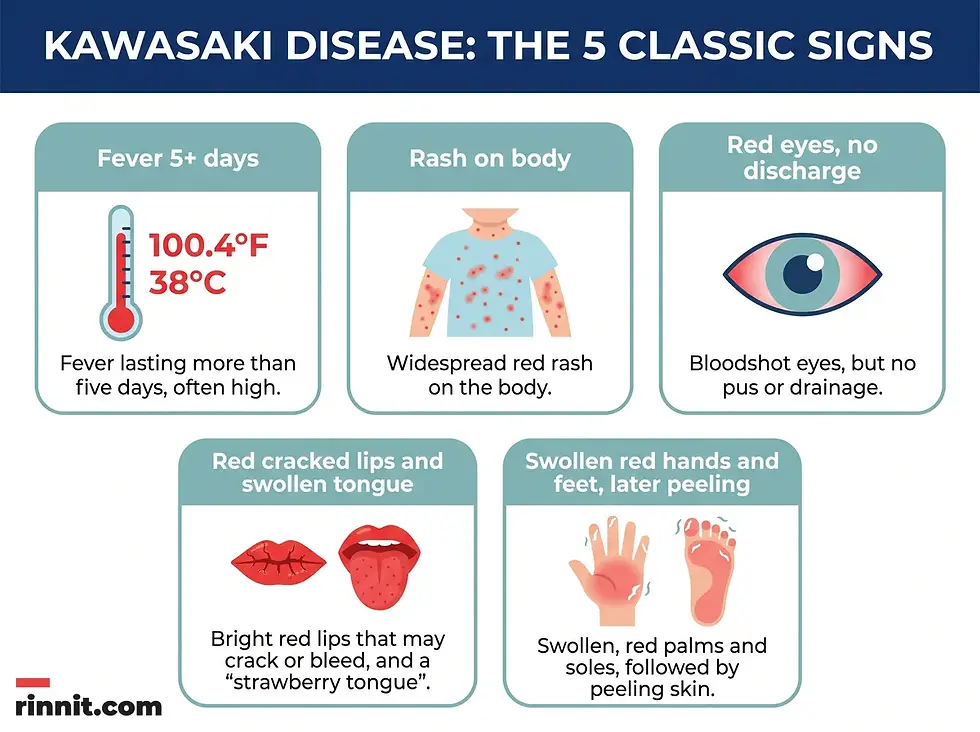
The five classic signs of Kawasaki disease in a child with a persistent fever.
What are the symptoms of Kawasaki disease?
Kawasaki disease symptoms typically include a fever greater than 100.4°F (38°C) for five or more days. Children also have at least four of the following [1]:
Symptom | What parents may notice |
Rash | On the main part of the body or in the genital area |
Neck lymph node | A swollen lymph node in the neck |
Red eyes | Very red eyes without thick discharge |
Mouth and lips | Red, dry, cracked lips and a red, swollen tongue |
Hands and feet | Swollen, red skin on the palms and soles; skin later peels on the fingers and toes |
The symptoms might not all happen at the same time. Tell your child's healthcare professional about any symptom that has gone away. Other symptoms can include belly pain, loose stools, fussiness, joint pain, vomiting, cough or runny nose, and sluggishness or sleepiness in older children [1].
Incomplete Kawasaki Disease
Some children have a high fever for five or more days but fewer than four of the symptoms needed for a diagnosis. They might have incomplete Kawasaki disease. These children are still at risk of damage to the heart arteries and still need treatment within 10 days of when symptoms appear. Kawasaki disease can also look like multisystem inflammatory syndrome in children (MIS-C), which can happen in children with COVID-19 [1].
When should you see a doctor about Kawasaki disease?
If your child has a fever that lasts more than three days, contact your child's healthcare professional. Treating Kawasaki disease within 10 days of when it begins may lower the chances of lasting damage to the arteries that supply the heart [1].
Fever duration | What it may mean | Recommended action |
1 to 2 days | Common with routine infections | Monitor and manage the fever |
More than 3 days | Needs a professional opinion | Call your child's doctor |
5 or more days with 4 or more classic signs | Possible Kawasaki disease | Seek prompt medical evaluation |
Any duration with serious signs | Chest pain, fainting or trouble breathing | Seek urgent care |
What causes Kawasaki disease?
No one knows what causes Kawasaki disease, but experts do not believe it spreads from person to person. Some think it happens after a bacterial or viral infection, or that it is linked to factors in the environment. Certain genes might make children more likely to get it [1].
Who Is at Risk?
Three things are known to raise a child's risk [1]:
Risk factor | Effect on risk |
Age under 5 | Highest risk group |
Assigned male at birth | Slightly more likely to develop it |
Asian or Pacific Islander descent | Higher rates of the disease |
Season | Most common in winter and early spring in North America and similar climates |
What are the complications of Kawasaki disease?
Heart complications include dilation or enlargement of blood vessels (most often the arteries that supply the heart), swelling of the heart muscle, and heart valve conditions. Dilation can weaken the artery and cause a bulge in the wall called an aneurysm. Aneurysms raise the risk of blood clots, which can lead to a heart attack or bleeding inside the body. Rarely, for children who get heart artery conditions, Kawasaki disease can cause death [1].
Complication | What happens | Potential outcome |
Dilation of blood vessels | Enlarged heart arteries | Weakened artery walls |
Aneurysm | Bulge in the artery wall | Higher risk of blood clots |
Heart muscle swelling | Inflamed heart muscle | Heart damage |
Heart valve conditions | Valve function affected | Long-term heart issues |
Blood clots | Can form from aneurysms | Heart attack or internal bleeding |
How is Kawasaki disease diagnosed?
Kawasaki disease cannot be confirmed with any single test, so doctors piece the diagnosis together. Diagnosis involves ruling out other diseases that cause similar symptoms [2]:
Scarlet fever, an illness caused by bacteria that affects some people who have strep throat.
Juvenile rheumatoid arthritis, the most common type of arthritis in children under 16.
Stevens-Johnson syndrome, a rare condition of the skin and mucous membranes.
Toxic shock syndrome, a rare, life-threatening complication of some bacterial infections.
Measles, a virus that spreads easily through the air.
Some tick-borne illnesses, such as Rocky Mountain spotted fever.
A member of your child's healthcare team will do an exam and order blood and urine tests, and may order heart tests [2]:
Test | What it checks | What it can show |
Blood tests | Blood cell count and inflammation | High white blood cell count, anemia and inflammation are signs of Kawasaki disease |
ECG (EKG) | The heart's electrical activity | Irregular heartbeat; Kawasaki disease can cause heart rhythm changes |
Echocardiogram | Sound-wave pictures of the heart in motion | Blood flow through the heart and valves, and changes in the heart arteries |
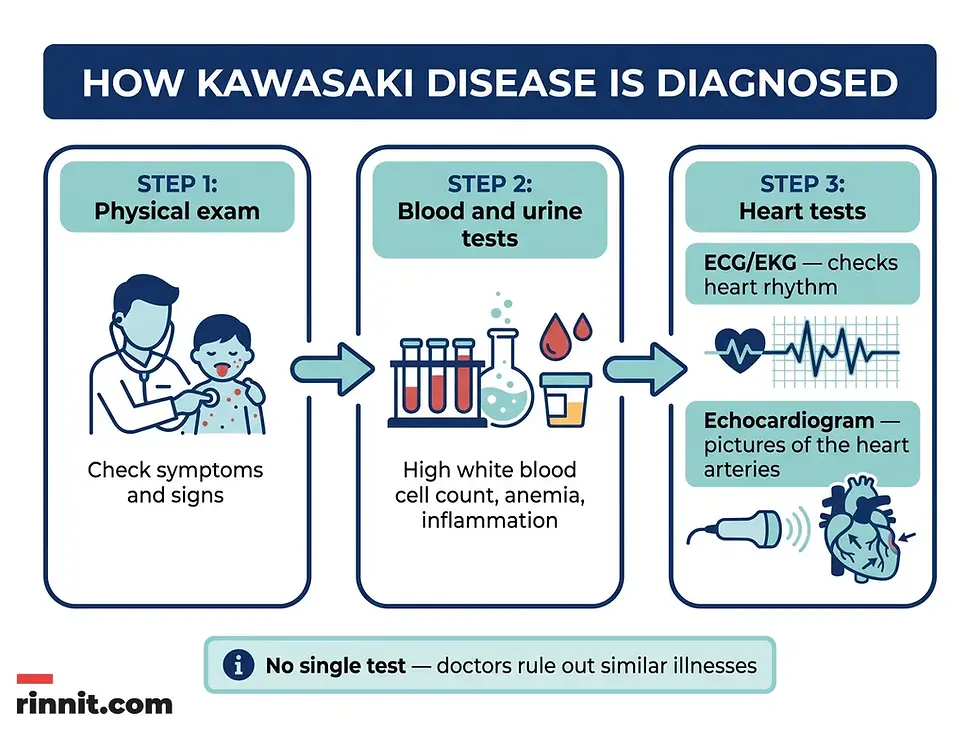
How Kawasaki disease is diagnosed: an exam, blood and urine tests, and heart tests.
What are the treatment options for Kawasaki disease?
Kawasaki disease treatment works best when started as early as possible, while your child still has a fever. Treatment often happens in a hospital, and its goals are to lower the fever, reduce swelling and prevent heart damage [2].
Gamma Globulin
This protein is given through an IV and lowers inflammation in the blood vessels, which can lower the risk of problems with the heart arteries. After gamma globulin, wait at least 11 months before a live vaccine such as chickenpox or measles, because gamma globulin can affect how well these vaccines work [2].
Aspirin
High doses of aspirin might help treat inflammation, pain, joint swelling and fever, and the dose is likely to be lowered once the fever has been gone for 48 hours. A healthcare professional must oversee aspirin for children with Kawasaki disease, and children who get flu or chickenpox during treatment might need to stop it [2].
After the First Treatment
Once the fever goes down, a child might need low-dose aspirin for at least six weeks, or longer if there are heart artery problems, to help prevent blood clotting. A child might start to improve soon after one gamma globulin treatment. Without treatment, symptoms last about 12 days, but heart complications might last longer [2].
Treatment | How it is given | What it does |
Gamma globulin | IV infusion | Lowers blood vessel inflammation and the risk of heart artery problems |
High-dose aspirin | By mouth | Treats inflammation, pain, joint swelling and fever |
Low-dose aspirin | By mouth, at least 6 weeks | Helps prevent blood clotting after the fever resolves |
Heart follow-up | Repeat testing | Monitors artery health over time |

Kawasaki disease treatment: hospital care, gamma globulin, aspirin and six weeks of low-dose aspirin.
How are heart conditions watched after Kawasaki disease?
If your child has any signs of heart conditions, the healthcare professional might suggest follow-up tests. Often, tests are done within one week after diagnosis, again 6 to 8 weeks after the illness began, and again after six months or a year, depending on the damage to the heart arteries. If heart issues last, your child might see a pediatric cardiologist, and treatment depends on the type of heart condition [2].
Follow-up timing | Purpose |
Within 1 week after diagnosis | Early check of heart health |
6 to 8 weeks after the illness began | Reassess the heart arteries |
6 months to 1 year later | Long-term check, depending on artery damage |
How can families cope with Kawasaki disease and find support?
Find out all you can about Kawasaki disease so you can help make choices about treatment with your child's healthcare team. Most children who have been treated get well within a few weeks and return to their usual activities. If your child's heart has been affected, talk with the pediatric cardiologist about whether activities need to be limited [2].
How should you prepare for a Kawasaki disease appointment?
For a Kawasaki disease appointment, you will likely first see your family healthcare professional or pediatrician. Sometimes children see doctors with special training in heart conditions (pediatric cardiologists), bone and joint disorders (rheumatologists) or infectious diseases. Bring someone with you if you can, to take notes, and make a list of [2]:
Your child's symptoms and when they began, including any that do not seem linked to Kawasaki disease, plus how high the fever has been and how long it has lasted.
All medicines, vitamins and supplements your child takes, including doses.
Questions to ask, such as: What is the most likely cause? Are there other possible causes? Does my child need tests? How long will symptoms last? What treatments do you suggest? How can I make my child more comfortable?
Your child's healthcare professional is likely to ask how bad the symptoms are, how high and how long the fever has been, what makes symptoms better or worse, whether your child has been around people with infectious diseases, and whether your child has allergies [2].
What is the bottom line on Kawasaki disease?
Kawasaki disease is frightening for any parent, but it is also one of the most treatable pediatric heart conditions when caught early. The warning signs are clear: a fever above 100.4°F that lasts five or more days, together with red eyes, a red swollen tongue, rash, and swollen hands and feet. The most important thing parents can do is act quickly, because treatment started within 10 days of symptom onset greatly lowers the chance of lasting damage to the heart arteries, and most treated children recover within a few weeks.
Your next step: if your child has a fever that lasts more than three days, contact your child's healthcare professional right away. Track the fever and symptoms carefully, keep a list of medicines and questions, and seek prompt medical evaluation.
Frequently Asked Questions
What is Kawasaki disease?
Kawasaki disease is a childhood illness that causes inflammation and enlargement of small to medium blood vessels, most often the arteries that supply the heart. It also affects lymph nodes and the mucous membranes in the mouth, nose, eyes, and throat.
What age gets Kawasaki disease?
Children under 5 years old are at the highest risk. Children assigned male at birth are slightly more likely to develop it, and children of Asian or Pacific Islander descent have higher rates.
What are the symptoms of Kawasaki disease?
The main symptom is a fever greater than 100.4°F (38°C) lasting five or more days, plus at least four signs: a body or genital rash, a swollen neck lymph node, very red eyes without thick discharge, red dry cracked lips with a red swollen tongue, and swollen red skin on the palms and soles that later peels on the fingers and toes.
Is Kawasaki disease contagious?
No. Experts do not believe Kawasaki disease spreads from person to person. Some think it happens after a bacterial or viral infection, or that it is linked to environmental factors.
What is incomplete Kawasaki disease?
Incomplete Kawasaki disease is when a child has a high fever for five or more days but fewer than four of the symptoms needed for a full diagnosis. These children are still at risk of heart artery damage and still need treatment within 10 days of when symptoms appear.
How is Kawasaki disease diagnosed?
There is no single test. Doctors rule out similar conditions such as scarlet fever, juvenile rheumatoid arthritis, measles, and Stevens-Johnson syndrome, and order blood tests, an ECG to check heart rhythm, and an echocardiogram to look for changes in the heart arteries.
How is Kawasaki disease treated?
Treatment, often in a hospital, includes gamma globulin given through an IV to lower blood vessel inflammation, and high-dose aspirin to treat inflammation and fever. Low-dose aspirin is usually continued for at least six weeks to prevent blood clotting.
Can Kawasaki disease damage the heart?
Yes, which is why early treatment matters. It can enlarge the heart arteries, swell the heart muscle, or affect the heart valves, and enlarged arteries can form aneurysms that raise the risk of blood clots. With treatment, however, few children have lasting heart problems.
How long does Kawasaki disease last?
Without treatment, symptoms last about 12 days. With treatment, most children start to improve soon after one gamma globulin treatment and get well within a few weeks. Heart complications, if they occur, might last longer.
When should I take my child to the doctor for a fever?
Contact your child's healthcare professional if a fever lasts more than three days. Treating Kawasaki disease within 10 days of when it begins may lower the chances of lasting damage to the arteries that supply the heart.
Can my child get vaccinated after Kawasaki disease treatment?
After receiving gamma globulin, wait at least 11 months to get a live vaccine, such as the chickenpox or measles vaccine, because gamma globulin can affect how well these vaccines work.
Related Articles
External Resources
References
Mayo Clinic Staff. Kawasaki disease: symptoms and causes. Mayo Clinic. June 12, 2026. https://www.mayoclinic.org/diseases-conditions/kawasaki-disease/symptoms-causes/syc-20354598
Mayo Clinic Staff. Kawasaki disease: diagnosis and treatment. Mayo Clinic. June 12, 2026. https://www.mayoclinic.org/diseases-conditions/kawasaki-disease/diagnosis-treatment/drc-20354603
McCrindle BW, Rowley AH, Newburger JW, et al. Diagnosis, treatment, and long-term management of Kawasaki disease: a scientific statement for health professionals from the American Heart Association. Circulation. 2017;135(17):e927-e999. PMID 28356445. https://doi.org/10.1161/CIR.0000000000000484
Newburger JW, Takahashi M, Beiser AS, et al. A single intravenous infusion of gamma globulin as compared with four infusions in the treatment of acute Kawasaki syndrome. New England Journal of Medicine. 1991;324(23):1633-1639. PMID 1709446. https://doi.org/10.1056/NEJM199106063242305
Medical disclaimer
This article is for informational purposes only and is not a substitute for professional medical advice, diagnosis, or treatment. The clinical information in this guide reflects source material last reviewed in June 2026.



Comments