Impetigo: Symptoms, Causes, and Treatment — A Complete Guide

Updated: 2 days ago
Medically reviewed by Dr. Baraa Alnahhal, MD · Last reviewed: October 2026
Impetigo is a common, highly contagious skin infection that mainly affects infants and young children, especially ages 2 to 5. It starts as reddish sores around the nose and mouth that burst and form honey-colored crusts, and it is usually treated with a prescription antibiotic ointment [1].
Quick Answer: What is impetigo?
Impetigo is a contagious bacterial skin infection, usually caused by staphylococci, that mainly affects infants and young children. Reddish sores around the nose and mouth rupture and form honey-colored crusts. Treatment is usually prescription mupirocin ointment for five to 10 days, or oral antibiotics for wider cases. Children should stay home until 24 hours after starting antibiotics. [1] [2]
What the research says
Topical antibiotics beat placebo, and mupirocin and fusidic acid work about equally well. A Cochrane review of 68 randomized trials (5,578 participants) found better cure rates with topical antibiotics than placebo (pooled risk ratio 2.24, 95% CI 1.61 to 3.13, from 6 studies with 575 participants). There was no clear difference between mupirocin and fusidic acid (RR 1.03), mupirocin was slightly better than oral erythromycin (RR 1.07), and there was a lack of evidence for disinfectant solutions. Side effects were mostly mild and more common with oral antibiotics (Koning et al., Cochrane Database of Systematic Reviews, 2012 [3]).
Impetigo is very common worldwide. A systematic review of 89 studies (82 of them with population data on 145,028 children) found a median childhood prevalence of 12.3%, and estimated that more than 162 million children have impetigo at any one time, mostly in tropical, resource-poor settings (Bowen et al., PLoS ONE, 2015 [4]).
Antibiotic resistance is a growing concern, and evidence for newer options is limited. A systematic review of 10 studies (6,651 participants) found limited recent evidence supporting topical ozenoxacin or retapamulin in non-endemic settings, and called for careful antibiotic use because of troubling increases in resistance to existing treatments (Gahlawat et al., Clinical Therapeutics, 2021 [5]).
What Is Impetigo?
Impetigo (im-puh-TIE-go) is a common and highly contagious skin infection that mainly affects infants and young children. It usually appears as reddish sores on the face, especially around the nose and mouth, and on the hands and feet. Over about a week, the sores burst and develop honey-colored crusts [1].
Treatment with antibiotics can limit the spread of impetigo to others. Children should be kept home from school or daycare until they are no longer contagious, which is usually 24 hours after beginning antibiotic treatment [1].
Key fact | Detail |
Who it affects most | Infants and young children, especially ages 2 to 5 |
Typical locations | Face (especially around the nose and mouth), hands, and feet |
Hallmark sign | Reddish sores that burst and form honey-colored crusts |
How it spreads | Direct contact with sores or contaminated items such as clothing, towels, and toys |
Standard treatment | Prescription antibiotic ointment applied for 5 to 10 days |
Return to school or daycare | Usually 24 hours after starting antibiotic treatment |

What impetigo is: common in ages 2 to 5, honey-colored crusts over about a week, sores on the face, hands and feet, and spread through touch, clothing and towels.
Impetigo Symptoms
The main symptom of impetigo is reddish sores, often around the nose and mouth. The sores quickly rupture, ooze for a few days, and then form a honey-colored crust. Sores can spread to other areas of the body through touch, clothing, and towels. Itching and soreness are generally mild [1].
There are two other forms worth knowing about. A less common form called bullous impetigo causes larger blisters on the trunk, arms and legs of infants and young children. A more serious form called ecthyma penetrates deeper into the skin and causes painful fluid- or pus-filled sores that turn into deep ulcers [1].
Form of impetigo | Who it affects | What it looks like |
Common (nonbullous) impetigo | Infants and young children | Reddish sores around the nose and mouth that rupture and form honey-colored crusts |
Bullous impetigo | Mostly children younger than 2 | Larger fluid-filled blisters on the trunk, arms, and legs |
Ecthyma | Anyone with a more serious infection | Deep, painful fluid- or pus-filled sores that become ulcers |

The three forms of impetigo: common crusted sores, bullous blisters, and deeper ecthyma ulcers.
When to See a Doctor
If you suspect that you or your child has impetigo, consult your family doctor, your child's pediatrician, or a dermatologist. A clinician can confirm the diagnosis and prescribe the right antibiotic treatment [1].
Seek care promptly rather than waiting, because early antibiotic treatment helps limit how far the infection spreads to other areas of the body and to other people in the household.
Causes: How Impetigo Spreads
Impetigo is caused by bacteria, usually staphylococci. You might be exposed to the bacteria when you come into contact with the sores of someone who is infected, or with items they have touched, such as clothing, bed linen, towels, and even toys [1].
This is why impetigo spreads so easily in households and childcare settings. A single infected child can pass the bacteria through a shared towel, a favorite stuffed animal, or close play with another child.
Impetigo Risk Factors
Several factors increase the risk of developing impetigo [1]:
Risk factor | Why it matters |
Age | Most common in children ages 2 to 5 |
Close contact | Spreads easily within families, in crowded settings such as schools and child care facilities, and in sports involving skin-to-skin contact |
Warm, humid weather | Infections are more common in warm, humid weather |
Broken skin | Bacteria often enter through a small cut, insect bite, or rash |
Other health conditions | Children with eczema (atopic dermatitis) are more likely to develop it; older adults, people with diabetes, and people with a weakened immune system are also at higher risk |
Complications: What Happens If It Isn't Treated
Impetigo typically is not dangerous, and the sores in mild forms of the infection generally heal without scarring. Rarely, however, complications can occur [1].
Cellulitis is a potentially life-threatening infection that affects the tissues underlying the skin and may eventually spread to the lymph nodes and bloodstream. One of the types of bacteria that cause impetigo can also damage the kidneys (see our guide to kidney disease for how kidney damage is staged and treated). And the sores associated with ecthyma can leave scars [1].
Complication | How serious | What it involves |
Potentially life-threatening | Infection of tissues under the skin; can spread to lymph nodes and bloodstream | |
Serious | One of the impetigo-causing bacteria can damage the kidneys | |
Scarring | Cosmetic | The deeper sores of ecthyma can leave scars |
How Impetigo Is Diagnosed
To diagnose impetigo, your doctor might look for sores on your face or body. Lab tests generally are not needed, which makes this a straightforward diagnosis in most cases [2].
If the sores do not clear even with antibiotic treatment, your doctor might take a sample of the liquid produced by a sore and test it to see which antibiotics would work best. This step matters because some types of the bacteria that cause impetigo have become resistant to certain antibiotics [2].
Impetigo Treatment
The standard treatment for impetigo is a prescription mupirocin antibiotic ointment or cream applied directly to the sores two to three times a day for five to 10 days [2].
Before applying the medicine, soak the area in warm water or apply a wet cloth compress for a few minutes. Then pat dry and gently remove any scabs so the antibiotic can get into the skin. Place a nonstick bandage over the area to help prevent the sores from spreading [2].
For ecthyma, or if more than just a few impetigo sores are present, your doctor might prescribe antibiotics taken by mouth. Be sure to finish the entire course of medication even if the sores have healed [2].
Treatment type | When it is used | How it works |
Prescription mupirocin ointment or cream | Most cases | Applied directly to sores 2 to 3 times a day for 5 to 10 days |
Oral antibiotics | Ecthyma or many sores | Taken by mouth; finish the entire course even if the sores heal |
Over-the-counter antibiotic cream | Minor infections that have not spread | A self-care option for small, contained infections |
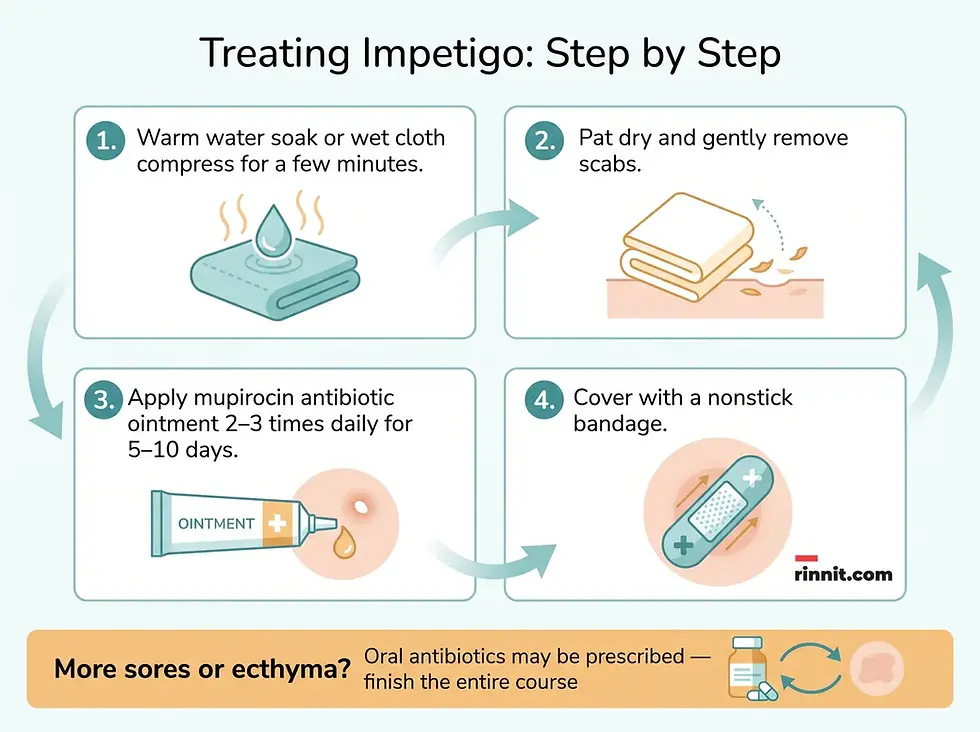
The impetigo treatment routine: warm compress, pat dry and remove scabs, apply mupirocin, and cover with a nonstick bandage.
Preventing Impetigo from Spreading
Keeping skin clean is the best way to keep it healthy, and it is important to wash cuts, scrapes, insect bites, and other wounds right away [1].
If someone in your household has impetigo, several practical steps help protect the rest of the family. Gently wash the affected areas with mild soap and running water and cover them lightly with gauze. Wash an infected person's clothes, linens, and towels every day with hot water, and do not share them with anyone else in your family. Wear gloves when applying antibiotic ointment and wash your hands thoroughly afterward. Cut an infected child's nails short to prevent damage from scratching. Encourage regular and thorough handwashing and good hygiene in general. Finally, keep your child home until your doctor says they are not contagious [1].
Prevention step | Purpose |
Wash affected areas with mild soap and running water; cover with gauze | Removes bacteria and limits spread |
Wash clothes, linens, and towels daily in hot water; do not share | Removes bacteria from shared items |
Wear gloves when applying ointment; wash hands afterward | Protects caregivers from transferring bacteria |
Cut the child's nails short | Prevents scratching damage and spreading |
Regular, thorough handwashing | General hygiene against spread |
Keep the child home until the doctor says they are not contagious | Protects school or daycare peers |
While contagious, avoid sharing personal items such as towels or athletic equipment. These simple habits break the chain of transmission and help the infection clear faster [2].
Getting Ready for Your Doctor's Appointment
When you call your family doctor or child's pediatrician to make an appointment, ask if you need to do anything to prevent infecting others in the waiting room. This small step protects other families [2].
Before the visit, make a list of the symptoms you or your child is experiencing, all medications, vitamins and supplements being taken, key medical information including other conditions, and the questions you want to ask your doctor [2].
You can expect your doctor to ask several questions, including when the sores started, what they looked like at the beginning, whether there were any recent cuts, scrapes, or insect bites in the affected area, whether the sores are painful or itchy, what makes them better or worse, whether someone in your family already has impetigo, and whether this problem has occurred in the past [2].
Prepare ahead | Bring or note |
List of symptoms | When they started and how they looked at first |
Medication list | All medications, vitamins, and supplements |
Medical history | Other conditions such as eczema or diabetes |
Questions | Cause, tests, treatment options, preventing spread, skin care while healing |
Bottom Line
Impetigo is one of the most common skin infections in young children, but it is also one of the most treatable. Recognizing the honey-colored crusts early, starting prescribed antibiotic treatment promptly, and following good hygiene habits at home can stop the infection in its tracks and protect the rest of your family.
Your next step: if you have questions about impetigo symptoms, treatment, or how to keep it from spreading in your home, talk to your family doctor or your child's pediatrician today.
Frequently Asked Questions
What does impetigo look like?
Impetigo appears as reddish sores, most often around the nose and mouth, that quickly rupture, ooze for a few days, and form a characteristic honey-colored crust. Sores can also appear on the hands and feet, and itching and soreness are usually mild.
What causes impetigo?
Impetigo is caused by bacteria, usually staphylococci. The bacteria spread through contact with the sores of an infected person or with items they have touched, such as clothing, bed linen, towels, and toys.
Is impetigo contagious?
Yes. Impetigo is highly contagious and spreads easily within families, schools, and child care facilities through direct contact and shared items. Children should stay home until their doctor says they are no longer contagious, usually about 24 hours after starting antibiotic treatment.
How is impetigo treated?
The standard treatment is a prescription antibiotic ointment or cream called mupirocin applied directly to the sores two to three times a day for five to ten days. For more serious or widespread cases, such as ecthyma, doctors may prescribe antibiotics taken by mouth.
How long does impetigo take to go away?
With treatment, sores typically begin to improve within days. The full ointment course runs five to ten days, and oral antibiotic courses must be completed in full even if the sores have already healed.
Can impetigo be treated without a doctor?
Only minor infections that have not spread to other areas can be tried with an over-the-counter antibiotic cream or ointment, along with a nonstick bandage. If the sores do not improve, or if there are many sores, see a doctor for prescription treatment.
Can impetigo cause complications?
Impetigo is usually not dangerous, but rarely it can lead to cellulitis, a potentially life-threatening infection of the tissues under the skin; kidney problems, because one of the causative bacteria can damage the kidneys; and scarring from the deeper sores of ecthyma.
Who is most at risk of getting impetigo?
Impetigo most commonly affects children ages 2 to 5. Other risk factors include warm, humid weather, broken skin from cuts or insect bites, close contact in crowded settings, eczema, diabetes, older age, and a weakened immune system.
How do I keep impetigo from spreading at home?
Wash the affected areas with mild soap and running water and cover them lightly with gauze, wash the infected person's clothes, linens, and towels daily in hot water without sharing them, wear gloves when applying ointment and wash hands afterward, cut the child's nails short, and keep the child home until the doctor says they are no longer contagious.
Do I need lab tests to diagnose impetigo?
Usually not. Doctors typically diagnose impetigo just by looking at the sores on the face or body. Lab tests are considered only if the sores do not clear with antibiotic treatment, in which case a sample of the sore's fluid is tested to find which antibiotics work best.
Related Reading
Trusted Resources
American Academy of Dermatology: dermatology guidance and public education
Centers for Disease Control and Prevention: infectious disease information for families
American Academy of Pediatrics (HealthyChildren.org): pediatric skin condition guidance
National Institute of Arthritis and Musculoskeletal and Skin Diseases: skin disease research and education
References
Mayo Clinic Staff. Impetigo: symptoms and causes. Mayo Clinic. April 19, 2023. https://www.mayoclinic.org/diseases-conditions/impetigo/symptoms-causes/syc-20352352
Mayo Clinic Staff. Impetigo: diagnosis and treatment. Mayo Clinic. April 19, 2023. https://www.mayoclinic.org/diseases-conditions/impetigo/diagnosis-treatment/drc-20352358
Koning S, van der Sande R, Verhagen AP, et al. Interventions for impetigo. Cochrane Database of Systematic Reviews. 2012;(1):CD003261. PMID 22258953. https://doi.org/10.1002/14651858.CD003261.pub3
Bowen AC, Mahé A, Hay RJ, et al. The global epidemiology of impetigo: a systematic review of the population prevalence of impetigo and pyoderma. PLoS ONE. 2015;10(8):e0136789. PMID 26317533. https://doi.org/10.1371/journal.pone.0136789
Gahlawat G, Tesfaye W, Bushell M, et al. Emerging treatment strategies for impetigo in endemic and nonendemic settings: a systematic review. Clinical Therapeutics. 2021;43(6):986-1006. PMID 34053699. https://doi.org/10.1016/j.clinthera.2021.04.013
Medical disclaimer
This article is for informational purposes only and is not a substitute for professional medical advice, diagnosis, or treatment. The clinical information in this guide reflects source material last reviewed in April 2023.



Comments