Ischemic Optic Neuropathy: Understanding Sudden Vision Loss and Optic Nerve Damage

Updated: 3 days ago
Medically reviewed by Dr. Baraa Alnahhal, MD · Last reviewed: October 17, 2026
Quick Answer: Key Facts About Ischemic Optic Neuropathy
Ischemic optic neuropathy is sudden vision loss caused by inadequate blood flow to the optic nerve, typically painless blurring or loss of vision, often in the lower visual field. Causes include arterial inflammation, a crowded optic disk and vascular disease. Risk factors include age over 50, hypertension and diabetes. Immediate care is required to protect the unaffected eye.
Feature | Details |
Core Problem | Sudden vision loss due to inadequate blood flow to the optic nerve. |
Major Symptoms | Painless blurring or loss of vision, often in the lower half of the visual field. |
Primary Types | Anterior (AION) and Posterior (PION); Arteritic vs. Nonarteritic. |
Common Causes | Arterial inflammation (GCA), crowded optic disk, and vascular diseases. |
Risk Factors | Age over 50, hypertension, diabetes, smoking, and sleep apnea. |
Urgency | Extremely high; immediate care is required to protect the unaffected eye. |
What the research says
There is still no definitive therapy for nonarteritic ION. A systematic review of neuroprotective strategies for NAION found only 24 eligible studies — 21 in animals and just 3 in humans — and concluded that more clinical studies are needed to show whether any of these approaches works in patients (Budihardja et al., Korean J Ophthalmol, 2023) [2]
Cataract surgery raises NAION risk about fourfold in the following year, but the absolute risk is low. A meta-analysis found a hazard ratio of 4.6 (95% CI 2.7–7.8) for NAION within one year of cataract surgery, with an absolute risk of about 1 in 1,000 to 3,100 surgeries (Shew et al., J Neuroophthalmol, 2023) [3]
Semaglutide has been linked to NAION, but the absolute risk is small. In a meta-analysis of observational studies in people with type 2 diabetes, semaglutide use was associated with a higher hazard of NAION (HR 2.17, 95% CI 1.73–2.74), equal to about 1 additional case per 7,000 treated patients per year; the authors rated the certainty of the evidence as low (Chrzanowski et al., PLoS Med, 2026) [4]
What is Ischemic Optic Neuropathy?
Ischemic Optic Neuropathy (ION) refers to a group of conditions where vision is impaired or lost because the optic nerve does not receive sufficient blood flow. The optic nerve functions as the primary communication cable between the eye and the brain; when its blood supply is interrupted, the nerve fibers begin to malfunction and die. If this disruption is severe or prolonged, the resulting damage is often permanent. ION is relatively rare and most frequently diagnosed in individuals over the age of 50. [1]
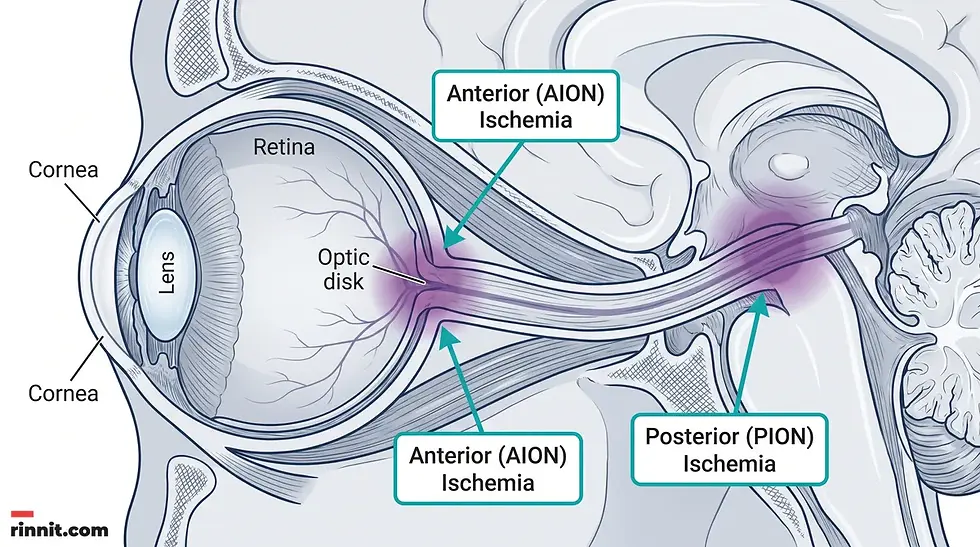
Anterior Ischemic Optic Neuropathy (AION) is the most common form and affects the portion of the optic nerve closest to the eye, specifically at or just behind the optic disk. Posterior Ischemic Optic Neuropathy (PION) occurs farther back along the nerve and is significantly harder to diagnose because it does not cause visible changes to the optic disk in its early stages. Both types are further classified as either arteritic (caused by inflammation) or nonarteritic (caused by other vascular factors). [1]
What are the symptoms and signs of ischemic optic neuropathy?
The hallmark symptom of Ischemic Optic Neuropathy is sudden, painless vision loss. In the most common subtype, Nonarteritic AION (NAION), patients often notice a blurring or "dark cloud" across their field of vision upon waking. This loss typically affects the lower half of the visual field in one eye. Patients may also experience dyschromatopsia, a condition where colors appear washed out or less vibrant. While NAION usually affects only one eye initially, approximately 15% of patients will eventually develop the condition in their other eye. [1]
Arteritic AION (AAION) presents with more systemic and severe symptoms. In addition to sudden darkening or complete loss of vision, patients often report intense headaches, muscle pain while chewing (jaw claudication), and swollen temple arteries that lack a detectable pulse. General feelings of malaise and unexplained weight loss are also common. Because AAION is often caused by Giant Cell Arteritis (GCA), it is considered a medical emergency due to the high risk of rapid, total blindness in both eyes. [1]
What causes ischemic optic neuropathy and who is at risk?
The causes of ischemic optic neuropathy (ION) vary significantly between its nonarteritic and arteritic subtypes. Nonarteritic forms are generally believed to result from a combination of factors that disrupt the eye's ability to self-regulate blood flow. A major anatomical risk factor is a "crowded" optic disk, sometimes referred to as a "disk at risk." Other contributing factors include:
Vascular Diseases: High blood pressure, Type 2 diabetes, and atherosclerosis (plaque buildup).
Sleep-Related Issues: Sleep apnea and nocturnal hypotension (low blood pressure during sleep).
Lifestyle and Meds: Smoking, vaping, and potentially certain medications used for erectile dysfunction, though the latter are not considered sole causes. [1]
Arteritic forms (AAION and APION) are caused by widespread circulatory inflammation, most notably Giant Cell Arteritis (GCA). This inflammatory condition attacks the medium and large arteries, including those supplying the optic nerve. General risk factors for all types of ION include being over age 50, male, and of white ethnicity. Managing these underlying conditions is the primary defense against the onset or progression of the disease. [1]
How is ischemic optic neuropathy diagnosed and treated?
Ischemic optic neuropathy (ION) is diagnosed through a comprehensive exam of the optic disk and visual field, and treatment focuses on the underlying cause. For AION, doctors can often see swelling or changes in the optic disk during an initial exam. However, PION is more elusive, as the back of the eye may appear normal despite significant vision loss. Diagnostic tools include:
Visual Field Tests: To map blind spots and areas of vision loss.
Imaging: Optical Coherence Tomography (OCT) and Fluorescein Angiography to visualize blood flow and nerve thickness.
Biopsy and Blood Work: For suspected arteritic cases, a temporal artery biopsy and tests for inflammatory markers like ESR and CRP are essential. [1]
Treatment focuses heavily on the underlying cause. For Arteritic ION, immediate high-dose corticosteroids are administered to reduce inflammation and protect the unaffected eye. For Nonarteritic ION, there is currently no proven treatment to restore lost vision. Instead, management centers on controlling vascular risk factors—such as blood pressure and cholesterol—and smoking cessation to prevent the condition from occurring in the second eye. [1]

What is the prognosis for ischemic optic neuropathy, and why does protection matter?
The prognosis for Ischemic Optic Neuropathy is generally guarded, as vision loss is often permanent. The primary clinical goal after an initial event is the protection of the remaining vision and the health of the other eye. In nonarteritic cases, the risk to the second eye is significant, making the management of diabetes and hypertension a lifelong priority. In arteritic cases, the risk of bilateral blindness is extremely high without immediate and aggressive steroid therapy. [1]
Preventative measures are identical to general cardiovascular health strategies. Maintaining a healthy weight, engaging in regular physical activity, and avoiding all forms of tobacco can significantly lower the risk of vascular-related nerve damage. While ION is a life-altering diagnosis, early recognition of symptoms like sudden blurring or temple pain can be the difference between preserving sight and total blindness. [1]

Frequently Asked Questions
Is vision loss from ION reversible?
Unfortunately, vision loss caused by optic nerve death is usually permanent. Treatment focuses on preventing further damage.
Why does NAION often happen during sleep?
It is believed that natural drops in blood pressure during sleep (nocturnal hypotension) can trigger ischemia in a "disk at risk."
What is a "disk at risk"?
A "disk at risk" refers to a crowded optic disk anatomy where the nerve fibers and blood vessels are packed tightly, making them more vulnerable to flow disruptions.
Can stress cause Ischemic Optic Neuropathy?
While stress doesn't directly cause ION, it contributes to high blood pressure, which is a major vascular risk factor.
How is ION different from Glaucoma?
Glaucoma is usually a slow, progressive loss of vision due to high eye pressure, whereas ION is a sudden event caused by blood flow failure.
Are both eyes always affected?
Usually, ION starts in one eye. However, the risk of it developing in the second eye is high, especially in arteritic cases.
What does "arteritic" mean?
The term "arteritic" means the condition is caused by arteritis, which is inflammation of the walls of the arteries.
Can smoking cause ION?
Yes. Smoking damages blood vessels and impairs circulation, significantly increasing the risk of all types of ischemia.
Is there a surgery to fix the optic nerve?
Optic nerve sheath decompression was once used but is now rarely recommended as it has not been proven effective in restoring vision.
Can erectile dysfunction drugs cause blindness?
There is a reported link between these drugs and ION, but experts believe they only contribute to the condition in people already at high risk.
What should I do if I wake up with blurred vision?
Treat it as a medical emergency. Contact an eye specialist or go to the emergency room immediately.
Is ION hereditary?
The anatomical "disk at risk" can be hereditary, as can the vascular conditions (like high cholesterol) that lead to ION.
What is Giant Cell Arteritis?
GCA is a serious inflammatory disease of the blood vessels that is the primary cause of the dangerous arteritic form of ION.
Can vitamins help prevent ION?
While general eye health is supported by vitamins, there is no specific supplement proven to prevent optic nerve ischemia.
Is ION the same as a stroke?
ION is often called a "stroke of the eye" because it involves a sudden loss of blood flow to a vital nerve, similar to how a brain stroke works.
Conclusion
Ischemic Optic Neuropathy is a stark reminder of how vital consistent blood flow is to our sensory health. By recognizing the signs of sudden vision loss and understanding the underlying vascular and inflammatory risks, patients can act quickly to protect their sight. Vigilance in managing chronic health conditions remains the most effective tool in preventing this rare but devastating condition.
Learn more. For more expert guides on eye health and vascular wellness, visit Rinnit.com.
Related Reading
Visual Evoked Potential (VEP) Test: Why It's Done, What to Expect and Results explains the eye-to-brain signal test used to detect optic nerve damage.
References
Cleveland Clinic. Ischemic Optic Neuropathy. Cleveland Clinic. Last updated June 30, 2024. https://my.clevelandclinic.org/health/diseases/ischemic-optic-neuropathy
Budihardja BM, Anggraini E, Pratiwi RW, et al. Neuroprotective Strategies for Nonarteritic Anterior Ischemic Optic Neuropathy: A Systematic Review. Korean J Ophthalmol. 2023;37(4):328-339. PMID 37563973. https://doi.org/10.3341/kjo.2022.0166
Shew W, Wang MTM, Danesh-Meyer HV. Nonarteritic Anterior Ischemic Optic Neuropathy After Cataract Surgery: A Systematic Review and Meta-Analysis. J Neuroophthalmol. 2023;43(1):17-28. PMID 36166807. https://doi.org/10.1097/WNO.0000000000001625
Chrzanowski J, Walicka M, Burzyński J, et al. Semaglutide-associated risk of nonarteritic anterior ischemic optic neuropathy in patients with type 2 diabetes: A systematic review and meta-analysis of observational studies. PLoS Med. 2026;23(5):e1005064. PMID 42166479. https://doi.org/10.1371/journal.pmed.1005064
Medical disclaimer
The information provided in this article is for educational purposes only and is not intended as medical advice. Always seek the advice of your physician or other qualified health provider with any questions you may have regarding a medical condition or sudden changes in your vision.



Comments