Iliotibial Band (IT Band) Syndrome: Symptoms, Causes, and Recovery

Updated: 2 days ago
Medically reviewed by Dr. Baraa Alnahhal, MD · Last reviewed: October 2026
Quick Answer
Iliotibial band syndrome is aching, burning or sharp pain on the outside of the knee or hip caused by a tight IT band rubbing against the bone. It accounts for about 12% of running injuries. Treatment includes rest, physical therapy, foam rolling and pain medicines, and 50% to 90% of people improve within four to eight weeks. [1]
What the research says
Hip strengthening is a common part of effective conservative treatment. A systematic review of 13 studies (201 runners, including five randomized trials) found that hip abductor strengthening emerged as a common strategy, with pain reduction ranging from 27% to 100% and functional improvement from 10% to 57% over 2 to 8 weeks. Studies varied widely, so no meta-analysis was possible. (Sanchez-Alvarado et al., Front Sports Act Living, 2024)
Weak hip abductors are linked to ITBS in female runners. A systematic review and meta-analysis of 17 articles (10 cross-sectional studies in the meta-analysis) found that female runners with current ITBS had lower isometric hip abductor strength and smaller peak hip internal rotation angles than runners without it. The authors note that biomechanical evidence is limited. (Foch et al., Gait Posture, 2023)
Running mechanics may also play a role. A systematic review of 13 studies reported that female runners who went on to develop ITBS showed increased peak hip adduction and increased peak knee internal rotation during stance. The authors note few studies, small effect sizes and methodological shortcomings. (Aderem and Louw, BMC Musculoskelet Disord, 2015)
What is iliotibial band syndrome?
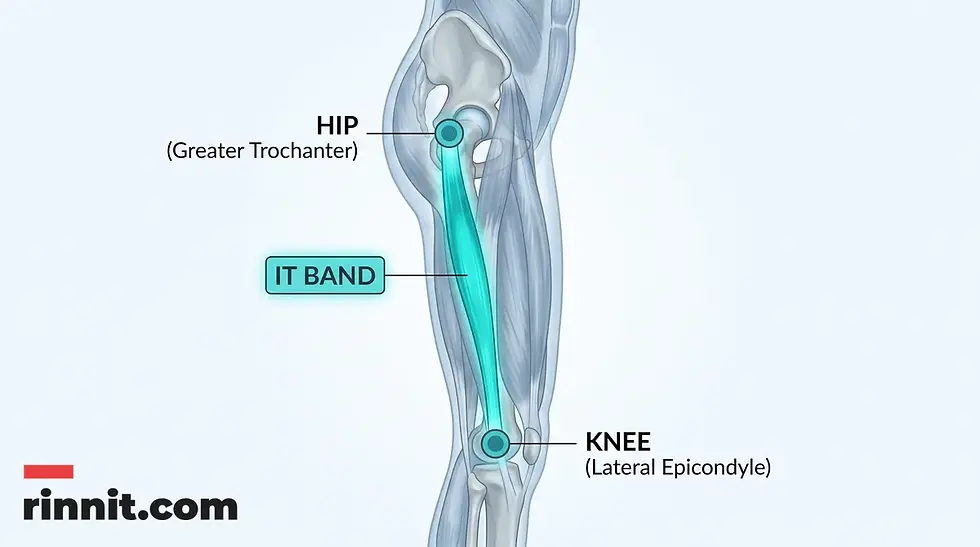
Iliotibial band syndrome, or ITBS, is a painful condition in which the iliotibial band becomes irritated and swollen. The IT band is a tendon, a flexible fibrous tissue that connects muscle to bone, that runs along the outside of the leg from the top of the pelvic bone down to the knee. When it becomes too tense, it rubs against the bone at the hip (the greater trochanter near the top of the thigh bone) or at the knee (the lateral epicondyle on the outside of the lower thigh bone). This repeated friction causes inflammation and pain. [1]
ITBS is most famously associated with long-distance runners, and it accounts for about 12% of running injuries. It is also common in basketball players, cyclists, hockey players, skiers and soccer players, and you are at higher risk if you are young and exercise frequently. It affects more females than males, and it can occur in one leg or in both legs, which is called bilateral ITBS. [1]
Recognizing the symptoms of ITBS
People with ITBS describe the first pain as aching and burning, and it gets sharper as the syndrome worsens. At first, the pain starts after exercise. As ITBS worsens, you feel it the whole time you exercise and, eventually, also at rest. [1]
Symptom | What you may notice |
|---|---|
Hip pain | Pain over the greater trochanter at the hip, sometimes with a snapping sound as the band rubs over the bone |
Knee pain | Pain over the lateral epicondyle on the outside of the knee when you bend and straighten the knee |
Clicking sensations | A snap, pop or click on the outside of the knee, or a grating feeling (crepitus) when the joint moves |
Warmth and redness | The outside of the knee may look discolored and feel warm to the touch |
Pain pattern | Pain that increases the longer you exercise and is worse when you go downhill |
Recognizing these early warning signs matters, because ITBS can worsen without treatment. [1]
Causes and risk factors
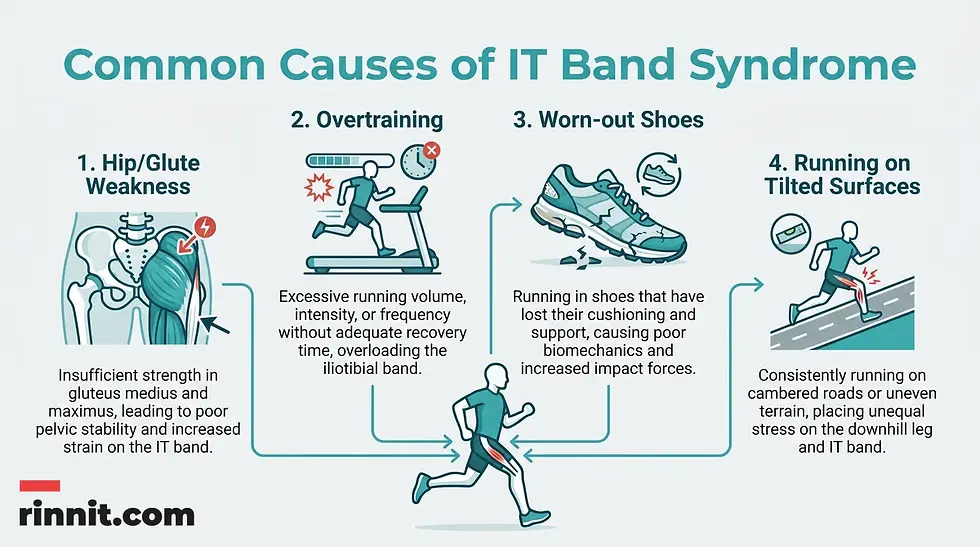
ITBS usually results from a mix of body mechanics and training habits. Anything that pulls the IT band closer to the bone or makes it tighter raises the risk of friction. Possible causes of a tight IT band include excessive foot pronation, hip abductor weakness, internal tibial torsion (a shinbone twisted inward), knee arthritis that leads to bowed legs, and a naturally tight IT band. Having one leg longer than the other, and weakness in the hip, glute or abdominal muscles, also raise your risk. [1]
Training habits can make a tight IT band rub against bone. Common examples include:
How ITBS is diagnosed
A healthcare provider may diagnose ITBS after discussing your exercise history and symptoms and performing a physical examination. They will check for grating sounds or a grating feeling when the knee or hip moves, pain over the greater trochanter or the lateral epicondyle, pain that increases the longer you exercise, and pain that is worse when you go downhill. [1]
Your provider might also perform the Noble and Ober test, which involves feeling the outside of the knee to see if your pain comes from that spot, moving your hip away from your body while supporting your knee, and moving the knee at different angles to see if that causes pain. If the diagnosis is unclear, an MRI can help rule out other injuries such as a meniscal tear or a lateral collateral ligament (LCL) injury, and an ultrasound can show how the IT band moves when you bend and straighten your hip or knee. [1]
The path to recovery
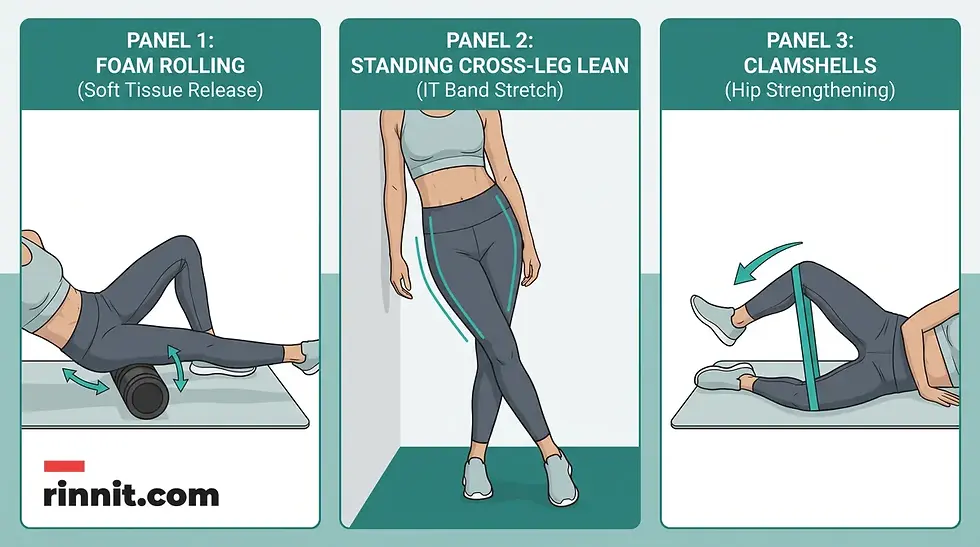
ITBS may heal with treatments such as rest, physical therapy and medicines, and some experts recommend not exercising the affected leg until the pain is gone. Nonsteroidal anti-inflammatory drugs (NSAIDs) such as ibuprofen or naproxen are examples of pain medicines, and your provider can advise you on the right dose. [1]
Strategy | What it involves |
|---|---|
Physical therapy | A physical therapist teaches stretches and strengthening exercises to lengthen the IT band and reduce tension, and shows you how to warm up and cool down |
Manual therapy | A physical therapist may teach you to use a foam roller to massage the area |
Posture training | Changing how you hold your body during daily activities and sports |
Medical treatment | Steroid injections can reduce inflammation, and surgery is rare, considered only if medicines and physical therapy do not work |
With nonsurgical treatment, about 50% to 90% of people improve after about four to eight weeks, and some studies show it can happen within two to six weeks. Without treatment, the pain will likely increase, and ITBS can sometimes cause patellofemoral pain syndrome, which adds pain around and under the kneecap. [1] Once you are pain-free, you can slowly return to your regular activities with your provider's permission. Contact your healthcare provider if your knee or hip pain does not get better after a few weeks or gets worse. [1]
To lower your risk, you can avoid running up or down hills or on slanted surfaces, use the right technique for your activity, increase training intensity gradually, warm up and cool down slowly, and wear supportive shoes. [1]
Learn more. For more evidence-based health guides, visit Rinnit.com.
Frequently Asked Questions
Can I run through IT band pain?
Running through IT band pain is not recommended. Some experts advise not exercising the affected leg until the pain is gone, because ITBS can get worse without treatment. Ask your healthcare provider how much rest and activity is right for you.
How long does it take for ITBS to heal?
With nonsurgical treatment, about 50% to 90% of people improve after about four to eight weeks, and some studies show improvement within two to six weeks.
Is foam rolling good for the IT band?
A physical therapist may teach you to use a foam roller as part of manual therapy to massage the area. Ask a provider or physical therapist how to use one safely for your situation.
Why does my knee click when I walk?
A snap, pop or click on the outside of the knee can be a symptom of ITBS, caused by a tight IT band rubbing over the bone. If it comes with pain, see a healthcare provider, since other knee injuries can cause similar symptoms.
Are there specific shoes for IT band syndrome?
There is no single magic shoe, but worn-out shoes are a listed risk factor, and Cleveland Clinic advises wearing supportive shoes.
Does IT band syndrome affect the hip too?
Yes. The IT band runs from the hip to the knee, so friction can cause pain and a snapping sound at the hip as well as pain at the outer knee.
What is the best stretch for the IT band?
A physical therapist can teach you stretches and strengthening exercises that help lengthen the band and reduce tension. A standing cross-leg lean is one common example.
Can weak glutes cause IT band syndrome?
Weakness in the hip, glute and abdominal muscles is a recognized risk factor. Weak hip abductors may cause the IT band to tense.
Is surgery common for ITBS?
No. Surgery is rare and is usually considered only if medicines and physical therapy do not work.
Can I prevent ITBS from coming back?
You may lower your risk by avoiding running up or down hills or on slanted surfaces, using correct technique, increasing training intensity gradually, warming up and cooling down slowly, and wearing supportive shoes.
What is bilateral IT band syndrome?
Bilateral IT band syndrome means ITBS is affecting both of your legs at the same time.
Is ITBS a permanent condition?
ITBS is treatable. It may heal with rest, physical therapy and medicines, but the pain will likely increase if it is not treated.
Who is most likely to get ITBS?
ITBS is more common in young people who exercise often. Basketball players, cyclists, hockey players, runners, skiers and soccer players are among those most prone, and it affects more females than males.
Should I see a doctor for IT band pain?
Contact your healthcare provider if your knee or hip pain does not get better after a few weeks or gets worse.
Can IT band syndrome cause other problems?
IT band syndrome can sometimes cause patellofemoral pain syndrome, which adds pain around and under the kneecap to the knee and hip pain.
Related Reading
Patellofemoral Pain Syndrome (Runner's Knee): Symptoms, Causes, and Treatment covers the other common overuse knee pain in runners.
Knee Pain: Symptoms, Causes, Diagnosis, and Treatment Guide helps sort out the many causes of knee pain and their treatment.
Patellar Tendinitis (Jumper's Knee): Symptoms, Causes, and Treatment Options explains tendon pain below the kneecap from repeated jumping and running.
Physical Therapy: Enhancing Mobility, Strength, and Recovery explains how physical therapy rebuilds strength and flexibility after injury.
References
Cleveland Clinic. Iliotibial Band Syndrome. Cleveland Clinic. Last updated October 19, 2021. https://my.clevelandclinic.org/health/diseases/21967-iliotibial-band-syndrome
Sanchez-Alvarado A, et al. Effects of conservative treatment strategies for iliotibial band syndrome on pain and function in runners: a systematic review. Front Sports Act Living. 2024;6:1386456. PMID 39247485. https://doi.org/10.3389/fspor.2024.1386456
Foch E, et al. Lower extremity kinematics during running and hip abductor strength in iliotibial band syndrome: A systematic review and meta-analysis. Gait Posture. 2023;101:73-81. PMID 36758425. https://doi.org/10.1016/j.gaitpost.2023.02.001
Aderem J, et al. Biomechanical risk factors associated with iliotibial band syndrome in runners: a systematic review. BMC Musculoskelet Disord. 2015;16:356. PMID 26573859. https://doi.org/10.1186/s12891-015-0808-7
Medical disclaimer
This article is for general educational purposes only and is not a substitute for professional medical advice, diagnosis, or treatment. Always seek the advice of your physician or other qualified health provider with any questions you may have regarding a medical condition.



Comments