Hypotonia in Babies: Symptoms, Causes, and Management

Updated: 2 days ago
Medically reviewed by Dr. Baraa Alnahhal, MD · Last reviewed: October 2026
Quick Answer
Hypotonia in babies is poor muscle tone, meaning decreased resistance to movement at rest, often called floppy infant syndrome. Signs include a limp feel, trouble lifting the head, a weak cry and difficulty sucking. Causes include brain damage, lack of oxygen around birth and genetic conditions such as Down syndrome. Management treats the cause and adds supportive therapies. [1]
What the research says
Genetic testing finds a cause for most babies with unexplained hypotonia. In an international study of 147 newborn intensive care infants with unexplained hypotonia, 121 had rapid exome and/or genome sequencing and 72 (60%) received a molecular diagnosis. Testing changed care for 57 of 66 infants who received a genetic diagnosis versus 14 of 33 who did not (odds ratio 8.4). (Morton et al., Neurology, 2025)
Experts recommend rapid genetic sequencing as a first-line test in the NICU. A multicenter consensus review reported diagnostic rates above 50% in academic neonatal intensive care units in Australia, Canada, the UK, and the US. After a genetic diagnosis, 17 of 23 patients (74%) had a change in clinical care, including 2 who received targeted therapy. (Morton et al., JAMA Neurol, 2022)
Some therapies have stronger evidence than others. A systematic review of 37 articles on children aged 0 to 6 with central hypotonia found proven-effective evidence for treadmill training and massage in infants with Down syndrome. Most other interventions were rated only possibly effective, so therapists should track progress with sensitive outcome measures. (Paleg et al., J Pediatr Rehabil Med, 2018)
What Is Hypotonia?

Hypotonia is the medical term for poor muscle tone, in which a person shows little or no resistance when the joints are moved. In infants it is often called "floppy infant syndrome." Muscle tone is the natural tension, or resistance to movement, that muscles have at rest. It helps a baby hold posture, sit upright, and use reflexes. For a baby with hypotonia, the muscles feel soft and offer little resistance when touched or moved. [1]
Hypotonia is not the same as muscle weakness. Weakness is a lack of strength, while hypotonia is a lack of tone, although weakness is often a symptom of hypotonia. The condition is present at birth and is most often diagnosed in early infancy, before a child reaches six months of age. It is the most common condition affecting a newborn's motor skills, and it can also affect adults. [1]
Recognizing the Symptoms: The "Rag Doll" Appearance
Children with hypotonia often look like a "rag doll" because of their limpness. Parents and caregivers may notice that the baby feels unusually soft or limp when held. [1]
Common physical signs
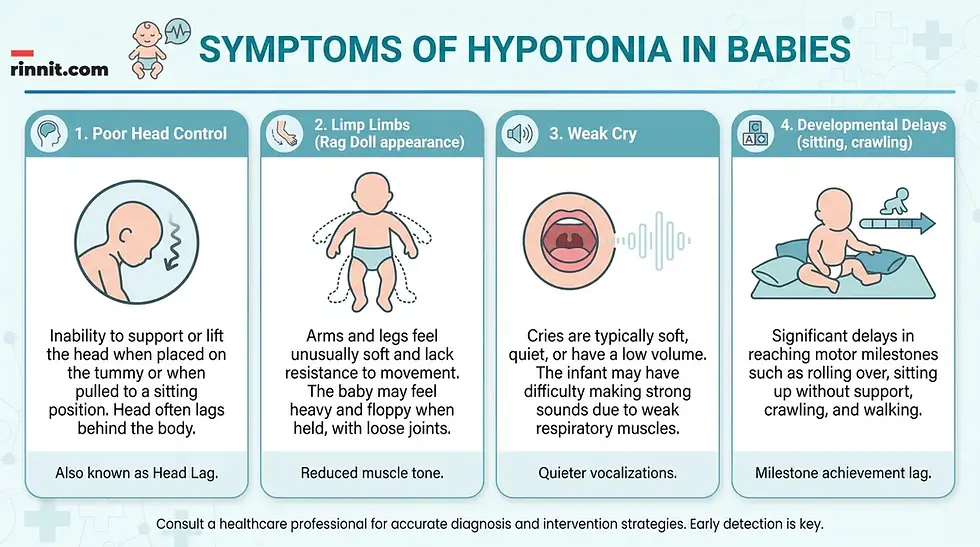
A baby with hypotonia may be unable to lift the head or control the neck muscles. When held, the arms and legs may hang straight at the sides without a bend at the elbows or knees, and the baby may be unable to place weight on the legs. A weak cry and difficulty with sucking or swallowing are also common. [1]
Developmental milestones
Because muscle tone is essential for movement, hypotonia often delays motor milestones. Parents can watch their child's progress in these areas: [1]
Sitting upright without support.
Crawling and rolling over.
Walking and feeding themselves.
Saying their first words.
Understanding the Causes
Hypotonia is rarely a diagnosis on its own. It is usually a symptom of a problem in the pathways that control movement, which connect the brain, spinal cord, nerves, and muscles. A break in this communication line at any point can lead to poor muscle tone. [1]
Primary triggers and associated conditions
Causes include brain damage or problems with how the brain formed during fetal development, conditions that affect the nerves or the muscles, infection, and a lack of oxygen before or immediately after birth. [1]
Hypotonia is often a symptom of a genetic or congenital condition, such as Down syndrome, Prader-Willi syndrome, SMA, Tay-Sachs disease, Williams syndrome, achondroplasia, or trisomy 13. Other possible links include premature birth (before 37 weeks), cerebral palsy, exposure to toxins, hypothyroidism, sleep apnea, and spinal cord injury. [1]
Diagnosis and Diagnostic Testing
Providers usually diagnose hypotonia soon after birth or within the first six months of life. They examine the baby's balance and coordination, motor skills (grasping, rolling over, sitting up), reflexes, and sensory skills (vision, hearing, touch). They also review the family's medical and genetic history and look for complications before or during delivery. [1]
To find the underlying cause, tests may include brain imaging (MRI or CT), genetic testing to identify abnormalities, and electromyography (EMG) to measure how well the muscles and nerves work. [1]
Management and Long-Term Care
Hypotonia is a lifelong condition, but muscle tone can improve over time, and most babies show great improvement as they get older. The main goals are to treat the underlying condition and support the child's development. If an underlying genetic condition is found, symptoms can sometimes worsen over time, and a genetic counselor can help families understand what to expect. [1]
Therapeutic interventions
Care is multidisciplinary. Physical and occupational therapy improve motor skills, speech-language therapy helps with difficulties speaking, swallowing, and breathing, and sensory stimulation therapy can improve sensory function. When swallowing is severely affected, a feeding tube, placed through the nose or directly into the stomach, may be used so the baby gets enough nutrition. [1]

Handling and safety
Babies with hypotonia need extra care when they are lifted. Because they lack muscle resistance, they can slip through a caregiver's hands if lifted by the armpits. Fully support the head, neck, and torso whenever the baby is moved or held, and work with the healthcare team to learn safe handling techniques and ways to support development at home. [1]
Learn more. For more evidence-based health guides, visit Rinnit.com.
Frequently Asked Questions
Can hypotonia be cured?
Hypotonia is a lifelong condition, but treating the underlying cause and consistent therapy can improve muscle tone over time, and most babies improve as they get older. [1]
Is hypotonia a disability?
Hypotonia as a symptom is not a disability, but it can affect how a child performs daily tasks, and the underlying condition may be considered a disability. [1]
Does hypotonia affect intelligence?
No. Hypotonia does not affect a person's intellectual abilities. Some underlying conditions that cause it can affect development in other ways, so ask your child's care team what to expect. [1]
How do I know if my baby is "floppy"?
Signs include being unable to lift the head, limbs that hang straight without bending, and a limp feeling when held. If you are concerned, contact your child's healthcare provider. [1]
Can adults have hypotonia?
Yes. A baby who is diagnosed keeps the diagnosis for life, even if symptoms improve. New hypotonia in adults can follow a traumatic injury, a brain tumor, a stroke, or a condition such as Parkinson's disease. [1]
What is the difference between muscle tone and strength?
Tone is the resistance muscles have to movement at rest, while strength is the ability to produce force. They are different, although muscle weakness often accompanies hypotonia. [1]
Can I prevent my child from having hypotonia?
Usually not, because hypotonia is often the symptom of an underlying condition, which can be genetic. During pregnancy, you can lower the risk of premature birth by following your provider's guidance, avoiding tobacco and recreational drugs, eating a well-balanced diet, and treating health conditions. Genetic testing before pregnancy can clarify your risk of a genetic condition. [1]
When should I see a doctor?
See a healthcare provider if you notice that your baby's muscle tone has decreased or that your baby is weaker than normal. This is especially important if your baby loses motor skills they had already achieved, such as sitting upright or grasping objects. [1]
What is SMA?
Spinal muscular atrophy (SMA) is a genetic condition that affects the motor neurons in the spinal cord, leading to muscle weakness and hypotonia. [1]
Why do babies with hypotonia need speech therapy?
Speech-language therapy helps with more than talking. It addresses difficulties with speaking, swallowing, and breathing and supports the muscles used for sucking and swallowing. [1]
Is hypotonia progressive?
It depends on the underlying cause. Most babies show great improvement in muscle tone as they get older, but some genetic conditions can cause symptoms to worsen over time. [1]
How do I safely lift a baby with hypotonia?
Never lift the baby by the armpits. Support the head, neck, and torso with your hands and arms so the baby cannot slip. [1]
Can a baby with hypotonia eventually walk?
Many children with hypotonia do learn to walk, although walking is often delayed and the outlook depends on the underlying condition. Physical therapy helps build motor skills, so ask your care team what to expect for your child. [1]
What is an EMG?
An electromyogram (EMG) is a test that measures how muscles and nerves function by recording the electrical activity of the muscles. [1]
Does hypotonia affect the heart?
Hypotonia mainly refers to muscle tone in the skeletal muscles, but some conditions that cause it can also involve the heart or other organs, which is one reason a full medical evaluation matters.
Related Reading
Down Syndrome: Symptoms, Causes, Types & Life Expectancy — Complete Guide explains a common genetic cause of low muscle tone in babies.
Understanding Spinal Muscular Atrophy: Types, Causes, and Management covers a genetic nerve disease that causes muscle weakness in infants.
Cerebral Palsy: Symptoms, Causes, Diagnosis, and Treatment Explained explains a movement disorder that can begin with low muscle tone.
Prader-Willi Syndrome Guide: Symptoms, Causes, Diagnosis, and Treatment describes a genetic syndrome known for newborn hypotonia and feeding problems.
References
Cleveland Clinic. Hypotonia in Babies. Cleveland Clinic. Last updated December 29, 2021. https://my.clevelandclinic.org/health/diseases/22223-hypotonia-in-babies
Morton SU, et al. Exome and Genome Sequencing to Diagnose the Genetic Basis of Neonatal Hypotonia: An International Consortium Study. Neurology. 2025;104(1):e210106. PMID 39700446. https://doi.org/10.1212/WNL.0000000000210106
Morton SU, et al. Multicenter Consensus Approach to Evaluation of Neonatal Hypotonia in the Genomic Era: A Review. JAMA Neurol. 2022;79(4):405-413. PMID 35254387. https://doi.org/10.1001/jamaneurol.2022.0067
Paleg G, et al. Interventions to improve sensory and motor outcomes for young children with central hypotonia: A systematic review. J Pediatr Rehabil Med. 2018;11(1):57-70. PMID 29630564. https://doi.org/10.3233/PRM-170507
Medical disclaimer
This article is for general educational purposes only and is not a substitute for professional medical advice, diagnosis, or treatment. Always seek the advice of your physician or other qualified health provider with any questions you may have regarding a medical condition.



Comments