Prader-Willi Syndrome Guide: Symptoms, Causes, Diagnosis, and Treatment

Updated: 2 days ago
Medically reviewed by Dr. Baraa Alnahhal, MD · Last reviewed: September 2026
Prader-Willi syndrome is a rare genetic condition that affects how the body grows, eats, and behaves. Its most recognizable feature is an unshakable sense of hunger: people with the condition never feel full. This guide explains what causes it, how it changes from infancy into adulthood, how doctors confirm the diagnosis, and how a team of specialists manages it over a lifetime.

TL;DR
Prader-Willi syndrome is a rare genetic disorder caused by a gene error on chromosome 15 that disrupts the hypothalamus, the brain region that controls hunger. The result is constant hunger, slow childhood growth, behavioral challenges, and a high risk of obesity-related complications. There is no cure, but early diagnosis through genetic testing and coordinated specialist care, including growth hormone therapy, strict meal planning, and behavioral support, significantly improves quality of life.
Quick Answer
What it is. A rare genetic condition in which the brain never signals fullness, so people are hungry all the time. This constant hunger is called hyperphagia.
Key signs. Babies are often floppy with poor muscle tone and feeding trouble, while older children show constant food-seeking, fast weight gain, delayed speech, and temper tantrums when food is denied.
What causes it. A gene error in a region of chromosome 15. In most cases the change is random and is not inherited from either parent.
How it is diagnosed. Doctors first suspect it based on symptoms, then confirm it nearly all the time with a genetic blood test.
How it is treated. There is no cure. A specialist team manages it with growth hormone therapy, sex hormone therapy at puberty, a structured low-calorie diet with food access limits, therapies for speech and movement, and mental health support.
What is Prader-Willi syndrome?
Prader-Willi (PRAH-dur VIL-e) syndrome is a rare genetic condition that leads to physical, mental, and behavioral problems. A key feature is a sense of being hungry all the time. People with the condition want to eat constantly because they never feel full. As a result, they usually find it hard to manage their weight, and many of the condition's complications are caused by obesity.
The symptoms vary from person to person and change slowly over time, from infancy through childhood into adulthood. Because the condition touches so many parts of the body and daily life, a team of different specialists works best. This team approach makes complications less likely and improves quality of life.
What are the signs in infants?
Symptoms can be present from birth. The main sign during infancy is poor muscle tone, also known as hypotonia. Babies may rest with their elbows and knees loosely extended instead of fixed, and they may feel floppy or like rag dolls when held.
Infants may also be born with distinct facial features, such as almond-shaped eyes, a narrowing of the head at the temples, a turned-down mouth, and a thin upper lip. A poor sucking reflex makes feeding difficult, so babies may not gain weight at the expected rate. Parents often describe a generally poor responsiveness: the baby may seem very tired, respond weakly to stimulation, have a hard time waking up, or cry weakly. Underdeveloped genitals are also common. Males may have a small penis and scrotum, and the testicles may not descend from the abdomen into the scrotum, a condition called cryptorchidism. In females, the clitoris and labia may be small.
What are the signs from early childhood into adulthood?
Other features appear when a child is very young and continue for life. The table below summarizes the main ones.
Feature | What it looks like |
|---|---|
Food craving and weight gain | A classic sign starting in early childhood: eating often and in large portions, quick weight gain, and unusual food-seeking such as hoarding food or eating frozen food or garbage |
Underdeveloped sex organs | Hypogonadism, where the testes or ovaries produce little or no sex hormones, leading to incomplete or delayed puberty; nearly all people cannot get pregnant, females may not start periods until their 30s or never, and males may lack facial hair or a fully deepened voice |
Poor growth and physical development | Not making enough growth hormone, which shortens adult height and leads to low muscle mass and high body fat; low thyroid hormone and central adrenal insufficiency may also occur |
Thinking and learning | Mild to moderate difficulty thinking, reasoning, and problem-solving (cognitive impairment), with learning disabilities possible even without cognitive impairment |
Delayed motor skills | Toddlers reach movement milestones such as sitting up or walking later than other children |
Speech problems | Delayed speech that may persist as trouble choosing words and speaking clearly in adulthood |
Behavioral problems | Stubborn, angry, controlling, or manipulative behavior; temper tantrums especially when denied food; difficulty accepting routine changes; obsessive-compulsive or repetitive behaviors; anxiety and skin picking |
Sleep conditions | Disrupted sleep cycles and sleep apnea (pauses in breathing during sleep), causing daytime sleepiness and worse behavior |
Other symptoms | Small hands and feet, scoliosis, hip problems, less saliva, dental problems, nearsightedness, pale hair, eyes, and skin (hypopigmentation), poor temperature control, and a higher-than-average pain tolerance |

What causes Prader-Willi syndrome?
Prader-Willi syndrome is caused by an error in one or more genes in a region of chromosome 15. Most genes come in pairs, one inherited from each parent, and both copies are usually active. With certain genes, only one copy is expressed. Prader-Willi syndrome occurs when specific paternal genes that should be expressed are not, for one of three reasons.
Cause | What happens |
|---|---|
Missing paternal genes | The paternal genes on chromosome 15 are missing |
Maternal-only inheritance | The child inherits two copies of chromosome 15 from the mother and none from the father |
Changed paternal genes | There is some change in the paternal genes on chromosome 15 |
A missing or changed gene on chromosome 15 disrupts how the hypothalamus, a portion of the brain, typically works. The hypothalamus controls the release of hormones, and a hypothalamus that is not working properly can affect hunger, growth, sexual development, body temperature, mood, and sleep. In most cases, a random gene change that is not inherited causes the syndrome. Identifying which gene change is responsible can help with genetic counseling.
Who is at risk?
A child with an error in one or more genes on chromosome 15 is at the highest risk. This error may or may not be inherited. Parents who have a child with Prader-Willi syndrome and would like to have another baby should consider genetic counseling, because a genetic counselor can help determine the risk of having another child with the condition.
What are the complications?
Complications fall into three groups: obesity-related, hormone-related, and others. In addition to constant hunger, people with Prader-Willi syndrome have low muscle mass, need fewer calories, and may not be physically active. These factors make obesity and its medical problems more likely.
Complication type | Examples |
|---|---|
Obesity-related | Type 2 diabetes, high blood pressure, high cholesterol, heart disease, sleep apnea, liver disease, gallstones |
Hormone-related | Sterility (most people cannot have children, though a few females have become pregnant) and osteoporosis, because low sex hormones and low growth hormone weaken bones |
Other | Choking and stomach rupture from rapid binge eating, since pain may go unreported and vomiting is rare; dental cavities and gum disease from thick, reduced saliva and poorly developed enamel; reduced quality of life from behavioral problems affecting family functioning, education, and social activities |
How is Prader-Willi syndrome diagnosed?
Doctors typically first suspect Prader-Willi syndrome based on symptoms. The diagnosis can then be confirmed nearly all the time through genetic testing. This blood test finds chromosome problems that indicate the syndrome. Regular well-baby visits help catch early signs of poor growth and development that may point to Prader-Willi syndrome or other conditions, and parents with concerns between visits should schedule an appointment.
How is Prader-Willi syndrome treated?
Early diagnosis and treatment improve quality of life, and a team of professionals usually manages the condition. The team may include an endocrinologist, a behavior specialist, a dietitian, physical and occupational therapists, a speech and language therapist, a mental health professional, a geneticist, and other specialists.
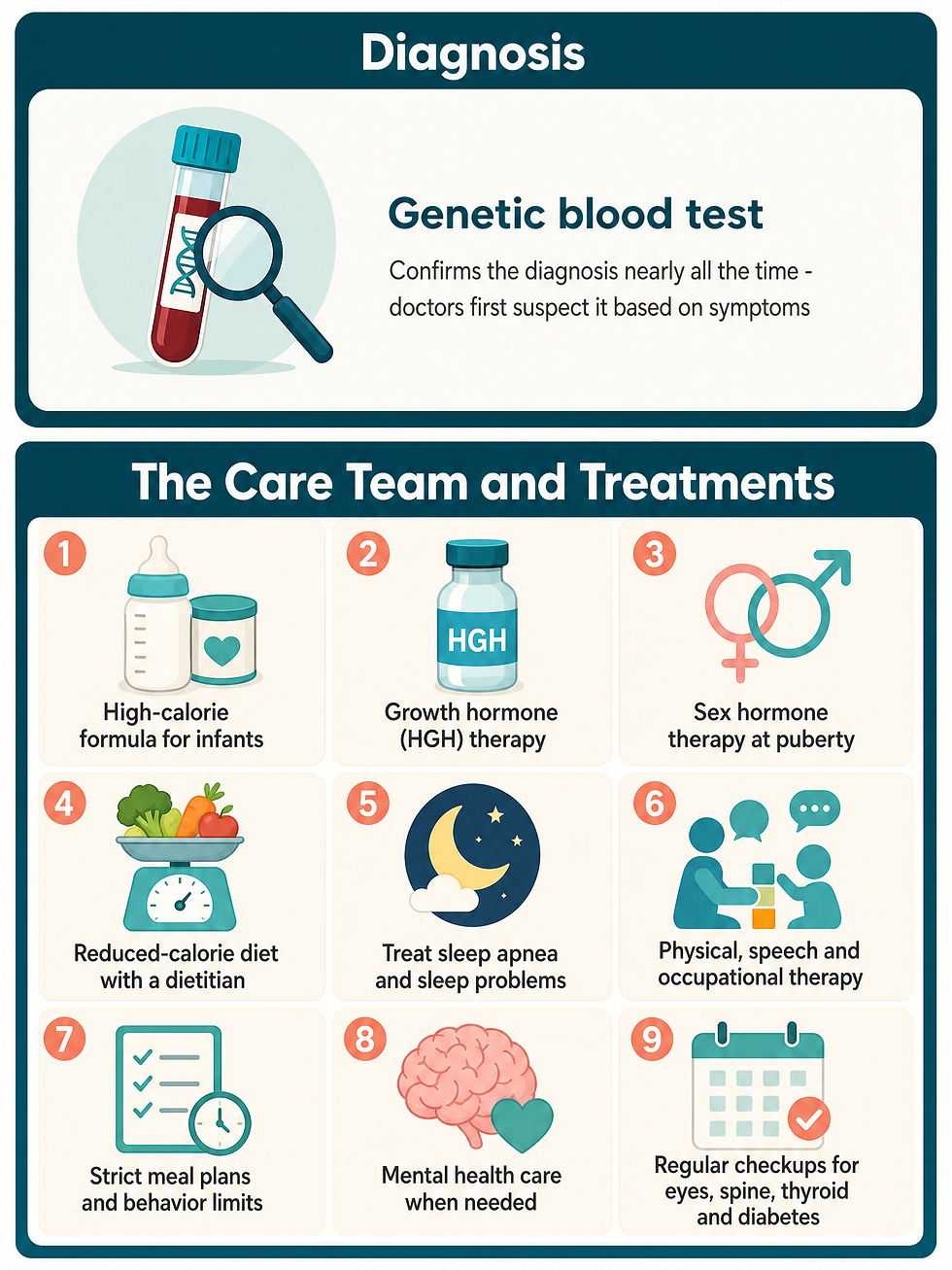
Although specific treatments vary by symptoms, most children will need the measures listed below.
Treatment | What it involves |
|---|---|
Good nutrition for infants | High-calorie formula or special feeding methods to help babies with low muscle tone gain weight, with growth monitored |
Human growth hormone (HGH) | Helps infants and children grow, improves muscle tone, and lowers body fat; may also be used in adults, with an endocrinologist weighing benefits and risks |
Sex hormone treatment | Testosterone for males or estrogen and progesterone for females, usually starting at the usual age for puberty, to lower osteoporosis risk; surgery may correct undescended testicles |
Weight management | A dietitian creates a healthy, reduced-calorie diet with supplemental vitamins or minerals as needed; physical activity and exercise help manage weight and improve function |
Sleep disturbance treatment | Treating sleep apnea and other sleep problems improves daytime sleepiness and behavior |
Therapies | Physical therapy for movement and strength, speech therapy for verbal skills, occupational therapy for everyday skills, and developmental therapy for age-appropriate social skills; early intervention programs are available through state health departments, with educational support during school years |
Behavior management | Scheduled routines and strict limits on food access and quantity, clear behavioral expectations, and sometimes medicine |
Mental healthcare | A psychologist or psychiatrist helps with obsessive-compulsive behaviors, skin picking, anxiety, or mood conditions; medicine may ease symptoms |
Other treatments | Vision and scoliosis exams, and tests for hypothyroidism or diabetes, to catch problems early |
Many adults with the condition live in residential care facilities that allow them to eat healthy diets, live safely, work, and enjoy leisure activities. As a child approaches adulthood, families should look into local adult resources through the school and the Prader-Willi Syndrome Association USA, consider guardianship, wills, and special needs trusts, and discuss switching to adult medical care.
What can families do at home?
Families play a central role in daily care. The following steps help.
Home strategy | How it works |
|---|---|
Learn about the condition | Work with the care team to understand the syndrome and build a care plan for hormones, weight, and complications |
Follow a strict meal plan | Serve low-calorie meals in structured mealtimes, use small dishes, avoid buying high-calorie snacks, keep food out of reach, and lock pantries, refrigerators, cupboards, and garbage cans |
Encourage daily activity | Regular exercise helps manage weight and improves physical function |
Set firm limits | Keep a consistent schedule and clear behavioral expectations, and ask the care team about help with problems |
Schedule regular checkups | Ongoing appointments and tests catch complications early |
Emotional support matters too. Parents who feel overwhelmed should talk to a mental health counselor, join a support group, ask about short-term care respite, and protect time for their own interests and activities.
What should you ask at the doctor's appointment?
Before the appointment, prepare a list of the child's symptoms and how long they have lasted, key medical information including recent illnesses and medicines with doses, and questions for the doctor. Useful questions include what is likely causing the symptoms, what tests are needed, the recommended treatment and its expected results and side effects, the follow-up schedule, the risk of long-term complications, and available educational materials, local support services, and early childhood development programs.
Be ready for the doctor's questions. About a baby, they may ask how often and how much the baby eats, whether there are sucking problems, how well the baby wakes, and whether the baby seems tired or weak. About a young child, they may ask how much the child eats, whether the child looks for food all the time, eats unusual items or sneaks food, throws tantrums, or shows other troubling behaviors.
Conclusion
Prader-Willi syndrome is a lifelong condition, but it is manageable. The defining hunger does not go away, yet early genetic diagnosis, growth hormone therapy, strict food routines, and coordinated specialist care let most people live safer, healthier, and more independent lives. If your baby seems unusually floppy, feeds poorly, or grows slowly, or if your child is obsessed with food and gaining weight quickly, ask your pediatrician whether evaluation is warranted.
This article is for general educational purposes only and is not medical advice. Always consult a qualified healthcare professional for diagnosis and treatment decisions.
FAQ
What is the main symptom of Prader-Willi syndrome?
The defining symptom is hyperphagia, an unshakable sense of hunger. People with the condition never feel full, eat constantly, gain weight quickly, and may hoard food or eat nonfood items such as frozen food or garbage.
Is Prader-Willi syndrome inherited?
Usually not. In most cases the gene error on chromosome 15 is random and is not inherited from either parent. Because a small share of cases can involve inheritance patterns, families wanting another child should seek genetic counseling to understand their specific risk.
Why are babies with Prader-Willi syndrome floppy and hard to feed?
Poor muscle tone, called hypotonia, is the main sign in infancy. It makes babies feel rag-doll floppy, weakens the sucking reflex, and makes feeding difficult, so babies often fail to gain weight at the expected rate before the hunger phase begins in early childhood.
Can Prader-Willi syndrome be cured?
No. There is no cure, but the symptoms are treatable. Early diagnosis plus a team approach, including growth hormone therapy, structured diet and food security, behavioral management, and therapy services, makes complications less likely and improves quality of life.
What test confirms Prader-Willi syndrome?
A genetic blood test that looks for the chromosome 15 error confirms the diagnosis nearly all the time. Doctors first suspect the condition based on symptoms such as infant hypotonia, poor feeding, and later constant food-seeking.
Do people with Prader-Willi syndrome go through puberty?
Many have incomplete or delayed puberty because the testes or ovaries produce little or no sex hormones. Sex hormone therapy, usually started at the usual age for puberty, supports development and lowers the risk of osteoporosis. Nearly all people with the condition cannot have children.
Why must food be locked away in Prader-Willi syndrome homes?
Because people never feel full, unrestricted access leads to binge eating, rapid weight gain, choking, and rarely stomach rupture. Families keep a low-calorie diet, store food out of reach, and lock pantries, refrigerators, cupboards, and garbage cans.
What complications are most dangerous?
Obesity-related problems drive the greatest risk: type 2 diabetes, high blood pressure, high cholesterol, heart disease, and sleep apnea. Rapid binge eating also creates acute dangers of choking and stomach rupture, and poor pain perception means injuries may go unreported.
References
This guide is based on specialist-reviewed hospital clinical guidance from November 2024 (last medically reviewed February 8, 2024), rare-disease resources from the U.S. National Institutes of Health, the peer-reviewed GeneReviews database, and endocrine and multidisciplinary management studies published between 2019 and 2020.
Comments