Hookworm Disease: Symptoms, Causes, and Effective Prevention

Updated: 2 days ago
Medically reviewed by Dr. Baraa Alnahhal, MD · Last reviewed: October 2026
Quick Answer
Hookworm disease is a parasitic infection in which worms attach to the walls of the small intestine. Larvae in soil contaminated by human feces penetrate bare skin, usually on the feet. Symptoms include an itchy rash, abdominal pain, diarrhea and weight loss, and chronic blood loss can cause iron-deficiency anemia. Treatment is a short course of albendazole or mebendazole. [1]
What the research says
Drugs clear worms, but they do not stop reinfection. A review in Nature Reviews Disease Primers reported that almost 500 million people in tropical developing countries are infected and that hookworm causes more than 4 million disability-adjusted life years lost each year. Anthelmintic drugs are widely used, but their efficacy varies and they do not prevent reinfection, so improved water quality, sanitation and hygiene are also needed. (Loukas et al., Nat Rev Dis Primers, 2016)
Anemia is tied to moderate and heavy infections, and treatment effects on hemoglobin are modest. A systematic review of 23 cross-sectional studies, 6 pre- and post-intervention studies and 14 trials found moderate and heavy infections linked to lower hemoglobin in school-aged children, and all infection levels linked to lower hemoglobin in adults. In trials, albendazole raised mean hemoglobin by 1.89 g/L (95% CI 0.13–3.63), mebendazole had no measurable impact, and albendazole plus praziquantel raised it by 2.37 g/L (95% CI 1.33–3.50). (Smith and Brooker, Trop Med Int Health, 2010)
What is hookworm disease?
Hookworm disease is an infection of the small intestine caused by parasitic worms, primarily Ancylostoma duodenale and Necator americanus. These organisms are widespread globally, affecting as many as 740 million people according to Cleveland Clinic (estimates vary; a 2016 review put the figure at almost 500 million), particularly in warm, humid tropical and subtropical regions where sanitation may be limited. [1][2]
A parasite is an organism that survives by living on or inside a host. In the case of hookworms, they use their hook-like heads to attach themselves to the intestinal lining, where they feed on the host's blood to mature and reproduce. While improved sanitation has made these infections much less common in the United States, they remain a significant public health concern in many developing nations. [1]

How hookworms infect humans
The journey of a hookworm into the human body is a complex, multi-stage process. It begins when an infected person passes eggs in their feces. In areas where outdoor defecation occurs or where human waste is used as fertilizer, these eggs hatch into larvae in the soil. [1]
When a person walks barefoot on contaminated ground, the microscopic larvae penetrate the skin. Once inside, they travel through the blood vessels to the heart and lungs. From the lungs, the larvae are coughed up and swallowed, finally reaching the small intestine. Here, they grow into adults and can live for two years or more, continuing the cycle by laying new eggs that exit the body in the host's stool. [1]
Human vs. animal hookworms
It is important to distinguish between human hookworms and those that affect pets. While dogs and cats can carry hookworms, these species typically do not mature in humans. Instead, they cause an itchy, red, wandering rash under the skin known as cutaneous larva migrans. [1]
Symptoms and warning signs
Many people with a mild hookworm infection may not notice any symptoms at all. However, as the number of worms in the intestine increases, the physical impact becomes more apparent.
Early and digestive symptoms
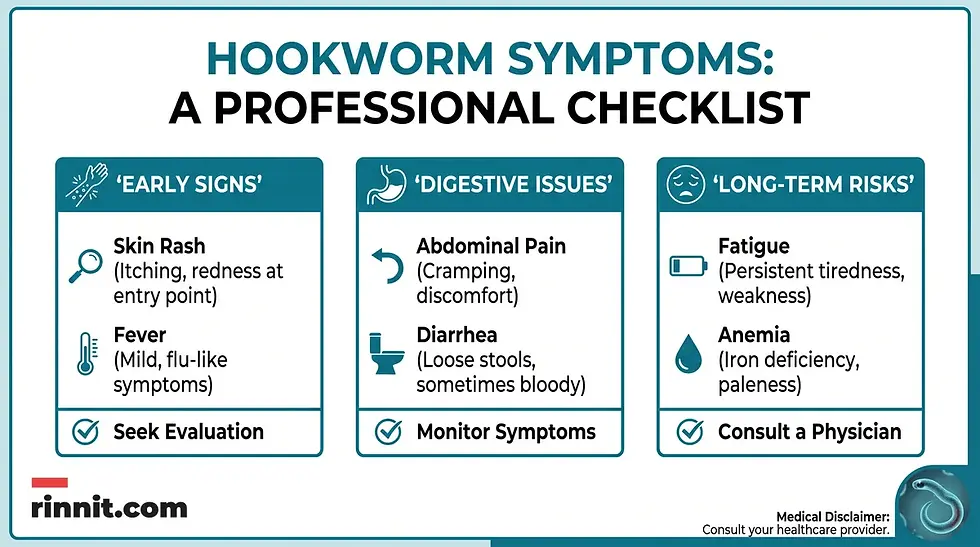
The first sign is often an itchy rash at the site where the larvae entered the skin. As the parasites move through the body, a person might experience a mild fever, coughing, or wheezing. Once the worms reach the digestive tract, symptoms often include:
Abdominal pain and cramping.
Loss of appetite and nausea.
Diarrhea and unexplained weight loss.
Long-term complications: anemia
The most serious complication of hookworm disease is iron-deficiency anemia. Because the worms feed on blood, a chronic, heavy infection leads to significant blood loss. This can cause profound fatigue, dizziness, muscle cramps, and even chest pain. In children, this lack of iron and protein can slow both physical and mental development. [1]
Diagnosis and treatment
If you suspect an infection, especially after traveling to a high-risk area, a healthcare provider can confirm the diagnosis through a simple stool test. Under a microscope, specialists look for the presence of hookworm eggs. In some cases, a blood test (complete blood count) may reveal eosinophilia, an increase in a specific type of white blood cell that can show up weeks before eggs appear in the stool. [1]
Effective medical care
Hookworm disease is highly curable. Treatment typically involves a short course of oral anthelmintic medication, lasting one to seven days, such as:
Albendazole (Albenza)
Mebendazole (Vermox, Emverm)
If the infection has caused significant blood loss, your doctor may also prescribe iron supplements to help your body recover from anemia. [1]
Prevention: staying safe
Preventing hookworm is largely a matter of breaking the transmission cycle between contaminated soil and human skin.

Preventive measure | How it helps |
Wear shoes | Provides a physical barrier against larvae in the soil. |
Hand hygiene | Washing hands after using the toilet and before eating prevents accidental ingestion or spread. |
Proper sanitation | Using toilets and disposing of waste correctly keeps larvae out of the soil. |
Safe fertilizers | Avoiding the use of human feces in agriculture protects the food supply and soil. |
Conclusion
While hookworm disease can lead to serious nutritional deficiencies if left untreated, it is a manageable and preventable condition. By practicing good hygiene and protecting your skin in high-risk environments, you can significantly reduce your risk. If you experience persistent digestive issues or unexplained fatigue after traveling, consult a healthcare provider promptly for testing and treatment.
Prioritize your intestinal health. Learn more about parasitic prevention and digestive wellness at Rinnit.com.
Frequently Asked Questions
Are hookworms contagious from person to person?
Not directly. Eggs passed in stool must develop in warm soil for days to weeks before the larvae can infect anyone, so people get hookworm from contaminated soil, not from contact with an infected person. [1]
Can hookworms go away on their own?
While they may eventually die off after several years, they can cause severe malnutrition and anemia in the meantime. Medical treatment is strongly recommended. [1]
Is it safe to walk barefoot on the beach?
In most well-maintained tourist areas, the risk is low. However, in tropical regions with poor sanitation, walking barefoot on moist soil or sand increases your risk.
How long do hookworms live in the human body?
Once they reach the intestines, they can survive and continue feeding for two years or more. [1]
Can children get hookworm from playing in the dirt?
Yes, if the dirt is contaminated with human feces containing hookworm eggs, children playing barefoot or with their hands are at high risk.
Does washing my feet after walking barefoot prevent infection?
Not necessarily. The larvae penetrate the skin very quickly. Wearing shoes is the most reliable physical protection.
What is the most common sign of hookworm in a child?
Beyond digestive upset, unexplained fatigue and a pale complexion (signs of anemia) are major red flags.
Can I get hookworm from eating contaminated food?
While the primary route is skin penetration, Ancylostoma duodenale can occasionally be ingested through contaminated food or water.
Are there natural remedies for hookworm?
There is no evidence that natural remedies can reliably clear a hookworm infection. Prescription anthelmintic medications are the standard of care.
Should I be tested for hookworm after every tropical vacation?
Only if you have symptoms like an unexplained rash, digestive issues, or fatigue, or if you know you were exposed to high-risk soil.
What is "ground itch"?
Ground itch is a common term for the itchy, red rash that occurs where the hookworm larvae enter the skin.
Can hookworms affect the heart or lungs?
Yes, during their migration phase, they pass through both organs, which can cause coughing or wheezing. [1]
How quickly does treatment work?
A course of medication lasts one to seven days, and most people feel significantly better within a week. [1]
Is hookworm common in the United States?
Hookworm was historically common in the South but is now much less common due to improved sanitation. [1]
Can I get hookworm twice?
Yes. Having a previous infection does not provide immunity; you can be reinfected if you are exposed to contaminated soil again.
Related Reading
Iron Deficiency Anemia: Symptoms, Causes, Treatment & Complete Guide explains low iron anemia, a common result of long-term hookworm infection.
Strongyloidiasis: Understanding Parasitic Infections and Management explains another soil worm that enters through bare skin.
Ascariasis (Roundworm Infection) — Symptoms, Causes, Diagnosis, Treatment & Complete Guide explains roundworm infection, its symptoms, diagnosis and treatment.
Whipworm Infection (Trichuris Trichiura): Symptoms, Causes, and Prevention explains whipworm infection, another parasite spread through contaminated soil.
References
Cleveland Clinic. Hookworm Disease. Cleveland Clinic. Last updated September 17, 2024. https://my.clevelandclinic.org/health/diseases/14072-hookworm-disease
Loukas A, Hotez PJ, Diemert D, et al. Hookworm infection. Nat Rev Dis Primers. 2016;2:16088. PMID 27929101. https://doi.org/10.1038/nrdp.2016.88
Smith JL, Brooker S. Impact of hookworm infection and deworming on anaemia in non-pregnant populations: a systematic review. Trop Med Int Health. 2010;15(7):776-95. PMID 20500563. https://doi.org/10.1111/j.1365-3156.2010.02542.x
Centers for Disease Control and Prevention. About Hookworm. CDC. Last reviewed June 13, 2024. https://www.cdc.gov/sth/about/hookworm.html
Marie C, Petri WA Jr. Hookworm Infection. Merck Manual Consumer Version. Full review Jan 2025; last updated Sept 2026. https://www.merckmanuals.com/home/infections/parasitic-infections-nematodes-roundworms/hookworm-infection
This article is for general educational purposes only and is not a substitute for professional medical advice, diagnosis, or treatment. Always seek the advice of your physician or other qualified health provider with any questions you may have regarding a medical condition.



Comments