Ascariasis (Roundworm Infection) — Symptoms, Causes, Diagnosis, Treatment & Complete Guide

Updated: 2 days ago
Medically reviewed by Dr. Baraa Alnahhal, MD · Last reviewed: October 2026
Quick Answer
Ascariasis is a roundworm infection in which a parasite uses the human body as a host to grow from an egg into an adult worm that can be more than a foot long [1]. It is one of the most common worm infections worldwide, mostly affecting children [1]. Most people have no symptoms, and anti-parasite medicines typically clear it [1] [2].
What the research says
A single dose of anti-worm medicine cures most infections. In a Cochrane review of 30 randomized trials with 6,442 participants, parasitological cure was 93.0% with a single dose of albendazole, mebendazole or ivermectin versus 16.1% with placebo (RR 6.29; 95% CI 3.91–10.12; 8 trials, 1,578 participants), and no differences were detected between the three drugs. (Conterno et al., Cochrane Database Syst Rev, 2020) [3]
Single-dose cure rates against Ascaris are high across drugs. A meta-analysis of 20 randomized trials found single-dose cure rates of 88% for albendazole (95% CI 79–93; 557 patients), 95% for mebendazole (95% CI 91–97; 309 patients) and 88% for pyrantel pamoate (95% CI 79–93; 131 patients). (Keiser and Utzinger, JAMA, 2008) [4]
Worm infections affect child health beyond the gut. A pediatric review reports that soil-transmitted worms, including Ascaris, infect more than 1 billion people worldwide; school-aged children carry the most worms and face poor growth, anemia and cognitive decline, and reinfection after treatment is possible. (Veesenmeyer, Pediatr Clin North Am, 2022) [5]
At a Glance
Aspect | Summary |
Condition type | Roundworm (parasitic) infection |
Cause | Swallowing food or water tainted with roundworm eggs [1] |
Most affected | Children aged 10 and younger in tropical/subtropical regions [1] |
Adult worm size | Females 13–15 inches (35–40 cm) long; more than a foot long; about a quarter inch (6 mm) wide [1] |
Egg production | A mated female can produce 200,000 eggs a day |
Life cycle time | About 2–3 months from egg to egg-laying adult; worms live 1–2 years [1] |
Main symptoms | Most people have none; lung symptoms (cough, wheeze, shortness of breath) and intestinal symptoms (stomach pain, vomiting, diarrhea) [1] |
Key complications | Slowed growth, intestine blockage and tearing, liver/pancreas duct blockages [1] |
Treatment | Anti-parasite medicines; surgery in severe cases [2] |
Prevention | Hygiene, washing/cooking produce, safe water, supervising children [1] |
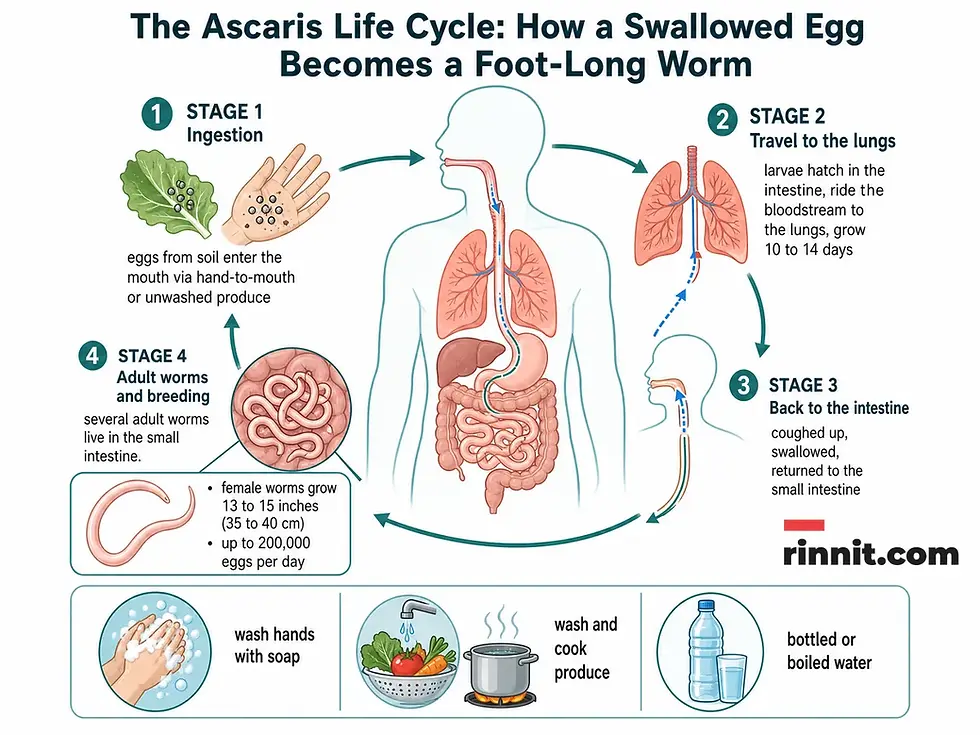
What is ascariasis (roundworm infection)?
Ascariasis is a type of roundworm infection. These worms are parasites that use the body as a host to mature from eggs to adult worms [1]. Adult worms can be more than a foot long.
Ascariasis worms are typically pink or white with tapered ends [1]. Female worms can be more than 15 inches (40 centimeters) long and a little less than a quarter inch (6 millimeters) in diameter. Male worms are generally smaller [1].
Ascariasis is one of the most common worm infections in people worldwide [1]. These infections happen most often in children in tropical and subtropical countries, and the risk is higher in areas that lack good sanitation and waste treatment services [1]. Most often, the infection is caused by eating food or drinking water tainted with roundworm eggs [1].
The good news: treatment exists. Anti-parasite medicines help get rid of the worms. And in places where ascariasis is common, the infection can be prevented by washing hands often, washing fresh vegetables and fruit, and peeling or cooking them before eating [1].
What are the symptoms of ascariasis, and how do they depend on worm location?
Ascariasis symptoms depend on three things: the amount of roundworms in your body, which organs are infected, and your immune system health [1]. Most people have no symptoms at all — but a high number of worms makes symptoms more likely [1].
The Lung Stage
The tiny ascaris eggs are too small to see. After you swallow the eggs, they hatch in the small intestine. Early forms of the worms, called larvae, come out of the eggs. The larvae travel into the lungs through the bloodstream or part of the immune system called the lymphatic system [1].
At this stage, you may have no symptoms — or symptoms like those of asthma or pneumonia:
Dry cough that may bring up blood [1].
Shortness of breath.
Wheezing.
After spending 10 to 14 days in the lungs, the larvae travel to the throat. You cough them up and then swallow them — sending them back down to the intestines [1].
The Intestine Stage
The larvae mature into adult worms in the small intestine [1]. Most often, adult worms live in the intestine until they die [1].
In mild or moderate ascariasis, worms in the intestine can cause:
If you have a large number of worms in the intestine, you might have:
When to see a doctor: Talk with your healthcare professional if you have ongoing stomach pain, diarrhea, or upset stomach or vomiting.

What causes ascariasis, and what is the roundworm's life cycle?
Ascariasis happens when roundworm eggs spread through human or pig stool [1]. Most often, people get ascariasis when they swallow food or water tainted with stool that contains the worms. For example, eating vegetables or fruits that have not been washed, peeled, or cooked can cause infection in places where ascariasis is common. So can eating pig or chicken liver that is infected and hasn't been cooked [1].
Tainted stool gets into food and water through soil. In some parts of the world, human or pig stool is used for fertilizer [1]. Poor sanitary facilities also may allow stool to mix with soil in yards, ditches, and fields. Small children often play in dirt, and infection can happen if they put unwashed fingers in their mouths. Much less often, infection happens after breathing in tainted dust in the air [1]. Handling pigs or their manure for work can also cause ascariasis if infected pig stool gets ingested [1].
The Four-Stage Life Cycle
Stage | What happens |
1. Ingestion | The tiny ascaris eggs can't cause infection unless they first come into contact with soil [1]. People swallow tainted soil through hand-to-mouth contact or by eating raw or undercooked fruits or vegetables grown in contaminated soil. |
2. Travel through the body | Larvae hatch in the small intestine, pass through the intestinal wall into the bloodstream or lymphatic system, and travel to the lungs. After growing about 10–14 days in the lungs, they break into the airway, travel up the throat, are coughed up, swallowed, and returned to the small intestine [1]. |
3. Growth | Back in the small intestine, the parasites grow into male or female worms. Females reach 13–15 inches (35–40 cm) and about a quarter inch (6 mm) wide; males are smaller [1]. |
4. Breeding | A mated female can produce 200,000 eggs a day. The eggs leave the body in stool and must be in soil for at least 2 to 4 weeks before they can infect people [1]. |
The whole process takes about two or three months, and the worms can live inside the body for about a year or two [1].
What are the risk factors for ascariasis?
Risk factor | Why it matters |
Age | Most people who have ascariasis are 10 years old or younger [1] — they are more likely to play in dirt and put fingers in their mouths. |
Warm climate | Most common in tropical and subtropical parts of the world with warm, wet climates [1]. |
Poor sanitation | Widespread where human stool mixes with soil; rare where sanitation is adequate [1]. |
What are the complications of ascariasis?
Ascariasis complications such as slowed growth, intestinal blockage and duct blockages are unlikely in mild cases. But having many worms in the body may lead to:
Slowed growth. Loss of appetite and poor absorption of digested food put children with ascariasis at risk of not getting enough nutrition — and that can slow growth [1].
Intestine blockage and tearing. A mass of worms could block part of the intestine, causing serious stomach cramping and vomiting. The blockage can also make a hole in the wall of the intestine or in the appendix — leading to internal bleeding or dangerous swelling of the appendix called appendicitis [1].
Duct blockages. Sometimes, worms block the narrow ducts of the liver or pancreas, causing serious pain [1].
How is ascariasis diagnosed?
Diagnosis involves a healthcare checkup to find out if the infection is the cause of your symptoms. Your healthcare professional asks about your symptoms and may order tests.
The main diagnostic tools:
Test | What it shows |
Stool test | Mature female worms lay eggs found in stool — but eggs appear only at least 40 days after infection, and if only male worms are present, there will be no eggs in stool at all [2]. |
Blood test | Checks for higher-than-usual eosinophils (a type of white blood cell) that ascariasis can raise — though other conditions can too [2]. |
X-rays | A stomach-area X-ray may show a mass of parasites; a chest X-ray can reveal larvae in the lungs [2]. |
Ultrasound | May show worms in the pancreas or liver [2]. |
CT scan or MRI | Detailed images that help find worms blocking ducts in the liver or pancreas [2]. |
How is ascariasis treated with medicines or surgery?
Ascariasis treatment usually involves taking medicine. Sometimes surgery is needed.
Anti-Parasite Medications
These medicines kill the adult worms in the small intestine [2]:
Medicine | How it is taken |
Albendazole | Taken once |
Ivermectin (Stromectol) | Taken once |
Mebendazole (Emverm) | Once in a large dose, or twice a day for three days in smaller amounts [2] |
Side effects can include mild stomach pain, headache, and diarrhea [2]. Pregnant people may take a different anti-parasite medicine called pyrantel pamoate [2].
Surgery
If many worms are in the body, surgery may be needed to remove worms and repair the damage they've caused [2]. Complications that may require surgery include intestine blockage or holes, bile duct blockage, and appendicitis [2].
How can ascariasis be prevented?
Ascariasis can be prevented with three habits: practicing good hygiene, eating and drinking safely, and supervising young children so they don't sit or play in soil.
Practice good hygiene. Wash your hands with soap and water after you go to the bathroom and before you handle food [1]. If your job involves raising pigs, wash your hands after handling pigs or their manure, or after cleaning pens [1].
Eat and drink safely. Wash fresh fruits and vegetables thoroughly. Peel or cook produce grown in soil fertilized with manure [1]. In places where ascariasis is common, eat only foods that are cooked and hot, and use bottled or boiled water [1].
Supervise young children. Don't let them sit directly on soil or play in it [1].
How should you prepare for an ascariasis appointment?
Your family healthcare professional might refer you to a doctor called a gastroenterologist — trained in digestive conditions [2]. You may need to see a surgeon if the worms have blocked the intestines [2].
Before your appointment, write down answers to these questions:
When did your symptoms start?
Does anything make your symptoms better or worse?
Have you noticed worms in your stool or vomit?
Have you traveled to developing countries lately?
What medicines and supplements are you taking?
During the physical exam, your provider may press on parts of the stomach area to check for pain or tenderness, and may ask for a stool sample for testing.
Frequently Asked Questions
What is ascariasis?
Ascariasis is a roundworm infection — one of the most common worm infections in people worldwide. The parasites use the body as a host to mature from eggs into adult worms that can be more than a foot long, most often affecting children in tropical and subtropical regions.
How do you get roundworms?
Most often by swallowing food or water tainted with roundworm eggs from human or pig stool — for example, unwashed or uncooked vegetables grown in contaminated soil, or infected uncooked pig or chicken liver. Children can also get it by playing in dirt and putting unwashed fingers in their mouths.
What are the symptoms of ascariasis?
Most people have no symptoms. When worms are numerous, lung-stage symptoms mimic asthma or pneumonia (dry cough that may bring up blood, shortness of breath, wheezing), and intestinal-stage symptoms include vague stomach pain, upset stomach and vomiting, diarrhea or bloody stools, and loss of appetite — and in heavy infections, a visible worm in vomit or stool.
How long do roundworms live in the body?
The complete life cycle takes about two to three months, and the worms can live inside the body for about one to two years. A mated female can produce 200,000 eggs a day.
Can ascariasis be cured?
Yes. Anti-parasite medicines such as albendazole, ivermectin, and mebendazole kill the adult worms in the small intestine and typically cure the infection. Surgery is reserved for complications such as intestine blockages, bile duct blockages, and appendicitis.
Is ascariasis contagious from person to person?
Not directly. The eggs must spend at least two to four weeks in soil before they become infective, so ascariasis spreads through contaminated soil, food, and water — not by casual contact.
Conclusion
Ascariasis is a lesson in how geography and hygiene shape disease — and a reminder that one of the world's most common infections has a thoroughly understood life cycle and a reliable cure:
The journey is what makes it strange. A swallowed egg hatches in the intestine, rides the bloodstream to the lungs, is coughed up and swallowed back down — then matures into a worm more than a foot long that can produce 200,000 eggs a day.
Most people never feel it. Symptoms only appear with heavier infections, which is why people in at-risk regions rely on the visible clues: a worm in vomit or stool, persistent stomach trouble, or a child growing too slowly.
It is treatable and preventable. One or two doses of anti-parasite medicine usually clears the worms, and simple hygiene — soap, washed produce, safe water — breaks the cycle that starts in soil.
This guide has walked you through the symptoms, the full life cycle, the three risk factors, the complications that need surgery, the diagnostic tests, the medicines, and the prevention habits — everything you need to recognize ascariasis and act early. If you would like to learn more about digestive conditions, explore our related guide on appendicitis.
Disclaimer: This article is for general informational purposes only and does not constitute medical advice. Always consult a qualified healthcare professional for diagnosis and treatment.
References
Mayo Clinic. Ascariasis — Symptoms & causes. Accessed October 12, 2026. https://www.mayoclinic.org/diseases-conditions/ascariasis/symptoms-causes/syc-20369593
Mayo Clinic. Ascariasis — Diagnosis & treatment. Accessed October 12, 2026. https://www.mayoclinic.org/diseases-conditions/ascariasis/diagnosis-treatment/drc-20369597
Conterno LO, Turchi MD, Corrêa I, et al. Anthelmintic drugs for treating ascariasis. Cochrane Database Syst Rev. 2020;4(4):CD010599. PMID 32289194. https://doi.org/10.1002/14651858.CD010599.pub2
Keiser J, Utzinger J. Efficacy of current drugs against soil-transmitted helminth infections: systematic review and meta-analysis. JAMA. 2008;299(16):1937-48. PMID 18430913. https://doi.org/10.1001/jama.299.16.1937
Veesenmeyer AF. Important nematodes in children. Pediatr Clin North Am. 2022;69(1):129-139. PMID 34794670. https://doi.org/10.1016/j.pcl.2021.08.005



Comments