Whipworm Infection (Trichuris Trichiura): Symptoms, Causes, and Prevention

Updated: 2 days ago
Medically reviewed by Dr. Baraa Alnahhal, MD · Last reviewed: October 2026
Quick Answer
Whipworm infection is an intestinal parasite infection caught by unknowingly swallowing eggs from contaminated soil or food. The eggs hatch in the small intestine and mature in the large intestine. [1] Symptoms, if present, include abdominal pain, nausea and bloody diarrhea. [1] A stool sample confirms it, and treatment is a short course of mebendazole or albendazole. [1] Handwashing and sanitation prevent it.
What the research says
A single dose of albendazole or mebendazole cured only about half of whipworm infections in children. A systematic review and meta-analysis that included 66 studies found cure rates against T. trichiura of 50.8% for albendazole and 48.15% for mebendazole, and combining either drug with another anthelmintic significantly improved efficacy (Bekele et al., J Epidemiol Glob Health, 2024) [4].
Better water, sanitation, and hygiene modestly lower the risk of soil-transmitted worm infection. A Cochrane review of 32 studies with 52,944 participants found an odds ratio of 0.86 for any infection in randomized trials (95% CI 0.74 to 1.01) and 0.71 in non-randomized studies (95% CI 0.54 to 0.94) (Garn et al., Cochrane Database Syst Rev, 2022) [5].
Treating children who are known to be infected may help them gain weight. A Cochrane review of 45 trials found that a single dose of deworming medicine in infected children may increase weight gain over one to six months by 0.2 kg to 1.3 kg (5 trials, 627 participants, low-quality evidence), while treating all children in endemic areas probably has little or no effect on average weight gain (Taylor-Robinson et al., Cochrane Database Syst Rev, 2015) [6].
What is Whipworm?
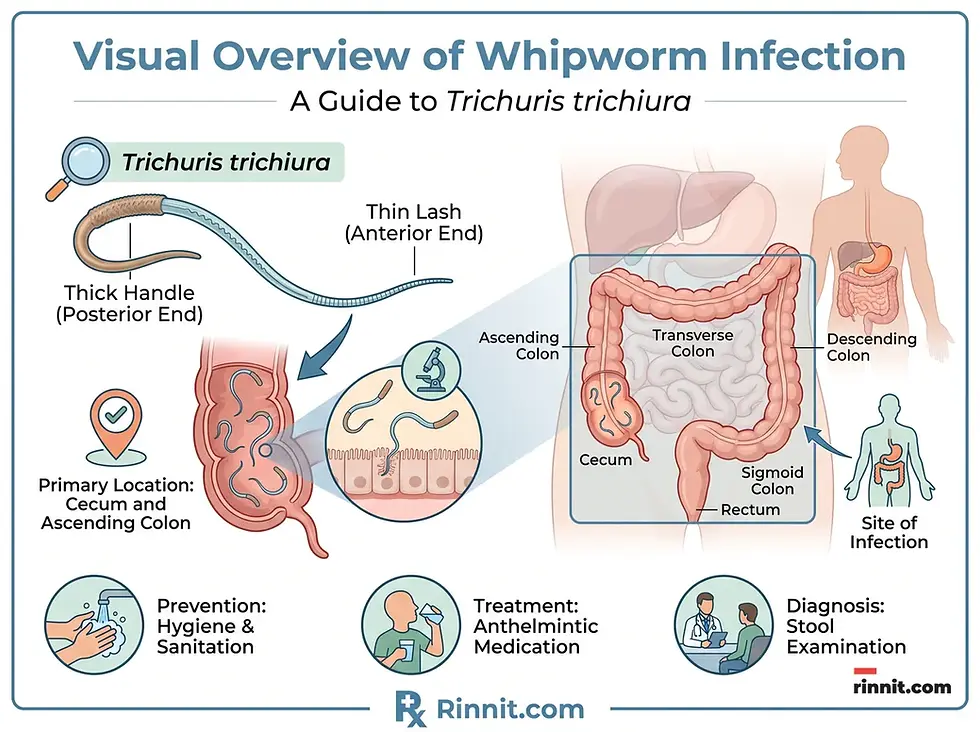
Whipworm, scientifically known as Trichuris trichiura, is a type of roundworm that infects the human digestive system. It earns its name from its distinctive physical appearance: one end is thick and resembles a whip handle, while the other is narrow and looks like the lash of a whip. [1]
The infection is most prevalent in children [1] and is commonly found in tropical regions with high humidity and limited access to modern sanitation. While the thought of a parasite can be unsettling, most people achieve a full recovery with prompt medical intervention. [1]
What are the symptoms of whipworm infection?
Many individuals with a whipworm infection experience no symptoms at all. [1] [2] However, as the number of worms in the intestines increases, symptoms can become more pronounced.
Common Signs
Complications in Children
Severe, untreated infections can lead to significant health issues for growing children:
What causes whipworm infection, and how does it spread?
Whipworm is spread through the fecal-oral route. [2] This means that eggs passed in the stool of an infected person eventually find their way into another person's mouth.
Transmission Method | Description |
Contaminated Soil | Ingesting dirt that contains eggs, often by touching the mouth with unwashed hands. |
Food and Water | Consuming unpeeled or unwashed fruits and vegetables grown in contaminated soil. [1] |
Poor Sanitation |
The Lifecycle
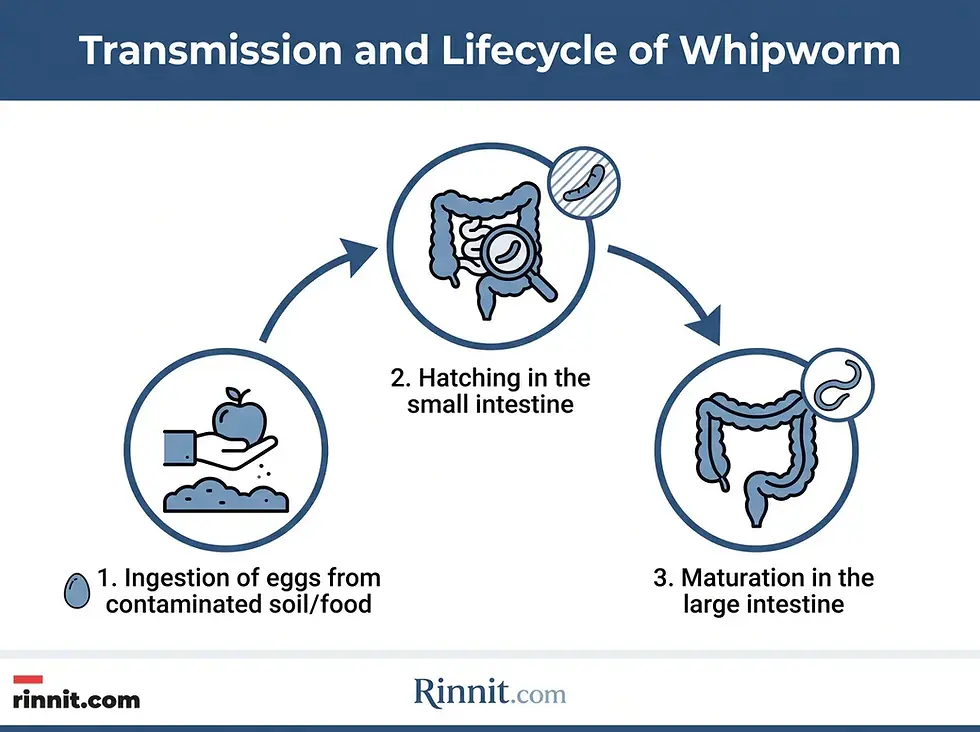
Ingestion: Eggs are swallowed via contaminated food, water, or hands.
Hatching: Eggs reach the small intestine, where they hatch and release larvae. [1]
Maturation: Larvae move to the large intestine [1], where adult worms embed themselves in the intestinal walls.
Reproduction: Female worms begin laying thousands of eggs daily about two months after the initial infection. [1]
What are the risk factors for whipworm infection?
Whipworm infection is more likely in hot, humid climates, areas with poor sanitation, jobs with frequent soil contact, and in children.
Climate: Living in hot, humid environments where the parasite thrives. [1]
Sanitation: Residing in areas with poor hygiene practices or lack of clean water.
Occupation: Working in industries like agriculture where frequent contact with soil is common. [1]
Age: Children are at the highest risk [1] due to frequent outdoor play and developing hygiene habits.
How is whipworm infection diagnosed and treated?
If you suspect an infection, a healthcare provider will perform a diagnostic evaluation to confirm the presence of the parasite.
Testing
Medication
Treatment is straightforward, but single doses often fail to clear whipworm, so a three-day course and a follow-up stool test are commonly used. Providers typically prescribe a short course (one to three days) of oral antiparasitic drugs: [1] [2]
A follow-up stool test may be recommended to ensure the infection has been completely cleared. [1]

How can you prevent whipworm infection?
Reducing the risk of whipworm infection relies heavily on breaking the cycle of contamination.
Rigorous Handwashing: Use soap and warm water before handling food and after using the restroom. [1] [2]
Food Safety: Thoroughly wash, peel, and cook all produce [1] [2], especially root vegetables.
Safe Water: Boil or purify water in areas where the quality is questionable. [1]
Sanitation Hygiene: Avoid using human waste as fertilizer [1] [2] and ensure proper disposal of human feces.
Frequently Asked Questions
1. Can I get whipworm from my dog or cat?
Getting whipworm from a dog or cat is extremely rare. The species that infects humans (Trichuris trichiura) is different from the one that infects dogs (Trichuris vulpis).
2. Do whipworms go away on their own?
Not reliably. Adult worms can live for about a year, and eggs must mature in soil before they can infect anyone, so you do not re-infect yourself directly; treatment is still recommended because heavy infections can cause long-term health problems.
3. How long does treatment take?
Most antiparasitic treatments last between one and three days.
4. What does a whipworm look like?
A whipworm is a thin, thread-like worm with a thick end that looks like a whip handle.
5. Is it contagious between people?
Whipworm infection is not spread through direct skin contact, but rather through the ingestion of eggs found in contaminated environments.
6. Are whipworms common in the United States?
Whipworms are less common in the U.S. than in tropical climates but can still be found in areas with poor sanitation.
7. Can whipworm cause weight loss?
Yes, unexpected weight loss is a potential symptom of a more significant infection.
8. What is rectal prolapse?
Rectal prolapse is a complication of severe infection where part of the large intestine slips out through the anus.
9. How do the worms stay in the body?
Adult worms use their thin ends to embed themselves into the lining of the large intestine.
10. Can whipworm be seen in the stool?
The eggs are microscopic, but adult worms may occasionally be visible in a stool sample during a severe infection.
11. Why are children more at risk?
Children are more likely to play in dirt and may not always wash their hands before eating.
12. Can you get it from swimming?
Only if the water is contaminated with feces containing whipworm eggs and you accidentally swallow it.
13. Does boiling water kill the eggs?
Yes, boiling or proper purification of water can kill the parasite's eggs.
14. What should I do if I think my child has whipworm?
Contact a healthcare provider for a stool test and proper diagnosis.
15. Is the medication safe?
Antiparasitic medications are standard treatments and are generally considered safe when taken as prescribed.
Related Reading
Trusted External Resources
Centers for Disease Control and Prevention (CDC): About Whipworms - fact sheet on whipworm infection (trichuriasis)
World Health Organization (WHO): Soil-transmitted helminth infections - global initiatives for controlling soil-transmitted helminth infections
MedlinePlus: Whipworm infection - overview of whipworm infection from the U.S. National Library of Medicine
References
Cleveland Clinic. Whipworm infection. Cleveland Clinic. Accessed October 8, 2026. https://my.clevelandclinic.org/health/diseases/whipworm-infection
Centers for Disease Control and Prevention. About whipworms. Soil-Transmitted Helminths, CDC. Accessed October 8, 2026. https://www.cdc.gov/sth/about/whipworms.html
World Health Organization. Soil-transmitted helminth infections. WHO Fact Sheets. January 18, 2023. Accessed October 8, 2026. https://www.who.int/news-room/fact-sheets/detail/soil-transmitted-helminth-infections
Bekele T, Lachisa L, Tsegaye A, et al. Efficacy of albendazole and mebendazole against soil transmitted infections among pre-school and school age children: a systematic review and meta-analysis. J Epidemiol Glob Health. 2024;14(3):884-904. PMID: 38696109. https://doi.org/10.1007/s44197-024-00231-7
Garn JV, Wilkers JL, Meehan AA, et al. Interventions to improve water, sanitation, and hygiene for preventing soil-transmitted helminth infection. Cochrane Database Syst Rev. 2022;6(6):CD012199. PMID: 35726112. https://doi.org/10.1002/14651858.CD012199.pub2
Taylor-Robinson DC, Maayan N, Soares-Weiser K, et al. Deworming drugs for soil-transmitted intestinal worms in children: effects on nutritional indicators, haemoglobin, and school performance. Cochrane Database Syst Rev. 2015;(7):CD000371. PMID: 26202783. https://doi.org/10.1002/14651858.CD000371.pub6
Medical Disclaimer
This content is for informational purposes only and does not constitute medical advice. Always seek the advice of a physician or other qualified health provider with any questions regarding a medical condition.



Comments