Histotripsy: How Sound Waves Destroy Liver Tumors, Who Qualifies, Risks and Recovery

Updated: 3 days ago
Written and medically reviewed by Dr. Baraa Alnahhal, MD · Last reviewed: November 2026 · How we review
Quick Answer: What is histotripsy?
Histotripsy is a noninvasive ultrasound treatment that destroys liver tumors without cuts, heat or radiation. A machine focuses short, powerful sound pulses on the tumor, creating tiny bubbles that break cancer cells apart. The U.S. FDA authorized it for liver tumors in October 2023. A session takes an hour, and most people go home the same day. [1]
What the research says
Most treated tumors were destroyed, with few serious problems. In the #HOPE4LIVER pivotal trials, 44 people with primary or metastatic liver tumors at 14 sites in the U.S. and Europe were treated. Technical success was seen in 42 of 44 tumors (95%), and procedure-related major complications occurred in 3 of 44 people (7%). (Mendiratta-Lala et al., Radiology, 2024) [2]
Tumor control held up at one year. In the one-year follow-up of 47 patients and 52 treated tumors, local tumor control was 90% using the post hoc imaging review (63.4% with the primary method). One-year overall survival was 73.3% for hepatocellular carcinoma and 48.6% for cancer that had spread to the liver. (Ziemlewicz et al., Annals of Surgery, 2025) [3]
Real-world safety looks favorable. After FDA authorization, 295 patients had 510 liver tumors treated at 18 centers. Among the 230 patients with safety data, 5.2% had a complication of any grade, most of them minor; all 3 major events were deaths from advanced disease in people treated with palliative intent. (Wehrle et al., Journal of Gastrointestinal Surgery, 2025) [4]
Key takeaways
Histotripsy uses focused sound waves, not heat, X-rays or drugs, to break up liver tumors. [1]
It treats tumors that start in the liver and cancers that have spread to the liver. [1]
Surgery is still the main treatment and the best chance of a cure; histotripsy may be an option when surgery is not. [1]
There are no incisions, and most people go home the same day with little to no pain. [1]
About 1 in 100 people has a serious or major complication. [1]
What is histotripsy?
Histotripsy is a newer, noninvasive ultrasound treatment for liver cancer. It uses high-intensity sound pulses aimed precisely at a tumor. The pulses create a cloud of tiny gas bubbles in the diseased tissue. These bubbles expand and collapse in a way that looks like boiling, but no heat is involved. The bubble cloud breaks apart the walls of cancer cells and leaves behind liquid cell debris that the body clears. [1]

Histotripsy breaks up tumor tissue mechanically, with no heat or incisions.
The FDA authorized histotripsy for liver tumors in October 2023. Experts are still studying how best to use it, but it has been shown to break up cancerous masses effectively and safely. [1]
What does histotripsy treat?
Histotripsy is currently used for liver tumors, including: [1]
Primary liver tumors, which start in the liver, such as hepatocellular carcinoma
Secondary liver tumors, which spread to the liver from another organ (see our guide to metastatic liver cancer)
Surgery remains the main treatment for liver cancer and offers the best chance of a cure. Histotripsy may be an option if surgery is not possible. [1]
Who is a good candidate for histotripsy?
You may be a good candidate for histotripsy if you have: [1]
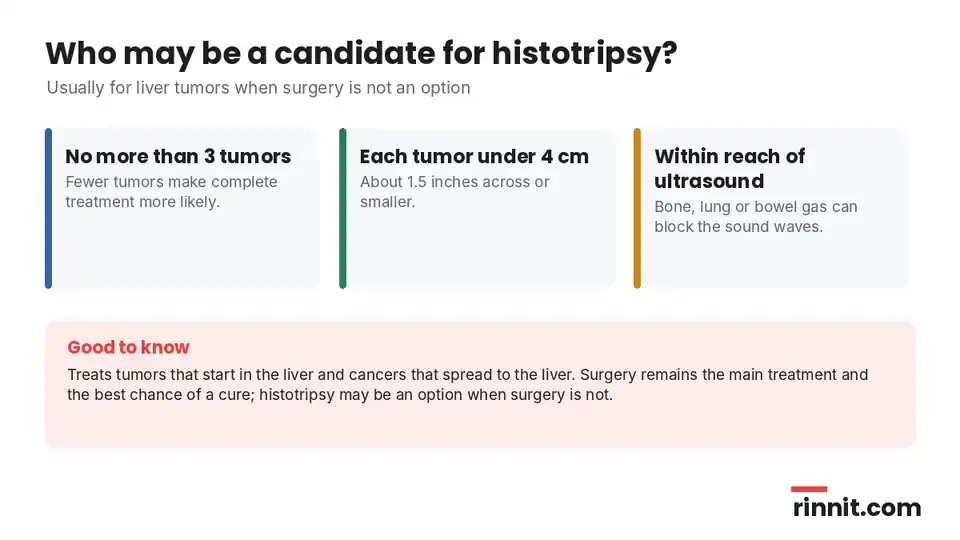
Tumor number, size and location all affect whether histotripsy can be used.
No more than three tumors
Tumors smaller than 4 cm (about 1.5 inches)
Tumors that ultrasound can reach. Bone, lung tissue and gas in the bowel block ultrasound, so tumors behind the rib cage, lungs or digestive tract may be out of reach.
Histotripsy may not suit every type of liver cancer. Ask your provider whether you are a good candidate. [1]
How do you prepare for histotripsy?
Your provider will give you specific instructions, which may include changes to your diet or medicines. Histotripsy is done under general anesthesia, so you will need someone to drive you home afterward. [1]
What happens during histotripsy?
During the procedure, a robotic arm holding a transducer is placed over your abdomen. The average session takes about one hour, depending on how large the treatment area is. [1]
Anesthesia. You are put to sleep, which keeps you still so the tumor can be targeted precisely.
Locating the tumors. Ultrasound imaging shows the tumors on a screen.
Treatment. Your provider programs the machine to send sound pulses to the target, creating a bubble cloud.
Monitoring. The screen shows the bubble cloud moving through the tissue as it breaks down the cancer.
Sources: [1]
Histotripsy at a glance
Item | Typical detail |
Approach | Noninvasive (no incisions) |
Anesthesia | General |
Session length | About 1 hour on average |
Going home | Usually the same day |
Back to normal activities | Often the next day |
Tumor debris cleared | Over the next couple of months |
Sources: [1]
What happens after histotripsy?
Most people wake up with little to no pain and may feel as though they have not had a procedure at all. Most go home the same day. [1]
Over the following couple of months, your body absorbs the tumor debris, with help from your lymphatic system. Healthy liver tissue eventually replaces it. [1]
What are the benefits of histotripsy?
Histotripsy causes minimal to no side effects compared with many cancer treatments, and it spares key liver structures such as blood vessels and bile ducts. Compared with other treatments, it: [1]
Needs no incisions, so it leaves no surgical scars
Does not cause radiation-type burns or hair loss
Does not cause typical chemotherapy side effects such as fatigue or nausea
Stays effective near blood vessels, unlike thermal ablation, which burns tumors with heat
Does not damage antigens, the proteins your immune system uses to find cancer
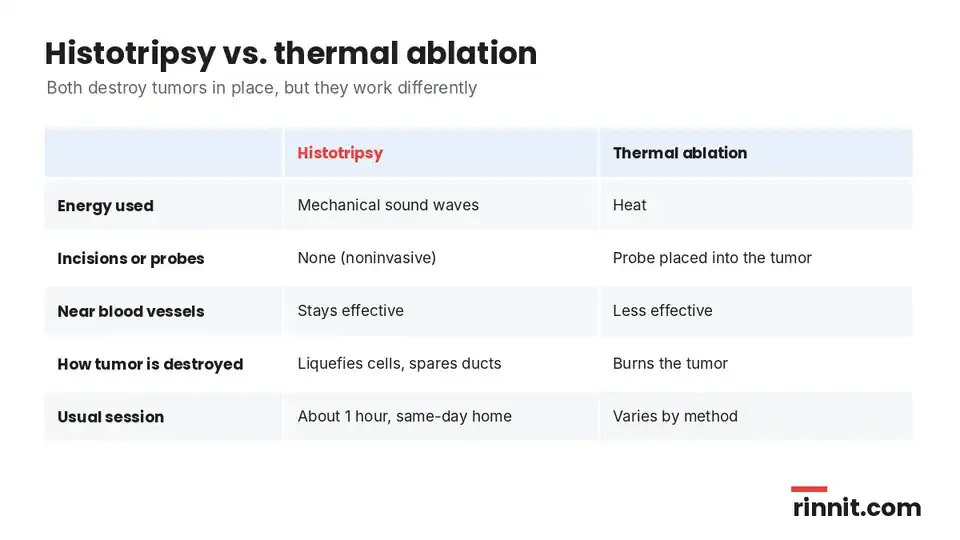
Both treatments destroy tumors where they sit, but histotripsy uses sound instead of heat.
Some studies suggest the immune system may get better at fighting tumors elsewhere in the body, including ones that were not treated directly. Research on this is ongoing. [1]
Histotripsy counts as an ablation technique because it destroys tumors where they sit. Most people use "ablation" to mean thermal ablation, which uses heat; histotripsy uses no heat, X-rays or drugs, only the mechanical energy of sound waves. [1] For another tumor-destroying option, see our guide to ablation for kidney cancer.
What are the risks of histotripsy?
Histotripsy is considered very safe, but complications can happen: [1]
Risk | What it means |
Anesthesia reaction | Usually minor and gone within 24 hours |
Bleeding or infection | Can occur where tissue was destroyed |
Belly pain or fatigue | Generally mild and short-lived |
Serious complication | Affects about 1 in 100 people |
What is recovery like after histotripsy?
Take it easy on the day of your procedure. Over-the-counter pain relievers may help if you need them. Many people can return to normal activities as early as the next day, and your provider will tell you what is right for you. [1]
When should you call your provider after histotripsy?
Contact your provider right away if you have any of these possible anesthesia side effects: [1]
Severe itching or swelling
Numbness anywhere in your body
Slurred speech
Trouble breathing
Trouble swallowing
Is histotripsy the same as lithotripsy?
No. Both use sound waves, but lithotripsy breaks up large kidney stones so they can pass, while histotripsy destroys small liver tumors. [1]
Conclusion
Histotripsy offers a noninvasive way to destroy small liver tumors using focused sound waves, with no incisions, heat or radiation. It is generally safe, most people go home the same day, and recovery is quick. Because researchers are still learning about its uses, it may not be right for every liver cancer, and surgery remains the best chance of a cure when it is possible. [1]
If you have liver cancer and surgery is not an option, ask your care team whether your tumors meet the size, number and location criteria for histotripsy.
Keep learning: Read our full guides to liver cancer and hepatocellular carcinoma. For an overview of liver cancer treatments, see the National Cancer Institute's adult liver cancer treatment summary.
FAQ
What is histotripsy?
Histotripsy is a noninvasive ultrasound treatment that uses focused sound pulses to create a bubble cloud that breaks liver tumor cells apart, with no incisions, heat or radiation.
What does histotripsy treat?
Histotripsy treats liver tumors, including cancers that start in the liver and cancers that have spread to the liver from another organ.
Is histotripsy FDA approved?
Yes. The U.S. Food and Drug Administration authorized histotripsy for liver tumors in October 2023 through its De Novo pathway.
Who is a good candidate for histotripsy?
Good candidates usually have no more than three liver tumors, each smaller than 4 cm, in a spot that ultrasound can reach.
Is histotripsy painful?
Histotripsy is done under general anesthesia, and most people wake up with little to no pain afterward.
How long does histotripsy take?
The average histotripsy session takes about one hour, depending on the size of the treatment area.
How long is recovery after histotripsy?
Most people go home the same day, and many return to normal activities as early as the next day.
What are the risks of histotripsy?
Risks include anesthesia reactions, bleeding or infection where tissue was destroyed, and mild belly pain or fatigue. About 1 in 100 people has a serious complication.
How is histotripsy different from thermal ablation?
Thermal ablation burns tumors with heat, while histotripsy uses the mechanical energy of sound waves and stays effective near blood vessels.
Does histotripsy replace surgery for liver cancer?
No. Surgery is still the main treatment and the best chance of a cure; histotripsy may be an option when surgery is not possible.
How do I prepare for histotripsy?
Your provider gives you specific instructions, which may include changes to what you eat or the medicines you take. Because histotripsy is done under general anesthesia, arrange for someone to drive you home afterward [1].
When should I call my doctor after histotripsy?
Contact your provider right away if you have possible serious anesthesia side effects, such as severe itching or swelling, numbness anywhere in your body, slurred speech, trouble breathing or trouble swallowing [1].
Related Reading
Learn more in our guide to Liver Cancer: A Comprehensive Guide to Symptoms, Causes, and Treatment.
Learn more in our guide to Hepatocellular Carcinoma: What It Is, the 10 Risk Factors, and How Treatment Protects Your Liver.
Learn more in our guide to Understanding Metastatic Liver Cancer: Causes, Symptoms, and Treatment.
References
Cleveland Clinic. Histotripsy: Procedure, Side Effects & What It Treats. Cleveland Clinic. Last updated September 28, 2025. https://my.clevelandclinic.org/health/procedures/histotripsy
Mendiratta-Lala M, Wiggermann P, Pech M, et al. The #HOPE4LIVER Single-Arm Pivotal Trial for Histotripsy of Primary and Metastatic Liver Tumors. Radiology. 2024;312(3):e233051. PMID: 39225612. https://doi.org/10.1148/radiol.233051
Ziemlewicz TJ, Critchfield JJ, Mendiratta-Lala M, et al. The #HOPE4LIVER Single-arm Pivotal Trial for Histotripsy of Primary and Metastatic Liver Tumors: One-year Update of Clinical Outcomes. Ann Surg. 2025;282(6):908-916. PMID: 40201962. https://doi.org/10.1097/SLA.0000000000006720
Wehrle CJ, Burns K, Ong E, et al. The first international experience with histotripsy: a safety analysis of 230 cases. J Gastrointest Surg. 2025;29(4):102000. PMID: 39978577. https://doi.org/10.1016/j.gassur.2025.102000
Medical disclaimer
This article is for general education only and does not replace advice from a qualified healthcare professional. Talk to your doctor about your own diagnosis and treatment, and seek emergency care right away for severe or sudden symptoms.



Comments