Gonorrhea Test: Types, Who Should Get Tested and What Results Mean

Updated: 4 days ago
Written and medically reviewed by Dr. Baraa Alnahhal, MD · Last reviewed: November 2026 · How we review
Quick Answer: What is a gonorrhea test?
A gonorrhea test checks a urine sample or a swab for Neisseria gonorrhoeae, the bacterium that causes gonorrhea, a common sexually transmitted infection (STI). Swabs can come from the vagina, cervix, urethra, rectum or throat. Many people with gonorrhea have no symptoms, so testing is the only way to know for sure. [1]
What the research says
Self-collected samples work well. A meta-analysis of 21 studies with more than 6,100 paired samples found that men's self-collected urine detected 92% of gonorrhea cases found by clinician urethral swabs, with 99% specificity, and self-collected vaginal swabs performed best for chlamydia. (Lunny et al., PLOS ONE, 2015) [2]
Testing only the genitals can miss infections. Among 10,389 patients at two STD clinics, 30.3% of gonorrhea infections in women who reported oral or anal exposure would have been missed with urogenital-only testing. (Trebach et al., Sexually Transmitted Diseases, 2015) [3]
Key takeaways
A gonorrhea test uses a urine sample or a swab from the area that might be infected. [1]
There is no blood test for gonorrhea. [1]
Most tests use a nucleic acid amplification test (NAAT), the most accurate method. [1]
Results usually take one to three days. [1]
A positive result means starting antibiotics right away and telling your partners. [1]
Why get a gonorrhea test?
Gonorrhea is treatable with antibiotics. Without treatment, it can lead to pelvic inflammatory disease (PID), testicular pain and infertility. Because many people have no symptoms, testing protects both you and your partners. [1]
Get tested if you've had sex with someone who has gonorrhea, even if you feel fine. Also get tested if you have any of these symptoms: [1]
Pain or burning when you pee
Unusual discharge from the penis, vagina or urethra
More vaginal discharge than usual or bleeding between periods
Pain in the testicles or scrotum
Rectal pain, itching, discharge or pain when you poop
A sore throat
Eye redness, pain, itching or drainage
Who should get regular gonorrhea screening?
Some people have a higher chance of getting gonorrhea. Ask a healthcare provider about regular screening if you: [1]
Are pregnant
Are a sexually active female younger than 25
Have a new sex partner
Have multiple sex partners
Have a sex partner with gonorrhea
Are living with HIV
Are a gay, bisexual or other man who has sex with men

How does gonorrhea testing work?
A lab tests your urine or swab sample for Neisseria gonorrhoeae. If the bacterium is found, you have gonorrhea. There are two main ways to get tested: [1]
Option | How it works |
At a provider's office | A provider collects urine or a swab from the vagina, cervix, urethra, rectum or throat. Sometimes you collect your own swab in the office. |
At-home kits | FDA-approved kits let you collect urine or a swab at home and mail it to a lab, or run the test yourself. |
Sources: [1]

Some clinics offer rapid tests with faster results, but most samples are still sent to a lab. [1]
How do you prepare for a gonorrhea test?
Your provider will tell you whether you need to prepare. They may ask you to: [1]
Share which parts of your body are involved when you have sex, so they know where to take samples from
Stop taking antibiotics, because some can affect results
Give a "first-catch" urine sample, collected as soon as you start peeing; peeing an hour or two before the test can make the sample too weak
Avoid vaginal creams for 24 hours before testing, because they can contaminate the sample
What happens during the test?
For a urine test, you pee into a cup. For a swab, your provider uses a cotton swab or small brush to collect fluid and cells from the area that may be infected. Sometimes you'll be given instructions to collect the sample yourself. It only takes a few minutes. [1]
What do gonorrhea test results mean?
Results are either negative (not detected) or positive (detected). [1]
Negative: Your sample didn't contain Neisseria gonorrhoeae. It can take several weeks after exposure for an infection to show up, so ask your provider whether the timing was right or whether to retest.
Positive: You have gonorrhea. Start antibiotics right away and tell your sexual partners so they can get tested too.
Sources: [1]
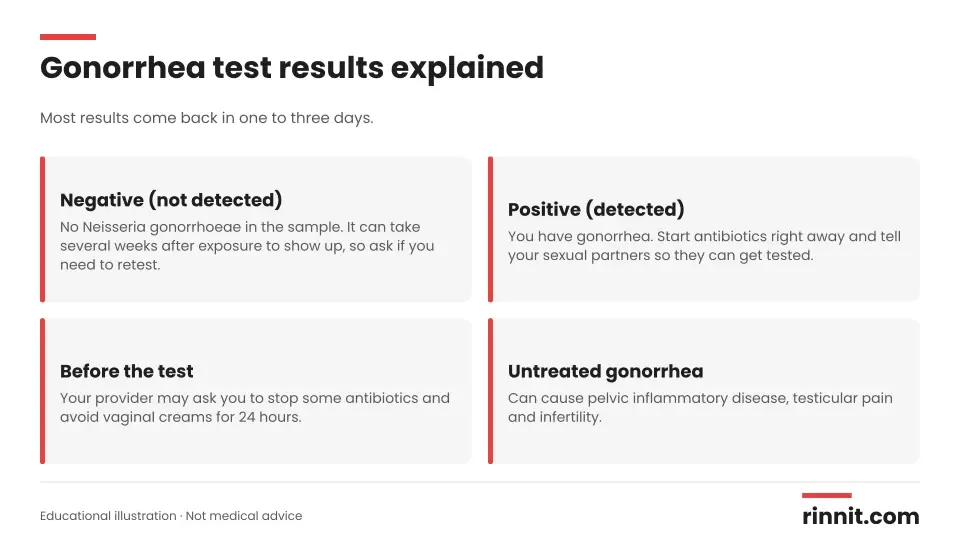
Most results come back in one to three days, depending on how the lab processes the sample. [1]
Conclusion
A gonorrhea test is quick, usually painless and the only reliable way to know whether you have this often-silent infection. Early treatment with antibiotics prevents complications and stops the spread to partners. [1]
Having an STI is nothing to be embarrassed about. If you think you may have been exposed, or you fall into a screening group, ask a provider about testing, and mention every type of sex you have so the right sites are tested.
Keep learning: Read our guide to sexually transmitted diseases or learn about pelvic inflammatory disease. For more background, see the STI testing guide from the CDC.
FAQ
What is a gonorrhea test?
It is a lab test of a urine sample or swab that checks for Neisseria gonorrhoeae, the bacterium that causes gonorrhea. [1]
How is gonorrhea tested?
With a urine sample or a swab from the vagina, cervix, urethra, rectum or throat. [1]
Is there a blood test for gonorrhea?
No. Gonorrhea is detected from urine or swab samples, not blood. [1]
Who should get tested for gonorrhea?
Anyone with symptoms or a partner with gonorrhea, plus screening for pregnant people, sexually active females under 25 and others at higher risk. [1]
How do I prepare for a gonorrhea urine test?
Avoid peeing for an hour or two before the test and give a first-catch sample, collected as soon as you start peeing. [1]
Can I test for gonorrhea at home?
Yes. FDA-approved kits let you collect a sample at home and mail it to a lab or run the test yourself. [1]
How long do gonorrhea test results take?
Most results come back in one to three days. [1]
What does a negative gonorrhea test mean?
No gonorrhea was found, but infection can take several weeks to show up, so ask whether you need to retest. [1]
What should I do if I test positive for gonorrhea?
Start antibiotics right away and tell your sexual partners so they can get tested. [1]
What happens if gonorrhea isn't treated?
It can cause pelvic inflammatory disease, testicular pain and infertility. [1]
Related Reading
Sexually Transmitted Diseases (STDs) Guide: Symptoms, Causes, Diagnosis, and Treatment gives an overview of STIs, including gonorrhea.
Chlamydia: Symptoms, Causes, Treatment, and How to Protect Yourself covers a closely related STI that is usually tested at the same time.
Pelvic Inflammatory Disease: Symptoms, Causes & Treatment — A Clear Guide explains a serious complication of untreated gonorrhea.
Epididymitis: What Causes It, How It's Diagnosed, and How Long Recovery Takes — A Complete Guide covers testicular pain and swelling that gonorrhea can cause.
References
Cleveland Clinic. Gonorrhea Test: Types and Results. Cleveland Clinic. Last updated August 6, 2026. https://my.clevelandclinic.org/health/diagnostics/25211-gonorrhea-test
Lunny C, Taylor D, Hoang L, et al. Self-Collected versus Clinician-Collected Sampling for Chlamydia and Gonorrhea Screening: A Systemic Review and Meta-Analysis. PLoS One. 2015;10(7):e0132776. PMID 26168051. https://doi.org/10.1371/journal.pone.0132776
Trebach JD, Chaulk CP, Page KR, et al. Neisseria gonorrhoeae and Chlamydia trachomatis among women reporting extragenital exposures. Sex Transm Dis. 2015;42(5):233-239. PMID 25868133. https://doi.org/10.1097/OLQ.0000000000000248
Medical disclaimer
This article is for general education only and does not replace advice from a qualified healthcare professional. Talk to your doctor about your own diagnosis and treatment, and seek emergency care right away for severe or sudden symptoms.



Comments