Fasciotomy: An Emergency Procedure for Compartment Syndrome

Updated: 2 days ago
Medically reviewed by Dr. Baraa Alnahhal, MD · Last reviewed: October 2026
Source currency note: This guide reflects medical information reviewed in July 2024. Always confirm current guidance with your healthcare professional.
Quick Answer: What is a fasciotomy?
A fasciotomy is an emergency surgery that treats compartment syndrome by cutting the fascia around muscles to relieve pressure, which can otherwise cut off blood flow and cause permanent tissue death. Done under general anesthesia, it usually takes one to two hours. The wound is often left open until swelling settles, and physical therapy is essential during recovery. [4]
What the research says
Speed matters for the limb. A meta-analysis of 11 studies and 2,504 people with lower-limb acute compartment syndrome estimated amputation after fasciotomy at 10.5% (95% CI 7.8% to 13.5%) and mortality at 7.7% (95% CI 4.6% to 11.5%). Fasciotomy within 6 hours was associated with lower odds of amputation (OR 0.31, 95% CI 0.13 to 0.75), although the studies were mostly observational, so this shows an association rather than proof (Kungwengwe et al., European Journal of Orthopaedic Surgery & Traumatology, 2025 [1]).
For chronic cases, surgery eases pain and raises satisfaction. A meta-analysis of four studies comparing fasciotomy with conservative care for chronic exertional compartment syndrome found greater pain reduction with surgery (standardized mean difference -0.46, 95% CI -0.74 to -0.17) and higher patient satisfaction (OR 3.51, 95% CI 2.19 to 5.60), but no significant difference in return to activity. Complications included hematomas, nerve injuries, and scar-related problems (Elsenosy et al., Cureus, 2024 [2]).
How the wound is closed varies. In a review of 101 adults who had lower-leg fasciotomy at one trauma center, the mean time to wound closure was 9.83 days, and skin grafting was needed in 38.2% of wounds managed with a vacuum dressing, 16.7% with the shoelace technique, and 67.6% with packing (Lutnick et al., Journal of the American Academy of Orthopaedic Surgeons Global Research & Reviews, 2025 [3]).
Indications and emergency context
Fasciotomy is mainly used for acute compartment syndrome, a medical emergency in which rapid pressure buildup threatens the viability of a limb. It is occasionally used for chronic compartment syndrome, which is usually not an emergency [4].
Feature | Acute compartment syndrome | Chronic compartment syndrome |
Urgency | Medical emergency | Elective (non-emergency) |
Primary cause | Severe trauma or injury | Overtraining or repetitive use |
Goal of surgery | Save the limb and prevent tissue death | Relieve chronic pain and pressure |
Success factor | Time to treatment (ideally within about 6 hours; complications rise steeply after 12) | Gradual return to activity and physical therapy |
The surgical procedure
The primary objective of a fasciotomy is to release the restrictive “envelope” of fascia to prevent irreversible damage to muscles and nerves [4].
Preparation and diagnosis
In acute cases, there is no time for traditional preparation. Diagnosis typically happens in an emergency setting based on severe symptoms, such as extreme pain, numbness, tingling, and decreased pulses in the hands or feet. Once the diagnosis is made, the patient is moved straight to the operating room. In chronic cases, the procedure is elective and is recommended only after other treatments have failed [4].
Execution and wound management
Under general anesthesia, the surgeon makes one or two incisions through the skin and the underlying fascia to release the affected compartments. Any dead tissue is removed, and the surgeon watches to make sure blood flow returns. Unlike most surgeries, the wound is often left open for several days so the swelling can subside, and negative pressure wound therapy may be used to draw off fluid. Once the swelling has settled, the wound is closed, sometimes with a skin graft, and wrapped in a compression bandage [4].

Recovery and long-term outlook
Recovery from a fasciotomy is a multi-stage process that prioritizes both wound healing and the restoration of physical function.
Immediately after the procedure, pain management is a priority, and many people manage with over-the-counter medicines or prescribed pain relief. Because the wound may be left open or grafted, specialized wound care is needed. Physical therapy is perhaps the most important part of long-term recovery; without it, the area can become stiff and lose range of motion. The fascia does grow back, but the resulting scar tissue can be less flexible, which makes consistent rehabilitation essential, particularly for athletes and active people [4].

Potential risks and complications
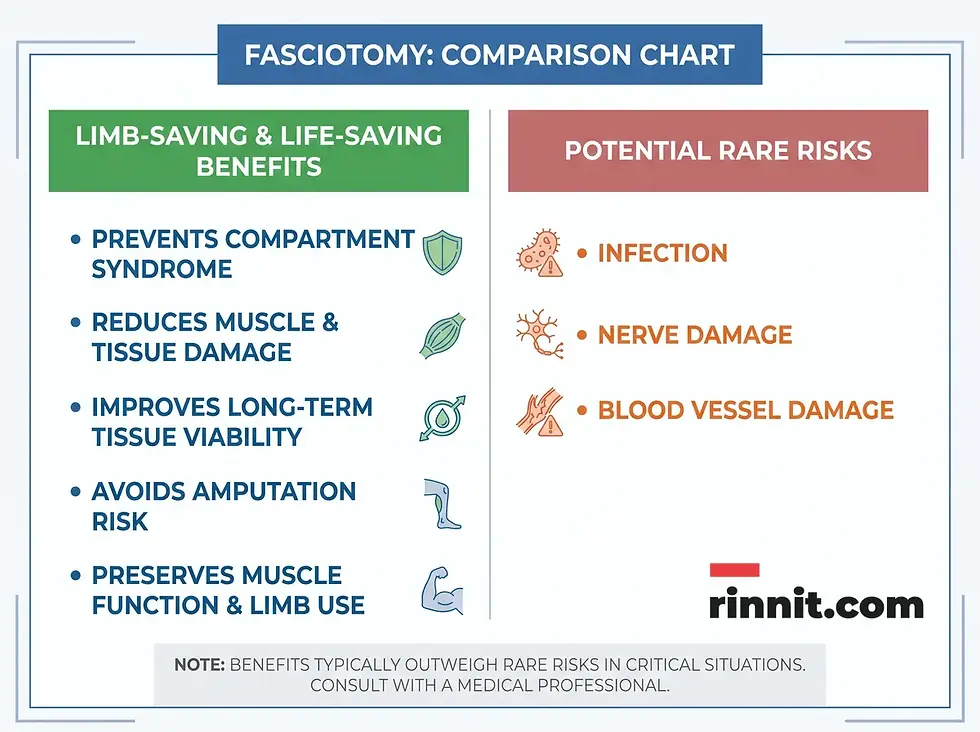
Fasciotomy for acute compartment syndrome is often a limb-saving and sometimes life-saving procedure, but it carries risks that the surgical team and the patient need to watch for.
Any surgery carries a small risk of infection, nerve damage, and damage to nearby blood vessels. With acute compartment syndrome, the procedure can fail to save the limb if blood flow was restricted for too long, compartment syndrome can return during healing, and delayed tissue death may need another operation. For chronic cases, the main risk is recurrence if a person returns to intense activity too quickly, before the tissues have fully adapted [4].
Conclusion
Fasciotomy is a vital intervention and the definitive treatment for the dangerous pressure of compartment syndrome. By acting quickly to release the fascia, surgeons can prevent permanent disability and save limbs. Success depends not only on the speed of the initial surgery but also on commitment to wound care and physical therapy afterward. Knowing the warning signs is essential for anyone at risk of a severe muscle injury.
Critical note: If you have extreme pain, numbness, or a “pins and needles” sensation after an injury, seek emergency medical attention immediately. Time is the most important factor in a successful fasciotomy [4].
Frequently Asked Questions
Is a fasciotomy always an emergency?
In most cases, yes. It is primarily used to treat acute compartment syndrome, which is a medical emergency requiring immediate action to save a limb.
How long does the procedure take?
A fasciotomy typically takes between one and two hours, depending on the complexity of the injury and the number of compartments involved.
Does the fascia grow back after surgery?
Yes, the fascia does grow back. Ideally, it heals in a way that provides more room in the muscle compartment, though scar tissue can sometimes cause stiffness.
Why is the wound left open after surgery?
The wound is left open to allow the intense internal swelling to go down. Closing it too early could cause the pressure to build up again.
Will I need a skin graft?
In many cases, yes. If the swelling was significant, a skin graft from another part of the body may be needed to close the wound once the pressure has subsided.
How soon should treatment begin for acute cases?
Treatment should ideally begin within six hours. After 12 hours, the risk of permanent nerve damage and other complications rises significantly.
What is the success rate of the procedure?
Done in time, it usually relieves the pressure and saves the limb, but results depend on the injury: in one large review of leg cases, about 1 in 10 people still needed an amputation.
Is physical therapy necessary?
Yes, physical therapy is essential to restore your range of motion and prevent the area from becoming permanently stiff.
What are the main risks of the surgery?
Risks include infection, nerve or blood vessel damage, and the potential failure to save the tissue if treatment was delayed.
Can compartment syndrome come back?
Yes, it can recur during the healing process or later if you return to strenuous activity too quickly.
How do I prepare for a fasciotomy?
In most cases there's no time to prepare, because a fasciotomy for acute compartment syndrome is an emergency that's usually diagnosed in the emergency room from symptoms such as severe pain, numbness, tingling and weak pulses in your hands or feet. [4] If you have the chronic form, the surgery can be planned ahead, but it's recommended only after other treatments have failed. [4]
Does a fasciotomy hurt, and what anesthesia is used?
A fasciotomy is done under general anesthesia, so you won't feel the surgery or remember it. [4] You can expect some pain once the anesthesia wears off. [4] Your provider can prescribe pain medication if you need it, and many people manage with over-the-counter pain relievers. [4] Physical therapy is usually recommended once you're ready, because without it the area can become stiff as the fascia heals and scars. [4]
When should I call my doctor after a fasciotomy?
After a recent injury or surgery, get medical care right away if you develop pain that seems out of proportion to the injury, temporary paralysis of a limb, unusual pain when you stretch a muscle group, or numbness, tingling or pins and needles. [4] With acute compartment syndrome, the risk of permanent nerve damage rises after about six hours, so don't wait to be seen. [4] If you had surgery for the chronic form, avoid overusing the muscles too soon, since that makes the problem more likely to return. [4]
Related Reading
References
Kungwengwe G, Donnachie D, Tong K, et al. Post-fasciotomy complications in lower extremity acute compartment syndrome: a systematic review and proportional meta-analysis. European Journal of Orthopaedic Surgery & Traumatology. 2025;35(1):69. PMID 39937292. https://doi.org/10.1007/s00590-025-04186-8
Elsenosy AM, Elnewishy A, Hassan E, et al. Outcomes of fasciotomy versus conservative management for chronic exertional compartment syndrome: a systematic review and meta-analysis. Cureus. 2024;16(12):e75803. PMID 39759644. https://doi.org/10.7759/cureus.75803
Lutnick E, Chernov D, Bousleiman J, et al. Time to wound closure in lower extremity fasciotomy: a retrospective and systematic review. Journal of the American Academy of Orthopaedic Surgeons Global Research & Reviews. 2025;9(12). PMID 41364383. https://doi.org/10.5435/JAAOSGlobal-D-25-00096
Cleveland Clinic. Fasciotomy. Cleveland Clinic. Medically reviewed July 19, 2024. https://my.clevelandclinic.org/health/procedures/fasciotomy
Medical disclaimer
This article was prepared for general information only and is not a substitute for professional medical advice.



Comments