ERP Therapy for OCD: How Exposure and Response Prevention Works, Steps, and Results

Updated: 6 days ago
Written and medically reviewed by Dr. Baraa Alnahhal, MD · Last reviewed: October 2026 · How we review
Quick Answer: What is ERP therapy?
Exposure and response prevention (ERP) therapy is a type of cognitive behavioral therapy and the gold-standard treatment for obsessive-compulsive disorder (OCD). You gradually face anxiety triggers, such as thoughts, images or situations, while resisting compulsions or avoidance. Over time, your brain learns to handle anxiety without rituals, and most people attend weekly sessions for at least a few months. [1][2]
What the research says
ERP has a large effect on OCD symptoms in randomized trials. A review of 36 randomized trials with 2,020 children and adults found a large benefit of CBT with ERP over control conditions (effect size g = 0.74), though the authors flagged concerns about the quality of many studies. (Reid et al., Comprehensive Psychiatry, 2021)
Online ERP works as well as in-person ERP for young people. Across 71 randomized trials in children and teens, ERP lowered OCD symptom scores by about 10.5 points more than waitlist, and remote ERP was as effective as face-to-face sessions. (Steele et al., Pediatrics, 2025)
Few young people drop out of ERP. In randomized trials of youth with OCD, about 10% left ERP early, compared with about 17% for medication and 21% for other active therapies; most ERP dropouts were for practical reasons. (Johnco et al., Depression and Anxiety, 2020)
Key takeaways
ERP is a structured, goal-based form of exposure therapy within cognitive behavioral therapy (CBT). [1]
It is the main psychological treatment for OCD and works through "response prevention": not performing the compulsion after an obsessive thought. [1][3]
Exposure starts with smaller triggers and builds up slowly. You are not pushed too far, too fast. [1]
In one review, more than 6 in 10 people had fewer OCD symptoms after ERP, and more than 3 in 10 were symptom-free at the end of therapy. [1][2]
ERP can feel hard at first. A trained therapist helps you manage the emotions it brings up. [1]
What is ERP therapy?
ERP therapy is a behavioral therapy that helps you face fears in a safe, step-by-step way. [1] You practice being around things that make you anxious, such as certain thoughts, images or situations. At the same time, you work on not avoiding the fear and not turning to rituals, which are repeated behaviors that make you feel safe.
Over time, this practice teaches your brain to handle anxiety better.
ERP is a form of exposure therapy, which is one type of cognitive behavioral therapy (CBT). CBT is a talk therapy that uses structure and goal setting to guide treatment. [1]
What conditions does ERP therapy treat?
ERP therapy is the main treatment for obsessive-compulsive disorder (OCD) and is recognized as a first-line, evidence-based psychotherapy for the condition. [1][2][3]
It works through "response prevention." This means learning not to perform a compulsion after an obsessive thought. Each time you resist, you weaken the habit, and anxiety drops over time. [1]
ERP can also help with other anxiety disorders, and exposure-based therapy is a core treatment for conditions such as specific phobias. [1]
How does ERP therapy work?
ERP therapy works by breaking the cycle between obsessions and compulsions. [1]
If you have OCD, you may live with upsetting, unwanted thoughts called obsessions. They can make you anxious about something that hasn't happened. To feel better, you may repeat certain behaviors or avoid situations. These actions are called compulsions.
Compulsions bring short-term relief. But over time, that relief makes the obsessions and compulsions stronger. [1]
In ERP, you face your fears without doing the ritual or avoiding the situation. You learn that you can handle the anxiety, and you see that the feared outcome doesn't happen. [1]
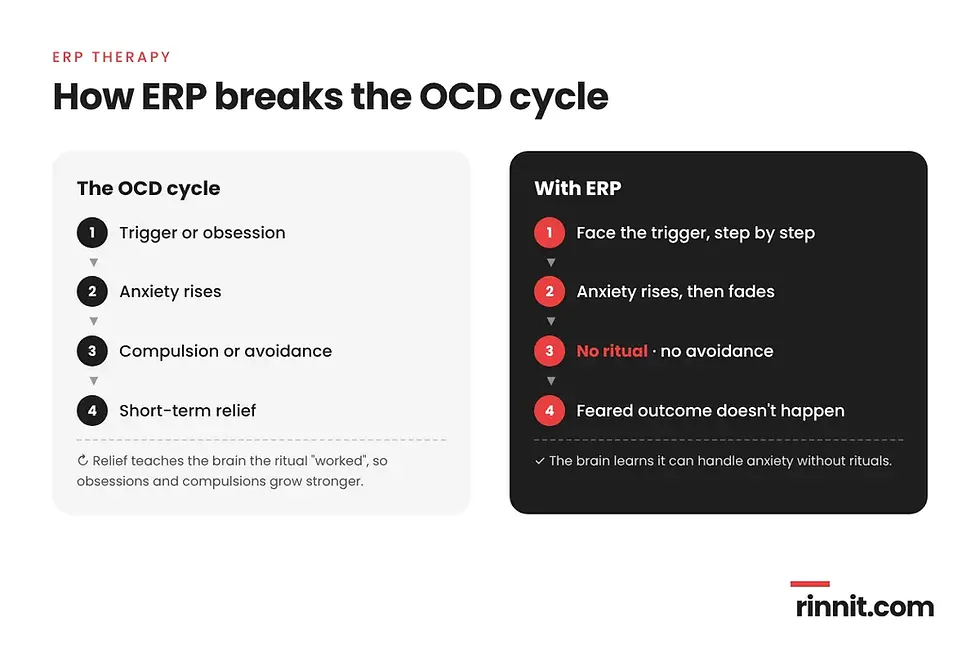
How ERP breaks the cycle: you face the trigger, skip the ritual, and let the anxiety fade on its own.
Stage | The OCD cycle | With ERP |
Trigger | Obsession appears | You face it on purpose, step by step |
Anxiety | Rises and feels urgent | Rises, then fades without action |
Response | Compulsion or avoidance | No ritual, no avoidance |
Result | Short relief, stronger OCD | Brain learns anxiety is manageable |
What happens during ERP therapy?
ERP therapy usually follows three core steps, plus practice at home between sessions. [1] Treatment varies with your needs, but most programs look like this:
Assessment and planning. Your therapist explains how ERP works. They ask about your triggers, obsessions and compulsions, then build a plan that fits you.
Practicing exposure. In each session, you slowly face your triggers and practice resisting rituals or avoidance.
Processing exposure. Afterward, you and your therapist talk about what happened and how you managed it.
Between sessions, you practice the same skills on your own, much like homework. When you meet a trigger in daily life, you use what you learned instead of avoiding it. If something feels too hard, you bring it to your next session. [1]
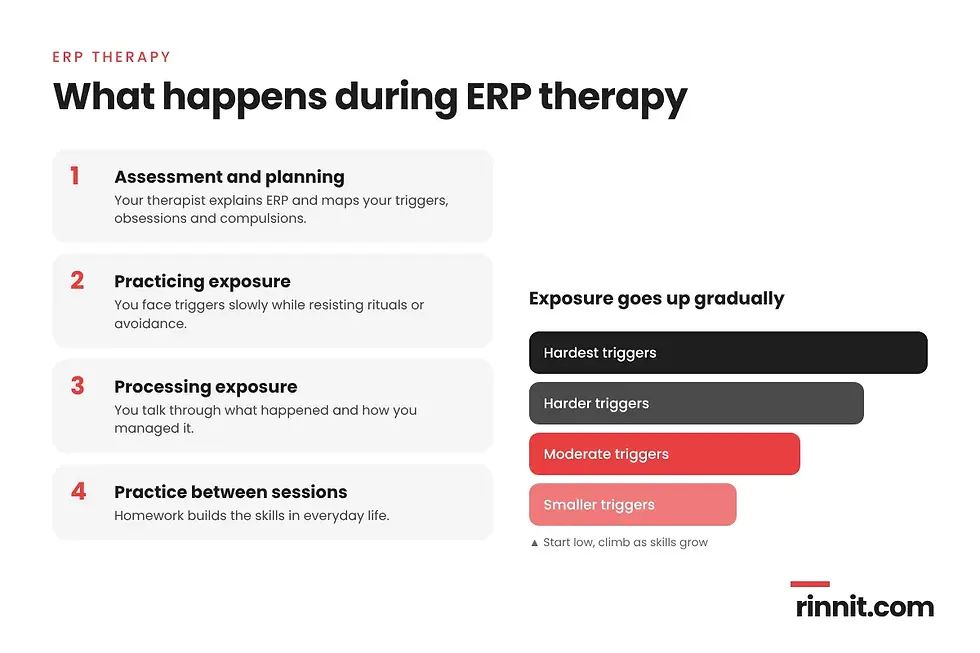
ERP moves in steps: plan, practice, process, repeat at home, while exposures climb from easier to harder triggers.
Exposure is slow and steady. It usually starts with smaller triggers that cause less anxiety. As your skills grow, you work up to harder ones. Your therapist also teaches coping tools to manage stress and lower the risk of relapse, which means slipping back into rituals. [1]
Relapses don't mean you've failed. They are a normal part of getting better, and your therapist will help you build skills to handle them. [1]
What are the main types of ERP exercises?
The two most common ERP exercises are imaginal exposure and in vivo exposure. [1]
Exercise | What you do | Example |
Imaginal exposure | Picture a situation that triggers your obsessions | Imagining a worst-case scenario, writing it down, and reading it aloud until it loses power |
In vivo exposure | Face the fear in real life | Touching a surface without washing your hands, or leaving objects out of order |
Both exercises help you approach difficult feelings safely. They can teach your brain that anxiety fades on its own, without rituals. [1]
How effective is ERP therapy?
ERP therapy is an effective treatment for OCD for many people. [1][2] In one review, more than 6 in 10 people who completed ERP had fewer OCD symptoms, and more than 3 in 10 were fully symptom-free when therapy ended. [1][2]
Results vary from person to person. Ask your provider what results you can realistically expect.

ERP results at a glance. Individual outcomes vary.
What are the benefits of ERP therapy?
The main benefits of ERP therapy are fewer OCD symptoms and less time lost to cycles of obsessions and compulsions. [1] People who go through ERP may also notice:
Better sleep
Better stress management
Greater overall well-being
More confidence
Stronger coping skills
What are the risks and challenges of ERP therapy?
The biggest challenge of ERP therapy is that you have to face your fears, which can make you feel anxious or stressed. [1]
You may dread sessions at first because they take an emotional toll. For some people, therapy feels so intense that it becomes hard to stick with. [1]
You will also need to share your biggest fears with someone new. That can feel uncomfortable, and that is normal. It usually gets easier as trust builds. [1]
You are not doing this alone. Your therapist supports you through each step and helps you manage whatever emotions come up. The process is gradual, and you won't be pushed too far, too quickly. [1]
How long does ERP therapy take?
ERP therapy has no fixed timeline, but most people attend weekly sessions for at least a few months. [1] Intensive daily programs are another option for some people. Your provider will suggest options based on your goals.
Each session is built around your needs. Tell your therapist if things feel too fast or you're struggling. Like learning any new skill, ERP takes practice, and there is no need to rush. [1]
When should you call your therapist during ERP therapy?
You should contact your therapist during ERP therapy if your symptoms get worse, you feel stuck, or home practice becomes too hard. [1] Reach out if:
Your symptoms are getting worse or harder to manage
You struggle to practice ERP exercises on your own
You feel stuck or overwhelmed
Get help right away: ERP can stir up difficult emotions. If you have thoughts of suicide, contact your provider immediately. In the U.S., call or text 988 to reach the Suicide & Crisis Lifeline, available 24/7. Outside the U.S., call your local emergency number or crisis line. [1]
Can you do ERP therapy by yourself?
You can practice some parts of ERP therapy at home, using apps or self-help books, but you get the most benefit from working with a trained therapist. [1] A therapist helps you handle the challenges, emotions and stress that come up, and can teach techniques you might not know about. You can search for trained OCD therapists, including online options, in the International OCD Foundation directory.
ERP therapy at a glance
Question | Answer |
What is it? | A type of exposure therapy within CBT |
Main use | Obsessive-compulsive disorder (OCD) |
Core idea | Face triggers without rituals or avoidance |
Main steps | Assessment and planning → practicing exposure → processing exposure |
Common exercises | Imaginal exposure, in vivo exposure |
Typical length | Weekly sessions for at least a few months; intensive daily programs exist |
Reported results | 6+ in 10 had fewer symptoms; 3+ in 10 symptom-free at the end of therapy |
Main challenge | Facing fears can feel stressful at first |
Conclusion
ERP therapy asks you to do the opposite of what OCD demands: face the fear and skip the ritual. That is hard, and it takes patience and courage. But the process is gradual, a trained therapist guides each step, and the research shows real results for many people. Each small exposure is progress, and over time your brain learns that fear does not have to be in charge.
Next step: If OCD symptoms are taking up your time or affecting your daily life, talk to a doctor or a licensed mental health professional about whether ERP is right for you. To understand the condition itself, read our complete OCD symptoms and treatment guide, and explore more evidence-based guides in our health library.
FAQ
What is ERP therapy?
ERP therapy is a type of cognitive behavioral therapy in which you gradually face anxiety triggers while resisting compulsions or avoidance. It is the gold-standard treatment for obsessive-compulsive disorder (OCD).
What does ERP stand for?
ERP stands for exposure and response prevention. "Exposure" means facing the thoughts, images or situations that trigger anxiety, and "response prevention" means not performing the compulsion afterward.
Is ERP the same as CBT?
ERP is a form of exposure therapy, which is one type of cognitive behavioral therapy (CBT). Like other CBT, it uses structure and goal setting to guide treatment.
How successful is ERP therapy for OCD?
In one review, more than 6 in 10 people who completed ERP had fewer OCD symptoms, and more than 3 in 10 were symptom-free at the end of therapy. Results vary, so ask your provider what to expect.
How long does ERP therapy take to work?
There is no fixed timeline, but most people attend weekly ERP sessions for at least a few months. Some people use intensive daily programs instead.
Is ERP therapy hard?
ERP therapy can feel hard because you face your fears, which may cause anxiety or stress at first. The process is gradual, and your therapist supports you so you are not pushed too far, too quickly.
Can I do ERP therapy on my own?
You can practice parts of ERP at home with apps or self-help books, but you get the most benefit from working with a trained therapist who can guide you through challenges.
Does ERP therapy work online?
Yes. In a large analysis of trials in children and teens with OCD, ERP delivered remotely worked as well as in-person ERP.
What is an exposure hierarchy in ERP?
An exposure hierarchy is a list of feared situations ranked from least to most upsetting. You and your therapist start with easier steps and work up slowly as your confidence grows.
Can ERP be combined with medication?
Yes. Many people with OCD use ERP together with medicine, such as an SSRI antidepressant. Your provider can help decide whether combining them makes sense for you.
Related Reading
Obsessive-Compulsive Disorder (OCD): Symptoms, Causes & Treatment Guide explains OCD symptoms, causes and treatment options.
Exposure Therapy: What It Is, How It Works, Types, and What to Expect describes how gradually facing fears helps reduce anxiety.
Cognitive Behavioral Therapy (CBT): What It Is, What It Treats and What to Expect explains how CBT works and the conditions it treats.
Body Dysmorphic Disorder: Symptoms, Causes, and How It Is Treated covers a related condition often treated with ERP-style therapy.
References
Cleveland Clinic. Exposure & Response Prevention (ERP) Therapy: What It Is. Cleveland Clinic. Last updated October 29, 2025. https://my.clevelandclinic.org/health/treatments/erp-therapy
Hezel DM, Simpson HB. Exposure and response prevention for obsessive-compulsive disorder: a review and new directions. Indian J Psychiatry. 2019;61(Suppl 1):S85-S92. PMID 30745681. https://doi.org/10.4103/psychiatry.IndianJPsychiatry_516_18
Law C, Boisseau CL. Exposure and response prevention in the treatment of obsessive-compulsive disorder: current perspectives. Psychol Res Behav Manag. 2019;12:1167-1174. PMID 31920413. https://doi.org/10.2147/PRBM.S211117
Reid JE, Laws KR, Drummond L, et al. Cognitive behavioural therapy with exposure and response prevention in the treatment of obsessive-compulsive disorder: a systematic review and meta-analysis of randomised controlled trials. Compr Psychiatry. 2021;106:152223. PMID 33618297. https://doi.org/10.1016/j.comppsych.2021.152223
Steele DW, Kanaan G, Caputo EL, et al. Treatment of obsessive-compulsive disorder in children and youth: a meta-analysis. Pediatrics. 2025;155(3):e2024068992. PMID 39639456. https://doi.org/10.1542/peds.2024-068992
Johnco C, McGuire JF, Roper T, et al. A meta-analysis of dropout rates from exposure with response prevention and pharmacological treatment for youth with obsessive compulsive disorder. Depress Anxiety. 2020;37(5):407-417. PMID 31778595. https://doi.org/10.1002/da.22978
National Institute of Mental Health. Obsessive-Compulsive Disorder (OCD). National Institute of Mental Health. Last reviewed December 2024. https://www.nimh.nih.gov/health/topics/obsessive-compulsive-disorder-ocd
Medical disclaimer
This article is for general educational purposes only and is not a substitute for professional medical advice, diagnosis, or treatment. Always talk to a qualified healthcare provider about your symptoms and treatment options. If you are in crisis or thinking about harming yourself, contact your local emergency number or crisis line right away.



Comments