Elastography: Types, Preparation, What to Expect and Liver Fibrosis Stages

Updated: 2 days ago
Written and medically reviewed by Dr. Baraa Alnahhal, MD · Last reviewed: November 2026 · How we review
Quick Answer: What is elastography?
Elastography is a painless, noninvasive test that measures how stiff an organ is, most often the liver. Stiff tissue usually means scarring (fibrosis), so the test helps find and track liver damage without a biopsy. It's done with ultrasound or MRI and takes minutes. Results are reported as fibrosis stages from F0 (no scarring) to F4 (cirrhosis).
What the research says
Point-of-care FibroScan reliably finds advanced liver scarring. In a meta-analysis of 20 studies with 6,159 patients with metabolic liver disease, transient elastography detected advanced fibrosis (F3 or higher) with an AUC of 0.84, a sensitivity of 88.1% and a specificity of 63.8%, and cirrhosis with a sensitivity of 87.5%. (Sarkar Das et al., Diagnostics, 2024) [2]
Liver stiffness beats blood-test scores for advanced fibrosis. In an individual patient data meta-analysis of 37 studies with 5,735 patients, liver stiffness by transient elastography had an AUROC of 0.85 for advanced fibrosis, compared with 0.76 for FIB-4 and 0.73 for the NAFLD fibrosis score; using FIB-4 first and elastography second left only 33% of patients needing a biopsy. (Mózes et al., Gut, 2022) [3]
Key takeaways
Elastography measures tissue stiffness with painless, low-frequency vibrations; stiffer tissue suggests scarring. [1]
Its main use is checking the liver for fibrosis, which can progress to cirrhosis, liver cancer and liver failure. [1]
Transient (ultrasound) elastography takes a few minutes; MR elastography takes about 5 minutes alone or 45 minutes with a full MRI. [1]
Avoid high-sugar foods beforehand, remove metal and jewelry, and tell the team about implants or pregnancy. [1]
Results are reported as stages F0 to F4, and a radiologist usually has them within a few days. [1]
What is elastography?
Elastography is an imaging test that measures the stiffness, or elasticity, of body organs, mainly the liver. It uses painless, low-frequency vibrations and tracks how they travel through tissue; vibrations move faster through stiff, scarred tissue than through healthy tissue. [1]
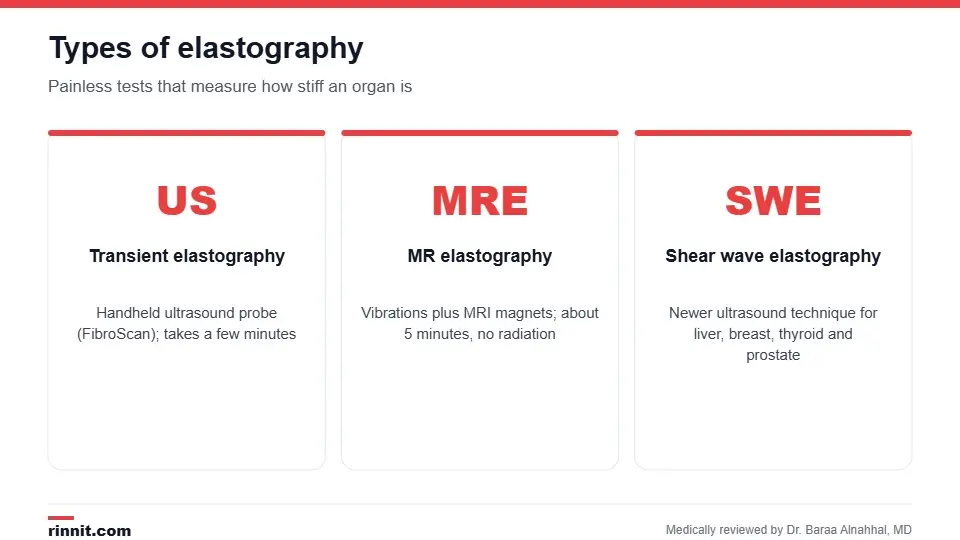
The main types of elastography.
Types of elastography
Type | How it works | Notes |
Transient elastography (FibroScan) | A handheld ultrasound probe sends vibrations through the liver | Painless and fast; the most common type |
Magnetic resonance elastography (MRE) | Combines vibrations with MRI magnets and radio waves | No radiation; done alone or with a full MRI |
Shear wave elastography | Ultrasound pulses create shear waves in the tissue | Newer technique used for the liver, breast, thyroid, prostate and muscles |
Sources: [1]
Why is elastography done?
Elastography is most often used to check the liver for fibrosis, scarring that can progress to cirrhosis. Providers order it for people with risk factors, signs or symptoms of liver disease, including fatty liver disease (MASLD) and hepatitis B. Untreated fibrosis can reduce blood flow through the liver and lead to cirrhosis, liver cancer, liver failure and bleeding in the digestive tract. [1]
The test also guides treatment, tracks how well treatment is working and helps predict complications. Research shows it is accurate for diagnosing fibrosis and useful for monitoring change over time. [1] Large analyses confirm that liver stiffness outperforms blood-test scores such as FIB-4 for advanced fibrosis and can spare many people a liver biopsy. [3]
How do you prepare for elastography?
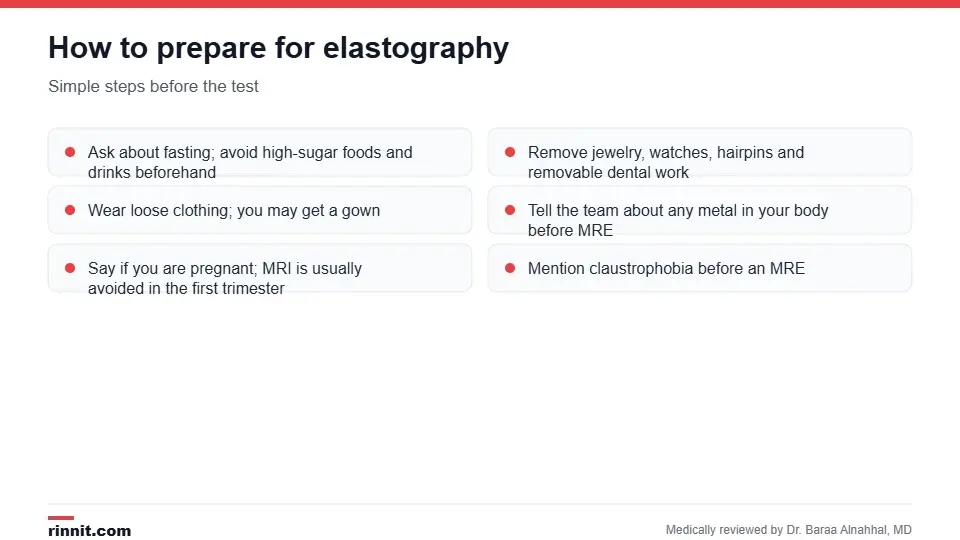
Preparation steps for elastography.
Avoid high-sugar foods and drinks beforehand, because they can change liver stiffness; ask your provider whether you need to fast. [1]
Remove jewelry and accessories, including rings, watches, hairpins, hearing aids and removable dental work. Wear loose clothing; you may be given a gown. [1]
Tell your provider about any metal in your body, such as shrapnel, older defibrillators or pacemakers, because metal interferes with MRI. [1]
Tell the team if you are or might be pregnant. Elastography is generally considered safe in pregnancy, but MRI is usually avoided in the first trimester unless the benefits outweigh the risks. [1]
Mention claustrophobia before an MRE. [1]
What happens during elastography?
Radiologists perform both types, often working with primary care providers, oncologists and hepatologists. [1]
Transient elastography
A water-based gel goes on your skin, and the radiologist moves the probe over the liver. The probe sends vibrations that bounce back to a computer, which produces an image showing the organ's size, shape, consistency, stiffness and any fluid. It takes a few minutes. [1]
Magnetic resonance elastography
You lie on a table, sometimes with straps, and a small driver device is placed on your lower right chest over the liver. If a contrast MRI is planned, gadolinium is given through an IV in your hand. You move into the MRI tube and hold your breath for 10 to 15 seconds at a time while the vibrations are applied. MRE alone takes about 5 minutes; with a full MRI it takes about 45 minutes. [1]
Elastography at a glance
Item | Transient elastography | MR elastography |
Time | A few minutes | About 5 minutes (45 with a full MRI) |
Pain | None | None |
Radiation | None | None |
Enclosed space | No | Yes, inside the MRI tube |
Results | Within a few days | Within a few days |
Sources: [1]
What are the risks of elastography?
Elastography ultrasound has no known risks. MRE has no risks for the average patient when safety guidelines are followed; the possible exceptions are excessive sedation, if sedation is used, and a small chance of an allergic reaction to gadolinium contrast when a contrast MRI is done. [1]
What do elastography results mean?
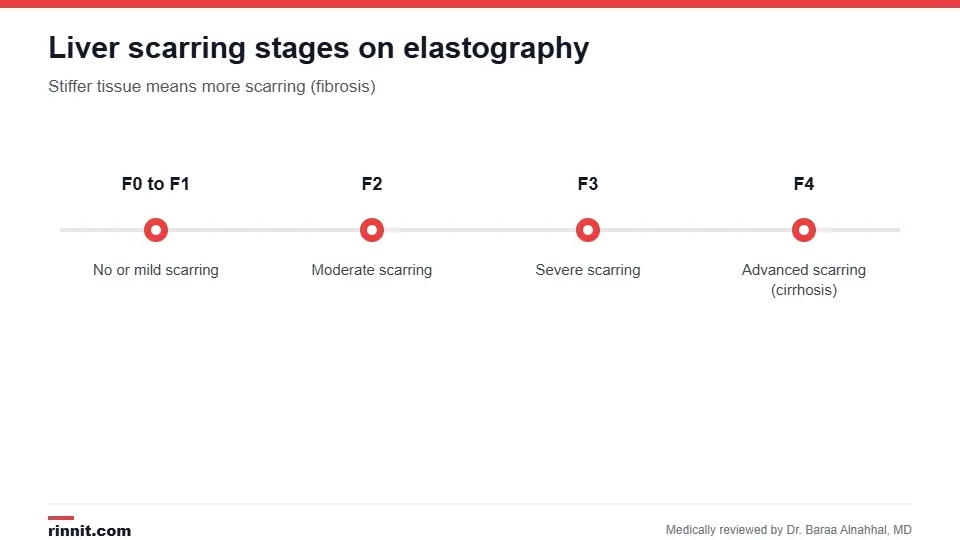
How liver scarring is staged.
The image shows the stiffness of your liver, which reflects scarring. Results are grouped into stages: [1]
Stage | Degree of scarring |
F0 to F1 | None or mild |
F2 | Moderate |
F3 | Severe |
F4 | Advanced scarring (cirrhosis) |
Sources: [1]
A radiologist usually determines the result within a few days and sends it to your referring providers, one of whom will contact you to review it. [1] Studies show the test is especially good at picking up advanced scarring, though body size and the probe used can affect accuracy. [2]
When should you call a doctor?
Contact your provider if you have not heard about your results within a week, or sooner if you develop yellowing of the skin or eyes, a swollen belly, confusion or vomiting blood, which can signal advancing liver disease.
Conclusion
Elastography is a quick, painless way to measure liver stiffness and stage scarring without a biopsy. Ultrasound-based FibroScan takes minutes, and MR elastography adds detail when needed. [1]
Results from F0 to F4 help your provider decide on treatment and how closely to monitor your liver. If you have fatty liver disease, hepatitis or other risk factors, ask whether elastography is right for you. [1]
Keep learning: Read our guide to fatty liver disease (MASLD), the most common reason elastography is ordered today.
Frequently asked questions
What is elastography?
A painless imaging test that measures how stiff an organ is, mainly to detect liver scarring.
What is a FibroScan?
A brand of transient elastography that uses a handheld ultrasound probe to measure liver stiffness in a few minutes.
Is elastography painful?
No. Both ultrasound and MR elastography are painless and noninvasive.
How long does elastography take?
Transient elastography takes a few minutes; MRE takes about 5 minutes alone or 45 minutes with a full MRI.
How do I prepare for elastography?
Avoid high-sugar foods, ask about fasting, remove metal and jewelry, and tell the team about implants or pregnancy.
What do elastography stages mean?
F0 to F1 means no or mild scarring, F2 moderate, F3 severe and F4 cirrhosis.
Can elastography replace a liver biopsy?
Often, yes. It can stage fibrosis and spare many people a biopsy, though a biopsy is still needed in some cases.
Does elastography use radiation?
No. Neither ultrasound nor MR elastography uses radiation.
Is elastography safe in pregnancy?
It is generally considered safe, but MRI is usually avoided in the first trimester unless the benefits outweigh the risks.
How accurate is elastography?
It is good at finding advanced fibrosis, with sensitivity near 88% in large analyses, though some positive results are false alarms.
Related Reading
Fatty Liver Disease (MASLD): The Silent Liver Condition Linked to Weight, Diabetes, and Metabolic Health — Causes, Testing, and Treatment explains the liver condition most often checked with elastography.
Cirrhosis of the Liver: What It Is, How Permanent Scarring Damages Your Liver, and What Treatment Involves describes the advanced scarring elastography aims to detect early.
Liver Biopsy: Procedure, Types, Risks, and Benefits covers the invasive test elastography can often replace.
Liver Function Tests (LFTs): What They Measure, Normal Ranges and Results explains the blood tests usually ordered alongside elastography.
Hepatitis B: Symptoms, Causes, Prevention, Diagnosis and Treatment describes an infection that can cause liver fibrosis.
Liver Ultrasound: Why It's Done, How to Prepare, Types and What Results Mean explains the no-radiation scan used to check for fatty liver, cirrhosis and liver masses.
References
Cleveland Clinic. Elastography: What It Is, Purpose, Preparation & Types. Cleveland Clinic. Last updated June 21, 2022. https://my.clevelandclinic.org/health/diagnostics/23335-elastography
Sarkar Das T, Meng X, Abdallah M, et al. An Assessment of the Feasibility, Patient Acceptance, and Performance of Point-of-Care Transient Elastography for Metabolic-Dysfunction-Associated Steatotic Liver Disease (MASLD): A Systematic Review and Meta-Analysis. Diagnostics (Basel). 2024;14(22):2478. PMID 39594144. https://doi.org/10.3390/diagnostics14222478
Mózes FE, Lee JA, Selvaraj EA, et al. Diagnostic accuracy of non-invasive tests for advanced fibrosis in patients with NAFLD: an individual patient data meta-analysis. Gut. 2022;71(5):1006-1019. PMID 34001645. https://doi.org/10.1136/gutjnl-2021-324243
Medical disclaimer
This article is for general education only and does not replace advice from a qualified healthcare professional. Talk to your doctor about your own diagnosis and treatment, and seek emergency care right away for severe or sudden symptoms.



Comments