Diffuse Idiopathic Skeletal Hyperostosis (DISH): A Form of Spinal Arthritis That Turns Soft Tissue to Bone — Symptoms, Causes, Diagnosis, Treatment and Outlook — What You Need to Know

Updated: 2 days ago
Medically reviewed by Dr. Baraa Alnahhal, MD | Last reviewed: October 7, 2026
Quick Answer
Diffuse idiopathic skeletal hyperostosis (DISH) is a type of arthritis in which excess bone grows into ligaments, tendons and joints, usually along the spine, causing stiffness, pain and bone spurs. It most often appears after age 50 and is twice as common in men. [1] There is no cure, but physical therapy, exercise, pain relievers and cortisone shots manage symptoms. [1]
What the research says
DISH is common, and far more common in men. A meta-analysis of 33 studies estimated that about 11.9% of people in the general population (36,925 people) and 14.3% of clinic patients have DISH, with prevalence higher in men (about 17.9% vs 6.5% in women in population-based studies) and in people aged 50 and over. These pooled figures cover all ages, which is why they are lower than the “up to 40% over 50” figure quoted by clinical sources (Weng et al., Frontiers in Endocrinology, 2025) [5].
A stiffened spine breaks more often. In a meta-analysis of 7 cohort studies including 1,193 people with DISH, the pooled prevalence of vertebral fractures was 22.6% (95% confidence interval 13.4%–33.4%), and fractures were most common at the thoracolumbar junction (where the middle and lower spine meet). The authors called for longitudinal studies to measure new fractures over time (Harlianto et al., North American Spine Society Journal, 2024) [6].
Swallowing and airway problems are rare but treatable. A systematic review of 138 case reports and case series describing 419 people with DISH-related dysphagia or airway obstruction (mean age 67.3; 85.4% male) found that 66% had surgery; dysphagia improved in 95.5% of those operated, the complication rate was 22.1%, and dysphagia recurred in about 4%. Because the evidence comes from case reports and series, randomized studies and guidelines are lacking (Harlianto et al., The Spine Journal, 2022) [7].
What is diffuse idiopathic skeletal hyperostosis (DISH)?
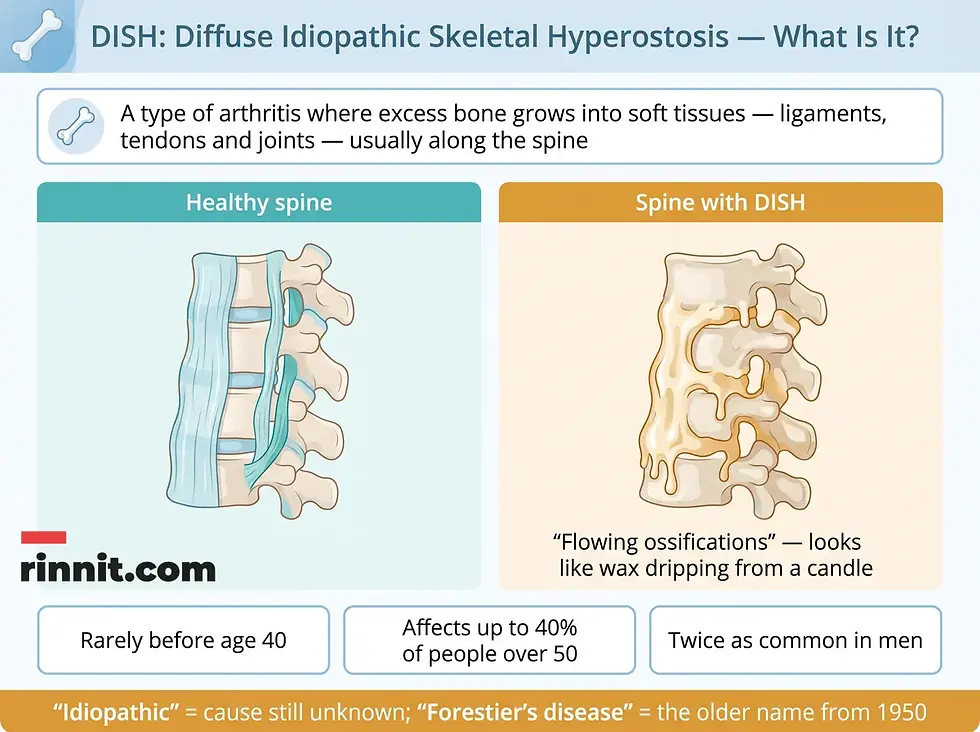
DISH is a type of arthritis that involves excess bone tissue growing into your soft tissues. It causes hardening and stiffness in your skeletal ligaments and joints. [1]
“Hyperostosis” is excess bone growth. In DISH, calcium deposits form in the soft tissues connected to your skeleton. This calcification leads to ossification: bone tissue forming within your soft tissues. [1]
“Diffuse” means this process can occur anywhere along your skeleton. But it typically begins along your spine, particularly in the middle (thoracic) part. [1] “Idiopathic” means it occurs for unknown reasons.
DISH can cause musculoskeletal pain and mobility problems. The ossification process can lead to bone spurs, which are outgrowths of bone that can interfere with how your joints move.
Term | Meaning |
DISH | Diffuse idiopathic skeletal hyperostosis: excess bone growth into soft tissue |
Hyperostosis | Excess bone growth |
Ossification | Bone tissue forming within soft tissue |
Idiopathic | Occurring for unknown reasons |
Diffuse | Able to occur anywhere along the skeleton |
Bone spur (osteophyte) | An outgrowth of bone that can interfere with joint movement |
Forestier's disease | The older name for DISH, after the doctor who first described it in 1950 |
Enthesis | The attachment site where a joint or ligament connects to bone |
Is DISH the same as Forestier disease?
DISH is also called Forestier's disease, after one of the doctors who first described it in 1950. Later, in 1975, Resnick and his research team coined the more specific term, diffuse idiopathic skeletal hyperostosis. [1]
How common is DISH?
DISH is common in older populations. It rarely appears before the age of 40, but it affects up to 40% of people over the age of 50. [1] It is twice as common in males as in females. [1]
What are the symptoms of DISH?
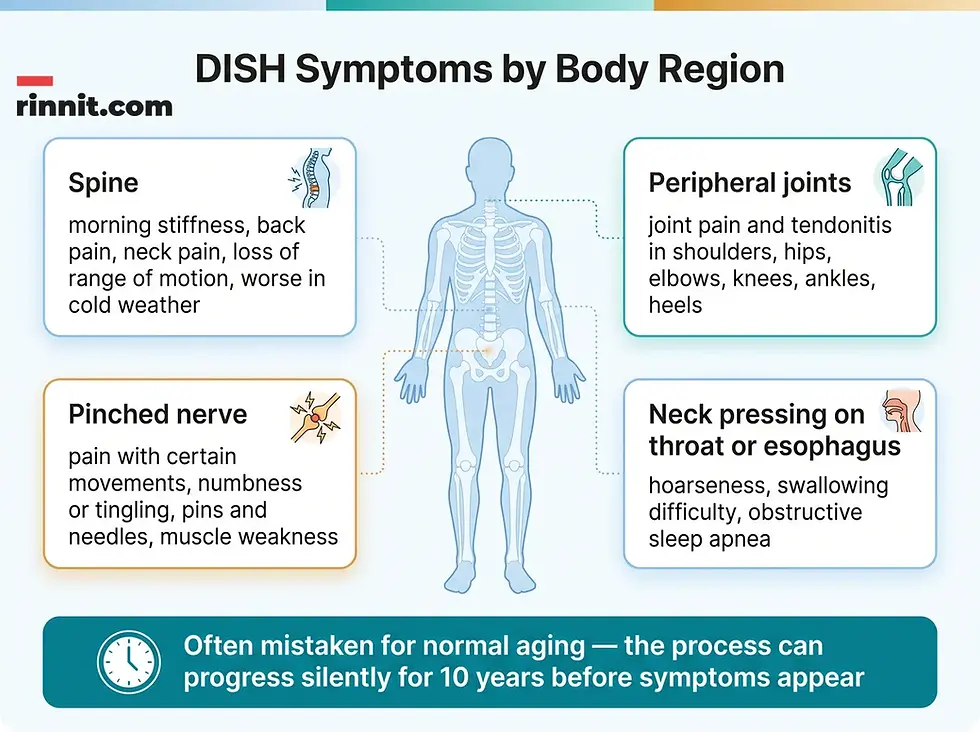
DISH may cause general stiffness and pain, most commonly back pain and neck pain. You might notice it most in the morning and in cold weather. [1] You will also notice a general loss in your range of motion.
DISH usually affects your spine and axial skeleton first, but it can also affect your peripheral skeleton, the parts that extend from your main trunk. You might develop joint pain or tendonitis in your shoulders, hips, elbows, knees, ankles or heels. [1]
DISH doesn't always cause noticeable symptoms. When it does, it is usually because it has been going on for a while: the process has finally progressed enough to harden your soft tissues.
What happens when bone overgrowth presses on a nerve?
Sometimes symptoms begin when bone overgrowth starts to put pressure on a nearby nerve. This can cause more noticeable pain, especially when you move a certain way or press on a certain spot. A pinched nerve may also cause numbness or tingling, pins and needles, and muscle weakness. [1]
What happens when DISH affects the neck?
If hyperostosis in your neck puts pressure on your esophagus or throat, it might cause hoarseness, swallowing difficulties, and obstructive sleep apnea. [1]
Symptom group | What you may notice |
Stiffness and pain | General stiffness; back pain; neck pain, most noticeable in the morning and in cold weather |
Loss of motion | General reduction in range of motion |
Peripheral joints | Joint pain or tendonitis in the shoulders, hips, elbows, knees, ankles and heels |
Pinched nerve | Pain with certain movements or pressure points; numbness or tingling; pins and needles; muscle weakness |
Neck pressing on esophagus or throat | Hoarseness; swallowing difficulties; obstructive sleep apnea |
What causes diffuse idiopathic skeletal hyperostosis?
Researchers are still working to understand what causes DISH. They are looking into a variety of factors that may be involved, though they are not sure how yet.
Suspected factor | What researchers have found |
Metabolism | Significant crossover between DISH and metabolic syndrome, a group of related conditions that increase cardiovascular disease risk, including diabetes or high insulin levels, high uric acid levels, high cholesterol and obesity |
Genetics | Many people with DISH have the HLA-B8 genetic marker, associated with autoimmune diseases such as Type 1 diabetes; DISH is not considered autoimmune itself, but many people with DISH also have diabetes |
Inflammation | DISH is considered a noninflammatory arthritis (not driven by automatic inflammation like autoimmune diseases), but low-grade inflammation might trigger the calcification process |
Growth factors | An excess of growth factors, including human growth hormone (HGH), insulin and insulin-like growth factor 1, may be related to excess bone growth; these are proteins and hormones that tell your body to keep making new tissues |
What are the risk factors for DISH?
You are more likely to develop DISH if you are older than 50, are male, have other types of arthritis, or have metabolic syndrome. [1]
Risk factor | Why it matters |
Older than 50 | DISH rarely appears before 40 and becomes common with age |
Male | DISH is twice as common in males as females |
Other arthritis | Having other types of arthritis raises your likelihood |
Metabolic syndrome | Diabetes, high insulin, high uric acid, high cholesterol, and obesity overlap significantly with DISH |
How serious is DISH?
DISH doesn't always cause problems. Some people never notice it at all. But in more severe cases, DISH can cause serious complications.
Complication | What happens |
Neck compression | Large bone spurs on the cervical spine can compress the esophagus or throat, causing difficulties with swallowing, speaking or breathing, particularly at night; sleep apnea can lead to chronically low blood oxygen (hypoxia) and put stress on your heart |
Spinal fractures and instability | DISH stiffens the spine, making it more vulnerable to breaks; even minor trauma (a low-energy impact) may fracture or displace a vertebra, leaving the spine unstable and injury-prone |
Spinal cord compression | Bone thickening or large spurs can compress the spinal cord, leading to nerve pain syndromes like sciatica and other nerve symptoms (myelopathy); in the worst-case scenario it could cause paralysis |
How is diffuse idiopathic skeletal hyperostosis diagnosed?
Healthcare providers use imaging tests to look for evidence of DISH. It will often show up on a routine X-ray or ultrasound. A CT scan (computed tomography scan) can offer more detail if needed. [1]
Radiologists look for “flowing ossifications”: a series of at least four vertebrae in a row that show bone overgrowth or hardening of the ligaments along the bone. [1] It looks a bit like wax dripping from a candle.
Providers might look for signs of the disease in other places if you have symptoms elsewhere. Entheses, the attachment sites where joints or ligaments connect to bones, are often calcified in other places too.
They will also look for signs that help distinguish DISH from other similar conditions, such as ankylosing spondylitis and osteoarthritis. [1] Sometimes, people have DISH together with these other conditions.
Diagnostic test | What it looks for |
X-ray | Often picks up DISH on routine imaging: flowing ossifications along the spine |
Ultrasound | Can show calcification in soft tissues |
CT scan | Offers more detail when needed |
Entheseal check | Looks for calcified attachment sites in symptomatic areas |
Differential diagnosis | Distinguishes DISH from ankylosing spondylitis and osteoarthritis, which can also coexist with it |
What treatment is available for DISH?
There is no cure for DISH, but a combination of movement, medication and monitoring keeps most cases manageable.
Physical therapy can relieve stiffness and improve your range of motion. A physical therapist can recommend appropriate, low-impact exercises to practice at home.
Medication options include over-the-counter pain relievers like NSAIDs to ease aches and pains. Your healthcare provider can also prescribe pain medications if needed. Cortisone shots can treat pain in specific areas. [1] Providers sometimes prescribe bisphosphonates to prevent or help heal fractures. [1]
Monitoring and surgery. Your provider will monitor your condition, looking out for possible fractures and other complications. If bone overgrowth or bone spurs begin to compress your nerves, causing new pain or other symptoms, you might need surgery to relieve the pressure. Bone fractures might also need surgery to repair. [1]
Treatment | Purpose |
Physical therapy | Relieves stiffness, improves range of motion; low-impact home exercises |
OTC pain relievers (NSAIDs) | Relieve aches and pains |
Prescription pain medication | For pain that over-the-counter options don't control |
Cortisone shots | Treat pain in specific areas |
Bisphosphonates | Prevent or help heal fractures |
Surgery | Relieve nerve pressure from bone spurs; repair bone fractures |

What is the outlook for people with DISH?
DISH begins late in life and progresses slowly. It may take 10 years for the process to begin causing symptoms. [1] When it does, starting a treatment plan early can help keep your symptoms in check.
When DISH is very advanced, it can become disabling, interfering with day-to-day movement and comfort. Rarely, serious complications can occur. Surgery can treat complications if they arise.
Is there any way to prevent DISH?
Researchers don't know what causes DISH, which makes it hard to prevent. But they do know that metabolic factors like high blood sugar, high insulin levels and high triglycerides can contribute to your risk. [1]
If you have any underlying metabolic conditions, treating them is your best bet for preventing DISH from starting. Treating these conditions may also help to prevent DISH from getting worse after it starts.
How should I take care of myself while living with DISH?
DISH, like many types of degenerative arthritis, benefits most from regular, low-impact exercise. [1] Developing a daily practice can help maintain your flexibility and strength for as long as possible.
Regular check-ins with your healthcare provider can help them keep track of your condition and how it progresses. This way, they can intervene to prevent serious complications before they develop.
When should I see my healthcare provider about DISH?
It is always worth mentioning your symptoms to a healthcare provider, especially morning stiffness and pain that you might otherwise brush off as normal aging. Catching DISH earlier can help you and your provider develop a plan for managing your symptoms and preventing complications.
Seek prompt care if stiffness or pain worsens, if you develop new numbness, tingling or weakness, if you have trouble swallowing or breathing at night, or after any fall or impact that could fracture a stiffened spine.
“Diffuse idiopathic skeletal hyperostosis is a long name for a still mysterious condition. But for you, what it boils down to is mostly pain and stiffness. It's often mild, and some even mistake it for normal aging. But it's always worth mentioning your symptoms to a healthcare provider. Catching DISH disease earlier can help you and your provider develop a plan for managing your symptoms and preventing complications.” — Cleveland Clinic
Questions to ask your provider
Question | Why it helps |
Could my back and neck stiffness be DISH rather than normal aging or osteoarthritis? | DISH is commonly mistaken for ordinary aging |
Which imaging test should I get: X-ray, ultrasound or CT scan? | Different tests reveal different levels of detail |
Do I have “flowing ossifications” along my spine? | The classic imaging finding of DISH |
Could my metabolic conditions (diabetes, cholesterol, weight) be contributing? | Metabolic factors overlap significantly with DISH |
What low-impact exercises do you recommend for me? | Regular low-impact exercise is the most beneficial self-care |
Should I be monitored for fractures, given how stiffened spines break more easily? | DISH spines fracture even from minor trauma |
Would a bisphosphonate help protect my bones? | Providers sometimes prescribe them to prevent or heal fractures |
The Bottom Line: What You Need to Know About DISH
DISH is a slow, age-related arthritis in which your own body turns soft tissue to bone, usually along the middle of the spine. Most people with DISH never know it's there, and those who do often blame the morning stiffness and aching on getting older. But up to 40% of people over 50 are affected, men twice as often as women, [1] and the condition deserves more than a shrug.
The condition is manageable even though it is not curable. Daily low-impact exercise, physical therapy, NSAIDs, cortisone shots and regular monitoring keep most cases well controlled. Because DISH stiffens the spine, even a minor fall can cause a fracture, [1] so protecting your bones and staying connected with your provider matters more than it might seem.
The honest truth is that researchers still don't know why DISH starts. The best protection we know of is metabolic: controlling blood sugar, insulin, cholesterol and weight. If your stiffness lasts more than a few months, or gets worse with cold and mornings, bring it up at your next visit. Early recognition is your best lever for preventing complications.
Take the first step. Ask your provider whether your stiffness could be DISH, keep your metabolic health in check, and build a daily low-impact exercise habit. Mention any new swallowing trouble, breathing difficulty at night, or numbness, and after any fall, get your spine checked.
Frequently Asked Questions
What is DISH disease?
DISH (diffuse idiopathic skeletal hyperostosis) is a type of arthritis in which excess bone tissue grows into your soft tissues (ligaments, tendons and joints), causing hardening and stiffness, usually along the spine.
What does DISH stand for?
Diffuse idiopathic skeletal hyperostosis: “diffuse” (can occur anywhere along the skeleton), “idiopathic” (cause unknown), “skeletal” (affecting the skeleton), and “hyperostosis” (excess bone growth).
What is another name for DISH?
Forestier's disease, after the doctor who first described it in 1950. The term DISH was coined in 1975 by Resnick and his research team.
Is DISH a type of arthritis?
Yes. DISH is considered a noninflammatory type of arthritis that hardens your ligaments and joints with excess bone growth.
What causes DISH?
The exact cause is unknown. Researchers are studying four suspect areas: metabolism (overlap with metabolic syndrome), genetics (the HLA-B8 marker), low-grade inflammation, and excess growth factors such as human growth hormone, insulin and insulin-like growth factor 1.
Who gets DISH?
It is common in older populations. It rarely appears before age 40, affects up to 40% of people over 50, and is twice as common in men.
Where does DISH start?
It typically begins along the spine, particularly in the middle (thoracic) part, though “diffuse” means it can occur anywhere along the skeleton.
What are the symptoms of DISH?
General stiffness and pain, most commonly back pain and neck pain, often worst in the morning and in cold weather, plus a general loss of range of motion. Peripheral joints (shoulders, hips, elbows, knees, ankles, heels) can develop joint pain or tendonitis.
Does DISH cause bone spurs?
Yes. The ossification process can lead to bone spurs (osteophytes): outgrowths of bone that can interfere with how your joints move.
Can DISH press on nerves?
Yes. Bone overgrowth can put pressure on a nearby nerve, causing noticeable pain with certain movements, numbness or tingling, pins and needles, and muscle weakness.
Can DISH cause swallowing problems?
Yes. If hyperostosis in the neck presses on the esophagus or throat, it might cause hoarseness, swallowing difficulties, and obstructive sleep apnea.
Can DISH cause sleep apnea?
Yes. Large bone spurs on the cervical spine can compress the throat and esophagus, and resulting sleep apnea can lead to chronically low blood oxygen and heart stress.
Is DISH the same as osteoarthritis?
No. They are different conditions, though they can occur together, and providers use imaging to distinguish between them.
Is DISH the same as ankylosing spondylitis?
No. Ankylosing spondylitis is a separate condition, and radiologists look for signs that help tell DISH apart from it.
What do “flowing ossifications” mean?
A series of at least four vertebrae in a row showing bone overgrowth or ligament hardening. This is the classic imaging finding of DISH, and it looks like wax dripping from a candle.
How is DISH diagnosed?
Through imaging. It often shows up on a routine X-ray or ultrasound, and a CT scan can add detail. Radiologists look for flowing ossifications and calcified entheses (ligament attachment sites).
Is DISH curable?
No, there is no cure, but treatment can relieve stiffness, manage pain and prevent complications.
How is DISH treated?
Physical therapy and low-impact exercise, over-the-counter pain relievers such as NSAIDs, prescription pain medication if needed, cortisone shots for specific areas, and sometimes bisphosphonates to protect against fractures. Surgery may be needed for nerve-compressing bone spurs or fractures.
What exercises help with DISH?
Regular, low-impact exercise is the most beneficial approach. A physical therapist can recommend appropriate exercises to practice at home to maintain flexibility and strength.
What medications are used for DISH?
NSAIDs for aches and pains, prescription pain relievers when needed, cortisone shots for specific areas, and bisphosphonates to prevent or help heal fractures.
When is surgery needed for DISH?
Surgery may be needed if bone overgrowth or bone spurs compress your nerves and cause new pain or symptoms, or to repair bone fractures.
Is DISH serious?
It doesn't always cause problems, and some people never notice it. But in more severe cases it can cause serious complications, including spinal fractures from minor trauma, spinal cord compression and neck compression affecting swallowing and breathing.
Can a stiffened spine fracture easily?
Yes. DISH stiffens the spine, making it more vulnerable to breaks. Even minor trauma (a low-energy impact) might fracture or displace a vertebra.
How slowly does DISH progress?
DISH begins late in life and progresses slowly. It may take 10 years for the process to begin causing symptoms.
Can DISH become disabling?
When very advanced, yes. It can interfere with day-to-day movement and comfort. Rarely, serious complications occur, and surgery can treat them if they arise.
Can you prevent DISH?
There is no guaranteed prevention since the cause is unknown, but treating underlying metabolic conditions (high blood sugar, high insulin, high triglycerides) is the best-known way to reduce the risk of DISH starting or worsening.
Is DISH related to diabetes and metabolic syndrome?
There is significant crossover. Metabolic syndrome (diabetes or high insulin, high uric acid, high cholesterol, obesity) overlaps with DISH, and many people with DISH also have diabetes.
Is DISH an autoimmune disease?
No. DISH is considered a noninflammatory arthritis, although many people with DISH carry the HLA-B8 genetic marker associated with autoimmune diseases.
What's the outlook with DISH?
Generally manageable. With an early treatment plan, symptoms can be kept in check; very advanced disease can become disabling, but surgery can address complications.
When should I see a doctor about possible DISH?
Mention any persistent morning stiffness or pain you might otherwise attribute to aging, especially with loss of range of motion, new swallowing or breathing trouble at night, numbness or weakness, or after any fall. Early recognition helps prevent complications.
Related reading on Rinnit
Pinched Nerve (Radiculopathy): Symptoms, Causes, and the Full Treatment Pathway
Sciatica: Complete Guide to Symptoms, Causes, Diagnosis, and Treatment
Spinal Fractures: Symptoms, Causes, Diagnosis, Treatment and Outlook — What You Need to Know
Obesity: Symptoms, Causes, Complications and Treatment — A Complete Guide
Obstructive Sleep Apnea: Symptoms, Causes, and What Actually Helps
Physical Therapy: Enhancing Mobility, Strength, and Recovery
Sources
Cleveland Clinic. Diffuse Idiopathic Skeletal Hyperostosis (DISH). Cleveland Clinic. Last updated April 28, 2024. https://my.clevelandclinic.org/health/diseases/diffuse-idiopathic-skeletal-hyperostosis-dish
Arthritis Foundation. Diffuse Idiopathic Skeletal Hyperostosis. Arthritis Foundation. Published December 19, 2025. https://www.arthritis.org/diseases/diffuse-idiopathic-skeletal-hyperostosis
Luo TD, Varacallo MA. Diffuse Idiopathic Skeletal Hyperostosis. In: StatPearls [Internet]. Treasure Island (FL): StatPearls Publishing; last update January 10, 2025. PMID 30855792. https://pubmed.ncbi.nlm.nih.gov/30855792/
Le HV, Wick JB, Van BW, et al. Diffuse idiopathic skeletal hyperostosis of the spine: pathophysiology, diagnosis, and management. J Am Acad Orthop Surg. 2021;29(24):1044-1051. PMID 34559699. https://doi.org/10.5435/JAAOS-D-20-01344
Weng R, Guo H, Ma L, et al. Global prevalence estimates of diffuse idiopathic skeletal hyperostosis: a systematic review and meta-analysis. Front Endocrinol (Lausanne). 2025;16:1517168. PMID 40444238. https://doi.org/10.3389/fendo.2025.1517168
Harlianto NI, Ezzafzafi S, Foppen W, et al. The prevalence of vertebral fractures in diffuse idiopathic skeletal hyperostosis and ankylosing spondylitis: a systematic review and meta-analysis. N Am Spine Soc J. 2024;17:100312. PMID 38370336. https://doi.org/10.1016/j.xnsj.2024.100312
Harlianto NI, Kuperus JS, Mohamed Hoesein FAA, et al. Diffuse idiopathic skeletal hyperostosis of the cervical spine causing dysphagia and airway obstruction: an updated systematic review. Spine J. 2022;22(9):1490-1503. PMID 35283294. https://doi.org/10.1016/j.spinee.2022.03.002
Orthobullets. DISH (Diffuse Idiopathic Skeletal Hyperostosis). Orthobullets. Updated September 15, 2026. https://www.orthobullets.com/spine/2045/dish-diffuse-idiopathic-skeletal-hyperostosis
Medical disclaimer
This article is provided for general educational purposes only and is not a substitute for professional medical advice, diagnosis or treatment. Only a qualified healthcare provider can diagnose DISH and determine the right treatment plan for you. If you develop new or worsening pain, numbness, weakness, trouble swallowing, or trouble breathing, contact your provider promptly, and seek emergency care after any trauma to a stiffened spine.



Comments