Cyanotic Heart Disease: Causes, Types, Symptoms, Diagnosis, and Treatment

Updated: 3 days ago
Medically reviewed by Dr. Baraa Alnahhal, MD · Last reviewed: October 17, 2026
Quick Answer
Cyanotic heart disease, which overlaps with critical congenital heart disease (CCHD), is any heart defect present at birth that reduces oxygen delivery to the body [1]. It usually appears in the first weeks of life as bluish skin, fast breathing and poor feeding. Doctors detect it with ultrasound, pulse oximetry screening and echocardiograms [1]. Most babies need surgery to survive [1].
What the research says
Newborn pulse oximetry is highly specific but not perfect. A meta-analysis of 13 studies covering 229,421 asymptomatic newborns found a sensitivity of 76.5% (95% CI 67.7–83.5) and a specificity of 99.9% (99.7–99.9) for critical congenital heart defects, with a false-positive rate of 0.14%. False alarms were fewer when testing was done after 24 hours of age (0.05% versus 0.50%). A normal screen does not fully rule out a heart defect (PubMed: Thangaratinam et al., Lancet, 2012 [2]).
Earlier diagnosis was linked to lower first-year mortality. In a New Zealand population-based review (2006–2010), 20% of critical cases were diagnosed late (after hospital discharge), and first-year mortality was 18% for critical cases versus 8% for non-critical cases. Mortality was 16% with early diagnosis versus 27% with late diagnosis (P = 0.04), and for isolated critical defects 12% versus 29% (P = 0.002). The study was retrospective and predates routine oximetry screening (PubMed: Eckersley et al., Arch Dis Child, 2016 [3]).
Prostaglandin E1 is standard care, but it was never tested in randomized trials. A Cochrane review searching for randomized or quasi-randomized trials of prostaglandin E1 to keep the ductus arteriosus open in newborns with ductal-dependent heart lesions found no eligible trials. Observational evidence supports it as standard of care, and the reviewers considered randomized trials unlikely to be done (PubMed: Akkinapally et al., Cochrane Database Syst Rev, 2018 [4]).
What Is Cyanotic Heart Disease?
Cyanotic heart disease is any heart defect present at birth that reduces the amount of oxygen delivered to your body [1]. It overlaps with critical congenital heart disease (CCHD), the group of serious heart defects present at birth that usually need surgery or a procedure in the first year of life. When a baby is born with CCHD, their skin develops a bluish tint known as cyanosis [1].
There are two broad types of congenital heart disease — defects that are present at birth. Cyanotic congenital heart disease involves heart defects that reduce the amount of oxygen delivered to the rest of the body [1]. Acyanotic congenital heart disease involves defects that do not interfere with oxygen delivery [1].
Your body needs a steady supply of oxygen to function properly. Cyanotic heart disease prevents your body from getting the oxygen it needs. Structural abnormalities in the heart can cause severe complications and even death [1].

Key Facts at a Glance
Fact | Detail |
What it is | Heart defects present at birth that reduce oxygen delivered to the body [1] |
Also called | Critical congenital heart disease (CCHD) [1] |
Visible sign | Bluish skin tint called cyanosis [1] |
How common | Congenital heart disease affects 8–9 per 1,000 live births; about 25% of those are CCHD [1] |
Highest-risk group | Newborns; signs often appear in the first weeks of life [1] |
Survival rate | About 75% survive 1 year; about 69% survive to 18 years [1] |
Main treatment | Oxygen therapy, prostaglandin E1, and surgery [1] |
Prevention | No proven prevention strategies exist [1] |
How is cyanotic heart disease different from acyanotic heart disease?
The key difference between the two types of congenital heart disease comes down to oxygen. The table below compares them directly.
Feature | Cyanotic (CCHD) | Acyanotic |
Oxygen delivery | Reduced to the rest of the body [1] | Not interfered with [1] |
Skin color | Bluish tint (cyanosis) [1] | Typically normal color |
Example conditions | Tetralogy of Fallot, transposition of the great arteries, HLHS | Small holes in the heart walls, narrow valves |
Typical urgency | Usually life-threatening, needs early treatment | Often less urgent, sometimes monitored |
How Common Is CCHD?
Congenital heart disease affects 8 to 9 per 1,000 live births [1]. Of those cases, about 25% have CCHD [1]. That makes critical congenital heart disease a relatively rare but serious category of birth defect.
What are the three types of cyanotic congenital heart disease (CCHD)?
Cyanotic heart disease falls into three categories based on how the defect disrupts blood flow: left heart obstructive lesions, right heart obstructive lesions and mixing lesions [1].
Left Heart Obstructive Lesions
These congenital heart defects reduce blood flow between your heart and the rest of your body — your systemic blood flow [1]. Two specific conditions fall into this category. Hypoplastic left heart syndrome (HLHS) involves underdeveloped structures in the left side of the heart. The left side of the heart is too small to pump enough blood to the rest of the body [1]. Interrupted aortic arch means the aorta — the body's main artery — is incomplete [1].
Right Heart Obstructive Lesions
These congenital heart defects reduce blood flow between your heart and lungs — your pulmonary flow [1]. Three specific conditions fall into this category. Pulmonary atresia (PA) means the pulmonary valve — which acts like a door between the right side of the heart and the lungs — does not develop correctly or is blocked [1]. Tricuspid atresia means the tricuspid valve, which sits between the two chambers on the right side of the heart, is not formed correctly; a piece of solid tissue blocks blood flow from the right atrium to the right ventricle [1]. Tetralogy of Fallot (TOF) is the most common form of CCHD and involves four separate heart defects [1].
Mixing Lesions
Mixing lesions cause the body to mix pulmonary blood flow (to the lungs) with systemic blood flow (to the body) [1]. Three specific conditions fall into this category. In transposition of the great arteries (TGA), the two main arteries that leave the heart — the main pulmonary artery and the aorta — are reversed [1]. This defect is the second most common CCHD [1]. In total anomalous pulmonary venous return (TAPVR), oxygen-rich blood does not travel from the lungs to the left side of the heart where it should; instead, the blood goes to the right side of the heart [1]. In truncus arteriosus, the heart has only one main artery carrying blood to the body and lungs, instead of two separate arteries [1].
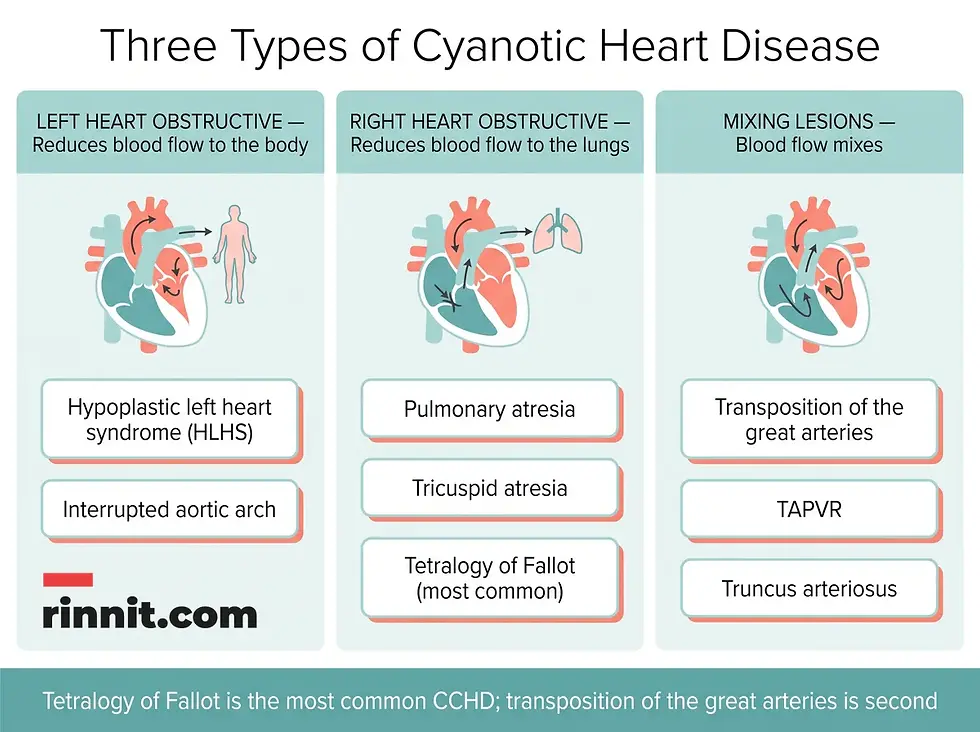
CCHD Conditions Compared
Category | How Blood Flow Is Affected | Specific Conditions |
Left heart obstructive | Reduces flow between heart and body (systemic) | Hypoplastic left heart syndrome, interrupted aortic arch [1] |
Right heart obstructive | Reduces flow between heart and lungs (pulmonary) | Pulmonary atresia, tricuspid atresia, tetralogy of Fallot [1] |
Mixing lesions | Mixes lung blood flow with body blood flow | Transposition of the great arteries, TAPVR, truncus arteriosus [1] |
Most common | Tetralogy of Fallot [1] | Second most common: transposition of the great arteries [1] |
What Causes Cyanotic Heart Disease?
Scientists do not fully understand what causes CCHD [1]. Evidence has shown that some cases may be linked to abnormal chromosomes, genetics, and illness in the mother during pregnancy — such as diabetes, phenylketonuria (an inherited metabolic disorder), drug use, or viral infection [1].
Possible Factor | Examples |
Chromosomes | Abnormal chromosomes |
Inheritance | Genetics |
Maternal illness during pregnancy | Diabetes, phenylketonuria, drug use, viral infection [1] |
What Are the Symptoms of CCHD?
Signs of CCHD usually appear in the first few weeks of life but may not be noticed until childhood [1]. The bluish or purple skin tint — cyanosis — is the namesake symptom.
Symptom | What It Looks Like |
Bluish or purple skin (cyanosis) [1] | The namesake sign of low oxygen |
Fast breathing (tachypnea) [1] | Breathing faster than normal |
Fast heart rate (tachycardia) [1] | Heart beats faster than normal |
Fluid in the lungs (pulmonary edema) [1] | Fluid buildup affecting breathing |
Heart murmur [1] | A whooshing sound heard through a stethoscope when the heart beats |
Irritability or lethargy [1] | Lack of energy |
Low oxygen levels [1] | Low levels of oxygen in the body |
Slow weight gain [1] | Baby does not gain weight at the expected rate |
Sweating or crying during feedings [1] | Feeding becomes exhausting |
Trouble breathing with exercise [1] | Seen in older children |
Weak pulse [1] | Pulse feels weak |
How Is Cyanotic Heart Disease Diagnosed?
CCHD may be detected before a baby is born [1]. If a routine fetal ultrasound shows a possible problem with a baby's heart, the healthcare provider will order a fetal echocardiogram [1]. This test uses an ultrasound device on the mother's belly or in her vagina [1] to take detailed pictures of the baby's heart.
After birth, CCHD is usually first noticed by pulse oximetry screening [1]. This simple, painless test uses sensors to measure oxygen levels [1]. It is part of standard newborn care before a baby is released from the hospital.
Test | What It Does |
Fetal ultrasound | Routine prenatal scan that may flag a possible heart problem |
Fetal echocardiogram | Detailed ultrasound pictures of the baby's heart before birth |
Pulse oximetry screening | Simple, painless newborn test using sensors to measure oxygen levels [1] |
Chest X-ray | Pictures inside the chest; reveals structural abnormalities and helps tell heart vs. lung issues apart [1] |
Hyperoxia test (oxygen challenge) | Compares blood oxygen on room air vs. after 100% oxygen for 10 minutes; distinguishes CCHD from lung problems |
Electrocardiogram (EKG/ECG) | Measures the electrical activity of the heart [1] |
Echocardiogram | Ultrasound images of the heart's valves and chambers [1] |
How Is CCHD Treated?
Most babies with CCHD will need treatment to survive [1]. The three core treatments are oxygen therapy, medication, and surgery [1].

What Is the Outlook for Babies with CCHD?
Babies with cyanotic heart disease need surgery to survive [1]. Even with treatment, mortality is high [1]. About 75% of babies with CCHD survive one year, and about 69% survive 18 years [1]. Because of low oxygen and congenital heart defects, children with CCHD face ongoing health risks. The table below summarizes them.
Can CCHD Be Prevented?
Scientists are not sure what causes cyanotic heart disease, and there are no proven strategies to prevent it [1].
How can people live with cyanotic congenital heart disease (CCHD)?
If your child has CCHD, the healthcare provider will likely recommend ongoing protective measures. Routine vaccinations help prevent illness [1]. Regular follow-up appointments and tests should happen as recommended by the cardiologist [1]. Good hygiene and limited exposure to sick people help prevent respiratory syncytial virus (RSV), which is especially dangerous for children with heart defects. Taking antibiotics before dental procedures helps prevent heart infection.
Conclusion
Cyanotic heart disease (CCHD) is a serious group of congenital heart defects that reduce oxygen delivery to the body, most often detected in newborns through bluish skin and newborn pulse oximetry screening. There are three categories of defects — left heart obstructive, right heart obstructive, and mixing lesions — encompassing eight specific conditions, with tetralogy of Fallot being the most common [1]. Oxygen therapy, prostaglandin E1, and surgery give babies a chance to survive, with about 75% reaching their first birthday [1]. No prevention exists, so early detection and lifelong cardiology follow-up are the best defenses.
If your baby's skin looks bluish, breathing is unusually fast, or feedings cause sweating and exhaustion, contact a pediatric cardiologist or seek emergency care right away.
Related guides: tetralogy of Fallot and heart failure.
Frequently Asked Questions
1. What is cyanotic heart disease?
Cyanotic heart disease is any heart defect present at birth that reduces the amount of oxygen delivered to the body. It overlaps with critical congenital heart disease (CCHD), and babies with it have bluish skin called cyanosis. Most babies need oxygen therapy and surgery to survive.
2. How common is cyanotic heart disease?
Congenital heart disease affects 8 to 9 per 1,000 live births, and about 25% of those cases are cyanotic (CCHD). That makes critical congenital heart disease a rare but serious category of birth defect.
3. What is the difference between cyanotic and acyanotic heart disease?
Cyanotic congenital heart disease involves defects that reduce the amount of oxygen delivered to the rest of the body, causing bluish skin. Acyanotic congenital heart disease involves defects that do not interfere with oxygen delivery to the body.
4. What are the symptoms of cyanotic heart disease?
Signs usually appear in the first weeks of life and include bluish or purple skin, fast breathing, fast heart rate, fluid in the lungs, a heart murmur, irritability or lethargy, low oxygen levels, slow weight gain, sweating or crying during feedings, trouble breathing with exercise in older children, and a weak pulse.
5. What are the types of cyanotic heart disease?
CCHD falls into three categories: left heart obstructive lesions (hypoplastic left heart syndrome, interrupted aortic arch), right heart obstructive lesions (pulmonary atresia, tricuspid atresia, tetralogy of Fallot), and mixing lesions (transposition of the great arteries, TAPVR, truncus arteriosus). Tetralogy of Fallot is the most common.
6. What causes cyanotic heart disease?
Scientists do not fully understand the cause. Some cases may be linked to abnormal chromosomes, genetics, and maternal illness during pregnancy such as diabetes, phenylketonuria, drug use, or viral infection. There are no proven strategies to prevent it.
7. How is cyanotic heart disease diagnosed?
CCHD may be detected before birth with a fetal ultrasound followed by a fetal echocardiogram. After birth, it is usually first noticed by painless pulse oximetry screening, a standard newborn test. Other tests include chest X-ray, hyperoxia (oxygen challenge) test, EKG, and echocardiogram.
8. How is cyanotic heart disease treated?
Most babies with CCHD need oxygen therapy (higher oxygen levels than room air), prostaglandin E1 (which keeps the ductus arteriosus blood vessel open), and surgery to repair defects or redirect blood flow. Most babies need surgery to survive.
9. What is the outlook for babies with cyanotic heart disease?
Mortality is high, but treatment improves outcomes: about 75% of babies with CCHD survive one year and about 69% survive to 18 years. Survivors remain at risk for developmental delays, arrhythmia, heart failure, sudden cardiac arrest, and stroke, and need lifelong cardiology follow-up.
10. Can cyanotic heart disease be prevented?
Scientists are not sure what causes cyanotic heart disease, and there are no proven strategies to prevent it. Early detection through prenatal screening and newborn pulse oximetry testing is the best protection.
Related Reading
References
Cleveland Clinic. Cyanotic Heart Disease. Cleveland Clinic. February 17, 2022. https://my.clevelandclinic.org/health/diseases/22441-cyanotic-heart-disease
Thangaratinam S, Brown K, Zamora J, Khan KS, Ewer AK. Pulse oximetry screening for critical congenital heart defects in asymptomatic newborn babies: a systematic review and meta-analysis. Lancet. 2012;379(9835):2459-2464. doi:10.1016/S0140-6736(12)60107-X. PMID: 22554860.
Eckersley L, Sadler L, Parry E, Finucane K, Gentles TL. Timing of diagnosis affects mortality in critical congenital heart disease. Arch Dis Child. 2016;101(6):516-520. doi:10.1136/archdischild-2014-307691. PMID: 26130379.
Akkinapally S, Hundalani SG, Kulkarni M, et al. Prostaglandin E1 for maintaining ductal patency in neonates with ductal-dependent cardiac lesions. Cochrane Database Syst Rev. 2018;2(2):CD011417. doi:10.1002/14651858.CD011417.pub2. PMID: 29486048.
Medical Disclaimer
This article is for informational purposes only and does not constitute medical advice. Always seek the advice of your physician or other qualified health provider with any questions you may have regarding a medical condition. Never disregard professional medical advice or delay in seeking it because of something you have read here.



Comments