Cutaneous Horn: What It Is, What It Looks Like, and When to Get It Checked

Updated: 2 days ago
Medically reviewed by Dr. Baraa Alnahhal, MD · Last reviewed: October 2026
Quick Answer
A cutaneous horn (cornu cutaneum) is a firm, cone-shaped skin lesion resembling a small animal horn that forms when the skin produces too much keratin. Around 60% are benign, but some are linked to precancerous or cancerous skin conditions, so diagnosis usually involves an exam and skin biopsy. Removal options include excision, cryotherapy, laser therapy and electrocauterization. [1]
What the research says
The horn is a symptom of what lies beneath. A review and case series found a cutaneous horn is most often associated with an actinic keratosis (25%), squamous cell carcinoma (19%), seborrheic keratosis (19% to 20%), or a common wart (18%), and that evaluating the base of the horn is usually required to reach the right diagnosis (Cohen, Cureus, 2023) [2].
Removal plus a tissue exam is the standard approach. A dermatology review describes the horn as a description of shape, not a diagnosis, says the key concern is telling a hyperkeratotic actinic keratosis from a squamous cell carcinoma, and names shave excision with histopathologic evaluation as the treatment of choice (Fernandes et al., Acta Dermatovenerologica Alpina, Pannonica et Adriatica, 2009) [3].
A large or long-standing horn can hide a cancer. In two reported cases of giant cutaneous horns, a well-differentiated squamous cell carcinoma was found at the base after wide local excision; the authors stress that the base should always be biopsied to rule out malignancy (Vanik et al., Indian Journal of Otolaryngology and Head & Neck Surgery, 2022) [4]. This is a small case report, not a measure of how common cancer is.
What Is a Cutaneous Horn?
A cutaneous horn is a hard, cone-shaped lesion on the surface of your skin that looks like a straight or curved animal horn. It develops when your body makes too much keratin in an area of your skin. Keratin is the protein that helps make your skin, hair, and nails. [1]
Cutaneous horns are not common. When they do develop, they are more likely to affect areas that get a lot of sun exposure. This includes your face, head, neck, arms, and hands. [1]
About 6 out of 10 cutaneous horns are benign, meaning they are not cancer. However, a cutaneous horn may be cancerous or precancerous. "Precancerous" means the growth has changes that can turn into cancer over time if it is not treated. Treatment usually involves removing the growth and, possibly, some surrounding tissue. [1]
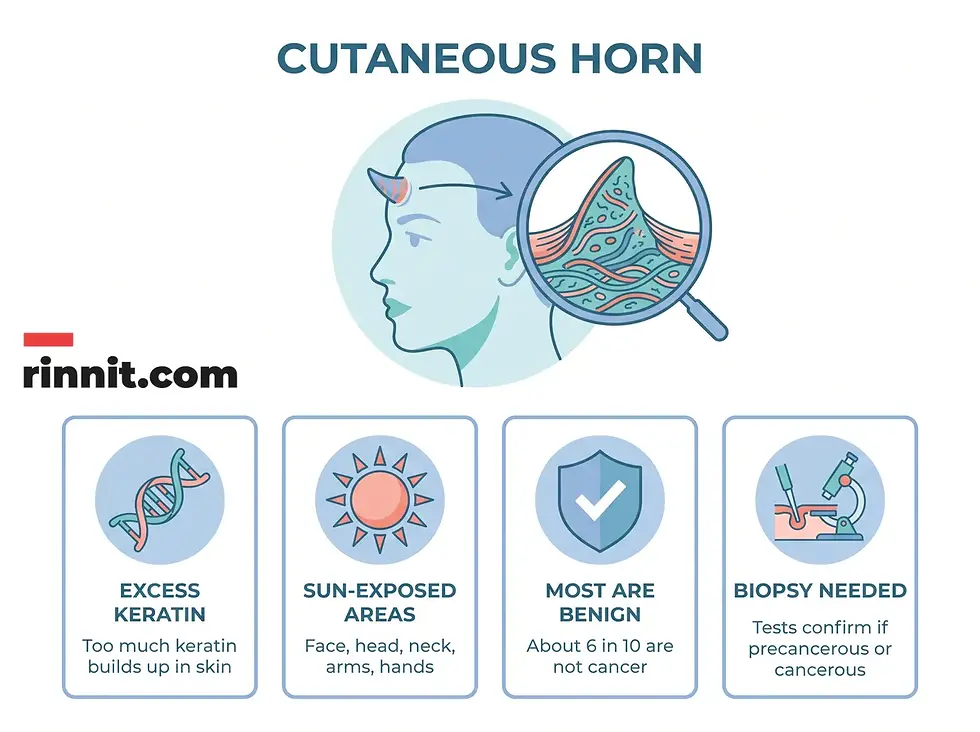
What a cutaneous horn is: a cone-shaped keratin growth on sun-exposed skin.
Cutaneous Horn at a Glance
Fact | Detail |
Also called | Cornu cutaneum |
What it is | Hard, cone-shaped skin lesion made of excess keratin |
Appearance | Resembles a straight or curved animal horn |
Size | Roughly 0.1 inches (2 mm) to 0.8 inches (2 cm) |
Common locations | Face, head, neck, arms, hands (sun-exposed areas) |
Cancer status | About 6 in 10 are benign (not cancer) |
Main concern | May be precancerous or cancerous |
Main treatment | Removal plus biopsy testing |
What Does a Cutaneous Horn Look and Feel Like?
A cutaneous horn is usually easy to recognize once you know what to look for. It may feel hard or firm to the touch and can be straight, curved, or spiraled. In terms of color, a cutaneous horn may look like the surrounding skin, or it may be discolored in black, brown, pink, tan, white, or yellow. It varies in size from around 0.1 inches (2 millimeters) to 0.8 inches (2 centimeters). [1]
It usually does not cause any other symptoms. However, it may hurt if you accidentally bump or pull on it. [1]

Cutaneous horn appearance and possible warning signs; cancer cannot be confirmed by looking, so a biopsy is needed.
Cutaneous Horn Appearance at a Glance
Feature | Possible Presentation |
Texture | Hard or firm |
Shape | Straight, curved, or spiraled |
Color | Skin-colored, or black, brown, pink, tan, white, or yellow |
Size | About 2 mm to 2 cm (0.1 to 0.8 inches) |
Symptoms | Usually none; may hurt if bumped or pulled |
Can Any Features Indicate Cancer?
Healthcare providers cannot confirm that a cutaneous horn is precancerous or cancerous just by looking at it. But they may recommend cancer testing, particularly if the horn is painful, large, hard, or discolored, especially around the base. [1]
What Causes a Cutaneous Horn?
Experts do not know exactly what causes cutaneous horns. But they think keratin overgrowth may occur because of sunlight, radiation, HPV warts, or scarring from burns. [1]
Cutaneous horns can be associated with other conditions. Many of them are not cancerous, including seborrheic keratosis, viral warts, moles, and trichilemmoma. Sometimes, however, there is a link between cutaneous horns and precancerous or cancerous conditions. These may include actinic keratosis, keratoacanthoma, squamous cell carcinoma, basal cell carcinoma, and melanoma (rare). [1]
Associated Condition | Cancer Status |
Seborrheic keratosis | Non-cancerous |
Viral warts | Non-cancerous |
Moles | Non-cancerous |
Trichilemmoma | Non-cancerous |
Actinic keratosis | Precancerous |
Keratoacanthoma | Precancerous/cancerous |
Squamous cell carcinoma | Cancerous |
Basal cell carcinoma | Cancerous |
Melanoma | Cancerous (rare) |
Who Is at Risk?
You are at greater risk of getting a cutaneous horn if you are white or have a lighter skin complexion, are 60 or older, or have a long history of sun exposure. [1]
Possible Complications
Precancerous cutaneous horns can turn into cancer if you do not get treatment. And if they are cancerous, there is a chance they can grow quickly and spread (metastasize) to other parts of your body. If they spread, they can be more challenging to treat. They can also be fatal. [1]
How Is a Cutaneous Horn Diagnosed?
Healthcare providers can usually diagnose a cutaneous horn with a physical exam. But because cutaneous horns can sometimes be associated with skin cancers, a provider will often recommend additional tests, such as a skin biopsy. A skin biopsy helps providers figure out if the lesion is benign, precancerous, or cancerous. You may need more treatment depending on the results of your biopsy. [1]
Diagnostic Step | What It Tells You |
Physical exam | Usually enough to identify the horn itself |
Skin biopsy | Confirms whether the lesion is benign, precancerous, or cancerous |
Follow-up care | Determined by biopsy results |
How Is a Cutaneous Horn Treated?
If the horn is not cancer and does not bother you, you do not need treatment. But if it is precancerous, cancerous, or you do not like the way it looks, your healthcare provider can remove it. [1]
Treatment Method | How It Works |
Excision | Cutting the horn off with a sharp surgical knife |
Cryotherapy | Freezing it off using extreme cold |
Laser therapy | Removing it with a laser |
Electrocauterization | Burning it off with an electric current |
Radiation therapy | Destroying it with high-powered X-rays |
Chemotherapy | Using drugs to destroy cancer cells |
It is important to emphasize what you should never do: do not try to remove a cutaneous horn yourself. You risk permanently damaging your skin or getting an infection. Even after treatment, it is possible for a cutaneous horn to come back. [1]

Six removal options; a benign horn that does not bother you needs no treatment.
When Should You See a Healthcare Provider?
It is a good idea to see a healthcare provider any time you notice a change in your skin. They can officially diagnose a cutaneous horn. They may also refer you to a dermatologist. [1]
What is the outlook for a cutaneous horn?
What you can expect depends on whether there is an association with precancerous or cancerous conditions. If the horn does not bother you and there is no link to precancerous or cancerous conditions, you do not need additional treatment. If a healthcare provider removes it, you may have some scarring. It is also possible for the horn to regrow. [1]
Providers can successfully treat nearly all skin cancers before they have a chance to spread. But you have the best outlook if they find and treat them sooner. After removing a cancerous cutaneous horn, you may need regular skin cancer screenings to make sure cancer does not come back. Your provider will give you a better idea of what to expect according to your unique situation. [1]
Scenario | What to Expect |
Benign horn, no symptoms | No treatment needed |
Removed benign horn | Possible scarring; possible regrowth |
Precancerous horn | Likely becomes cancer without treatment; removal recommended |
Cancerous horn | Successfully treated in nearly all cases if found before spreading; regular skin cancer screenings afterward |
Can a Cutaneous Horn Be Prevented?
Experts are not sure if there is a way to prevent cutaneous horns. But you may be able to help reduce your risk by preventing some of the possible causes. This includes avoiding exposure to the sun, wearing sun-protective clothing and applying a sunscreen of at least SPF 30, and getting the HPV vaccine. [1]
It can be a shock any time you notice unexpected changes to your body. It can be easy to jump to worst-case scenarios about a cutaneous horn. Though most cases are not cancer, there is a chance it may be. But before you get too overwhelmed with your thoughts, talk to a healthcare provider. They can officially diagnose a cutaneous horn, recommend the best treatment for you, guide you through the next steps, and answer any questions.
Conclusion: When in Doubt, Get It Checked
A cutaneous horn is an uncommon but recognizable skin growth: firm, cone-shaped, and made of excess keratin, often appearing on sun-exposed areas like the face, neck, and hands. The encouraging news is that most cutaneous horns are benign. The important news is that some are precancerous or cancerous, and you cannot tell the difference just by looking.
The single most important step is seeing a healthcare provider for a proper diagnosis, including a skin biopsy when recommended. Treatment is usually straightforward, and nearly all associated skin cancers can be successfully treated when caught early. Do not attempt to remove the growth yourself, and do not let worry delay a professional evaluation.
Your next step: if you have noticed a new, hard, cone-shaped growth on your skin, schedule an appointment with a healthcare provider or dermatologist for an official diagnosis and a personalized treatment plan.
Frequently Asked Questions
What is a cutaneous horn?
A cutaneous horn (cornu cutaneum) is a hard, cone-shaped skin lesion that looks like a small straight or curved animal horn. It forms when the body produces too much keratin, the protein that makes skin, hair, and nails. It is firm, may be discolored, and typically ranges from about 2 millimeters to 2 centimeters.
What does a cutaneous horn look like?
A cutaneous horn may feel hard or firm, be straight, curved, or spiraled, and look like the surrounding skin or be discolored in black, brown, pink, tan, white, or yellow. It usually has no other symptoms but may hurt if bumped or pulled.
Is a cutaneous horn cancerous?
Most are not. About 6 out of 10 cutaneous horns are benign (not cancer), but some are precancerous or cancerous. Providers cannot confirm cancer status by looking, which is why a skin biopsy is often recommended.
What causes cutaneous horns?
Experts are not certain of the exact cause, but keratin overgrowth may occur because of sunlight, radiation, HPV warts, or scarring from burns. Some horns are linked to benign, precancerous, or cancerous skin conditions.
Who is at risk for cutaneous horns?
You are at greater risk if you are white or have a lighter skin complexion, are 60 or older, or have a long history of sun exposure. They are more likely to appear on sun-exposed areas like the face, neck, arms, and hands.
How is a cutaneous horn diagnosed?
Providers usually diagnose it with a physical exam, but often recommend a skin biopsy because horns can be associated with skin cancers. The biopsy determines whether the lesion is benign, precancerous, or cancerous and guides further treatment.
How is a cutaneous horn treated?
If it is not cancer and does not bother you, no treatment is needed. Otherwise, providers may remove it through excision (surgical knife), cryotherapy (freezing), laser therapy, electrocauterization (electric current), radiation therapy, or chemotherapy for cancerous cases.
Can you remove a cutaneous horn yourself?
No. Do not try to remove a cutaneous horn yourself. You risk permanently damaging your skin or getting an infection. Leave removal to a healthcare provider.
Can a cutaneous horn come back after treatment?
Yes. Even after treatment, it is possible for a cutaneous horn to come back. After removing a cancerous cutaneous horn, you may also need regular skin cancer screenings to make sure cancer does not return.
Can a cutaneous horn be prevented?
Experts are not sure if cutaneous horns can be prevented. You may be able to reduce risk by avoiding sun exposure, wearing sun-protective clothing, applying sunscreen of at least SPF 30, and getting the HPV vaccine.
External Resources
Related Reading
Actinic Keratosis: Symptoms, Causes, Diagnosis, and Treatment Options explains sun-damaged skin patches that can form cutaneous horns.
Squamous Cell Carcinoma of the Skin: Symptoms, Causes, and Treatment Explained covers the skin cancer sometimes found at the base of a horn.
Skin Biopsy: Types, What to Expect, Results and Aftercare describes how a skin sample is taken and checked for cancer.
Common Warts: Symptoms, Causes, Prevention, and Treatment Explained explains warts, a common harmless cause of cutaneous horns.
References
Cleveland Clinic. Cutaneous Horn. Cleveland Clinic. Medically reviewed; last updated August 17, 2026. https://my.clevelandclinic.org/health/diseases/cutaneous-horn
Cohen PR. Cornu cutaneum: case reports of patients with a cutaneous horn associated with either a verruca vulgaris or an inverted follicular keratosis and a review of the etiologies of cutaneous horns. Cureus. 2023;15(10):e46747. PMID 38022343. https://doi.org/10.7759/cureus.46747
Fernandes NF, Sinha S, Lambert WC, Schwartz RA. Cutaneous horn: a potentially malignant entity. Acta Dermatovenerologica Alpina, Pannonica et Adriatica. 2009;18(4):189-193. PMID 20043059. https://pubmed.ncbi.nlm.nih.gov/20043059/
Vanik S, Mehta S, Shah R, et al. Giant cutaneous horn: is it a tip of an iceberg? Two case reports and a review of literature. Indian Journal of Otolaryngology and Head and Neck Surgery. 2022;74(Suppl 3):5432-5435. PMID 36742859. https://doi.org/10.1007/s12070-021-02719-1
Medical disclaimer
This article is for general educational purposes only and is not a substitute for professional medical advice, diagnosis or treatment. Do not try to remove a skin growth yourself; see a healthcare provider or dermatologist for any new or changing skin lesion.



Comments