Cryptosporidiosis: Symptoms, Causes, Diagnosis, and Treatment

Updated: 2 days ago
Medically reviewed by Dr. Baraa Alnahhal, MD · Last reviewed: October 17, 2026
Quick Answer: What is cryptosporidiosis?
Cryptosporidiosis is an infection caused by the parasite Cryptosporidium, which causes watery diarrhea, stomach pain, nausea and low fever. It spreads mainly through contaminated water because chlorine does not kill it, and children aged 1 to 4 are at highest risk. Most people recover within two to three weeks with hydration and rest, but weakened immune systems face prolonged illness. [1]
What the research says
Pools are a major source of outbreaks. A U.S. surveillance report counted 444 cryptosporidiosis outbreaks (7,465 cases) from 2009 to 2017; treated recreational water such as pools and water playgrounds was linked to 156 outbreaks (35.1%) and 4,232 cases (56.7%), and the number of reported outbreaks rose by about 13% per year (Gharpure et al., MMWR, 2019) [2].
Cryptosporidium causes most pool-related illness. Of 208 outbreaks tied to treated recreational water from 2015 to 2019, Cryptosporidium caused 76 (49%) of the 155 outbreaks with a confirmed cause and 2,492 (84%) of the 2,953 resulting cases (Hlavsa et al., MMWR, 2021) [3].
Nitazoxanide can speed recovery in people with typical immunity. A network meta-analysis of 18 randomized trials found nitazoxanide improved the clinical response in cryptosporidiosis compared with placebo (relative risk 1.46, 95% CI 1.22 to 1.74) (Hashan et al., Acta Tropica, 2020) [4].
What Is Cryptosporidiosis?
Cryptosporidiosis is an infection you get from the parasite Cryptosporidium. Most people get it after accidentally swallowing water that has the parasite in it, for example from public pools or swimming areas. The parasite reproduces in the digestive system and causes watery diarrhea and other stomach problems. [1]
The illness is pronounced krip-toh-spawr-i-dahy-OH-sis, and its shortened name is "crypto." It is one of the most common parasitic infections. There are over 800,000 cases in the U.S. each year, and it is the second most common cause of diarrhea in children. [1]
For most people, Cryptosporidium is not serious. However, if you do not have a healthy immune system, it can cause long-lasting diarrhea, and severe diarrhea can be life-threatening. [1]
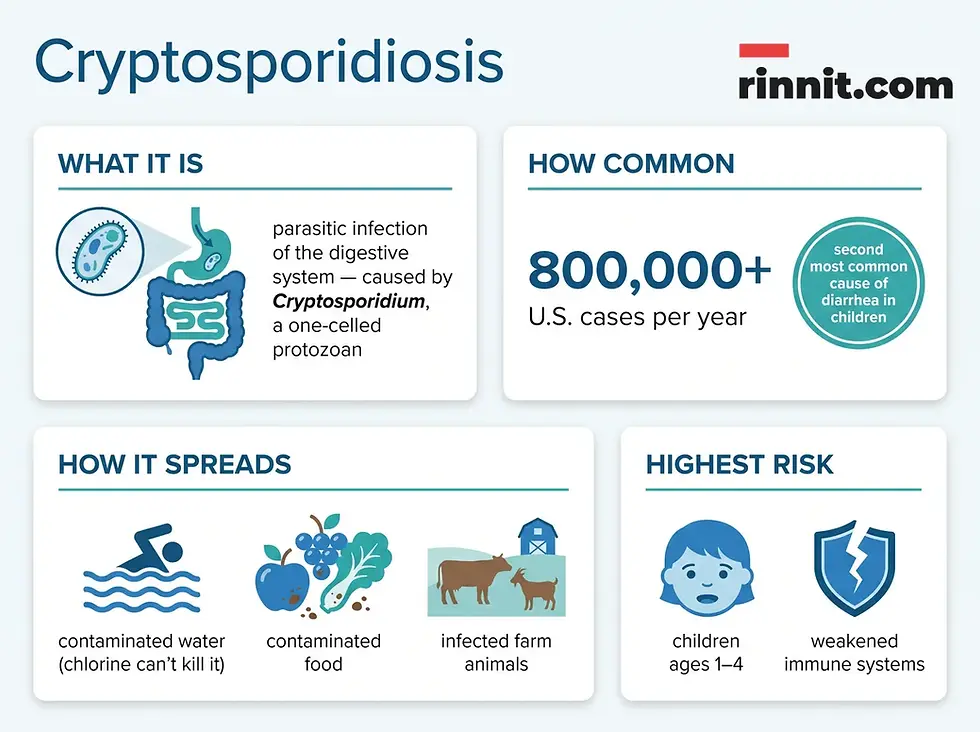
Cryptosporidiosis at a glance: definition, how common it is, how it spreads, and who is most at risk.
Key Facts About Cryptosporidiosis
Fact | Detail |
What it is | A digestive-system infection caused by the parasite Cryptosporidium |
Common name | "Crypto" |
Annual U.S. cases | Over 800,000 per year |
Rank in children | Second most common cause of diarrhea in children |
Main symptom | Watery diarrhea (up to 10 or more episodes a day) |
Most common route | Contaminated water, because chlorine cannot kill the parasite |
Highest-risk group | Children ages 1 to 4 |
Severe risk group | People with weakened immune systems |
What are the symptoms of cryptosporidiosis?
The most common symptoms center on the digestive system, with watery diarrhea as the hallmark sign. The most common symptoms include watery diarrhea that may be severe (10 or more instances a day), along with stomach pain and cramping, nausea, vomiting, loss of appetite, and a low fever. In some cases, you may have cryptosporidiosis without any symptoms at all. [1]
Symptom | What It Looks Like |
Watery diarrhea | The main sign; may be severe, with 10 or more episodes a day |
Stomach pain and cramping | Abdominal discomfort that accompanies the diarrhea |
Nausea | An unsettled, sick feeling in the stomach |
Vomiting | Throwing up, adding to fluid loss |
Loss of appetite | Reduced desire to eat |
Low fever | Mild elevation in body temperature |
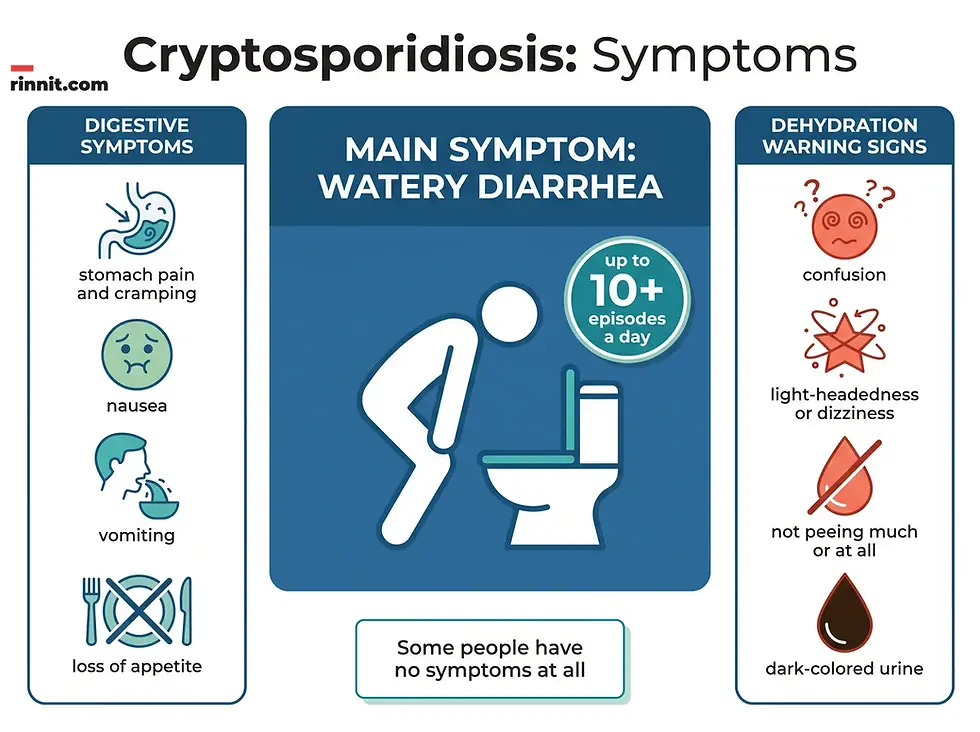
Symptoms of cryptosporidiosis and dehydration warning signs.
What Causes Cryptosporidiosis?
A few different species of Cryptosporidium cause cryptosporidiosis, but C. hominis and C. parvum cause most infections. Cryptosporidium is a protozoan parasite, a one-celled organism that lives off animals and people. It is very small; you can only see it with a microscope. [1]
How Is Cryptosporidium Transmitted?
The parasite spreads through the fecal-oral route: contaminated feces gets into the mouth. The most common transmission routes are summarized below. [1]
Transmission Route | How It Happens |
Contaminated water | Swallowing untreated drinking water or water from a lake, swimming pool, hot tub, or water park; chlorine does not kill Cryptosporidium, and contaminated water is the most common way to get crypto |
Contaminated food | Unwashed fruits and vegetables, plus unpasteurized apple cider and milk |
Contaminated items or surfaces | Touching items or surfaces someone with crypto has contacted, such as changing a sick baby's dirty diapers |
Infected animals | Touching petting zoo and farm animals |
Sexual contact | Not a sexually transmitted infection, but contact with an infected partner's anus during sexual activity can transmit the parasite |
Who Is at Highest Risk?
Anyone can get cryptosporidiosis, but children between 1 and 4 are the most likely to get it. It spreads easily among kids because they usually do not have good handwashing habits or understand how germs spread, and infected poop in diapers also helps it spread. [1]
Risk Factor | Why It Raises Your Risk |
Age 1 to 4 | Poor handwashing habits and diaper-related spread make this the most affected age group |
Age over 75 | Older adults are more likely to get crypto |
Living or working with young children | Close contact with the highest-risk group |
Drinking unfiltered or untreated water | Common when traveling, hiking, or camping |
Working with animals | Especially farm animals or livestock |
Time in public pools, lakes, or rivers | Exposure to contaminated recreational water |
Caring for someone with cryptosporidiosis | Direct contact with infected stool |
You are at risk of severe, long-term illness if you have a weakened immune system. This may apply if you have HIV or AIDS, have cancer, receive an organ or stem cell transplant, or take immunosuppressants. [1]
What complications can cryptosporidiosis cause?
Dehydration is one of the most common cryptosporidiosis complications, and pregnant women and infants are at a very high risk. Dehydration may cause problems like electrolyte imbalance and hypovolemia (low blood volume). Other crypto complications may include bile duct, gallbladder, or pancreatic disease, and slow growth in children. [1]
Complication | Who Is Most at Risk |
Dehydration | Everyone with crypto; pregnant women and infants at very high risk |
Electrolyte imbalance | Caused by dehydration |
Hypovolemia (low blood volume) | Caused by dehydration |
Bile duct, gallbladder, or pancreatic disease | People with prolonged infection |
Slow growth in children | Children with repeated or long-lasting infection |
How Is Cryptosporidiosis Diagnosed?
Your healthcare provider will first review your health history, ask about your symptoms, and do a physical exam. If they think you may have cryptosporidiosis, they will recommend a stool test to check for Cryptosporidium. Some days, you may have a lot of parasites in your stool, but others, you may not have many at all. To make an accurate diagnosis, you may have to give a few samples over several days. [1]
Diagnostic Step | What Happens |
Health history review | Provider asks about recent travel, water sources, and animal contact |
Symptom questions | Details about diarrhea frequency and duration |
Physical exam | Hands-on assessment |
Stool test | Checks for Cryptosporidium; may require several samples over several days because parasite amounts vary |
How is cryptosporidiosis treated?
If you have a healthy immune system, crypto usually goes away on its own in about two to three weeks. The most important step is to drink plenty of fluids and keep yourself hydrated. [1]
Your provider may recommend over-the-counter antidiarrheal medications, like loperamide (Imodium A-D) or bismuth subsalicylate (Pepto-Bismol). In some cases, they may prescribe a medication like diphenoxylate-atropine (Lomotil). These medications help prevent dehydration and mineral loss. Do not give antidiarrheal medicines to young children without a provider's advice: bismuth subsalicylate (Pepto-Bismol) contains a salicylate and is not for children or teenagers, and diphenoxylate-atropine (Lomotil) is not used in children under 6. In severe cases, you may need IV fluids to prevent or treat dehydration. [1]
Your provider may also recommend an antiprotozoal medication, like nitazoxanide (Alinia). These medicines help kill Cryptosporidium and stop it from growing. Nitazoxanide is not effective if you have a weakened immune system. If you have HIV or AIDS, your provider may recommend antiretroviral therapy (ART), which helps keep your immune system healthy so it can clear the parasite on its own. Your provider will also help manage any underlying conditions you may have. [1]

Treatment options for cryptosporidiosis.
Treatment Option | Purpose |
Fluids and hydration | The foundation of care; prevents dehydration while the body clears the parasite |
OTC antidiarrheals (loperamide, bismuth subsalicylate) | Reduce diarrhea and help prevent dehydration and mineral loss |
Prescription antidiarrheal (diphenoxylate-atropine) | For some cases, same purpose as OTC options |
IV fluids | For severe cases, to prevent or treat dehydration |
Nitazoxanide (antiprotozoal) | Kills Cryptosporidium and stops its growth; not effective with a weakened immune system |
Antiretroviral therapy (for HIV/AIDS) | Strengthens the immune system so it can clear the parasite on its own |
Managing underlying conditions | Reduces symptoms and supports recovery |
Recovery Time
If you have a healthy immune system, you should feel better after a few weeks. But in some cases, your symptoms may come and go for about a month. If your healthcare provider prescribes an antiprotozoal medication, you may start to feel better after about five days. Be sure to take all your medication as prescribed, even if you start to feel better. [1]
Does Cryptosporidium Ever Go Away?
If you have a weakened immune system, cryptosporidiosis may take a long time to go away; you may have symptoms for months or years. In some cases, it may not ever go away. Many people who have AIDS will never get rid of Cryptosporidium after an infection. It may not cause serious illness, but if it does, healthcare providers will work with you to make your symptoms more manageable. [1]
Immune Status | Typical Course |
Healthy immune system | Resolves on its own in about two to three weeks |
Healthy, on antiprotozoal medication | May feel better after about five days |
Weakened immune system | Symptoms may last months or years |
AIDS | The parasite may never fully go away; providers focus on managing symptoms |
When Should I See My Healthcare Provider?
Contact your healthcare provider if you have several bouts of watery diarrhea per day. Reach out again if your symptoms come back or get worse, if you get new symptoms, or if you have severe dehydration symptoms. [1]
Dehydration Warning Sign | What It Suggests |
Confusion | A sign of serious fluid loss affecting the brain |
Light-headedness or dizziness, especially when standing | Sign of low blood volume |
Not peeing much or at all | Kidneys conserving fluid |
Dark-colored pee | Concentrated urine from dehydration |
See your provider right away if you have a weakened immune system and experience any infectious disease symptoms.
Questions to ask your doctor:
How can I manage my symptoms at home?
What should I eat or drink?
Are there any foods or drinks I should avoid?
How can I avoid spreading cryptosporidiosis?
What is the outlook for cryptosporidiosis?
For most people, cryptosporidiosis is a self-limiting condition, meaning it will go away on its own. But because of the parasite's life cycle, your symptoms may go away and come back over several weeks to a month. You can still spread the parasite for up to two weeks after your symptoms stop. Make sure you take steps to help prevent it from spreading. [1]
Scenario | Outlook |
Healthy immune system | Self-limiting; resolves in about two to three weeks |
Relapsing symptoms | Life cycle can cause symptoms to return over several weeks to a month |
After recovery | Still contagious for up to two weeks after symptoms stop |
Weakened immune system | Months to years of symptoms; may never fully clear |
What Can You Do to Feel Better?
Making sure you are hydrated helps. Drink plenty of fluids, including water, broth, and sports drinks. Do not drink caffeinated drinks or alcohol. If you are able, take small bites of food. [1]
How can cryptosporidiosis be prevented?
Cryptosporidiosis spreads easily, and alcohol-based hand sanitizers and pool chlorine will not kill the parasite. Regularly taking precautions can help prevent you or anyone else from getting it. [1]
Prevention Strategy | How It Works |
Frequent handwashing | Especially before eating, after using the bathroom, and after touching animals |
Teach children handwashing | Kids ages 1 to 4 are the highest-risk group and need good habits |
Wash fruits and vegetables | Removes contamination before eating |
Avoid swimming while sick | Do not swim with diarrhea, and wait at least two weeks after it goes away |
Avoid untreated water and unpasteurized milk | Removes the most common transmission route |
Limit sexual activity after infection | Avoid intercourse for at least two weeks after diarrhea |
Weakened immune system | Best to avoid public swimming areas altogether |
HIV or AIDS | Use condoms or dental dams every time, including during acts with direct or indirect fecal contact |
How can people live with cryptosporidiosis?
When most people have diarrhea, they attribute it to a virus or something they ate. But cryptosporidiosis is a common cause, and the parasites that cause it spread easily, especially through public pools. If you have severe diarrhea that goes away and comes back, it is a good idea to talk to your healthcare provider. They can diagnose crypto and suggest ways to prevent spreading it to others, like those at a greater risk of complications. For a related illness, see our guide to food poisoning. [1]
When should I seek emergency care? Severe diarrhea can be life-threatening when dehydration becomes extreme. Go to the emergency room if you cannot keep any fluids down, are not urinating, become confused, or faint, especially if you are very young, elderly, pregnant, or immunocompromised.
Conclusion
Cryptosporidiosis is a common parasitic infection that causes watery diarrhea and other stomach problems after swallowing Cryptosporidium, most often from contaminated water that chlorine cannot disinfect. With over 800,000 U.S. cases a year and children ages 1 to 4 hit hardest, good hand hygiene and safe water habits matter. For most people it clears within two to three weeks on its own, but people with weakened immune systems can face long-lasting or lifelong illness.
If you have several bouts of watery diarrhea a day, especially if symptoms come and go for weeks or you recently swam in a public pool, talk to a healthcare provider about a stool test. Keep up with handwashing, drink safe water, and stay out of pools while sick and for two weeks after to protect yourself and others.
Frequently Asked Questions
What is cryptosporidiosis?
Cryptosporidiosis (also called crypto) is an illness caused by the parasite Cryptosporidium. The parasite reproduces in your digestive system and causes watery diarrhea and other stomach problems. It spreads most often through contaminated water and usually goes away on its own in a few weeks.
How common is cryptosporidiosis?
There are over 800,000 cases in the U.S. each year. It is also the second most common cause of diarrhea in children, with children ages 1 to 4 at the highest risk.
What causes cryptosporidiosis?
Several species of the one-celled protozoan parasite Cryptosporidium cause the illness, but C. hominis and C. parvum cause most infections. The parasite is microscopic and lives off animals and people.
How do you get cryptosporidiosis?
Through the fecal-oral route: swallowing contaminated water (the most common way, since chlorine does not kill the parasite), eating contaminated food, touching contaminated surfaces, touching infected farm or petting zoo animals, or contact with an infected partner's anus during sex.
What are the symptoms of cryptosporidiosis?
The main symptom is watery diarrhea, which may be severe (10 or more episodes a day). Other symptoms include stomach pain and cramping, nausea, vomiting, loss of appetite, and a low fever. Some people have no symptoms at all.
Is cryptosporidiosis contagious?
Yes, it spreads easily from person to person through the fecal-oral route, and you can still spread the parasite for up to two weeks after your symptoms stop.
How is cryptosporidiosis treated?
For most people it resolves on its own in two to three weeks, so treatment focuses on hydration, OTC antidiarrheals, and sometimes IV fluids. The antiprotozoal drug nitazoxanide kills the parasite but is not effective in people with weakened immune systems; people with HIV may use antiretroviral therapy.
How long does cryptosporidiosis last?
About two to three weeks for people with healthy immune systems, with symptoms sometimes coming and going for about a month. In people with weakened immune systems it can last months or years, and in many people with AIDS it never fully goes away.
Can cryptosporidiosis be prevented?
Yes, largely through hygiene: wash hands often, wash fruits and vegetables, avoid untreated water and unpasteurized milk, stay out of pools while sick and for two weeks after, and avoid swimming areas if immunocompromised. Hand sanitizer and pool chlorine do not kill the parasite.
When should I see a doctor for cryptosporidiosis?
See a provider for several bouts of watery diarrhea per day, or if symptoms return or worsen. Seek care right away for severe dehydration signs (confusion, dizziness when standing, little or no urination, dark urine) or if you have a weakened immune system.
External Resources
Related Reading
Giardia Infection: How This Waterborne Parasite Spreads, and What Treatment Can — and Can't — Do explains another waterborne parasite that causes watery diarrhea.
Dehydration: Symptoms, Causes, Risk Groups & Treatment — Complete Guide covers the warning signs of dehydration and how to replace fluids.
Traveler's Diarrhea: Symptoms, Prevention & Treatment — Complete Guide explains how to prevent and treat diarrhea while traveling.
Viral Gastroenteritis (Stomach Flu): How It Spreads, and What Actually Helps You Recover describes the stomach flu and what helps you recover.
References
Cleveland Clinic. Cryptosporidiosis. Cleveland Clinic. Medically reviewed; last updated March 30, 2026. https://my.clevelandclinic.org/health/diseases/21023-cryptosporidiosis
Gharpure R, Perez A, Miller AD, et al. Cryptosporidiosis outbreaks, United States, 2009-2017. MMWR Morbidity and Mortality Weekly Report. 2019;68(25):568-572. PMID 31246941. https://doi.org/10.15585/mmwr.mm6825a3
Hlavsa MC, Aluko SK, Miller AD, et al. Outbreaks associated with treated recreational water, United States, 2015-2019. MMWR Morbidity and Mortality Weekly Report. 2021;70(20):733-738. PMID 34014907. https://doi.org/10.15585/mmwr.mm7020a1
Hashan MR, Elhusseiny KM, Huu-Hoai L, et al. Effect of nitazoxanide on diarrhea: a systematic review and network meta-analysis of randomized controlled trials. Acta Tropica. 2020;210:105603. PMID 32598920. https://doi.org/10.1016/j.actatropica.2020.105603
Medical disclaimer
This article is for general educational purposes only and is not a substitute for professional medical advice, diagnosis or treatment. Seek medical care promptly for severe or persistent diarrhea, signs of dehydration, or if you have a weakened immune system.



Comments