Cough Variant Asthma: Why a Dry Cough Is Your Only Symptom

Updated: 2 days ago
Medically reviewed by Dr. Baraa Alnahhal, MD · Last reviewed: October 2026
Quick Answer
Cough variant asthma is a type of asthma in which a persistent dry cough is the only symptom, instead of wheezing or breathlessness. Cold air, weather changes and exercise are common triggers. Doctors diagnose it with lung function tests and medication trials. Treatment uses standard asthma medications, and about 40% of people eventually develop typical asthma symptoms.
What the research says
CVA is a common and often missed cause of chronic cough. A clinical review estimates that CVA accounts for 25% to 42% of chronic cough cases, notes that it is likely underdiagnosed, and reports that early recognition and treatment can reduce illness and delay progression to more typical asthma ( (Cox et al., The Journal of Allergy and Clinical Immunology: In Practice, 2025) [2].
Response to treatment varies between people. In a prospective multicenter cohort of 342 newly diagnosed CVA patients, three distinct clusters were identified, and the share with complete resolution of cough after anti-asthma treatment ranged from 54.1% to 73.3% depending on the cluster, which supports individualized treatment and follow-up ( (Zhan et al., Journal of Allergy and Clinical Immunology, 2023) [3].
What Is Cough Variant Asthma?
Cough variant asthma (CVA) is a type of asthma where cough is your only symptom. It causes a chronic or recurring dry cough that gets better with asthma treatment, like inhalers.
You do not have the 'traditional' asthma symptoms, such as shortness of breath or wheezing. CVA is one reason a lingering cough can be difficult to explain: the lungs sound clear, and the person otherwise feels well.
In other forms of asthma, cough can be the main symptom, along with other 'traditional' asthma symptoms, like wheezing or difficulty breathing. If you have CVA, cough will be your only symptom.
Is cough variant asthma serious? CVA is usually manageable with inhaled medications. However, it may eventually progress to additional, more serious symptoms. These can be managed too, but they can cause severe attacks.

Cough variant asthma at a glance: when cough is the only symptom.
How Common Is Cough Variant Asthma?
Cough variant asthma is one of the most common causes of a cough lasting more than eight weeks. Studies estimate that it explains roughly 25% to 42% of chronic cough cases, and it is likely underdiagnosed because it is easy to mistake for allergies, a lingering infection, or acid reflux.
Key Fact | Detail |
Only symptom | Chronic or recurring dry cough (sometimes with mucus) |
No wheezing | No shortness of breath or wheezing in classic CVA |
Attack pattern | Episodes can last hours or days |
Response to treatment | Cough improves with asthma medications |
Progression | About 40% develop additional asthma symptoms |
How is cough variant asthma different from traditional asthma?
The core difference between cough variant asthma and classic asthma is the symptom picture. Both conditions involve the same airway inflammation, but they present differently.
Feature | Cough Variant Asthma | Traditional Asthma |
Main symptom | Dry cough only | Wheezing, shortness of breath, chest tightness |
Wheezing | Absent | Common |
Breathing difficulty | Absent | Common |
Cough pattern | Chronic or recurring, sometimes with mucus | Can occur alongside other symptoms |
Lung inflammation | Present (same underlying mechanism) | Present |
Treatment | Same asthma medications | Same asthma medications |
Even though the symptoms differ, the underlying problem is identical: narrowed, swollen (inflamed) airways. The distinction matters for diagnosis, because without wheezing, CVA can be mistaken for allergies, a lingering infection, or acid reflux.
What are the symptoms of cough variant asthma?
Usually, people with asthma have breathing problems, wheezing, and other symptoms. But cough is the only symptom of cough variant asthma.
The cough is usually dry, but some people have a cough with mucus. Symptoms happen in episodes or attacks that can last hours or days. Attacks are triggered by things that irritate your lungs.
Symptom | How It Presents in CVA |
Chronic dry cough | Persists for more than 8 weeks; often worse at night |
Cough with mucus | Occurs in some people |
Cough episodes | Attacks lasting hours or days |
No wheezing | Absent in classic CVA |
No breathlessness | Absent in classic CVA |
What Causes Cough Variant Asthma?
Narrowed, swollen (inflamed) airways cause asthma. In many people, this makes it hard to breathe, but if you have cough variant asthma, it makes you cough.
Nobody knows exactly why some people develop asthma while others do not. Doctors also do not fully understand why some people with airway inflammation only cough rather than wheeze.
What Triggers Cough Variant Asthma?
Anything that triggers asthma, such as allergies or other irritants, can trigger cough variant asthma. The most common triggers tend to be:
Trigger | Why It Matters |
Cold air | Irritates inflamed airways |
Weather changes | Shifts in air conditions provoke coughing episodes |
Exercise | Physical exertion can set off an attack |
Who Is at Higher Risk?
While the cause of asthma is not fully understood, you might be at higher risk for CVA if you:
Risk Factor | Detail |
Family history | A biological parent or close relative with asthma |
Smoking | Current or past tobacco use |
Obesity | Body mass index (BMI) of 30 or higher |
Childhood environment | Grew up in an area with high levels of air toxins |
Occupational exposure | Work around dust, chemicals, and vapors |
When should you see a doctor about a chronic cough from cough variant asthma?
Talk to your healthcare provider if you have a chronic, unexplained cough, meaning a cough lasting more than eight weeks. CVA is one of the common explanations for a cough that simply will not go away.
If you have already been diagnosed with CVA, let your provider know if you start having additional asthma symptoms, such as shortness of breath or wheezing. New symptoms can signal that your asthma is progressing and your treatment plan needs adjustment.
How Is Cough Variant Asthma Diagnosed?
A healthcare provider will diagnose cough variant asthma based on your symptoms, health history, and lung function tests. They might put you on a trial of asthma medications to see if that relieves your symptoms.
Because CVA has no wheezing or visible breathing difficulty, diagnosis depends on testing and response to treatment.
Diagnostic Tests to Expect
Test | What It Shows |
Pulmonary function tests | How well your lungs work |
Spirometry | Most commonly used test to evaluate asthma |
Cough questionnaires | How often you cough, triggers, and life disruption |
Chest X-ray | Rules out other causes of cough |
Bronchoprovocation test | Measures airway sensitivity and reactivity |
Treatment trial | 2–4 weeks of inhaled corticosteroids or leukotriene receptor antagonists to check for improvement |
A bronchoprovocation test is especially useful for CVA. During this test, you inhale a medication that can make your airways narrow. The result shows how sensitive or reactive your airways are, a key marker of asthma even when no wheezing is present.

The diagnosis pathway for cough variant asthma, from lung function tests to a medication trial.
How is cough variant asthma treated?
The treatments for cough variant asthma are the same as those for other forms of asthma. Managing CVA means combining trigger avoidance with daily maintenance medications and having rescue medication available for sudden attacks.
Medications Used to Treat CVA
Medication Type | Examples | How It Works | How Used |
Short-acting bronchodilators | SABAs, SAMAs | Quickly open airways during a sudden attack | Rescue inhaler, as needed |
Inhaled corticosteroids (ICS) | Daily maintenance inhalers | Reduce inflammation and mucus | Every day to prevent flare-ups |
Leukotriene receptor antagonists | Montelukast | Daily pill that helps prevent asthma symptoms | Taken daily |
Long-acting bronchodilators | Combined with ICS in maintenance inhalers | Keep airways open long-term | Every day, only together with an ICS |
Important safety note: You should not use long-acting bronchodilators without also using an inhaled corticosteroid. Long-acting bronchodilators alone can increase your risk of severe complications, including death, from an asthma-related event.
How Soon Will You Feel Better?
It might take a few weeks of maintenance medications to notice an improvement in your cough. Rescue inhalers work quickly, usually within 15 to 20 minutes.
What are the complications of untreated cough variant asthma?
When CVA goes unrecognized or untreated, the inflammation does not resolve on its own. The condition can follow several paths that are worth understanding.
Complication | What It Involves |
Progression to classic asthma | About 40% of people with CVA eventually develop additional asthma symptoms |
Severe attacks | Worsening symptoms can cause severe asthma attacks |
Persistent cough | Ongoing episodes lasting hours or days, disrupting sleep and daily life |
What is the outlook for cough variant asthma?
If you have cough variant asthma, you should be able to manage your symptoms by avoiding your triggers and taking maintenance medications. The prognosis is good for most people who follow their treatment plan.
However, the condition is not static. About 40% of people with CVA will eventually develop additional asthma symptoms. If that happens, the treatment approach simply expands, because the medications for classic asthma are the same ones used for CVA.
Prognosis Factor | Detail |
Symptom control | Achievable with trigger avoidance and maintenance medications |
Disease progression | About 40% develop additional asthma symptoms over time |
Attack risk | Severe attacks possible if symptoms are ignored |
Treatment response | Cough improves with standard asthma medications |
Can Cough Variant Asthma Be Prevented?
Cough variant asthma has no known prevention, since it is not always clear why some people get asthma, but you might be able to lower your risk. You might be able to lower your risk by:
Prevention Approach | Recommendation |
Avoid smoking | Do not smoke; avoid secondhand smoke |
Occupational protection | Wear a mask or other safety gear around dust or chemicals |
Healthy weight | Maintain a weight that is healthy for you |
Which self-care strategies help people live with cough variant asthma?
You can manage your symptoms and reduce your risk of a severe attack by combining trigger avoidance, an action plan, and regular follow-up.
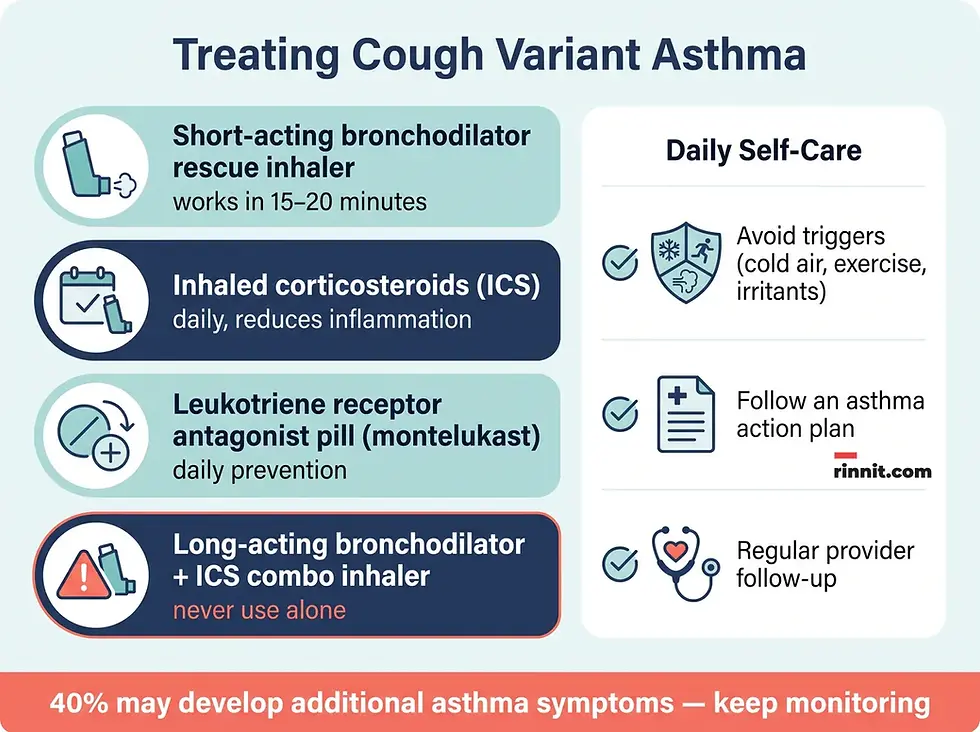
Treatment and daily self-care for cough variant asthma.
Daily Self-Care and Follow-Up
Self-Care Step | Why It Helps |
Avoid known triggers | Reduces cough episodes and attack frequency |
Create an asthma action plan | Guidelines for treating different symptom stages and knowing when to call your provider |
Follow up frequently | Keeps treatment aligned with your symptoms; report new symptoms or medications that stop working |
When to Seek Emergency Care
Go to the emergency room if you have severe symptoms, including:
Emergency Sign | Detail |
Severe shortness of breath | Sudden, significant breathing difficulty |
High heart rate | Tachycardia |
Blue skin, lips, or nails | Cyanosis |
Confusion | Altered mental state |
Questions to Ask Your Doctor
Ask your healthcare provider to give you step-by-step instructions and show you how to use your inhalers. It is also helpful to ask:
Question | Purpose |
What new or worsening symptoms should I look out for? | Early warning signs of progression |
How do I take my medications? | Correct dosing and timing |
What do I do if I have an attack? | Clear action steps during episodes |
Can you help me make an action plan? | Structured guidance for daily management |
Conclusion: A Persistent Cough Deserves an Answer
Cough variant asthma is a real form of asthma hiding behind a single symptom: a dry cough that will not go away. There is no wheezing and no breathlessness, which is why it is often missed or mistaken for something else. The good news is that it responds to the same treatments as classic asthma: daily maintenance inhalers, rescue medication for sudden attacks, and trigger avoidance.
Because about 40% of people with CVA eventually develop additional asthma symptoms, the condition deserves ongoing attention rather than a one-time fix. Following your action plan, avoiding triggers, and keeping regular provider appointments give you the best chance of long-term control.
If you have had a cough lasting more than eight weeks, talk to a healthcare provider about whether cough variant asthma could be the cause. Early diagnosis means earlier relief, and a lower risk of progression to more serious asthma symptoms.
Related reading: Chronic cough: causes, symptoms, diagnosis, and treatment.
Frequently Asked Questions
What is cough variant asthma?
Cough variant asthma is a type of asthma where cough is the only symptom. It causes a chronic or recurring dry cough, without wheezing or shortness of breath, that improves with asthma treatment such as inhalers.
What are the main symptoms of cough variant asthma?
The only symptom is a chronic or recurring cough, usually dry but sometimes with mucus. Symptoms occur in episodes or attacks that can last hours or days. There is no wheezing or breathing difficulty in classic CVA.
What triggers cough variant asthma?
Anything that triggers regular asthma can trigger CVA. The most common triggers are cold air, weather changes, and exercise. Allergies and other lung irritants can also set off coughing episodes.
What causes cough variant asthma?
Narrowed, swollen (inflamed) airways cause asthma. In most people this causes breathing difficulty, but in CVA the inflammation makes you cough instead. The reason some people develop asthma is not fully known.
How is cough variant asthma diagnosed?
Doctors diagnose CVA using symptoms, health history, and lung function tests such as spirometry and bronchoprovocation testing, plus a chest X-ray to rule out other causes. A 2-to-4-week trial of asthma medication that relieves the cough supports the diagnosis.
How is cough variant asthma treated?
Treatment is the same as for other asthma: short-acting rescue inhalers, daily inhaled corticosteroids, leukotriene receptor antagonist pills like montelukast, and long-acting bronchodilators combined with an inhaled corticosteroid. Rescue inhalers work within 15 to 20 minutes; maintenance medication may take a few weeks.
Does cough variant asthma go away?
CVA is manageable but usually persistent. About 40% of people with CVA eventually develop additional asthma symptoms such as wheezing. With trigger avoidance and maintenance medication, most people control their symptoms well.
Can acid reflux cause cough variant asthma?
No. There is no evidence that acid reflux causes CVA. Treating cough variant asthma with acid reflux medications usually does not help relieve symptoms.
What are the emergency signs of cough variant asthma?
Go to the emergency room for severe shortness of breath, a high heart rate (tachycardia), blue skin, lips, or nails (cyanosis), or confusion and an altered mental state.
Can cough variant asthma be prevented?
There is no known way to prevent CVA because the cause of asthma is not fully understood. Not smoking, wearing protective gear around dust and chemicals, and maintaining a healthy weight may lower your risk.
Related Reading
Asthma: Symptoms, Causes, Triggers, Diagnosis & Treatment — Complete Guide explains classic asthma, its triggers and long-term treatment options.
Chronic Cough: Causes, Symptoms, Diagnosis, and Treatment (2026 Guide) reviews the main causes of a cough that lasts more than eight weeks.
Methacholine Challenge Test: How It Diagnoses Asthma, How to Prepare and What Results Mean explains the breathing test often used to confirm cough variant asthma.
Inhalers: Types, Medicines and How to Use Them describes the types of inhalers used for asthma and how to use them.
References
Cleveland Clinic. Cough-Variant Asthma. Cleveland Clinic. Medically reviewed; last updated August 18, 2023. https://my.clevelandclinic.org/health/diseases/25200-cough-variant-asthma
Cox JK, Lockey R, Cardet JC. Cough-variant asthma: a review of clinical characteristics, diagnosis, and pathophysiology. The Journal of Allergy and Clinical Immunology: In Practice. 2025;13(3):490-498. PMID 39557293. https://doi.org/10.1016/j.jaip.2024.11.005
Zhan W, Wu F, Zhang Y, et al. Identification of cough-variant asthma phenotypes based on clinical and pathophysiologic data. Journal of Allergy and Clinical Immunology. 2023;152(3):622-632. PMID 37178731. https://doi.org/10.1016/j.jaci.2023.04.017
Medical disclaimer
This article is for general educational purposes only and is not a substitute for professional medical advice, diagnosis or treatment. Always seek the guidance of your healthcare professional with any questions about your or your child's health. In a medical emergency, call 911 or your local emergency number.



Comments