Constrictive Pericarditis: What It Is, Symptoms, Causes, and Treatment

Updated: 3 days ago
Medically reviewed by Dr. Baraa Alnahhal, MD · Last reviewed: October 2026
Quick Answer
Constrictive pericarditis is a condition in which the pericardium, the membrane holding the heart in place, becomes stiff and thick, stopping the heart from filling properly and potentially causing heart failure [1]. Symptoms include shortness of breath, fatigue and swelling [1]. It usually follows heart surgery, radiation or infection [1]. It is usually treatable with pericardiectomy or medications such as diuretics [1].
What the research says
Constriction is an uncommon complication of acute pericarditis. A 2024 review reports that pericarditis accounts for up to 5% of emergency department visits for nonischemic chest pain in North America and Western Europe, and that constrictive pericarditis develops in fewer than 0.5% of acute pericarditis cases (tamponade in fewer than 3%). Tuberculosis is the most common cause in endemic areas, where corticosteroids are considered for associated constriction (PubMed: Cremer et al., JAMA, 2024) [2].
Most patients improve after pericardiectomy, with survival of about 81% at 10 years in one series. In 47 patients treated with pericardiectomy (tuberculosis was the cause in 46.8% and idiopathic disease in 31.9%), 80% improved by at least one New York Heart Association functional class. In-hospital mortality was 2.1%, and survival was 91%, 85% and 81% at 1, 5 and 10 years. This was a retrospective single-center series, and the authors noted high morbidity and mortality, especially with cancer-related disease, low cardiac output, or reoperation (PubMed: Biçer et al., J Cardiothorac Surg, 2015) [3].
A more complete (radical) pericardiectomy was linked to better long-term survival than a partial one. In 41 patients, 10-year survival was 94% after radical versus 55% after sub-total pericardiectomy (P = 0.014), and 85% of radical-surgery patients were in NYHA class I or II at 5 years versus 53% (PubMed: Nozohoor et al., J Card Surg, 2018) [4]. A separate series of 90 patients found 20-year survival of 74.7% after radical versus 50.4% after conventional surgery (PubMed: Choi et al., J Cardiothorac Surg, 2019) [5]. Both were small, retrospective, single-center studies.
What Is Constrictive Pericarditis?
The pericardium is a thin, fluid-filled membrane with two layers that surrounds the heart. It holds the heart in place, and a layer of fluid inside it cushions the heart and protects it from injury [1]. Under normal circumstances the pericardium is flexible and stretchy, so the heart has no trouble expanding to fill up with blood between heartbeats.
In constrictive pericarditis, that membrane becomes stiffer and thicker than normal [1]. The rigid pericardium keeps the heart from expanding as it should. When the heart can't expand enough to fill with blood, it struggles to pump enough to meet the body's needs. To compensate, the filling pressures increase, which leads to heart failure [1].
You may also hear the term restrictive pericarditis. These are the same condition; the "restrictive" name is simply no longer in common use [1].
Key fact | Detail |
What is affected | The pericardium, the membrane surrounding the heart |
Core problem | The pericardium becomes stiff and thick, blocking heart expansion |
Typical course | Usually a chronic (long-term) problem |
Treatable? | Yes, in most cases, and a cure is often possible, especially with early diagnosis |
Main risk | Elevated filling pressures that can lead to heart failure |
How Common Is It, and Who Gets It?
Constrictive pericarditis is rare overall. Cleveland Clinic estimates it develops in about 9% of people with acute pericarditis [1], while a 2024 JAMA review puts the figure below 0.5% [2], so published estimates vary. Acute pericarditis itself accounts for about 5% of chest pain-related emergency room visits [1].
The condition is most likely to affect people with a history of heart surgery, radiation therapy around the heart, or idiopathic or viral pericarditis ("idiopathic" simply means the original cause is unknown) [1]. In developing countries, tuberculosis is the most common cause [1]. It is two to three times more likely to occur in men than women, and it is extremely rare in children [1].
Population factor | Detail |
Overall frequency | Rare; estimates range from under 0.5% to about 9% of acute pericarditis cases |
Acute pericarditis | Accounts for about 5% of chest pain-related ER visits |
Highest-risk history | Heart surgery, chest radiation, idiopathic or viral pericarditis |
Developing countries | Tuberculosis is the most common cause |
Sex | 2 to 3 times more likely in men than women |
Children | Extremely rare |
What are the 5 types of constrictive pericarditis?
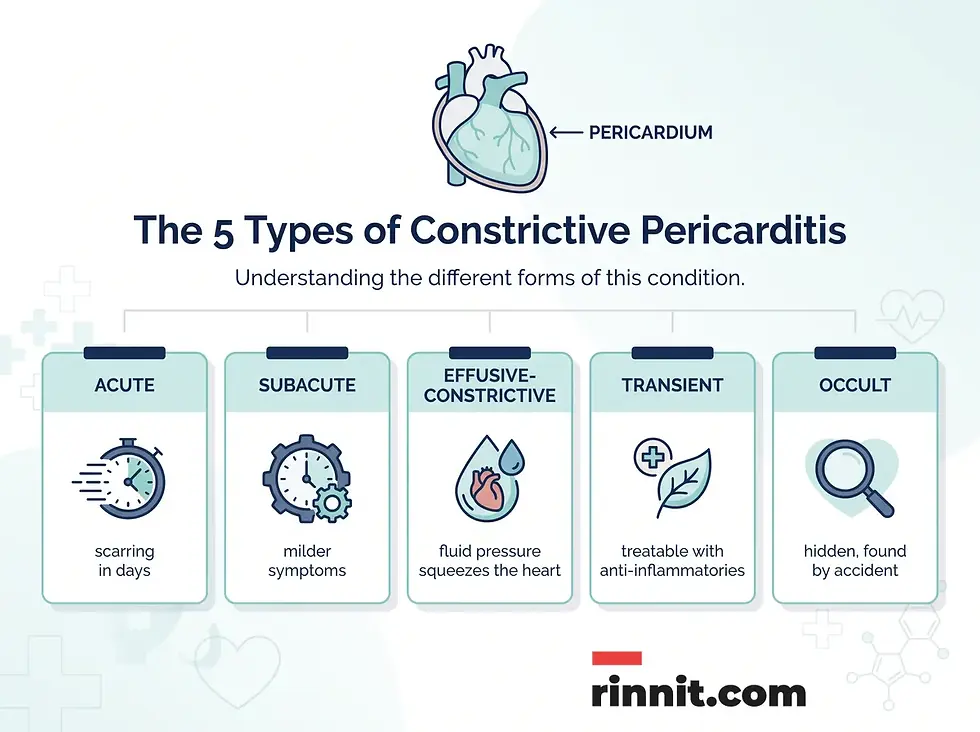
Constrictive pericarditis is not a single pattern of disease. It has several subtypes that differ in how quickly scarring develops, how severe symptoms are, and how the condition is treated [1].
Type | What happens |
Acute | Scarring of the pericardium happens quickly, usually over a matter of days |
Subacute | Like acute constrictive pericarditis, but the symptoms aren't as severe |
Effusive-constrictive | Fluid builds up inside the pericardium (pericardial effusion), putting too much pressure on the heart and causing cardiac tamponade, where the heart can't beat because fluid takes up more and more space. "Effusive constriction" means elevated filling pressures remain even after the extra fluid is drained |
Transient | Usually acute pericarditis that turns into inflammatory constrictive pericarditis; treatable with anti-inflammatory medications |
Occult | "Occult" means hidden; this type is hard to detect and is usually found by accident when running other tests |
What are the symptoms of constrictive pericarditis?
Symptoms develop because the heart can't fill with blood properly and fluid begins to back up in the body. The main symptoms include the following [1].
Symptom | Why it happens |
Shortness of breath (dyspnea) | The heart can't pump enough to meet the body's needs |
Chest pain | Pressure and inflammation around the heart |
Fatigue | Reduced blood flow and oxygen delivery |
Dizziness | Insufficient circulation |
Swelling, especially in the abdomen and lower legs | Fluid buildup (fluid retention) from elevated filling pressures |
Loss of muscle mass | The body's response to chronic illness |
Loss of appetite, feeling full after eating very little | Fluid and pressure affecting the abdomen and digestion |
What Causes Constrictive Pericarditis?
The pericardium stiffens or thickens because of scar tissue from previous medical conditions [1]. The stiffening can happen for several reasons.
Cause category | Examples |
Infections | In developing countries, usually bacterial, especially tuberculosis (constrictive pericarditis develops in 20% to 30% of tuberculosis-related cases of pericarditis). In developed countries, viral infections are more likely |
Heart and circulatory problems | Heart attacks or other conditions affecting the major blood vessels closest to the heart |
Trauma | Chest injuries, either blunt impacts or penetrating injuries like knife or bullet wounds, that cause inflammation and lead to scar tissue |
Immune system or inflammatory disorders | Lupus, rheumatoid arthritis, or Sjögren's syndrome |
Medical causes | After heart surgery, radiation therapy for cancer, or as a side effect of some medications |
Cancer | Cancer of the pericardium itself, or cancer that started elsewhere in the body |
Unknown (idiopathic) | Occurs for unknown reasons; providers often assume a viral infection, and unknown and viral causes are grouped together for statistics |
A common question is whether constrictive pericarditis is contagious. It is not. While the condition can follow infections, some of which are potentially contagious, the condition itself is not contagious [1].
When Should You See a Doctor?
Shortness of breath, chest pain, dizziness, and swelling can signal many different conditions, and some of them are life-threatening. The symptoms of constrictive pericarditis overlap with emergencies such as cardiac tamponade and heart attack, so you should not attempt to self-diagnose or self-treat. Seek emergency medical care immediately if you experience any of the following [1].
Emergency symptom | What it may signal |
Shortness of breath (dyspnea) | Heart failure, cardiac tamponade, or heart attack |
Chest pain | Cardiac tamponade or heart attack |
Dizziness or feeling lightheaded | Inadequate circulation |
Fainting or passing out | A life-threatening cardiac event |
Because symptoms like chest pain and fainting can point to immediately dangerous conditions, do not wait. Call emergency services or go to the nearest emergency department right away.
How Is Constrictive Pericarditis Diagnosed?
A doctor diagnoses constrictive pericarditis using a combination of symptoms, medical history, physical examination, and diagnostic tests. The condition is sometimes difficult to diagnose, especially when symptoms aren't severe or when other conditions produce similar or related symptoms [1]. If a healthcare provider suspects it, any of the following tests are possible.
Test | What it shows |
Tuberculosis testing | Rules out or confirms TB as the underlying cause |
Blood tests | Confirm or rule out immune system conditions |
Echocardiogram | Ultrasound showing how well the heart fills and pumps |
Electrocardiogram (EKG) | Records the heart's electrical activity |
Chest X-ray | Checks the size and shape of the heart and surrounding structures |
Heart CT scan | Detailed imaging of the thickened pericardium |
Heart MRI | Detailed imaging of the pericardium and heart tissue |
Left and right heart catheterization | Measures the elevated filling pressures inside the heart |

How Is Constrictive Pericarditis Treated? Is There a Cure?
Constrictive pericarditis is usually treatable, and curing it is often possible [1]. In most cases, treatment follows two main principles: relieve the pressure on the heart that builds up because the pericardium can't stretch, and treat the underlying causes or related symptoms.
Surgery: Pericardiectomy
Pericardiectomy, the surgical removal of the entire pericardium, usually offers the best chance of successfully treating this condition [1]. Importantly, you don't need your pericardium to survive, and many people return to their normal lives without any difficulty or long-term effects [1].
Medications
Depending on the underlying cause and symptoms, different medications can treat the symptoms directly or attempt a cure by stopping whatever is causing the condition. In some cases, medications alone are enough, avoiding the need for surgery [1]. Medications can also manage symptoms for people who can't have surgery.
Medication class | How it helps |
Diuretics | Help the kidneys remove extra fluid from the body |
NSAIDs (e.g., ibuprofen, naproxen) | Reduce inflammation and relieve pain |
Steroids | Anti-inflammatory effects that can help treat the condition |
Cause-specific medications | For example, antibiotics for bacterial infections like tuberculosis |

Possible Complications and Side Effects
Potential complications vary based on the treatment and medication, and the underlying cause or type of constrictive pericarditis are also factors. Your healthcare provider is the best person to explain possible side effects and what to watch for. Potential complications from surgery include heart failure, irregular heart rhythms (arrhythmias), infections and sepsis, and death [1].
Recovery: How Soon Will You Feel Better?
Recovery time depends on the cause of the condition and the treatments you receive, and it may take days or weeks to feel better. If you have surgery, recovery time also has to account for healing from the surgery itself. Most people feel better within three months [1], but some people may need several months for a full recovery. Some cases go away on their own or with medication only, which usually takes a few weeks to a few months [1]. The more severe the case or cause, the longer recovery usually takes.
What is the outlook and life expectancy for constrictive pericarditis?
The outlook depends on the cause, the severity of your case, the treatments involved, and any other health conditions you have. Because this condition often happens alongside, or because of, severe or deadly conditions, the outlook can be poor, especially when it results from radiation therapy or when you also have one of the conditions below [1].
Co-occurring condition | Effect on outlook |
Advanced kidney disease or kidney failure | Makes the outlook more negative |
Heart failure | Increases risk |
Liver disease | Increases risk |
Pulmonary hypertension | Increases risk |
The best outcomes usually happen with early diagnosis and treatment, and good outcomes are also more likely with the transient type of the condition [1]. About 5% to 10% of people who undergo surgery don't survive, and hospitals that specialize in heart care tend to have better outcomes [1]. The good news is that most people recover and do well. Nearly 80% of people who have surgery live at least five years, and nearly 60% live at least 10 years [1].
Prognosis indicator | Statistic |
Surgical mortality | About 5% to 10% do not survive surgery |
5-year survival after surgery | Nearly 80% |
10-year survival after surgery | Nearly 60% |
Best outcomes | Early diagnosis and treatment; transient type |
Specialty centers | Heart-care specialty hospitals tend to have better outcomes |
Can You Prevent Constrictive Pericarditis?
Constrictive pericarditis happens unpredictably, so it is not possible to prevent it [1]. The only way to reduce your risk is to avoid situations that might lead to developing it. For example, get bacterial infections treated quickly rather than delaying care, and, if you receive radiation therapy, medical personnel can limit radiation damage to the pericardium [1].
How can people live well with constrictive pericarditis?
Self-care for this condition means following your provider's guidance closely. Because testing and imaging are necessary to diagnose it, this is not something you should treat or manage on your own.
Take your medication as prescribed. Don't stop just because you feel better.
Follow diet instructions. Many people need to limit salt, because sodium makes the body retain too much fluid, which can worsen the condition.
Limit physical activity if necessary. This reduces strain on the heart and helps prevent or limit heart muscle damage.
Follow-up care: Most people need to see their provider regularly while recovering. If your condition improves, your provider will likely recommend reducing how often you're seen. Call your provider or schedule an appointment if your symptoms return or change in ways that affect your usual activities and routine.
Questions to ask your healthcare provider:
What is the most likely cause in my case?
Do I need surgery, or can medications treat me?
What are the risks of pericardiectomy for someone like me?
How often should I be seen during recovery?
What symptoms should send me to the ER?
Conclusion
Constrictive pericarditis is an uncommon, unpredictable condition in which the membrane around the heart stiffens and thickens, preventing the heart from filling with blood and often leading to heart failure. It shares symptoms with many other conditions, which can make diagnosis difficult, but advances in imaging (echocardiogram, CT, MRI, catheterization) have made it easier to detect, and treatment has made great strides. In most cases the condition is treatable, and in many cases curable, especially through pericardiectomy surgery. Early diagnosis gives you the best possible outcome, so if you experience shortness of breath, chest pain, dizziness, or unexplained swelling, talk to a healthcare provider right away.
If you or a loved one has been diagnosed with constrictive pericarditis, don't navigate it alone. Our related guides cover heart failure, pericarditis, and heart attack symptoms. Explore them to understand the full picture and the questions worth asking your care team.
Frequently Asked Questions
1. What is constrictive pericarditis in simple terms?
Constrictive pericarditis is a condition where the pericardium, the thin, fluid-filled membrane holding the heart in place, becomes stiffer and thicker than normal. The stiff membrane stops the heart from expanding to fill with blood, so it can't pump enough to meet the body's needs, and filling pressures rise, which can lead to heart failure.
2. Is constrictive pericarditis the same as restrictive pericarditis?
Yes. Constrictive pericarditis and restrictive pericarditis are the same condition. The term restrictive pericarditis is simply no longer in common use.
3. What are the main symptoms of constrictive pericarditis?
The main symptoms are shortness of breath, chest pain, fatigue, dizziness, swelling (especially in the abdomen and lower legs) from fluid buildup, loss of muscle mass, and loss of appetite with a feeling of fullness even after eating very little.
4. What causes the pericardium to become stiff and thick?
Common causes include infections (tuberculosis in developing countries, viral infections in developed countries), prior heart surgery, chest radiation therapy, chest trauma, immune or inflammatory disorders such as lupus or rheumatoid arthritis, and cancer. In some cases the cause is unknown (idiopathic).
5. Who is most at risk for constrictive pericarditis?
People with a history of heart surgery, radiation therapy around the heart, or idiopathic or viral pericarditis are most at risk. Men are two to three times more likely to develop it than women, and it is extremely rare in children.
6. How is constrictive pericarditis diagnosed?
Doctors use symptoms, medical history, a physical examination, and tests such as tuberculosis testing, blood tests for immune conditions, an echocardiogram, an electrocardiogram (EKG), chest X-ray, heart CT scan, heart MRI, and left and right heart catheterization.
7. Can constrictive pericarditis be cured?
The condition is usually treatable and curing it is often possible. The best chance of a cure is pericardiectomy, surgery that removes the entire pericardium. You don't need the pericardium to survive, and many people return to normal life without long-term effects. Some cases resolve with medication alone.
8. What medications treat constrictive pericarditis?
The most common medications are diuretics (to help the kidneys remove extra fluid), NSAIDs such as ibuprofen or naproxen (to reduce inflammation and pain), steroids (for anti-inflammatory effects), and cause-specific medications such as antibiotics for bacterial infections like tuberculosis.
9. What is the survival rate after pericardiectomy surgery?
Most people recover and do well after surgery. Nearly 80% of people who have surgery live at least five years, and nearly 60% live at least 10 years. About 5% to 10% of surgical patients don't survive, and hospitals specializing in heart care tend to have better outcomes.
10. How long does it take to recover from constrictive pericarditis?
It may take days or weeks to feel better after treatment starts, and surgery adds its own recovery time. Most people feel better within three months, though some need several months for full recovery. Cases treated with medication alone usually resolve within a few weeks to a few months.
11. What are the warning signs that need emergency care?
Seek emergency care immediately for shortness of breath, chest pain, dizziness or feeling lightheaded, or fainting. These symptoms overlap with life-threatening conditions such as cardiac tamponade and heart attack, so do not wait to see if they pass.
Related Reading
Heart MRI (Cardiac MRI): What It Shows, How to Prepare, What Happens and Results explains the imaging test used to assess the heart muscle and its lining.
References
Cleveland Clinic. Constrictive Pericarditis. Cleveland Clinic. February 1, 2022. https://my.clevelandclinic.org/health/diseases/22373-constrictive-pericarditis
Cremer PC, Klein AL, Imazio M. Diagnosis, risk stratification, and treatment of pericarditis: a review. JAMA. 2024;332(13):1090-1100. doi:10.1001/jama.2024.12935. PMID: 39235771.
Biçer M, Özdemir B, Kan İ, Yüksel A, Tok M, Şenkaya I. Long-term outcomes of pericardiectomy for constrictive pericarditis. J Cardiothorac Surg. 2015;10:177. doi:10.1186/s13019-015-0385-8. PMID: 26613929.
Nozohoor S, Johansson M, Koul B, Cunha-Goncalves D. Radical pericardiectomy for chronic constrictive pericarditis. J Card Surg. 2018;33(6):301-307. doi:10.1111/jocs.13715. PMID: 29761570.
Choi MS, Jeong DS, Oh JK, Chang SA, Park SJ, Chung S. Long-term results of radical pericardiectomy for constrictive pericarditis in Korean population. J Cardiothorac Surg. 2019;14(1):32. doi:10.1186/s13019-019-0845-7. PMID: 30728044.
Medical Disclaimer
This article is for informational purposes only and does not constitute medical advice. Always seek the advice of your physician or other qualified health provider with any questions you may have regarding a medical condition. Never disregard professional medical advice or delay in seeking it because of something you have read here.



Comments