Congenital Diaphragmatic Hernia (CDH): What It Is, Why It Happens, and How It's Treated

Updated: 3 days ago
Medically reviewed by Dr. Baraa Alnahhal, MD · Last reviewed: October 2026
Quick Answer
Congenital diaphragmatic hernia (CDH) is a birth defect in which the fetal diaphragm does not fully form, letting abdominal organs move into the chest and crowd the lungs. Babies are born critically ill and need immediate intensive care, including oxygen, a breathing tube or ECMO, then surgery. Between 7 and 9 in 10 babies survive.
What the research says
Fetal surgery (FETO) improved survival in severe left-sided CDH. In a randomized trial of 80 women carrying fetuses with severe isolated left-sided CDH, 40% of babies (16 of 40) in the FETO group survived to discharge, compared with 15% (6 of 40) with expectant care (relative risk 2.67; 95% CI 1.22 to 6.11). FETO also raised the risk of preterm, prelabor rupture of membranes (47% vs. 11%) and preterm birth (75% vs. 29%). (Deprest et al., N Engl J Med, 2021) [5]
In moderate left-sided CDH, FETO did not show a significant survival benefit. In a randomized trial of 196 women, 63% of babies (62 of 98) in the FETO group and 50% (49 of 98) in the expectant care group survived to discharge (relative risk 1.27; 95% CI 0.99 to 1.63; P = 0.06). Preterm birth was more common with FETO (64% vs. 22%). (Deprest et al., N Engl J Med, 2021) [6]
Survival depends heavily on how severe CDH is. In a French national register of 158 CDH cases, 67% of live-born babies with a known outcome (93 of 141) survived to hospital discharge: 60% of those diagnosed before birth and 93% of those diagnosed after birth. Mortality rose with each prenatal marker of severity (odds ratio 3.38 with one marker and 20.64 with two). (Barrière et al., J Pediatr, 2017) [4]
Study details are from PubMed abstracts.
What Is a Congenital Diaphragmatic Hernia?
A congenital diaphragmatic hernia is a birth defect that forms while the baby is still developing in the womb. The word congenital means it is present at birth. It starts when the fetus's diaphragm — the muscle barrier that normally separates the belly (abdomen) from the chest — does not fully form or is not strong enough to hold its position.
When that barrier is incomplete, organs that belong in the abdomen can slip upward into the chest cavity. These organs include the stomach, intestines, liver, gallbladder, pancreas, and spleen. When an organ passes through a muscle barrier, doctors call it a hernia.
Term | Plain-language meaning |
Congenital | Present at birth; begins during fetal development |
Diaphragm | The muscle barrier between the belly and the chest |
Hernia | An organ passing through a muscle barrier |
Fetal development | How a baby grows inside the womb before birth |
Why does the crowding matter? The extra organs sitting in the chest squeeze the developing lungs and keep them from growing normally. As a result, babies born with CDH usually have small, underdeveloped lungs. This is called pulmonary hypoplasia. It causes low blood oxygen levels and breathing trouble the moment the baby is born, plus high blood pressure in the lung arteries that strains the heart. These babies need critical care at birth to stabilize.

What Are the Signs of CDH in a Newborn?
The first sign that a newborn has CDH is usually severe difficulty breathing. Healthcare providers and delivery teams watch for other warning signs in the hours after birth.
Symptom | What it looks like |
Severe difficulty breathing | The first and most common sign |
Rapid heart rate (tachycardia) | The heart beats faster than normal |
Cyanosis | Skin discoloration from lack of oxygen |
Weak breath sounds | Usually heard on one side of the chest |
Bowel sounds in the chest | Abnormal sounds heard through the ribcage |
Barrel chest and concave belly | An uneven chest shape with a sunken abdomen |
Rarely, a small hernia causes no noticeable symptoms at all. In those cases, providers may not find the CDH until later in childhood, or even adulthood.
What Causes Congenital Diaphragmatic Hernia?
Doctors do not know the exact cause of CDH. Research points to a handful of factors that may play a role in how it develops.
Possible factor | How it may contribute |
Genetics | Inherited or spontaneous gene changes may affect how the diaphragm forms |
Harmful environmental exposure during pregnancy | Outside factors the pregnant person is exposed to may interfere with development |
Fetal malnutrition | Insufficient nutrition for the fetus may affect diaphragm formation |
It is important to understand that no one can be blamed for CDH. The cause is not fully understood, and most cases have no single clear trigger that parents could have prevented.
What Complications Can CDH Cause?
Because the lungs do not grow to full size, most complications of CDH come from underdeveloped lungs and low oxygen. These problems can affect many parts of the body.
Complication | What happens |
Low blood oxygen (hypoxemia) | Affects how all of the baby's organs work, especially the brain and heart; severe or persistent low oxygen can cause long-term damage |
Pulmonary hypertension | High blood pressure in the lung arteries strains the right ventricle of the heart and can lead to heart failure |
Lung infections | Underdeveloped lungs are more vulnerable to infections like pneumonia; this can remain a lifelong concern even after repair |
Feeding difficulties | Pressure on the digestive organs or a difficult birth can cause long-term feeding problems, sometimes needing tube feeding; growth faltering may occur |
Developmental delays | Lack of oxygen can cause delays; children may need physical, speech, or occupational therapy over time |
Sensorineural hearing loss | Some infants develop progressive hearing loss; it is unclear whether this comes from the condition, the treatment, or both |

How Do Doctors Diagnose CDH?
Many cases are found before the baby is born. A provider may spot CDH during a routine prenatal ultrasound. Once it is found, they usually follow up with a fetal MRI to see the hernia more clearly, and a fetal echocardiogram to check whether the heart is affected.
Sometimes CDH is not seen until after birth. The delivery team may notice breathing distress or body features such as an uneven chest or a barrel chest paired with a small, concave belly. Providers then order a chest X-ray and an echocardiogram, and may take a blood sample to test the baby's blood oxygen levels and look for other genetic anomalies.
Timing | How CDH is found |
Before birth | Routine prenatal ultrasound; followed by fetal MRI and fetal echocardiogram |
After birth | Signs of breathing distress or unusual body shape; confirmed with chest X-ray, echocardiogram, and blood oxygen testing |
Later childhood or adulthood | Rarely, a small hernia causes no symptoms and is found much later |
How Is CDH Treated?
Treatment begins as soon as CDH is diagnosed. It can feel frightening, but the care team is working to keep the baby safe at every step.
Treatment Before Birth
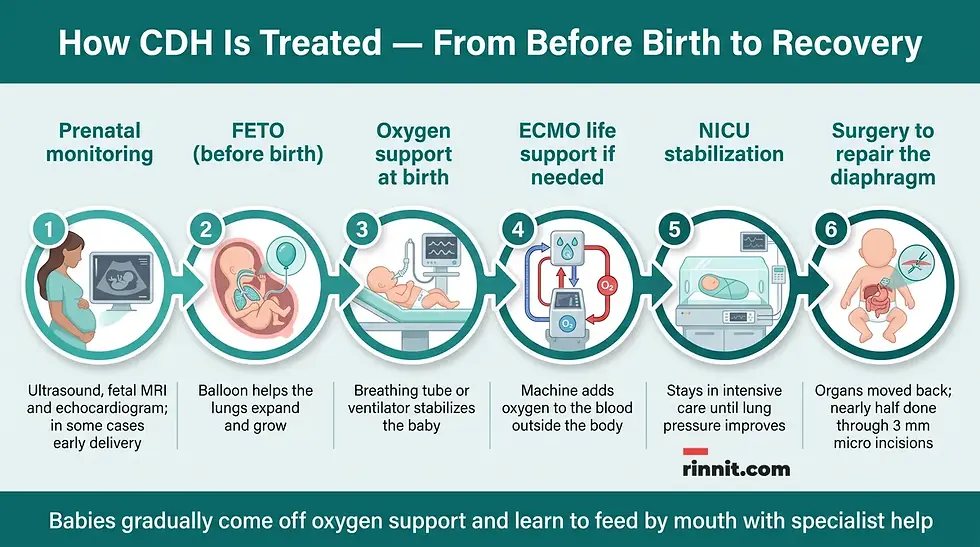
If CDH is found during pregnancy, providers monitor the pregnancy closely. They look for congenital issues in other organ systems, because CDH can sometimes be part of a more complex condition. They also watch for signs of premature labor and decide whether to induce labor early for the sake of the baby.
In some specific cases, the care team can treat the fetus before birth using a procedure called FETO (fetoscopic tracheal occlusion). This fetal surgery can improve the size and function of the growing lungs. The surgeon uses a fetoscopy — a minimally invasive technique with a tiny lighted camera — to reach the fetus through small incisions in the skin and into the uterus. A balloon is placed in the fetus's windpipe (trachea). Amniotic fluid then builds up in the lungs behind the balloon, causing them to expand. That expansion can improve lung growth and reverse some of the damage CDH caused.
Treatment After Birth
Babies born with CDH usually need immediate intensive care from a specialized team. The treatment path typically follows these steps.
Step | What happens |
Oxygen support | The first treatment for underdeveloped lungs; some babies get a breathing tube attached to a mechanical ventilator |
ECMO life support | Extracorporeal membrane oxygenation bypasses the underdeveloped lungs (and sometimes the heart); a machine adds oxygen to blood drawn from an artery or vein and returns it to the body |
Stabilization in the NICU | The baby stays in the neonatal intensive care unit until pulmonary hypertension improves and ECMO is no longer needed |
Surgery | A pediatric surgeon moves the organs back into the abdomen and repairs the diaphragm defect; in almost half of cases, this is done with minimally invasive surgery through 3 mm micro incisions instead of open surgery |
What Is Recovery Like?
As the baby recovers, they gradually come off oxygen support. Nutrients are given through a tube until the breathing tube is removed. After that, speech and lactation specialists help the family begin feeding by mouth. Some babies take longer than others to make this transition, and the healthcare team stays with the family for as long as needed.
What Is the Outlook for Babies Born With CDH?
The reported survival rate for babies born with CDH has improved. Between 7 and 9 out of every 10 babies survive. These babies are born critically ill, but for those who make it through the tense early days, the outlook gets better. Some children may have long-term complications, but they can still live long and full lives. Medical advances continue to improve the odds of both short-term survival and long-term health.
The longer-term prognosis depends on several factors, including whether the baby was born prematurely, how severe the condition is at birth, the size of the hernia, which organs are involved, and any other health conditions. Babies who need breathing or feeding support for longer have a higher risk of ongoing complications such as chronic lung disease, growth failure, hearing loss, and developmental delays. Providers monitor these children closely throughout early life.
Factor | Influence on outlook |
Premature birth | Higher risk if born early |
Severity at birth | More severe illness lowers short-term odds |
Hernia size | Larger hernias cause more crowding |
Organs involved | More organs in the chest means more complexity |
Other health conditions | Additional conditions affect the plan and prognosis |
Length of breathing/feeding support | Longer support raises the risk of lasting complications |
A reassuring note: It can be scary and confusing to learn your baby has a congenital diaphragmatic hernia. After birth, your baby will be taken for intensive care and possibly a long hospital stay. But thanks to medical advances, the prognosis for CDH is better than ever. You and your newborn will have a team of providers supporting you from diagnosis through your child's early life.
Can CDH Be Prevented?
Because the exact cause of CDH is not known, there is no proven way to prevent it. Research suggests genetics, environmental exposures during pregnancy, and fetal malnutrition may play a role, but no single cause explains most cases. If you are pregnant and worried about CDH, talk with your healthcare provider about prenatal screening options.
When Should You Seek Immediate Care?
CDH is a medical emergency at birth. A newborn with severe breathing difficulty, blue-tinged skin, or weak breathing on one side needs emergency care immediately. For older children or adults with a rare small hernia that was never caught, seek urgent care if new breathing problems or chest pain appear.
Conclusion: CDH Is Serious at Birth — But the Odds Keep Improving
Congenital diaphragmatic hernia is a birth defect where abdominal organs move into the chest during fetal development and crowd the lungs. It leads to small, underdeveloped lungs and low blood oxygen at birth, which is why babies need intensive care, breathing support, and surgery right away. The good news is that between 7 and 9 in 10 babies with CDH survive, and many go on to live long, full lives — even if some need ongoing care for breathing, feeding, hearing, or development. Advances in fetal surgery like FETO and in NICU care keep improving the outlook. If your pregnancy or your newborn involves CDH, work closely with a specialized care team from the first diagnosis.
Get clear answers and trusted health guidance. For more plain-language health guides written to help you make confident decisions, visit Rinnit.com.
Frequently Asked Questions
What is a congenital diaphragmatic hernia in simple terms?
A congenital diaphragmatic hernia is a birth defect where the muscle between the belly and chest does not fully form before birth, so organs like the stomach and intestines move into the chest and crowd the developing lungs.
Is a congenital diaphragmatic hernia dangerous?
Yes. Babies are born critically ill with small lungs and low blood oxygen, and they need immediate intensive care. With modern treatment, between 7 and 9 out of 10 babies survive.
What causes CDH?
The exact cause is unknown. Research suggests genetics, harmful environmental exposures during pregnancy, and fetal malnutrition may play a role.
How do doctors know a baby has CDH?
Often through a routine prenatal ultrasound, confirmed with a fetal MRI and fetal echocardiogram. Sometimes it is found after birth from breathing distress, an unusual chest shape, a chest X-ray, or blood oxygen testing.
Can CDH go unnoticed?
Rarely. Small hernias can cause no symptoms and may not be discovered until later in childhood or even adulthood.
What are the symptoms of CDH in a newborn?
Severe difficulty breathing, fast heart rate, blue-tinged skin from lack of oxygen, weak breath sounds on one side, bowel sounds in the chest, and a barrel chest with a sunken belly.
What is pulmonary hypoplasia?
Small, underdeveloped lungs. This is the main problem in CDH, caused by abdominal organs crowding the chest while the baby develops.
What is hypoxemia?
Low blood oxygen levels. In CDH it can affect how all of the baby's organs function, especially the brain and heart.
What is ECMO?
Extracorporeal membrane oxygenation is a life support machine that draws blood out of the body, adds oxygen to it, and returns it, bypassing the baby's underdeveloped lungs (and sometimes the heart).
What is FETO?
Fetoscopic tracheal occlusion is a fetal surgery where a balloon is placed in the fetus's windpipe so amniotic fluid builds up in the lungs behind it, helping the lungs expand and grow.
Does every baby with CDH need ECMO?
No. Some babies only need oxygen support, sometimes through a breathing tube. ECMO is for babies who need more aggressive life support.
How is the hernia repaired?
A pediatric surgeon moves the organs back into the abdomen and repairs the diaphragm. In almost half of cases, this is done with minimally invasive surgery through 3 mm micro incisions.
When does the surgery happen?
After the baby has stabilized, usually once pulmonary hypertension has improved and the baby no longer needs ECMO.
How long is the recovery after CDH surgery?
Babies come off oxygen support gradually and receive tube feeding until the breathing tube is removed. Some take longer to transition to mouth feeding than others.
Can babies with CDH feed normally afterward?
Many eventually feed by mouth with help from speech and lactation specialists, but some have feeding difficulties and may need long-term tube feeding.
Can CDH cause long-term problems?
Some children have ongoing complications such as chronic lung disease, growth failure, hearing loss, and developmental delays. Babies needing longer breathing or feeding support have a higher risk.
Can CDH cause hearing loss?
Some infants with CDH develop progressive sensorineural hearing loss. Scientists are not sure whether this comes from the condition, the treatment, or both.
Will my child with CDH be able to live a normal life?
Many children with CDH live long and full lives, even if they have some long-term complications and need continued medical follow-up.
What is the survival rate for CDH?
Between 7 and 9 out of every 10 babies born with CDH survive, and the rate has improved over time.
What affects the long-term outlook?
Whether the baby was born prematurely, how severe the condition is at birth, the size of the hernia, which organs are involved, and any other health conditions.
Can CDH be prevented?
There is no proven way to prevent CDH because the exact cause is unknown. Discuss prenatal screening options with your healthcare provider.
Is CDH hereditary?
Genetics may play a role, but there is no single inherited pattern that explains all cases, and many cases occur without a family history.
What is pulmonary hypertension in CDH?
High blood pressure in the lung arteries. It strains the right ventricle of the heart and can lead to heart failure if not treated.
Can CDH be treated before the baby is born?
In some specific cases, yes. FETO surgery before birth can help the fetus's lungs grow. Providers also monitor the pregnancy closely and may deliver early.
Who is on the care team for a baby with CDH?
A specialized team including a pediatric surgeon, pediatric anesthesiologist, NICU staff, speech specialists, and lactation consultants, with your baby's provider monitoring throughout early life.
Related Reading
20-Week Ultrasound (Anatomy Scan): What It Checks, How to Prepare and What Results Mean explains the mid-pregnancy scan that can detect signs of this condition before birth.
Fetoscopy: How It Treats Babies Before Birth, Procedure and Risks explains the camera procedure used to treat some conditions before birth.
References
Fazle T, Mustafa H, Alahmadi MH, et al. Congenital Diaphragmatic Hernia. StatPearls [Internet]. Treasure Island (FL): StatPearls Publishing. Updated June 19, 2026. PMID 32310536. https://www.ncbi.nlm.nih.gov/books/NBK556076/
Belkind-Gerson J. Diaphragmatic Hernia. Merck Manual Consumer Version. Full review August 2025; last updated May 2026. https://www.merckmanuals.com/home/children-s-health-issues/birth-defects-of-the-digestive-tract/diaphragmatic-hernia
MedlinePlus Genetics. Congenital diaphragmatic hernia. National Library of Medicine. Last updated December 1, 2019. https://medlineplus.gov/genetics/condition/congenital-diaphragmatic-hernia/
Barrière F, Michel F, Loundou AD, et al. One-Year Outcome for Congenital Diaphragmatic Hernia: Results From the French National Register. J Pediatr. 2017;193:204-210. PMID 29212620. https://doi.org/10.1016/j.jpeds.2017.09.074
Deprest JA, Nicolaides KH, Benachi A, et al. Randomized Trial of Fetal Surgery for Severe Left Diaphragmatic Hernia. N Engl J Med. 2021;385(2):107-118. PMID 34106556. https://doi.org/10.1056/NEJMoa2027030
Deprest JA, Benachi A, Gratacos E, et al. Randomized Trial of Fetal Surgery for Moderate Left Diaphragmatic Hernia. N Engl J Med. 2021;385(2):119-129. PMID 34106555. https://doi.org/10.1056/NEJMoa2026983
Medical disclaimer
This article is for general educational purposes only and is not a substitute for professional medical advice, diagnosis, or treatment. Always seek the advice of your physician or other qualified healthcare provider with any questions you may have about a medical condition. Never disregard professional medical advice or delay seeking care because of something you have read here. If you think you may have a medical emergency, call your doctor or emergency services immediately.



Comments