Ciguatera Fish Poisoning: What It Is, How It Sneaks Into Reef Fish, and What Treatment Involves

Updated: 2 days ago
Medically reviewed by Dr. Baraa Alnahhal, MD · Last reviewed: October 2026
Quick Answer
Ciguatera fish poisoning is food poisoning caused by ciguatoxin, a nerve toxin from reef algae that builds up in large tropical reef fish such as grouper, snapper and barracuda [1]. Cooking or freezing does not remove it [1]. Symptoms usually start within six hours; go to the emergency room right away, as fast treatment prevents rare but serious heart and breathing complications [1].
What the research says
Ciguatera is the most frequently reported seafood-toxin illness, and symptoms can last. An updated review described ciguatera fish poisoning as the most frequently reported seafood-toxin illness in the world, with gastrointestinal, neurological, neuropsychological, and cardiovascular symptoms that may last days, weeks, or months (Friedman et al., Mar Drugs, 2017) [2].
Nerve symptoms dominate and can return later; there is no specific treatment. A review of the neurological features found that peripheral neurological signs predominate in the acute phase but also persist or reoccur long afterward, that diagnosis is clinical and can be a challenge for physicians unfamiliar with the condition, and that no specific treatment exists (L'Herondelle et al., Cells, 2020) [3].
What Is Ciguatera Fish Poisoning?
Ciguatera is food poisoning you get from eating fish contaminated with ciguatoxin [1]. Ciguatoxin is a neurotoxin, which is simply a substance that changes how your nervous system works: the network of nerves that controls everything from your senses to your heartbeat.
The toxin starts with ocean algae called dinoflagellates (Gambierdiscus toxicus). These algae grow in and around coral reefs. Tiny fish eat the algae, and then bigger fish that people eat, like grouper or snapper, eat the little fish, picking up the ciguatoxin along the way [1].
Here is the tricky part: ciguatoxin is not harmful to the fish that carry it, but it is poisonous to humans [1]. If you eat contaminated fish, the toxin can cause symptoms that affect your digestive system, your nervous system, and, in severe cases, your cardiovascular system: your heart and blood circulation [1] [2].
Although ciguatera is not usually fatal, it is important to go to the emergency room (ER) immediately. Acting fast stabilizes your condition and prevents serious complications from developing.

How ciguatoxin moves from reef algae, through the food chain, and into the fish on your plate.
Key Terms to Know
Key terms for understanding ciguatera fish poisoning include ciguatoxin, a nerve poison, the reef algae called dinoflagellates that produce it, and symptoms such as allodynia and bradycardia.
Term | What it means in plain language |
Ciguatoxin | A nerve poison that changes how your nervous system works |
Neurotoxin | Any substance that interferes with the normal function of nerves |
Dinoflagellates (Gambierdiscus toxicus) | The reef algae that actually produce ciguatoxin |
Allodynia | Feeling pain or temperature changes that shouldn't be there, like a hot object feeling cold |
Bradycardia | A slower-than-normal heartbeat |
Hypotension | Low blood pressure |
Dyspnea | Shortness of breath |
Osmotic diuretics | Medicines (like mannitol) that remove water from the body to calm nervous system symptoms |
How Common Is Ciguatera?
Ciguatera is the most common type of food poisoning involving fish [1] [2]. About 50,000 cases are reported worldwide each year, and even more cases are likely treated without ever being reported [1].
Scientists also expect cases may rise over time. As environmental shifts damage coral reefs while creating ideal conditions for Gambierdiscus toxicus, the algae that cause ciguatera, the poison-producing algae actually thrive around dead or dying coral. Several factors influence where these algae grow, including water temperature, how salty the water is (its salinity), and how much light it receives [1]. Scientists continue to study and monitor these conditions.
Where Is Ciguatera Fish Poisoning Found?
Anyone around the world can get this type of food poisoning. What matters is not where you are dining; it is where the fish you are eating was caught. Fish caught in risky waters are shipped worldwide, so you can get sick far from the reef [1].
The fish at risk live in waters with coral reefs, because that is where the toxin-making algae live. This includes fish from the Caribbean and the South Pacific Ocean [1]. Within the United States, coral reef waters that carry risk include those off the coast of:
High-risk region | Notes |
Southern Florida | Reef waters along the state's southern coast |
The Bahamas | Caribbean reef waters |
The U.S. and British Virgin Islands | Caribbean reef waters |
Puerto Rico | Caribbean reef waters |
Hawaii | Pacific reef waters |
What Kinds of Fish Can Carry Ciguatera?
More than 400 species of fish can carry ciguatera, and any of them can give you food poisoning if you eat them [1]. Most of the culprits are large predatory reef fish, like barracudas, moray eels, and amberjacks [1]. Some of the most common types responsible for ciguatera include:
Risky reef fish | Risky reef fish |
Amberjack | Moray eel |
Barracuda | Parrot fish |
Grouper | Red snapper |
Sea bass | Spanish mackerel |
Sturgeon | Surgeonfish |
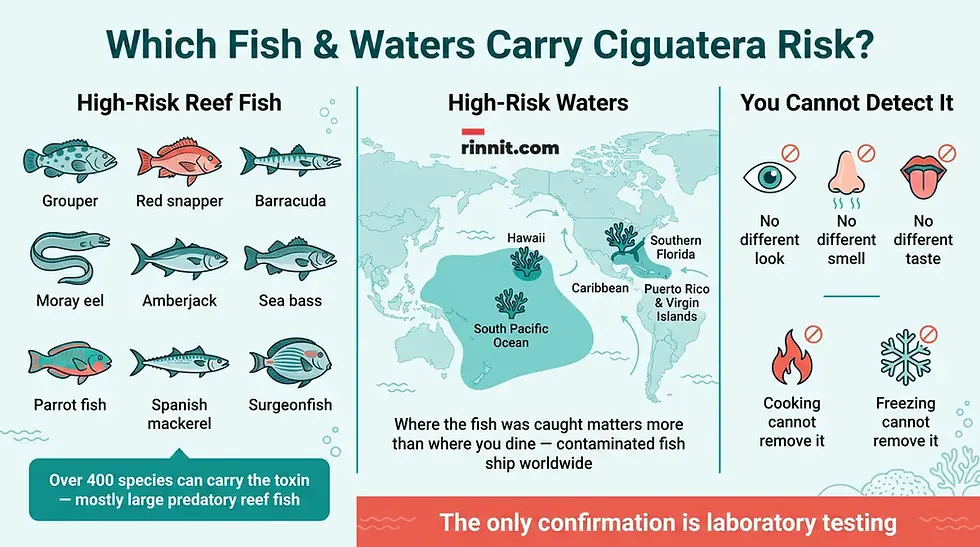
High-risk reef fish and waters. Where the fish was caught matters more than where you dine, and cooking or freezing cannot remove the toxin.
Can You Tell If a Fish Has Ciguatoxin?
Short answer: no. You can only know for sure if the fish is tested in a lab [1]. In the United States, the Food and Drug Administration (FDA) has labs that can test fish for ciguatoxin, but that does not help you while you are preparing dinner.
A contaminated fish does not smell, taste, or look any different from a safe one [1]. You also cannot remove the toxin by freezing or cooking the fish [1]. This is one of the main challenges of preventing ciguatera: it is impossible to detect the toxin without lab tests, and you cannot remove it during food preparation.
What Are the Symptoms of Ciguatera?
Symptoms usually appear within the first six hours of eating contaminated fish [1]. They may start as soon as 30 minutes after eating or up to a day later [1].
Body system | Common symptoms |
Digestive | Nausea and vomiting, diarrhea |
General | Weakness and fatigue, headache, heavy sweating |
Nervous system | Blurred vision, hallucinations, dizziness and vertigo, numbness or tingling in your mouth, fingers and toes |
Sensations | Intense itching, teeth that feel achy or loose, burning or metallic taste in your mouth, pain in your muscles, joints, or abdomen |
Temperature confusion | Hot objects feel cold and cold objects feel hot (allodynia) |
More severe, but less common, symptoms include chills, a skin rash, paralysis, a watering mouth and eyes, shortness of breath (dyspnea), a slow heartbeat (bradycardia), and low blood pressure (hypotension) [1].
When to seek care: If you've recently eaten a fish that lives in tropical or subtropical waters and you're experiencing any of these symptoms, get to an ER immediately. Acting fast can prevent potentially life-threatening complications.
What Causes Ciguatera?
Ciguatera is your body's reaction to swallowing ciguatoxin, a substance produced by a specific type of marine algae. The toxin gets stronger and more harmful as it moves through the food chain, from little fish to big fish to humans. For example, concentrations of ciguatoxin increase in the digestive systems of the bigger tropical fish that eat the little fish. The toxin concentrates especially in the fish's head, intestines, liver, and eggs [1].
When you eat contaminated fish, your nerves are exposed to the toxin and stop operating the way they should. That is why symptoms hit three systems at once:
Affected system | Example symptoms |
Digestive system | Nausea and vomiting |
Nervous system | Weakness, numbness, tingling, and pain |
Cardiovascular system | Slow heart rate |
Does Ciguatera Spread Between People?
You get ciguatera by eating contaminated fish, not from touching or being near a sick person. However, some breastfeeding parents with ciguatera have reported symptoms like diarrhea and rash in their infants. That means it is possible to pass the toxin along while nursing [1]. If you have ciguatera, you should not feed your infant from your body until you have recovered.
What Are the Complications of Ciguatera?
The biggest day-to-day danger is dehydration. You may vomit so much that your body loses too much fluid, and you may need intravenous (IV) fluids (liquid delivered directly into a vein) in the ER to make sure your body has enough [1].
The life-threatening complications are respiratory failure (when your lungs stop keeping up) or heart failure [1]. Although ciguatera is not usually fatal, getting to an ER is essential to stop these complications from progressing.
How Is Ciguatera Diagnosed?
The only way to know for certain that you have ciguatera is to test the fish itself in a lab for the toxin, and there is no time for that during an ER visit. Instead, your healthcare provider will diagnose you based on your symptoms and on whether you have recently eaten one of the high-risk fish [1] [3].
How Is Ciguatera Treated?
Ciguatera fish poisoning cannot be reversed with an antidote, because no antidote for the toxin exists [1] [3]. Instead, treatment focuses on managing your symptoms and preventing life-threatening complications.
Treatment | What it does |
Activated charcoal | If you ate the fish within the last four hours and you are not at risk of dehydration, your provider may give you activated charcoal to help bind some of the toxin in your gut |
Osmotic diuretics (mannitol/Osmitrol) | These medicines remove water from your body and can reduce nervous system symptoms; given through an IV if you are stable and not at risk of dehydration |
Nerve pain medications | Gabapentin or amitriptyline can ease nerve pain and may also help with intense itching |
General pain relief | A nonsteroidal anti-inflammatory drug (NSAID) or acetaminophen (Tylenol) for more general pain |
Which Foods Should You Avoid Afterward?
Some foods can make recovered patients experience symptoms all over again, so your provider will ask you to avoid them as part of your treatment [1]. For at least the next six months, avoid:
Food or drink | Why it's avoided |
Alcohol | Also increases your risk of heart-related symptoms |
Fish (even uncontaminated fish) | Can trigger symptom recurrence |
Nuts | Can trigger symptom recurrence |
Seeds | Can trigger symptom recurrence |

There is no antidote, so treatment manages symptoms. Most people feel better within days to weeks, while nerve symptoms can linger.
How Soon After Treatment Will I Feel Better?
For most people, symptoms last a few days or weeks [1] [2]. In some cases, however, symptoms continue for months or, rarely, years [1]. The symptoms affecting your nervous system are usually the ones that linger the longest [1] [3].
What is the prognosis for ciguatera fish poisoning?
Most people start feeling better within a few weeks, though it may take months or even years to be completely free of all nervous system symptoms. If you avoid the foods and drinks that can trigger a symptom recurrence, like alcohol, you should eventually feel better.
Fewer than 1 in 1,000 people die from ciguatera poisoning [1]. When deaths do occur, they usually relate to complications affecting the heart and lungs, complications that can be avoided if you get to an ER quickly [1].
A Note of Reassurance
Food poisoning is frightening, and a meal can seem harmless one moment and dangerous the next. The good news is that ciguatera is rarely fatal, and getting care quickly protects you from the serious complications. Most people are back on their feet within weeks.
Can Ciguatera Fish Poisoning Be Prevented?
The only way to prevent ciguatera is to avoid eating contaminated fish, and outside of lab testing, there is no way to know if a specific fish contains the toxin [1]. You can still meaningfully reduce your risk in two ways. First, steer clear of the reef fish most likely to contain ciguatera (see the fish table above). Second, if you do eat these fish, avoid the parts that contain the highest concentrations of the toxin: the head, intestines, liver, and eggs [1].
Prevention step | How it lowers your risk |
Avoid large predatory reef fish from coral reef waters | Removes the fish most likely to be contaminated |
Don't eat the head, liver, intestines, or eggs of reef fish | Skips the body parts where the toxin concentrates most |
Remember cooking and freezing don't help | These methods cannot remove the toxin, so don't rely on them |
Know where your fish was caught | Fish shipped from the Caribbean, South Pacific, Florida, Puerto Rico, and Hawaii carry the risk |
When Should I Go to an ER?
If you have recently eaten a type of fish that lives in tropical and subtropical waters and you are experiencing any of the symptoms of ciguatera, get to an ER immediately. Acting fast can prevent potentially life-threatening complications from taking hold.
What questions should you ask your healthcare provider about ciguatera?
Questions about ciguatera recovery are not always obvious, so it helps to bring sensible ones to your visit. Your provider may ask what symptoms you have, how quickly they started, and what fish you recently ate. You can ask:
What treatments will I need to manage my symptoms?
How frequently will you check on my progress as I recover?
What foods and drinks should I avoid in the days, weeks, and months ahead?
How can I remain healthy and active while recovering from food poisoning?
Should I steer clear of eating reef fish in the future?
What is the bottom line on ciguatera fish poisoning?
Ciguatera is the most common type of fish-related food poisoning, caused by a nerve toxin that algae around coral reefs put into the food chain, ending up in large tropical fish like grouper, snapper, and barracuda [1] [2]. The contaminated fish looks, smells, and tastes completely normal, and cooking or freezing will not remove the toxin [1]. Symptoms usually begin within six hours of eating and can affect your stomach, your nerves, and your heart [1] [2]. There is no antidote, but treatment manages symptoms and protects you from the rare serious complications, which is why an immediate ER visit matters [1] [3]. Most people recover within days or weeks, and fewer than 1 in 1,000 people die from it [1].
Get trusted health answers from Rinnit.com. Our health information is clear, practical, and reviewed for accuracy, so you always know what's happening, what to expect, and what questions to ask next. Visit Rinnit.com
Frequently Asked Questions
What is ciguatera fish poisoning?
Ciguatera is food poisoning you get from eating fish contaminated with ciguatoxin, a neurotoxin made by reef algae called dinoflagellates. The toxin travels up the food chain into large tropical reef fish and poisons the people who eat them.
How do you get ciguatera?
By eating contaminated fish. Algae (Gambierdiscus toxicus) living around coral reefs make the toxin; tiny fish eat the algae, and bigger fish eat the tiny fish, concentrating ciguatoxin, especially in the fish's head, intestines, liver, and eggs.
Is ciguatera contagious?
No, not in the usual sense; you get it only by eating contaminated fish. However, some breastfeeding parents with ciguatera have passed the toxin to their infants through nursing, causing symptoms like diarrhea and rash, so nursing should be paused until recovery.
Which fish are most likely to have ciguatera?
Large predatory reef fish, most commonly amberjack, barracuda, grouper, moray eel, parrot fish, red snapper, sea bass, Spanish mackerel, and surgeonfish. Over 400 species can carry the toxin.
Where in the world is ciguatera found?
In waters with coral reefs, mainly the Caribbean and the South Pacific Ocean. In the U.S., risky waters include those off southern Florida, the Bahamas, the U.S. and British Virgin Islands, Puerto Rico, and Hawaii, but fish from these waters are shipped worldwide.
Can you see, smell, or taste a fish with ciguatoxin?
No. A contaminated fish does not look, smell, or taste any different from a safe one. The toxin can only be detected through laboratory testing.
Does cooking or freezing kill the ciguatera toxin?
No. You cannot remove ciguatoxin by cooking or freezing the fish, which is one reason prevention is so challenging.
How common is ciguatera?
It is the most common type of food poisoning involving fish, with about 50,000 cases reported worldwide each year, and more cases are likely treated but never reported.
How quickly do ciguatera symptoms start?
Usually within the first six hours of eating contaminated fish, sometimes as soon as 30 minutes after eating, and occasionally up to a day later.
What are the symptoms of ciguatera?
Nausea, vomiting, diarrhea, weakness, fatigue, headache, blurred vision, hallucinations, dizziness, vertigo, heavy sweating, intense itching, achy or loose-feeling teeth, a burning or metallic taste in the mouth, muscle and joint pain, and numbness or tingling in the mouth, fingers, and toes.
What is allodynia in ciguatera?
It is the sensation that hot objects feel cold and cold objects feel hot: a temperature-confusion symptom caused by the nerve toxin.
What are the severe symptoms of ciguatera?
Chills, skin rash, paralysis, watering mouth and eyes, shortness of breath (dyspnea), slow heartbeat (bradycardia), and low blood pressure (hypotension).
Is there a test to diagnose ciguatera in people?
The only definitive test is testing the fish itself in a lab for the toxin, which is not practical during an ER visit. Providers diagnose based on your symptoms and whether you recently ate a high-risk fish.
Is there a cure or antidote for ciguatera?
No. Treatment focuses on managing symptoms and preventing life-threatening complications, using activated charcoal, osmotic diuretics like mannitol, nerve pain medications (gabapentin, amitriptyline), and general pain relievers (NSAIDs, acetaminophen).
How long does ciguatera last?
For most people, symptoms last a few days or weeks. In some cases they continue for months or, rarely, years; the nervous system symptoms are usually the ones that linger longest.
How deadly is ciguatera?
Fewer than 1 in 1,000 people die from ciguatera poisoning. Deaths usually relate to heart and lung complications, which can be avoided with prompt emergency care.
Can you eat fish again after ciguatera?
Your provider will advise avoiding certain foods for at least six months after recovery (alcohol, fish, even uncontaminated fish, nuts, and seeds) because they can trigger symptoms all over again.
Can ciguatera come back after you recover?
Yes, symptoms can recur after eating trigger foods and drinks such as alcohol, fish, nuts, or seeds during the months following recovery.
Can pregnant people get ciguatera?
Yes; anyone can get it by eating contaminated fish. There is also a risk of passing the toxin to an infant through breast milk, so nursing should be paused until the parent recovers.
What should I do right away if I suspect ciguatera?
Get to an ER immediately, especially if you recently ate tropical or subtropical reef fish and are having stomach upset or nervous system symptoms like weakness, numbness, or tingling. Fast action prevents serious complications.
How can I reduce my risk of ciguatera?
Avoid the reef fish most likely to carry the toxin, and if you do eat them, skip the parts where the toxin concentrates most: the head, intestines, liver, and eggs. Cooking and freezing do not help.
Related Reading on Rinnit.com
Content reviewed and produced following the Rinnit editorial framework. Last updated: October 13, 2026.
This article is for general informational purposes only and is not a substitute for professional medical advice, diagnosis, or treatment. Always seek the advice of a physician or other qualified health provider with any questions you may have regarding a medical condition. Never disregard professional medical advice or delay in seeking it because of something you have read on this website. If you think you may have a medical emergency, call your doctor or emergency services immediately.
References
Cleveland Clinic. Ciguatera. Cleveland Clinic. Last updated July 25, 2024. https://my.clevelandclinic.org/health/diseases/ciguatera
Friedman MA, Fernandez M, Backer LC, et al. An updated review of ciguatera fish poisoning: clinical, epidemiological, environmental, and public health management. Mar Drugs. 2017;15(3):72. PMID 28335428. https://doi.org/10.3390/md15030072
L'Herondelle K, Talagas M, Mignen O, et al. Neurological disturbances of ciguatera poisoning: clinical features and pathophysiological basis. Cells. 2020;9(10):2291. PMID 33066435. https://doi.org/10.3390/cells9102291



Comments