Chronic Myelomonocytic Leukemia (CMML): The Rare Blood Cancer Where Too Many Faulty Monocytes Crowd Out Healthy Cells

Updated: 2 days ago
Medically reviewed by Dr. Baraa Alnahhal, MD · Last reviewed: October 17, 2026
Quick answer
Chronic myelomonocytic leukemia (CMML) is a rare blood cancer in which the bone marrow makes too many abnormal monocytes that crowd out healthy blood cells. [1] It mostly affects older adults and may cause fatigue, infections, bruising and an enlarged spleen. [1] Diagnosis uses blood tests, bone marrow biopsy and genetic testing; allogeneic stem cell transplant is the only potentially curative option. [1] [2]
What the research says
According to PubMed:
CMML is a genetic disease with a real risk of leukemic transformation. A 2024 update describes a risk of leukemic transformation of about 15%–20% over 3–5 years, with more than 95% of patients carrying somatic mutations: TET2 (about 60%), SRSF2 (about 50%), ASXL1 (about 40%), and RAS pathway genes (about 30%). ASXL1 mutations negatively affect survival. (Patnaik and Tefferi, American Journal of Hematology, 2024) [2].
Survival varies widely, and transplant is the only treatment that secures cure or long-term survival. In the Mayo Molecular Model, median survival was 16, 31, 59 and 97 months across the high, intermediate-2, intermediate-1 and low-risk groups. Drug therapy isn't disease-modifying: in the phase 3 DACOTA trial in high-risk proliferative CMML, overall survival was similar at 18.4 months with decitabine and 23.1 months with hydroxyurea, even though response rates were higher with decitabine (56% vs. 31%). (Patnaik and Tefferi, 2024) [2].
About 4 in 10 patients respond to hypomethylating agents. A meta-analysis of 14 studies with 600 CMML patients (196 on decitabine, 404 on azacitidine) found a pooled overall response rate of 43% (95% CI 36%–50%), with similar response rates for the two drugs (43% vs. 45%). (Xu et al., Hematology, 2021) [3].
What is chronic myelomonocytic leukemia (CMML)?
Chronic myelomonocytic leukemia (CMML) is a rare type of blood cancer. [1] Blood cancer means there's a problem with how your bone marrow makes blood cells.
With CMML, your bone marrow makes too many abnormal monocytes, a type of white blood cell that helps your body fight infection. These abnormal monocytes can crowd out the cells you need, like red blood cells (which carry oxygen), platelets (which help your blood clot), and healthy white blood cells. [1]
Doctors classify CMML as a myeloproliferative neoplasm/myelodysplastic syndrome (MPN/MDS) [1] [2] — a hybrid of two kinds of blood disorders:
Term | What it means |
|---|---|
Myeloproliferative neoplasm (MPN) | Your bone marrow makes too many blood cells. Too many of one type can cause problems with how your blood works. [1] |
Myelodysplastic syndrome (MDS) | Your bone marrow makes abnormal blood cells. Instead of mature, healthy cells, you may have too many immature blast cells. [1] |
Monocyte | A type of white blood cell that helps fight infection — the cell CMML overproduces. |
Blast cell | An immature, undeveloped blood cell. A buildup of blasts signals that something is wrong in the bone marrow. |
CMML can range from slow-growing to aggressive. [1] Your healthcare provider will explain treatment options that may slow its progression.

What are the symptoms of CMML?
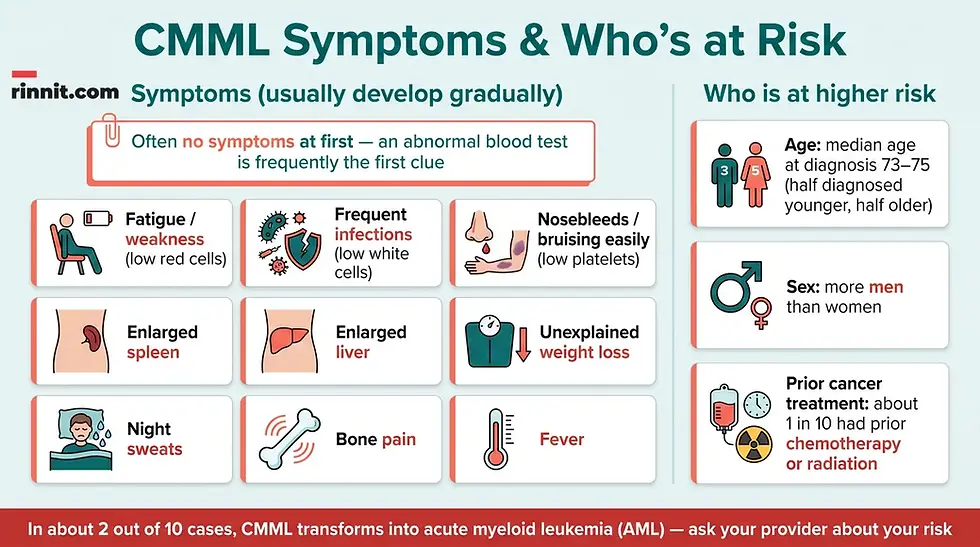
Chronic myelomonocytic leukemia (CMML) doesn't always cause symptoms, and when it does, they usually develop gradually. The first sign may simply be abnormal results on a blood test. [1] When symptoms are noticeable, they usually develop gradually, and each one reflects which healthy blood cells are running low:
Symptom | What it usually signals |
|---|---|
Fatigue or weakness | Low red blood cells (anemia) [1] |
Frequent infections | Low white blood cells (neutropenia) [1] |
Excessive nosebleeds or easy bruising | Low platelets (thrombocytopenia) [1] |
Enlarged spleen (splenomegaly) | The spleen, a blood-filtering organ on the upper left side of the belly, swells |
Enlarged liver (hepatomegaly) | The liver grows |
Unexplained weight loss | A general sign the body is under strain |
Night sweats | A general sign the body is under strain |
Bone pain | Can reflect the bone marrow working abnormally |
Fever | Can reflect infection or the disease itself |
What causes CMML, and who is at risk?
Researchers don't know what causes CMML, but they have identified several gene changes (mutations) associated with it. [1] If you're diagnosed, you'll likely have more than one. [1] The most common involve these genes, with the most common first:
Can CMML lead to complications?
In about 2 out of 10 cases, CMML transforms into acute myeloid leukemia (AML), a fast-growing type of blood cancer. [1] [2] This is more likely if you have CMML-2, the stage with more blast cells. [1] Ask your healthcare provider about your own risk based on your diagnosis and risk factors.
How is CMML diagnosed?
Chronic myelomonocytic leukemia (CMML) is diagnosed by considering your symptoms and medical history and running tests to check your blood cells.
Test | What it checks |
|---|---|
Complete blood count (CBC) | A monocyte count that's too high (monocytosis) may be a sign of CMML [1] |
Peripheral blood smear | Monocytes that look irregular or immature (blast cells) under a microscope may be a sign of CMML [1] |
Bone marrow biopsy | A sample of bone marrow is tested in a lab for abnormal monocytes [1] |
Genetic testing | Looks for gene mutations associated with blood cancers, which helps rule out conditions with similar symptoms and blood test results [1] |
How is CMML staged?
Providers stage CMML based on how many blast cells you have:
The stage helps your provider decide the most effective treatment. [1] CMML-2 also carries a higher chance of transforming into AML.
How is CMML treated?
Chronic myelomonocytic leukemia (CMML) treatment may start with supportive care for low blood counts, and stem cell transplant is the only approach that secures cure or long-term survival. [1] [2]
First: supportive care for low blood counts
You may first need treatment to make sure you have enough healthy blood cells. That can mean medications or regular blood transfusions (transfers of donated blood) to boost your counts. [1] This may be part of palliative care, which focuses on managing symptoms and improving quality of life. [1]
Treatments that target CMML directly
Treatment | What it does |
|---|---|
Allogeneic stem cell transplant | |
Chemotherapy | |
Clinical trials |
Research reflects this picture: a review of CMML management found that stem cell transplant is the only approach that secures cure or long-term survival, while available drugs aren't disease-modifying (Patnaik and Tefferi, 2024) [2]. A meta-analysis found hypomethylating agents produced a response in about 43% of patients (Xu et al., 2021) [3].

How often will I see my healthcare provider?
You'll see your provider regularly, usually every one to six months, and it's important not to skip appointments. [1] At these visits your provider will ask about your symptoms, run blood tests, assess how treatment is working, and make adjustments. In between, contact your provider if you have unexpected or severe treatment side effects. [1]
What is the outlook for CMML?
The median life expectancy after a CMML diagnosis is approximately one to three years. [1] A median is a midpoint: half of people have a shorter lifespan and half live longer, and your own outcome can differ a great deal. Risk models show wide variation, with median survival ranging from 16 months in the highest-risk group to 97 months in the lowest-risk group (Patnaik and Tefferi, 2024) [2]. Several factors shape your prognosis:
Factor | How it shapes your outlook |
|---|---|
Blood test results | Monocyte, blast cell, and platelet counts provide clues, and so does your hemoglobin level [1] |
Genetic mutations | |
Need for transfusions | Outcomes are generally better if you don't need repeat transfusions [1] |
Progression to AML | Transformation to AML worsens prognosis and is more likely with CMML-2 [1] |
Is there anything I can do to feel better?
One of the best things you can do is take charge of your health in every way you can. Eating nutrient-rich foods and getting enough sleep are essential, and so is balancing activity and rest. [1] Connecting with others living with cancer can ease feelings of isolation, and so can speaking with a therapist who works with people with cancer. [1] Cancer can make a person feel helpless, but you're still in charge of your life, and there are treatments available to help.
What's the bottom line?
CMML is a rare blood cancer in which the bone marrow produces too many abnormal monocytes that crowd out healthy blood cells, a hybrid of a myeloproliferative neoplasm and a myelodysplastic syndrome. It often causes no symptoms at first, and an abnormal blood test is frequently the first clue. Most people diagnosed are in their 70s, and in about 2 out of 10 cases it transforms into AML. Diagnosis relies on blood counts, a blood smear, a bone marrow biopsy, and genetic testing, with staging based on blast cells. Treatment ranges from transfusions and chemotherapy to clinical trials and, for some, a stem cell transplant — the only potentially curative option. Prognosis varies widely, so an individual conversation with your healthcare provider matters.
Ready to learn more? Visit Rinnit.com for trusted, easy-to-understand health guides like this one.
Conclusion
There are no easy answers when it comes to living with CMML, and your outcome depends on factors unique to you. Ask your healthcare provider to explain what those factors are and how they shape your prognosis, and make sure you understand your treatment options so the care you choose aligns with your goals.
Find more compassionate, plain-English health guides at Rinnit.com.
Frequently Asked Questions
What is chronic myelomonocytic leukemia?
CMML is a rare blood cancer in which the bone marrow, the spongy tissue inside your bones, makes too many abnormal monocytes, a type of white blood cell. These abnormal cells crowd out red blood cells, platelets, and healthy white blood cells.
What does MPN/MDS mean?
Doctors classify CMML as a myeloproliferative neoplasm/myelodysplastic syndrome (MPN/MDS). An MPN means the bone marrow makes too many blood cells, and an MDS means it makes abnormal ones. CMML has features of both.
Does CMML always cause symptoms?
No. CMML doesn't always cause symptoms, and the first sign may be abnormal results on a blood test.
What are the most common symptoms?
When symptoms appear they develop gradually: fatigue or weakness, frequent infections, excessive nosebleeds or easy bruising, an enlarged spleen or liver, unexplained weight loss, night sweats, bone pain, and fever.
What does fatigue in CMML usually mean?
Fatigue or weakness is typically a sign of low red blood cells, a condition called anemia.
Why do I get infections more often?
Frequent infections usually signal low white blood cells, called neutropenia.
Why do I bruise and bleed so easily?
Excessive nosebleeds or easy bruising signal low platelets, called thrombocytopenia. Platelets are the cells that help blood clot.
What causes CMML?
Researchers don't know what causes CMML. They have identified gene mutations associated with it, most commonly in TET2, SRSF2, ASXL1, and RAS. People with CMML usually have more than one mutation.
Who is most likely to develop CMML?
Risk increases with age, and the median age at diagnosis is between 73 and 75. More males are diagnosed than females, and about 1 in 10 people with CMML had previous cancer treatment such as chemotherapy or radiation.
What is a median age of diagnosis?
A median is a midpoint: half of people diagnosed are younger than that age and half are older.
Does CMML ever turn into another cancer?
Yes. In about 2 out of 10 cases, CMML transforms into acute myeloid leukemia (AML). This is more likely with CMML-2.
How is CMML diagnosed?
Providers review your symptoms and history, then use a complete blood count, a peripheral blood smear, a bone marrow biopsy, and genetic testing to find abnormal monocytes, identify mutations, and rule out similar conditions.
What is monocytosis?
Monocytosis is a monocyte count that's too high on a blood test. It may be a sign of CMML.
What are the stages of CMML?
Staging is based on blast cells. CMML-1 has fewer than 5 blasts per 100 blood cells and fewer than 10 per 100 bone marrow cells. CMML-2 has 5 to 19 blasts per 100 blood cells and 10 to 19 per 100 bone marrow cells.
Is there a cure for CMML?
An allogeneic stem cell transplant is the only treatment that can potentially cure CMML. It isn't an option for most people and can cause life-threatening complications such as graft vs. host disease.
What chemotherapy options exist?
Chemotherapy makes it harder for monocytes to multiply out of control and can relieve symptoms. Common drug types are hydroxyurea and hypomethylating agents (HMAs).
Are there new treatments in development?
Yes. Clinical trials are studying newer treatments, including targeted therapy and immunotherapy. Your provider may recommend a trial if other treatments aren't helping.
How often will I need checkups?
Usually every one to six months, with symptom reviews and blood tests to see how treatment is working.
What is the life expectancy with CMML?
The median life expectancy after diagnosis is approximately one to three years, but half of people live longer. Your outlook depends on blood counts, gene mutations, transfusion needs, and whether CMML progresses to AML.
What factors affect prognosis?
Blood test results (monocyte, blast, platelet, and hemoglobin levels), genetic mutations such as ASXL1 (linked to a worse outlook), how often you need transfusions, and whether the disease progresses to AML.
What can I do to feel better day to day?
Take charge of your health: eat nutrient-rich foods, get enough sleep, balance activity and rest, connect with others living with cancer, and consider a therapist experienced with people with cancer.
This article is for general informational purposes only and does not constitute medical advice, diagnosis, or treatment. Always seek the guidance of your physician or other qualified health provider with any questions about a medical condition. Never disregard professional medical advice or delay seeking care because of something you have read here. If you have persistent fatigue, frequent infections, easy bruising or bleeding, unexplained weight loss, or abnormal blood test results, talk to your healthcare provider about an evaluation.
Related Reading
What Is Myelodysplastic Syndrome? A Plain-Language Guide to Symptoms, Causes, and Treatment explains a related bone marrow disorder that shares features with CMML.
Myeloproliferative Neoplasms: Types, Symptoms, Diagnosis and Treatment explains blood cancers where the marrow makes too many cells.
Monocytosis: Understanding High Monocyte Counts explains what a high monocyte count means and its causes.
Bone Marrow Biopsy: Why It's Done, What to Expect, Pain and Recovery describes the test used to confirm CMML and what to expect.
References
Cleveland Clinic. Chronic Myelomonocytic Leukemia. Cleveland Clinic. Last updated March 17, 2025. https://my.clevelandclinic.org/health/diseases/chronic-myelomonocytic-leukemia-cmml
Patnaik MM, Tefferi A. Chronic myelomonocytic leukemia: 2024 update on diagnosis, risk stratification and management. Am J Hematol. 2024;99(6):1142-1165. PMID 38450850. https://doi.org/10.1002/ajh.27271
Xu R, Li M, Wu P, et al. Hypomethylating agents in the treatment of chronic myelomonocytic leukemia: a meta-analysis and systematic review. Hematology. 2021;26(1):312-320. PMID 33706667. https://doi.org/10.1080/16078454.2021.1875600
Geissler K. Molecular Pathogenesis of Chronic Myelomonocytic Leukemia and Potential Molecular Targets for Treatment Approaches. Front Oncol. 2021;11:751668. PMID 34660314. https://doi.org/10.3389/fonc.2021.751668



Comments