Cholecystostomy

Updated: 3 days ago
Medically reviewed by Dr. Baraa Alnahhal, MD · Last reviewed: October 2026
Quick Answer
A cholecystostomy is a minor surgical procedure that creates an opening in the gallbladder to insert a drainage catheter, letting infected bile and fluids drain out [1]. It is primarily used for patients too ill for gallbladder removal surgery [1]. Guided by imaging, it typically takes 30 minutes to an hour and provides temporary relief while the patient's condition stabilizes [1].
What the research says
Cholecystectomy generally has better outcomes, but drainage remains a viable option for high-risk patients. A meta-analysis of 27 observational studies found that cholecystectomy was associated with lower mortality (OR 0.26; 95% CI 0.14 to 0.48) and lower readmission (OR 0.37; 95% CI 0.18 to 0.75) than percutaneous cholecystostomy. The authors still identified cholecystostomy as a viable alternative in high-risk surgical patients, and draining first and then removing the gallbladder showed no significant advantage over immediate cholecystectomy. All of the studies were observational (PubMed: Fanciulli et al., World J Emerg Surg, 2025) [2].
Tube problems and recurrence are common in practice. In a retrospective review of 145 patients who had a percutaneous cholecystostomy tube at one tertiary hospital, 37% had periprocedural complications, most commonly tube dislodgement. Cholecystitis came back in 18% (26 patients) at a median of 65 days, 28% went on to have an interval cholecystectomy, and 30-day mortality was 9%. These were high-risk patients from a single center (PubMed: Bhatt et al., J Surg Res, 2018) [3].
Endoscopic drainage is an alternative in some patients who cannot have surgery. A meta-analysis of 5 comparative studies (206 patients with endoscopic ultrasound-guided gallbladder drainage versus 289 with percutaneous drainage) found no significant difference in technical or clinical success. Endoscopic drainage needed fewer reinterventions (OR 0.16) and led to fewer unplanned readmissions (OR 0.16; 95% CI 0.05 to 0.53) (PubMed: Luk et al., Endoscopy, 2019) [4].
What is a cholecystostomy procedure?
A cholecystostomy is clinically defined as a minor surgical intervention that creates an opening into the gallbladder [1]. The term combines "cholecyst," meaning gallbladder, and "ostomy," referring to a surgically created opening. This procedure is most commonly performed percutaneously, meaning a catheter is inserted through the skin to reach the internal organ [1].
The primary goal of a cholecystostomy is to provide a drainage pathway for bile when the gallbladder becomes blocked or severely inflamed. This is often necessary in cases of acute cholecystitis, where gallstones or infections prevent normal bile flow [1]. By relieving the buildup of fluids, the procedure helps prevent life-threatening complications and allows the gallbladder to heal.
Term or route | Entry route | Key characteristic |
Percutaneous | Through the skin | The overall approach: a drainage catheter is placed through the skin. Both routes below are percutaneous. |
Transperitoneal | Through the peritoneum, the membrane that covers the gallbladder | Direct access to the gallbladder without passing through liver tissue. |
Transhepatic | Through the liver, which sits on top of the gallbladder | Passes through liver tissue to reach the gallbladder. |
Why is a cholecystostomy necessary?
Healthcare providers recommend a cholecystostomy when a patient is suffering from acute gallbladder disease but is not a suitable candidate for a cholecystectomy, which is the complete removal of the organ [1]. This often occurs when a patient is too weak for major surgery or has other health complications that increase the risks of general anesthesia.
The procedure treats severe inflammation and infections that arise when bile flow is stalled. Without drainage, these conditions can lead to gallbladder rupture or systemic infection. A cholecystostomy offers a safe, temporary solution that stabilizes the patient's health, providing relief from pressure and pain while a long-term treatment plan is developed [1].

What happens during a cholecystostomy procedure?
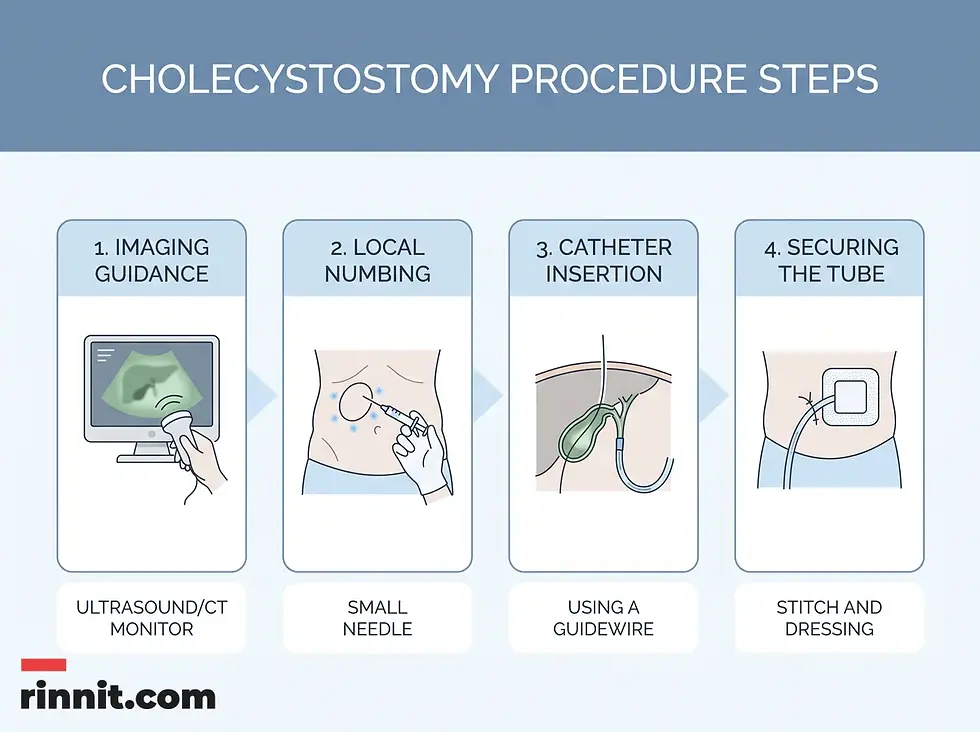
The placement of a cholecystostomy tube is typically performed by an interventional radiologist [1]. Using imaging technology such as ultrasound or CT scans, the specialist identifies the safest path for the catheter [1]. The procedure is performed under local anesthesia, meaning the treatment area is numbed, and sedation can be given if the patient wishes [1].
Once the optimal route is determined, a needle and guidewire are used to position the catheter within the gallbladder. The tube is then secured to the skin with a stitch and connected to an external drainage bag [1]. The entire process generally takes between 30 and 60 minutes [1]. Patients are monitored briefly after the procedure before returning to their recovery area.
How do you care for a cholecystostomy after the procedure?
After a cholecystostomy, the drainage tube typically remains in place for four to six weeks [1]. During this time, patients or their caregivers must perform daily maintenance to ensure the tube remains functional and free from infection. This includes cleaning the insertion site, flushing the tube with sterile saline, and emptying the drainage bag [1].
Flushing the tube is a critical step that helps prevent blockages and infection. Patients are also instructed to monitor their bile output and report any sudden changes in volume or color to their healthcare team. Before the tube is eventually removed, providers may perform a cholangiogram to confirm that bile is flowing normally through the natural ducts [1].

How is a cholecystostomy different from a cholecystectomy?
A cholecystostomy and a cholecystectomy both treat gallbladder disease, but each procedure serves a different clinical purpose. A cholecystectomy is a definitive surgery that removes the gallbladder entirely, preventing future issues [1]. In contrast, a cholecystostomy is an alternative, less invasive treatment designed for temporary stabilization and relief.
For many patients, a cholecystostomy acts as a "bridge" to surgery. Once the acute inflammation has subsided and the patient's overall health has improved, the gallbladder may still need to be removed to prevent a recurrence of symptoms [1]. However, for some high-risk individuals, the drainage procedure may be the primary method of long-term management [1].
Conclusion
A cholecystostomy is a vital medical intervention for managing severe gallbladder conditions when traditional surgery is not an option. By providing a reliable way to drain infected fluids, it reduces pain and helps prevent life-threatening complications. Proper care of the drainage catheter is essential for a successful recovery and the long-term resolution of gallbladder issues.
Consult Your Provider. If you have a cholecystostomy tube, always follow your specific discharge instructions carefully. Contact your healthcare team immediately if the tube becomes loose, if you develop a fever, or if your drainage stops unexpectedly.
Frequently Asked Questions
1. What is a cholecystostomy?
A cholecystostomy is a minor surgical procedure that creates an opening in the gallbladder to place a catheter for draining excess bile and infected fluids.
2. Why is this procedure done instead of removing the gallbladder?
A cholecystostomy is used for patients who are too ill or have health complications that make a major surgery like gallbladder removal (cholecystectomy) unsafe at that time.
3. What conditions does a cholecystostomy treat?
A cholecystostomy primarily treats acute cholecystitis (gallbladder inflammation) and infections caused by gallstones or blocked bile ducts.
4. Who performs the procedure?
In most cases, an interventional radiologist performs the procedure using imaging guidance like ultrasound or X-ray.
5. How long does the procedure take?
The placement of the cholecystostomy tube typically takes between 30 minutes and one hour.
6. How long will the drainage tube stay in?
The catheter usually remains in place for four to six weeks to allow the inflammation to subside and the gallbladder to heal.
7. Is the procedure painful?
The area is numbed with a local anesthetic, so you shouldn't feel pain during the procedure, though you may feel some pressure as the tube is inserted.
8. How do I care for the tube at home?
Home care involves keeping the dressing clean and dry, flushing the tube daily with sterile saline as your care team instructs, and emptying the drainage bag.
9. What is a cholangiogram?
A cholangiogram is an imaging test performed before the tube is removed to ensure that bile is flowing correctly through your bile ducts without obstruction.
10. When should I call my doctor?
Contact your provider if the tube comes out, if you develop a fever, if the skin around the tube becomes red or painful, or if you notice a sudden stop in bile drainage.
11. How do I prepare for a cholecystostomy?
Before a cholecystostomy, your care team will explain the risks and benefits and ask you to sign an informed consent form. [1] You'll be asked not to eat or drink for a few hours beforehand. [1] Your blood's ability to clot will be tested, and if needed you may be treated with a transfusion or vitamin K to lower your bleeding risk. [1] An IV line may be placed to give you fluids, antibiotics and sedation if you'd like it. [1]
Related Reading
References
Cleveland Clinic. Cholecystostomy: What It Is, Procedure Steps, Complications. Cleveland Clinic. Nov. 15, 2023. https://my.clevelandclinic.org/health/procedures/cholecystostomy
Fanciulli G, Favara G, Maugeri A, Barchitta M, Agodi A, Basile G. Comparing percutaneous treatment and cholecystectomy outcomes in acute cholecystitis patients: a systematic review and meta-analysis. World J Emerg Surg. 2025;20(1):50. PMID 40483437. https://doi.org/10.1186/s13017-025-00622-6
Bhatt MN, Ghio M, Sadri L, Sarkar S, Kasotakis G, Narsule C, Sarkar B. Percutaneous cholecystostomy in acute cholecystitis: predictors of recurrence and interval cholecystectomy. J Surg Res. 2018;232:539-546. PMID 30463770. https://doi.org/10.1016/j.jss.2018.06.051
Luk SW, Irani S, Krishnamoorthi R, Wong Lau JY, Wai Ng EK, Teoh AY. Endoscopic ultrasound-guided gallbladder drainage versus percutaneous cholecystostomy for high risk surgical patients with acute cholecystitis: a systematic review and meta-analysis. Endoscopy. 2019;51(8):722-732. PMID 31238375. https://doi.org/10.1055/a-0929-6603
Medical Disclaimer
This article is for informational purposes only and does not constitute medical advice. Always seek the advice of your physician or other qualified health provider with any questions you may have regarding a medical condition. Never disregard professional medical advice or delay in seeking it because of something you have read here.



Comments