Chlamydia Test: Who Should Get Tested, How It Works and Results

Updated: 2 days ago
Written and medically reviewed by Dr. Baraa Alnahhal, MD · Last reviewed: November 2026 · How we review
Quick Answer: What is a chlamydia test?
A chlamydia test checks for the bacteria that cause chlamydia, the most common bacterial sexually transmitted infection (STI). Most tests use a urine sample or a swab. Results are ready in about 24 hours. Because chlamydia often causes no symptoms, screening matters, especially if you are sexually active and under 25. Avoid sex while you wait for results. [1]
What the research says
Vaginal swabs catch more chlamydia than urine. A meta-analysis of 28 studies found pooled sensitivity for chlamydia was 94.1% with vaginal swabs versus 86.9% with urine, supporting swabs as the preferred sample for women. (Aaron et al., Annals of Family Medicine, 2023) [2]
Screening and treating chlamydia prevents pelvic infection. In a randomized trial of 2,607 high-risk women aged 18 to 34, testing and treating chlamydia cut pelvic inflammatory disease over one year (9 vs 33 cases; relative risk 0.44). (Scholes et al., The New England Journal of Medicine, 1996) [3]
Key takeaways
Chlamydia often has no symptoms, so you may not know you have it. [1]
Untreated chlamydia can cause serious problems, including infertility. [1]
The most common test is a nucleic acid amplification test (NAAT) on urine or a swab. [1]
Swab tests are more accurate than urine tests. [1]
A positive result means antibiotic treatment, telling partners and a follow-up test. [1]
What is a chlamydia test?
A chlamydia test detects a chlamydia infection by looking for the bacteria that cause it. You provide a urine sample, or your provider swabs fluid from your vagina, anus, throat or eye, depending on where the infection might be. Most people are tested in a provider's office, but at-home test kits are also available. [1]
Who should get a chlamydia test?

You should be screened for chlamydia if you: [1]
Are sexually active, especially if you are under 25
Are pregnant
Have HIV
Live somewhere with higher rates of infection, such as a corrections facility
Know your partner has an STI
Plan to have sex with a new partner, or have more than one partner
Chlamydia usually causes no symptoms. When it does, they can include burning when you pee, unusual discharge from the vagina, penis or anus, and pain during sex or bleeding after sex. [1]
How does a chlamydia test work?
Test type | How it works | When it is used |
Nucleic acid amplification test (NAAT) | Detects the DNA of the bacteria in urine or a vaginal or urethral swab | The most common chlamydia test |
Cell culture | Cells collected with a swab are grown in a lab; growing bacteria show infection | Less often; sometimes for anal infections or to check how treatment is working |
Rapid test | Gives results in about 90 minutes | Not used often |
Sources: [1]
How do you prepare for a chlamydia test?
Ask your provider how to prepare. Before the test, you may need to: [1]
Avoid peeing for a couple of hours.
Avoid douching or using creams in your genital area.
Stop taking certain medicines, such as antibiotics.
What happens during a chlamydia test?
For a urine test, you pee into a clean cup, collecting the first part of the stream as soon as it starts (a first-catch sample). Follow your provider's instructions carefully. [1]
Instead, your provider may rub a cotton swab inside your vagina, penis or anus to collect secretions. If an eye infection is suspected, they swab fluid from your eye. With an at-home kit, you collect the sample yourself and mail it to a lab, following the kit instructions closely. [1]
How accurate is a urine chlamydia test?
For women, a urine test is less accurate than a vaginal swab. For men, a first-catch urine sample is the recommended test. [1]

Sample | Approximate accuracy |
Urine | About 87% |
Vaginal or urethral swab | About 94% |
Sources: [1]
What happens after a chlamydia test?
The lab tests the sample for bacterial DNA, and your provider contacts you with the results and next steps. While you wait, it is very important to avoid sex, because if you do have the infection you can pass it to others. [1]
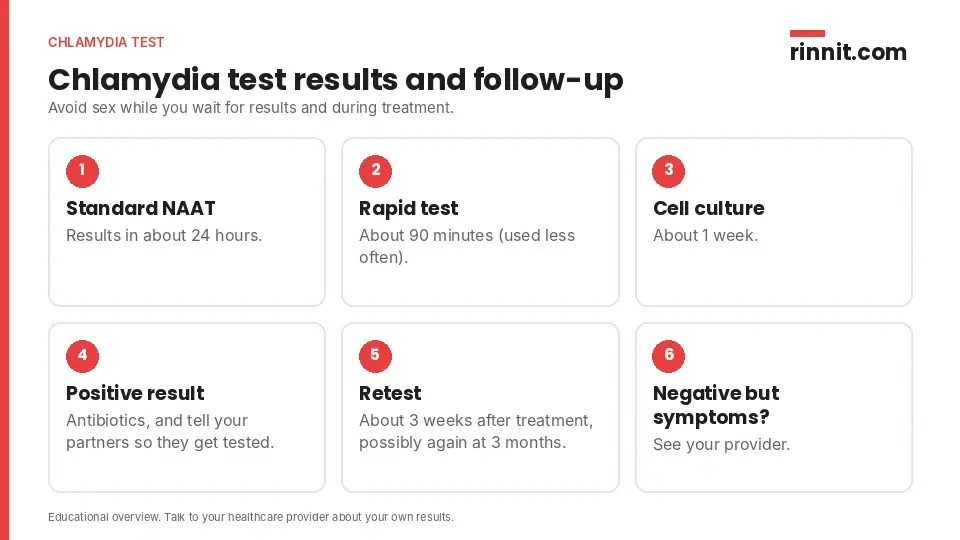
Test | Time to results |
Standard NAAT | About 24 hours |
Rapid test | About 90 minutes |
Cell culture | About 1 week |
Sources: [1]
What do chlamydia test results mean?
Positive result
A positive test means the lab found the bacteria that cause chlamydia, so you have an infection and need antibiotics. Tell your sexual partners so they can be tested too. After treatment, you will need follow-up testing, possibly about 3 weeks after treatment and again 3 months later. Ask your provider when to retest. [1]
Negative result
A negative result means the lab did not find the bacteria's DNA. If you have symptoms of chlamydia but test negative, see your provider. [1]
When should you call your provider?
Call your provider if you have questions about your results, if you test negative but have symptoms, or if symptoms do not go away after treatment. Ask about getting regular STI testing. [1]
Conclusion
A chlamydia test is a simple, essential step in stopping the spread of this common STI, which often causes no symptoms but can lead to serious health problems if untreated. Get screened regularly if you are at higher risk, avoid sex while waiting for results and during treatment, and wait until your provider says it is safe. Practicing safe sex helps prevent future infections. [1]
Keep learning: Read our guides to chlamydia, pelvic inflammatory disease and the HIV test. For more, see the CDC's chlamydia overview.
FAQ
What is a chlamydia test?
A chlamydia test looks for Chlamydia trachomatis, the bacteria that cause chlamydia, the most common bacterial sexually transmitted infection in the world [1].
Who should get a chlamydia test?
Anyone sexually active, especially under 25, plus people who are pregnant, have HIV, have a partner with an STI or have a new or multiple partners [1].
How is a chlamydia test done?
You give a first-catch urine sample, or a provider swabs your vagina, penis, anus, throat or eye depending on where infection might be [1].
Is a urine or swab chlamydia test more accurate?
A swab is more accurate. In women, a urine test is about 87% accurate and a vaginal swab about 94%; for men, urine is the preferred sample [1].
How long do chlamydia test results take?
Usually about 24 hours. Rapid tests take about 90 minutes, and a cell culture about a week [1].
How do I prepare for a chlamydia test?
You may need to avoid peeing for a couple of hours, avoid douching or genital creams and stop certain medicines such as antibiotics, as your provider advises [1].
Can I test for chlamydia at home?
Yes. At-home kits let you collect a sample yourself and mail it to a lab. Follow the kit instructions carefully [1].
What does a positive chlamydia test mean?
It means you have a chlamydia infection and need antibiotics. Tell your sexual partners so they can be tested [1].
Do I need a test after chlamydia treatment?
Yes. You may need a follow-up test about 3 weeks after treatment and possibly another 3 months later [1].
Can I have sex while waiting for chlamydia results?
No. Avoid sex while waiting for results and during treatment, because you can spread the infection [1].
Related Reading
Learn more in our guide to Chlamydia: Symptoms, Causes, Treatment, and How to Protect Yourself.
Learn more in our guide to Pelvic Inflammatory Disease: Symptoms, Causes & Treatment — A Clear Guide.
Learn more in our guide to Sexually Transmitted Diseases (STDs) Guide: Symptoms, Causes, Diagnosis, and Treatment.
References
Cleveland Clinic. Chlamydia Test: What It Is, Purpose, Procedure & Results. Cleveland Clinic. Last updated November 12, 2024. https://my.clevelandclinic.org/health/diagnostics/22352-chlamydia-test
Aaron KJ, Griner S, Footman A, et al. Vaginal Swab vs Urine for Detection of Chlamydia trachomatis, Neisseria gonorrhoeae, and Trichomonas vaginalis: A Meta-Analysis. Ann Fam Med. 2023;21(2):172-179. PMID 36973065. https://doi.org/10.1370/afm.2942
Scholes D, Stergachis A, Heidrich FE, et al. Prevention of pelvic inflammatory disease by screening for cervical chlamydial infection. N Engl J Med. 1996;334(21):1362-1366. PMID 8614421. https://doi.org/10.1056/NEJM199605233342103
Medical disclaimer
This article is for general education only and does not replace advice from a qualified healthcare professional. Talk to your doctor about your own diagnosis and treatment, and seek emergency care right away for severe or sudden symptoms.



Comments