Central Serous Retinopathy: The "Stress Eye Disease" That Can Blur Your Vision — and Usually Goes Away on Its Own

Updated: 2 days ago
Medically reviewed by Dr. Baraa Alnahhal, MD · Last reviewed: October 17, 2026
Quick answer
Central serous retinopathy is a condition where fluid builds up behind the retina, sometimes causing it to detach. [1] It is most common in males between ages 30 and 50 and is strongly linked to stress and corticosteroids. [1] Symptoms include blurry vision and a dark central spot. [1] [2] Many cases heal on their own; persistent cases may need medication or laser therapy. [1]
What the research says
According to PubMed:
An evidence-based guideline supports waiting in acute cases. Drawing on several large randomized trials, a treatment guideline says treatment of acute CSC can often be deferred for up to 3–4 months after diagnosis. For chronic CSC, half-dose or half-fluence photodynamic therapy with verteporfin is the preferred treatment (Feenstra et al., Progress in Retinal and Eye Research, 2024) [4].
Immune-mediated disease was linked to a harder course. In a multicenter study of 287 eyes of 267 patients (mean age 48.3; 144 males), having an immune-mediated disease predicted recurrence (OR 2.64; P = .02) and lower visual improvement (Lall et al., American Journal of Ophthalmology, 2026) [6].
Increased blood flow in the choroid appears to play a key role. A systematic review of 29 studies (966 eyes, 266 with CSC) found elevated choroidal blood flow in acute CSC that fell after photodynamic therapy, pointing to choroidal hyperperfusion as a key mechanism (Bellucci et al., Graefe's Archive for Clinical and Experimental Ophthalmology, 2026) [7].
Study details are from PubMed abstracts.
What is central serous retinopathy (CSR)?
Central serous retinopathy (CSR) is a condition that occurs when fluid builds up behind the retina in your eye. The retina is the layer of tissue at the back of each eye that senses light and translates it into images your brain can understand. When fluid accumulates there, it can cause your retina to detach, leading to vision loss or other vision problems. [1]
The fluid doesn't come from nowhere. It leaks out of a layer of blood vessels beneath your retina called the choroid. [1] [2]
You may also hear this condition called central serous chorioretinopathy or central serous choroidopathy — these are simply other names for the same condition. [1]
CSR is uncommon. It affects about 10 out of every 100,000 people, with risk varying by sex and other factors. [1] [5]

What does central serous retinopathy look and feel like?
CSR can affect one eye or both eyes at the same time. [1] The warning signs all center on the middle of your vision, because the fluid collects right under the part of the retina you rely on most.
Here's the surprising part: CSR doesn't always cause symptoms. A person can have the condition and no vision problems at all. [1] [3] That's one more reason vision checks matter.
What causes central serous retinopathy?
Scientists don't fully understand what causes CSR — but stress appears to play a key role. When you're stressed, your body releases the hormone cortisol, which can cause inflammation and fluid leakage. [1] People with high stress levels and reduced coping skills are at a higher risk for the condition. [1]
CSR is also associated with the use of medications containing corticosteroids — drugs commonly prescribed to treat inflammation. [1] [3]
What raises your risk?
CSR can affect anyone, but it shows up most often in certain groups.
Risk factor | Detail |
Age and sex | Males between the ages of 30 and 50 [1] |
Vision type | People with myopia (nearsightedness) [1] |
Medications | Corticosteroids, plus some nasal congestion and erectile dysfunction medications [1] |
Autoimmune disease | Such as lupus and rheumatoid arthritis [1] |
Circulation | |
Infection | |
Kidney disease | Such as glomerulonephritis |
Pregnancy | Hormonal changes may play a role |
Sleep | Sleep apnea and insomnia [1] |

How is central serous retinopathy diagnosed?
If you notice changes to your vision, the first step is talking to your primary care provider or an ophthalmologist — a doctor who specializes in eye care. They'll discuss your symptoms and perform a full eye exam.
Because CSR is a retina problem, they may also order specialized retina tests:
Test | How it works |
Fluorescein angiography (IVFA) | |
Optical coherence tomography (OCT) | A scan that provides 3D pictures of your retina so your provider can measure retinal thickness, identify swelling, and detect serous retinal detachment. [1] |
How is central serous retinopathy treated?
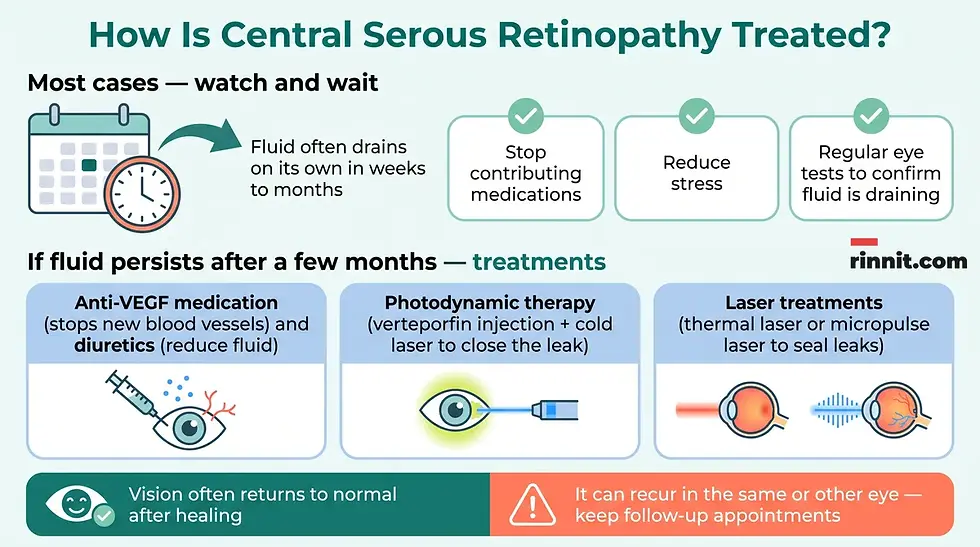
Central serous retinopathy often heals on its own over weeks or months, and treatment options are used if the fluid does not drain after a few months. [1]
Many cases heal on their own
Here's the good news: many cases of CSR go away on their own over a few weeks or months as the fluid naturally drains. [1] [2] If that's the pattern, your provider may simply recommend a "watch and wait" approach — monitoring the eye and repeating tests to make sure the fluid is draining. [1]
Your provider may also ask you to stop medications that contribute to the condition and counsel you to reduce your stress levels. [1]
When treatment is needed
If the fluid doesn't drain on its own after a few months, treatment options include:
Treatment | What it does |
Anti-VEGF medications | Used mainly when abnormal new blood vessels have grown under the retina; guidelines do not recommend them for typical CSR. [1] |
Diuretics | Pills that block the hormone aldosterone, such as eplerenone, have been tried, but large randomized trials found they did not improve outcomes. [1] |
Photodynamic therapy (PDT) | |
Thermal laser treatment | A heated laser seals the leaks (given after numbing medication). [1] |
Micropulse laser | Uses smaller, shorter laser pulses for the same goal. [1] |
How can I take care of myself at home?
Caring for central serous retinopathy at home includes getting at least seven hours of sleep, limiting caffeine, alcohol and corticosteroids, and managing stress. [1]
Sleep: Get at least seven hours of sleep every night. [1]
Limit triggers: Cut back on caffeine and alcohol, and ask the doctor who prescribed any corticosteroid (including creams, inhalers and nasal sprays) whether it can be reduced; never stop a steroid suddenly on your own. [1]
Manage stress: Use exercise, meditation, time with loved ones, or counseling to reduce stress levels. [1]
If you're experiencing vision loss, coping strategies include joining a support group, talking to loved ones or a counselor about your feelings, and using aids to help you complete daily tasks safely. [1]
When to see a provider: If you experience any changes to your vision, talk to your primary care provider or an ophthalmologist. Even though CSR can go away on its own, it can get worse and cause permanent vision changes or loss — and sometimes vision problems are a sign of underlying disease.
What's the outlook?
Many cases of CSR go away on their own as fluid naturally drains. After the condition resolves, vision generally improves on its own, often returning to normal. [1] But sometimes damage can be permanent, with vision changes that don't improve. [1]
There's also a catch: the condition can come back, even after successful treatment, in the same eye or your other eye. [1] [2] For this reason, you may need regular follow-up appointments with an ophthalmologist. [1]
Frequently asked questions
What is central serous retinopathy?
Central serous retinopathy is a condition where fluid builds up behind the retina — the light-sensing layer at the back of your eye — which can cause the retina to detach and lead to vision problems.
Is central serous retinopathy the same as central serous chorioretinopathy?
Yes. Central serous chorioretinopathy and central serous choroidopathy are simply other names for the same condition.
How common is central serous retinopathy?
It's uncommon — it affects about 10 out of every 100,000 people, with risk varying by sex and other factors.
Who gets central serous retinopathy most often?
Males between the ages of 30 and 50, especially people with myopia (nearsightedness) or those taking corticosteroid medications.
What causes central serous retinopathy?
Scientists don't fully understand the cause, but stress appears to play a key role — it makes your body release cortisol, which can cause inflammation and fluid leakage. Corticosteroid medications are also strongly associated with the condition.
What does vision loss from CSR look like?
It typically appears as blurry vision (like a smudge in the center of your sight), a dark spot, dimmer vision, colors that look dull or brown, objects that seem smaller or farther away, and straight lines that look crooked.
Can CSR affect both eyes?
Yes — it can affect one eye or both at the same time.
Can you have CSR without symptoms?
Yes. A person can have the condition without having vision problems, which is why monitoring matters.
Is stress really a cause of central serous retinopathy?
Stress appears to play a key role. It triggers cortisol release, which can cause inflammation and fluid leakage. People with high stress levels and reduced coping skills face a higher risk.
What medications are linked to CSR?
Corticosteroids are the main association. Other medications, such as those used for nasal congestion and erectile dysfunction, are also listed as risk factors.
What other risk factors raise my chance of CSR?
Autoimmune diseases (lupus, rheumatoid arthritis), heart disease or high blood pressure, H. pylori infection, kidney disease (glomerulonephritis), pregnancy, and sleep problems like sleep apnea and insomnia.
How is CSR diagnosed?
An eye specialist performs an eye exam and may order retina tests such as fluorescein angiography (IVFA) — where dye injected into your arm highlights leaks — or optical coherence tomography (OCT), which provides 3D pictures of your retina.
What is an OCT scan?
Optical coherence tomography is a scan that provides 3D pictures of your retina so your provider can measure retinal thickness, identify swelling, and detect serous retinal detachment.
Does CSR go away on its own?
Many cases do, healing over a few weeks or months as the fluid drains naturally. Your provider may recommend a "watch and wait" approach with repeat tests to make sure the fluid is draining.
When does CSR need treatment?
If the fluid doesn't drain on its own after a few months, treatment may include anti-VEGF medications, diuretics, photodynamic therapy, thermal laser, or micropulse laser.
What is photodynamic therapy (PDT)?
A drug called verteporfin is injected into your arm and travels to your eye, then a cold laser is used to close the leak.
What can I do at home to manage CSR?
Get at least seven hours of sleep, limit caffeine, alcohol, and corticosteroids, and reduce stress through exercise, meditation, time with loved ones, or counseling.
What's the long-term outlook?
Vision generally improves on its own after the condition resolves, often returning to normal — but permanent vision changes are possible in some cases.
Can CSR come back?
Yes. The condition can recur even after successful treatment, in the same eye or your other eye, which is why regular ophthalmologist follow-ups matter.
When should I see a doctor about my vision?
If you experience any changes to your vision. Even though CSR can go away on its own, it can cause permanent vision loss — and vision problems sometimes signal underlying disease. Early intervention helps.
Conclusion
Central serous retinopathy is often called the "stress eye disease" because stress and corticosteroids are its strongest known triggers. The reassuring news is that many cases heal on their own within weeks or months, and vision often returns to normal. But CSR can recur, and permanent changes are possible — so any shift in your vision, such as a smudge, a dark spot, or crooked lines, deserves a prompt visit to a primary care provider or ophthalmologist, along with good sleep, less caffeine and alcohol, and steps to manage stress.
Looking for clear answers on tough health questions? Browse hundreds of plain-language guides at Rinnit.com.
Related reading
This article is for informational purposes only and does not constitute medical advice. Always consult a qualified healthcare provider for diagnosis and treatment of any eye condition. If you experience sudden or worsening vision changes, seek care from an eye specialist promptly.
Fluorescein Angiography: How the Eye Dye Test Works, How to Prepare and What Results Mean explains the eye dye test that shows changes in the retina's blood vessels.
References
Cleveland Clinic. Central Serous Retinopathy. Cleveland Clinic. Last updated March 9, 2025. https://my.clevelandclinic.org/health/diseases/24335-central-serous-retinopathy
American Academy of Ophthalmology. What is Central Serous Chorioretinopathy? American Academy of Ophthalmology. Published December 2, 2025. https://www.aao.org/eye-health/diseases/what-is-central-serous-retinopathy
American Society of Retina Specialists. Central Serous Chorioretinopathy. ASRS. Accessed October 14, 2026. https://www.asrs.org/patients/retinal-diseases/21/central-serous-chorioretinopathy
Feenstra HMA, van Dijk EHC, Cheung CMG, et al. Central serous chorioretinopathy: an evidence-based treatment guideline. Prog Retin Eye Res. 2024;101:101236. PMID 38301969. https://doi.org/10.1016/j.preteyeres.2024.101236
Gupta A, Tripathy K. Central Serous Chorioretinopathy. StatPearls (NCBI Bookshelf). Last updated August 25, 2023. https://www.ncbi.nlm.nih.gov/books/NBK558973/
Lall SR, Sahoo NK, Hasan N, et al. Central serous chorioretinopathy in patients with preexisting immune-mediated disorders: MICRoN Report 21. Am J Ophthalmol. 2026;292:244-254. PMID 42636996. https://doi.org/10.1016/j.ajo.2026.08.022
Bellucci C, Virgili M, Romano A, et al. Laser speckle flowgraphy (LSFG) in retinal vein occlusion and central serous chorioretinopathy: a systematic review of the recent literature. Graefes Arch Clin Exp Ophthalmol. 2026 (online ahead of print). PMID 42696013. https://doi.org/10.1007/s00417-026-07461-4



Comments