Celiac Plexus Block: How It Works, Recovery, Risks, and How Long Relief Lasts

Updated: 6 days ago
Written and medically reviewed by Dr. Baraa Alnahhal, MD · Last reviewed: October 31, 2026 · How we review
Quick Answer: What is a celiac plexus block?
A celiac plexus block is a pain-relief injection into a bundle of nerves in the upper abdomen that stops them from sending pain signals to the brain. It mainly treats severe abdominal pain from pancreatic cancer and pancreatitis. It is an outpatient procedure; relief can start within 30 minutes, and a numbing-plus-steroid block may last three to six months. [1]
What the research says
Nerve-destroying blocks ease cancer pain in the first weeks. A review of 10 randomized trials (646 people with pancreatic cancer that could not be removed) found pain scores (0–10 scale) were 0.58 points lower at 4 weeks when the block was added to pain medicine; the difference was no longer statistically clear at 8 and 12 weeks, and no serious side effects were reported. (Okita et al., Pain Practice, 2022)
Less need for opioid pain medicine. A Cochrane review of 6 randomized trials (358 people with pancreatic cancer) found slightly lower pain at 4 weeks and significantly lower opioid use in people who had the block compared with pain medicine alone (P < 0.00001). (Arcidiacono et al., Cochrane Database of Systematic Reviews, 2011)
In chronic pancreatitis, about half get relief, for around 3 months. Across 11 studies (729 patients), an ultrasound-guided block relieved pain in 53% of people with chronic pancreatitis; relief lasted 81 days on average, fell to 19% at 12 weeks, and side effects occurred in 8%. (Machicado et al., Pancreatology, 2025)
Key takeaways
A celiac plexus block is a type of nerve block for chronic, severe upper abdominal pain. [1]
It is used mainly for pain from pancreatic cancer and pancreatitis. [1]
The whole visit takes about an hour; the injection itself takes only a few minutes. [1]
A numbing-and-steroid block may last three to six months. A neurolytic block, which destroys part of the nerves, gives longer relief. [1]
Serious complications are rare, but you need a driver home and should avoid driving and heavy lifting for 24 hours. [1]
Celiac plexus block at a glance
Feature | What to expect |
What it is | An injection that blocks pain signals from upper abdominal nerves [1] |
Main uses | Pain from pancreatic cancer and pancreatitis [1] |
Setting | Outpatient — you go home the same day [1] |
Sedation | Relaxing medicine through a vein; you stay awake [1] |
Total time | About 1 hour (injection: a few minutes) [1] |
Onset of relief | Within 30 minutes [1] |
Back to normal activities | Within 24 to 48 hours [1] |
How long relief lasts | 3 to 6 months (anesthetic + steroid); longer with a neurolytic block [1] |
What is the celiac plexus?
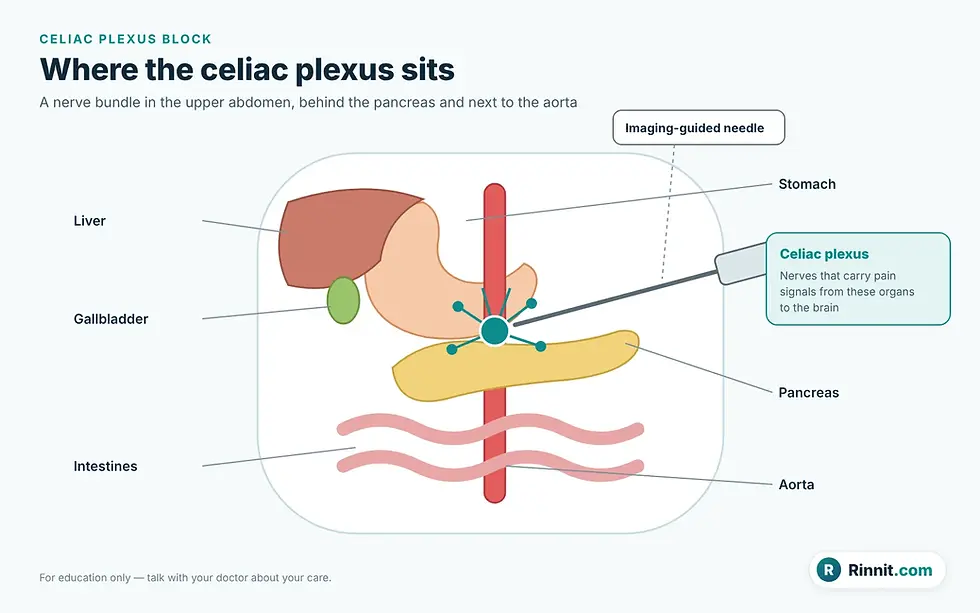
The celiac plexus is a group of nerves in the upper abdomen that sits behind the pancreas, close to the aorta, the body's largest blood vessel. [1]
These nerves are part of the nervous system. They carry signals between the brain and spinal cord and several digestive organs: [1]
Stomach
Liver
Gallbladder
Intestines
When something presses on these nerves — such as a tumor — it can cause pain. [1]
What does a celiac plexus block treat?
A celiac plexus block treats chronic and severe abdominal pain, mainly from two conditions: [1]
Condition | Why it causes pain |
Pancreatic cancer | Tumors can press on the celiac plexus [1] |
Pancreatitis | Swelling (inflammation) of the pancreas causes severe upper abdominal or back pain [1] |
Most people already have significant abdominal pain when pancreatic cancer is diagnosed. Strong pain medicines are the usual treatment. [1]
But those medicines can cause confusion, constipation, and nausea. Some people still have pain even while taking them. A celiac plexus block may help in these situations. [1]
What are the benefits of a celiac plexus block?
The main benefit of a celiac plexus block is better control of chronic or severe abdominal pain. [1] It can also:
Reduce how often breakthrough pain (sudden bursts of intense pain) happens [1]
Lower the dose or amount of pain pills you need to take by mouth [1]
How do you prepare for a celiac plexus block?
Preparing for a celiac plexus block means following your care team's instructions, which may include these steps: [1]
Step | Why it matters |
Stop certain medicines, such as blood thinners, a few days before | Your provider will say which medicines to pause — don't change any medicine without their approval [1] |
Do not eat or drink for several hours before | Anesthesia is safer on an empty stomach [1] |
Quit smoking | Tobacco may increase the risk of complications [1] |
Arrange a driver | You go home the same day but cannot drive yourself [1] |
What happens during a celiac plexus block?
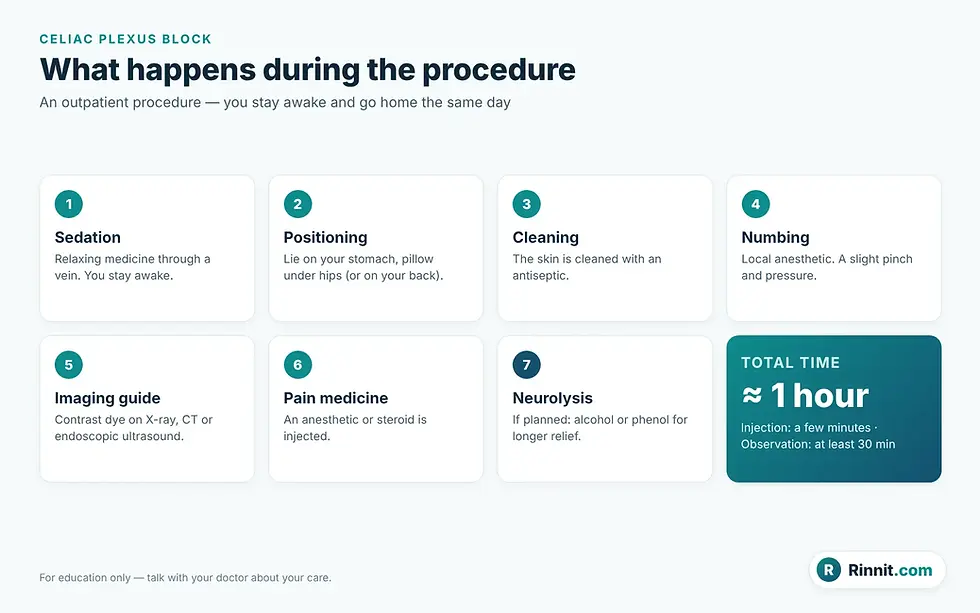
During a celiac plexus block, the provider uses imaging to guide a needle to the nerves and inject medicine. The usual steps are: [1]
Sedation. You get relaxing medicine through a vein in your arm. You stay awake.
Positioning. You lie on your stomach with a pillow under your hips. If that is uncomfortable, you may lie on your back.
Cleaning. The skin is cleaned with an antiseptic.
Numbing. A local anesthetic numbs the area. You may feel a slight pinch and pressure.
Guidance. The provider injects contrast dye that shows on an X-ray, CT scan, or endoscopic ultrasound, so the medicine goes to the right spot.
Pain medicine. An anesthetic (numbing medicine) or a steroid is injected.
Neurolysis (if planned). Alcohol or phenol is injected into the nerves for longer-lasting relief.
How long does a celiac plexus block take?
A celiac plexus block usually takes about an hour from start to finish. [1]
The injection itself lasts only a few minutes. The rest is preparation and at least 30 minutes of observation afterward. The procedure can take longer depending on the technique used. [1]
What is the difference between a celiac plexus block and neurolysis?
A celiac plexus block uses an anesthetic and/or steroid for temporary relief, while neurolysis uses alcohol or phenol to destroy part of the nerves for longer-term relief. [1]
Celiac plexus block | Neurolytic celiac plexus block | |
Medicine injected | Anesthetic and/or steroid [1] | Alcohol or phenol [1] |
Effect on nerves | Temporarily blocks pain signals [1] | Destroys part of the pain-carrying nerves [1] |
Typical relief | 3 to 6 months (anesthetic + steroid) [1] | Longer-term [1] |
Repeat treatment | May be needed later [1] | Generally not needed [1] |
What happens after a celiac plexus block?
After a celiac plexus block, pain relief may begin within 30 minutes. [1]
You stay at the treatment center for at least 30 minutes so the team can watch for complications. Within an hour or so, you can go home — with someone else driving. [1]
What does recovery look like after a celiac plexus block?
Recovery after a celiac plexus block is usually quick, with a return to regular activities within 24 to 48 hours. [1]
Time after the procedure | What you can do |
Right away | Eat and drink as usual [1] |
First 24 hours | No driving, strenuous exercise, or lifting [1] |
24 to 48 hours | Return to regular activities [1] |
Medicines you paused | Restart when your provider says it is safe — usually right after the procedure [1] |
How long does a celiac plexus block last?
How long a celiac plexus block lasts varies from person to person and depends on the medicine injected. [1]
A combination of an anesthetic and a steroid — a common choice — may give three to six months of relief. You may need another treatment later. [1]
A neurolytic block destroys part of the pain-carrying nerves. It offers longer-term relief, and you generally will not need another treatment. [1]

What are the side effects and risks of a celiac plexus block?
A celiac plexus block rarely causes complications, but side effects are possible. [1]
Possible side effects | Rare but serious complications |
Bruising, swelling, or soreness at the injection site | Allergic reaction to anesthesia or contrast dye |
Infection at the treatment site | Reduced blood flow to the spinal cord |
Diarrhea | Slow stomach emptying (gastroparesis) |
Kidney or other organ damage | |
Muscle spasms | Nerve damage |
Paralysis from spinal cord injury | |
Seizures |
Source for table: [1]
Your provider will review these risks with you before the procedure so you can make an informed decision. [1]
When should you call your doctor after a celiac plexus block?
Call your healthcare provider after a celiac plexus block if you notice any of these: [1]
Dizziness, fainting, unusual thirst, or other signs of low blood pressure
Shortness of breath
Signs of infection, such as fever, or redness and oozing at the injection site
Tingling, numbness, or loss of feeling in your legs
Conclusion
A celiac plexus block can be a practical option when abdominal pain from pancreatic cancer or pancreatitis is not well controlled — or when pain medicines cause side effects that are hard to live with. [1]
It is a same-day procedure, relief can start within half an hour, and most people are back to normal activities within two days. [1] A standard block may last three to six months, while a neurolytic block aims for longer relief. [1]
If pain is keeping you from daily life, ask your care team whether a celiac plexus block could fit into your pain plan.
Preparing for your appointment? Save or print this guide and bring it to your doctor's visit. Explore more clear, research-backed guides in our Diseases & Conditions library — starting with our guides to the pancreas, pancreatic cancer, and pancreas removal surgery.
FAQ
Is a celiac plexus block painful?
A celiac plexus block should not be painful while it happens. You receive relaxing medicine through a vein and a numbing injection first, so you may feel only a slight pinch and pressure. [1]
Are you awake during a celiac plexus block?
Yes. The sedative helps you relax, but you are not asleep during the procedure. [1]
How soon does a celiac plexus block work?
Pain relief may start within 30 minutes after the injection. [1]
How long does a celiac plexus block last?
A block with an anesthetic and a steroid may relieve pain for three to six months. A neurolytic block, which destroys part of the nerves, gives longer-term relief. [1]
Can a celiac plexus block be repeated?
Yes. After a standard block, you may need another treatment in the future. A repeat is generally not needed after a neurolytic block. [1]
Can I drive after a celiac plexus block?
No. You need someone to drive you home, and you should not drive for the first 24 hours. [1]
Can I eat after a celiac plexus block?
Yes. You can go back to eating and drinking normally after the procedure. [1]
What is the most common side effect of a celiac plexus block?
Commonly listed side effects include bruising, swelling, or soreness at the injection site, diarrhea, low blood pressure, and muscle spasms. Serious complications are rare. [1]
Does a celiac plexus block reduce the need for pain medicine?
It can. One benefit is a lower dose or amount of pain medicines taken by mouth. [1] Research also links the block to lower opioid use in pancreatic cancer. [3]
Who is a good candidate for a celiac plexus block?
It is mainly used for people with severe upper belly pain from pancreatic cancer or long-term pancreatitis. It may help when pain medicines do not give enough relief or cause too many side effects.
Further reading
Related Reading
Pancreatic Cancer: Symptoms, Causes, and Treatment — A Clear Guide for Patients and Families covers pancreatic cancer symptoms, causes and treatment options.
Pancreatitis: Symptoms, Causes, and Treatment — A Clear Guide to Understanding and Managing the Condition explains pancreas inflammation, its symptoms and how it is treated.
Understanding Nerve Blocks: A Comprehensive Guide to Targeted Pain Relief explains how nerve blocks relieve pain and their possible risks.
Neurolysis: Procedures for Chronic Pain Management describes nerve-destroying procedures for long-lasting pain relief.
References
Cleveland Clinic. Celiac Plexus Block. Cleveland Clinic Health Library. Last updated July 22, 2024. https://my.clevelandclinic.org/health/treatments/16853-celiac-plexus-block
Okita M, Otani K, Gibo N, et al. Systematic review and meta-analysis of celiac plexus neurolysis for abdominal pain associated with unresectable pancreatic cancer. Pain Pract. 2022;22(7):652-661. PMID 35748531. https://doi.org/10.1111/papr.13143
Arcidiacono PG, Calori G, Carrara S, et al. Celiac plexus block for pancreatic cancer pain in adults. Cochrane Database Syst Rev. 2011;(3):CD007519. PMID 21412903. https://doi.org/10.1002/14651858.CD007519.pub2
Machicado JD, Tanner S, Adoor D, et al. Endoscopic ultrasound-guided celiac plexus block for painful chronic pancreatitis: A systematic review and meta-analysis. Pancreatology. 2025;25(6):860-867. PMID 40813224. https://doi.org/10.1016/j.pan.2025.08.006
Cornman-Homonoff J, Holzwanger DJ, Lee KS, et al. Celiac Plexus Block and Neurolysis in the Management of Chronic Upper Abdominal Pain. Semin Intervent Radiol. 2017;34(4):376-386. PMID 29249862. https://doi.org/10.1055/s-0037-1608861
Nitschke AM, Ray CE Jr. Percutaneous neurolytic celiac plexus block. Semin Intervent Radiol. 2013;30(3):318-321. PMID 24436554. https://doi.org/10.1055/s-0033-1353485
Disclaimer
This article is for general education only and is not a substitute for professional medical advice, diagnosis, or treatment. Always talk with your healthcare provider about your own situation before starting or changing any treatment.



Comments