Catatonia: Symptoms, Causes, and the Highly Effective Treatments

Updated: 2 days ago
Medically reviewed by Dr. Baraa Alnahhal, MD · Last reviewed: October 2026
Quick answer
Catatonia is a disorder that disrupts awareness and reaction to the world, causing little or no response to surroundings or unusual, sometimes unsafe behavior [1]. It always occurs alongside another condition, most often bipolar disorder, schizophrenia or major depression [1]. Treatment with benzodiazepines or electroconvulsive therapy is highly effective [1], but malignant catatonia can be deadly without quick treatment [1].
What the research says
According to PubMed:
Catatonia shows up across many conditions. A meta-analysis of 74 studies (110,764 patients) found a mean catatonia prevalence of 9.0% (95% CI 6.9–11.7), and 20.6% in people with a medical or neurological illness and no psychiatric condition. (Solmi et al., Schizophrenia Bulletin, 2018 [7]).
About 1 in 10 people with autism have catatonia. In a meta-analysis of 7 studies covering 969 individuals with autism spectrum disorder, 10.4% (95% CI 5.8–18.0) had catatonia. (Vaquerizo-Serrano et al., European Psychiatry, 2021 [8]).
Benzodiazepines were highly effective. In a systematic review of 53 studies, mostly case series using lorazepam (median dose 8 mg/day), the overall remission rate was 55% and the overall response rate was 77%. No clear dose-response relationship was found. (Bot et al., Acta Psychiatrica Scandinavica, 2026 [9]).
What is catatonia?
Catatonia is a disorder that disrupts how the brain works, changing how a person processes and reacts to the world around them [1]. People with catatonia often don't react to things happening nearby, or they may react in ways that seem unusual. Impaired communication, unusual movements (or a lack of movement), and behavior abnormalities are the most striking features of this condition [1].
Researchers have studied catatonia since German psychiatrist Karl Kahlbaum named and described it in 1874 [1], but it remains highly underdiagnosed [1]. Part of the problem is that, until recent decades, catatonia was mistakenly believed to only occur in people with schizophrenia. Experts also disagree on which criteria and how many are needed to diagnose it, and some catatonic signs — such as agitation and mutism — overlap with other conditions [1].

Who does catatonia affect?
Catatonia doesn't affect any population differently based on race or sex [1]. It most commonly occurs alongside three broad kinds of conditions: psychiatric conditions (which affect mental health), neurological conditions (which affect how the brain works), and medical conditions (which affect one or more body systems) [1].
How common is catatonia?
How does catatonia affect the body?
Catatonia disrupts how certain parts of the brain work, causing a person to go into a "catatonic state." The brain areas affected are those that control or manage movement, the senses (vision, hearing, smell, touch, and taste), memory, thinking and concentration, motivation, emotions, and judgment and self-control [1]. Because so many different brain areas can be involved, catatonia produces many different symptoms — which is one reason it can happen with so many conditions and why it's challenging to diagnose.
What are the symptoms of catatonia?
Catatonia has 12 officially accepted symptoms, as listed in the DSM-5 diagnostic manual from the American Psychiatric Association [1]. A diagnosis typically requires a specific number of these to be present, and your healthcare provider is the best person to evaluate them.
Symptom | What it looks like |
|---|---|
Agitation | Acting upset or irritable — counts only when it isn't a response to something in the surroundings |
Catalepsy | Holding a position in which someone places the person (they can still be repositioned) |
Echolalia | Echoing sounds that someone else makes |
Echopraxia | Mimicking or mirroring someone else's movements |
Grimacing | Holding the same facial expression with stiff or tense facial muscles; sometimes smiling in inappropriate contexts |
Mannerism | Doing motions that could be normal, but in an unusual or exaggerated way |
Mutism | Being very or totally quiet — only a symptom if no other condition (like aphasia) explains the silence |
Negativism | Not reacting to what's happening around them, or actively resisting it for no rational reason |
Posturing | Holding a specific position — often one that would be uncomfortable for others — without being placed there |
Stereotypy | Repetitive movements with no apparent purpose, such as finger-play or patting/rubbing the body |
Stupor | Being awake but not responding to what's happening around them, often including not responding to pain like a pinch |
Waxy flexibility | Slight resistance when someone tries to change their position, then muscles release and limbs bend like a warm candle |
What are the different types of catatonia?
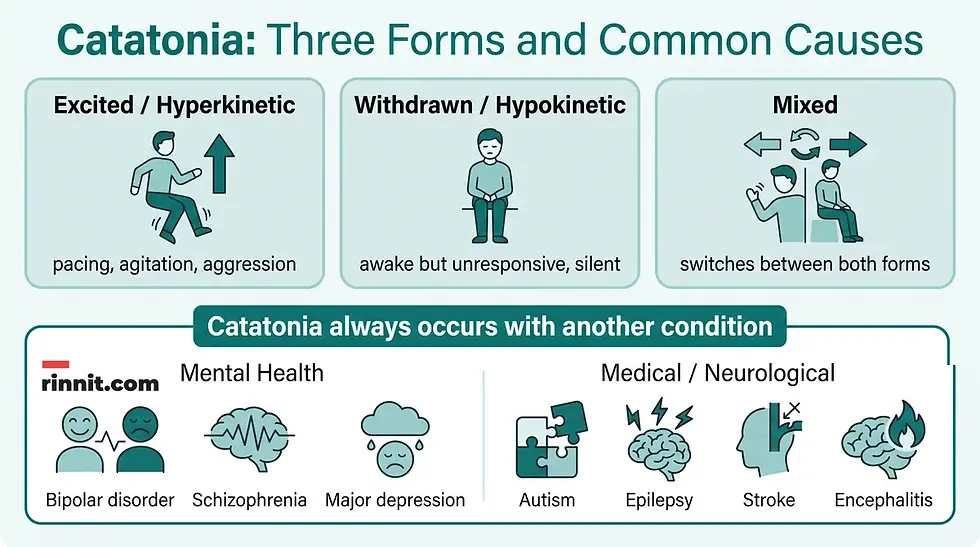
Catatonia is not always a disorder of moving very little or not at all, since it can also involve sudden behavior changes and excessive movement. Catatonia can also involve sudden, unpredictable behavior changes, including excessive or even constant movement. There are three recognized activity levels [1]:
Form | What it looks like |
|---|---|
Excited/hyperkinetic | Pacing, agitation, aggression, and violent behavior without any situation causing the change; strange speech or actions; mimicking how others move or talk; possible self-harm |
Withdrawn/hypokinetic | Awake but unresponsive, as if unaware of surroundings; usually silent with little or no facial expression; may hold unusual postures, resist being moved, skip eating and drinking, and have incontinence |
Mixed | Combines features of both — a person can switch between hyperkinetic and hypokinetic behaviors quickly and without warning |
The withdrawn/hypokinetic form is what most people picture when they think of catatonia [1].
What is malignant catatonia?
In some cases, catatonia can have deadly complications — this is known as malignant catatonia. It causes dysautonomia, a failure of the autonomic nervous system, which is the system that controls automatic body processes you don't need to think about, such as heartbeat and blood pressure [1]. The symptoms include:
Dangerously high body temperature and fever (hyperthermia)
Fast heart rate (tachycardia)
Sweating (diaphoresis)
Unstable blood pressure
Cyanosis (low blood oxygen that turns areas of the skin — especially around the lips and fingernails — blue)
Because malignant catatonia disrupts how the brain runs the body's automatic processes, it has the potential to cause death. That means it needs immediate medical care [1].
What causes catatonia?
Despite almost 150 years of study, experts still don't know exactly why catatonia happens [1]. Possible explanations range from chemical imbalances in the brain to genetic causes passed from generation to generation [1]. What is known is that catatonia always occurs alongside another condition [1].
Type of underlying condition | Examples most commonly involved |
|---|---|
Mental health conditions | Bipolar disorder, schizophrenia, schizoaffective disorder, major depressive disorder [1] |
Neurological and medical conditions | Autism spectrum disorder; autoimmune diseases (lupus, multiple sclerosis); degenerative brain diseases (dementia, Parkinson's disease); Down syndrome; drug-related conditions (prescription and recreational); encephalitis, including anti-NMDA receptor encephalitis; electrolyte imbalance conditions; epilepsy; intellectual disability; normal-pressure hydrocephalus; stroke; Tourette syndrome [1] |
Catatonia is not contagious — you can't catch it from or spread it to others [1].
How is catatonia diagnosed?
A healthcare provider usually starts with a neurological examination, testing reflexes, reactions, and how a person responds — or doesn't respond — to the world around them. They then use a standardized assessment tool, usually the Bush Francis Catatonia Rating Scale, to rate the presence or absence of catatonia and its severity [1].
Once catatonia is identified, providers must find its cause, because catatonia is always associated with another psychiatric or medical condition [1]. Ruling out more severe underlying conditions is a priority. The workup usually involves lab, diagnostic, and imaging tests:
Test type | What it involves |
|---|---|
Imaging tests | CT scans, MRI scans, and other imaging to look at the brain |
Fluid tests | Blood, urine, and cerebrospinal fluid (spinal tap) tests looking for chemical changes, infections, and more |
Brain activity testing | An electroencephalogram (EEG) records electrical activity in the brain, which can rule out seizures or epilepsy [1] |
How is catatonia treated?
Catatonia has no single cure, and treatment usually depends on the condition it occurs with, with medications and electroconvulsive therapy as the two main options. If it happens alongside a medical or neurological condition, treating that condition — if possible — will often reverse the effects of the catatonia [1]. For catatonia that occurs with mental health conditions, other treatment approaches have the best chance of success. The two main treatments are medications and electroconvulsive therapy.
Which medications work best?
Benzodiazepines are the primary medication for treating catatonia because they're safe and very effective. Between 60% and 90% of people with catatonia improve with benzodiazepines [1]. Lorazepam is the medication of choice [1] [6], though clonazepam, diazepam, and zolpidem are also effective. Providers can give these as an intravenous (IV) infusion, an injection, or a pill [1].
Other medications such as mood stabilizers or antipsychotic drugs may help but usually aren't first-line treatments. They're most helpful for treating other symptoms after the initial catatonia improves — notably because antipsychotic medications can cause catatonia to worsen into malignant catatonia or neuroleptic malignant syndrome [1].
When is electroconvulsive therapy used?
Electroconvulsive therapy (ECT) runs a very mild electrical current through an area of the brain to cause a short seizure. It's done under general anesthesia, so the person is in a deep sleep and feels no pain [1]. ECT helps nearly all people with catatonia who receive it [1]. It is the main treatment for malignant catatonia [1] [5] — often life-saving — and it also helps people whose catatonia isn't responding to medications [1] [6]. Transcranial magnetic stimulation (TMS) is another possible treatment, but more research is needed before it can be widely recommended [1].
How quickly do treatments work?
Treatment | Typical response time |
|---|---|
Benzodiazepines by IV | Many people start to improve within 10 to 15 minutes [1] |
Benzodiazepines by mouth (pills) | Can take as little as 20 to 30 minutes to work [1] |
ECT | Some people show improvement within minutes or hours; others need multiple treatments, usually a few times a week for a few weeks (sometimes daily) |
Some people may need several days of treatment to find the right dose [1], so patience matters — but help tends to work quickly once the right approach is found.

What happens in the hospital, and how do people live with catatonia?
People with severe catatonia can't take care of themselves and need care from trained medical professionals. Without movement or the ability to respond, they can't eat or drink, which can lead to dehydration and malnutrition [1]. Lack of movement can also lead to pneumonia and blood clots, raising the risk of stroke or pulmonary embolism [1]. There is also a risk of behavior that could cause harm to themselves or others [1].
Most people with catatonia are at least somewhat aware of the world around them — they simply can't react as they normally would [1]. Many also remember some of what happened to them even though they seemed unaware. Because catatonia can make it hard to speak for themselves, healthcare providers will usually talk to a family member or loved one to make care decisions [1].
What's the outlook?
Catatonia usually isn't life-threatening by itself, except for malignant catatonia, which is deadly without quick treatment [1]. Still, it's associated with an increased risk of death from complications of not moving much, such as pulmonary embolism and pneumonia, and it's harder to treat when it lasts longer or recurs [1].
The encouraging news: benzodiazepines and ECT have very high success rates, so catatonia is very treatable. With timely, effective treatment, the effects are often reversible [1], offering the chance to treat or recover from the underlying conditions. People with mood disorders like bipolar disorder and major depressive disorder tend to respond better to treatment than people with schizophrenia [1], though no two cases are alike.
Can catatonia be prevented?
Catatonia happens unpredictably and for reasons experts still don't fully understand, so it isn't possible to prevent it or reduce the risk of it happening [1]. One important caution: if you have a mental health condition and are prescribed medication, stopping your medications may increase your risk of catatonia [1].
When should someone get care?
People who show signs of catatonia need medical attention as soon as possible, because the same symptoms can occur with dangerous conditions that are emergencies [1]. If a loved one shows signs of catatonia, you may need to take them to the hospital or call 911 (or your local emergency number).
If you or someone you're with is having thoughts of self-harm or suicide, or of harming others, go to the ER or call 911 right away. In the United States, you can call or text the Suicide and Crisis Lifeline at 988. Local mental health organizations and centers may also offer crisis lines.
What's the bottom line?
Catatonia is a disorder that disrupts how the brain processes and reacts to the world, and it always occurs alongside another psychiatric, neurological, or medical condition. Its 12 recognized signs — from stupor and mutism to echolalia and posturing — can be subtle and are often missed, which is why awareness matters. The encouraging news is that catatonia is highly treatable: benzodiazepines help 60% to 90% of people, often within minutes, and ECT helps nearly everyone who receives it, making it a potentially life-saving option for the dangerous malignant form. Because signs of catatonia can overlap with medical emergencies, and because the condition can make someone unable to eat, drink, or stay safe, getting medical attention quickly is the single most important step a family can take.
Ready to learn more? Visit Rinnit.com for trusted, easy-to-understand health guides like this one.
Conclusion
Catatonia is a brain-based disorder that changes how a person reacts to the world — and while it has been misunderstood for well over a century, modern medicine treats it with remarkable success. Benzodiazepine medications bring improvement for 60% to 90% of people, often within minutes, and ECT helps nearly all who receive it. The key message for families: recognize the signs early, seek medical care without delay, and hold onto hope, because with timely treatment the effects are often reversible.
Find more compassionate, plain-English health guides at Rinnit.com.
Frequently Asked Questions
What is catatonia?
Catatonia is a disorder that disrupts how the brain works, changing how a person processes and reacts to the world around them. People with it often don't react to their surroundings, or they react in unusual, unexpected, or sometimes unsafe ways.
Is catatonia the same as being in a coma?
No. People with catatonia are typically awake and are at least somewhat aware of the world around them — they simply can't react to it as they normally would. Many also remember some of what happened even though they seemed unaware.
What are the symptoms of catatonia?
There are 12 officially accepted symptoms, including stupor (awake but unresponsive), mutism (not speaking), posturing (holding unusual positions), catalepsy (holding a position someone places them in), waxy flexibility, echolalia (repeating sounds), echopraxia (mimicking movements), stereotypy (repetitive purposeless movements), mannerisms, grimacing, agitation, and negativism (resisting or ignoring what's happening for no rational reason).
Can catatonia involve moving too much instead of too little?
Yes. While most people think of catatonia as little or no movement, the excited/hyperkinetic form involves pacing, agitation, aggression, and even violent behavior without any situation causing it. A mixed form can switch between high-activity and low-activity behaviors without warning.
What is malignant catatonia?
Malignant catatonia is a rare, life-threatening form that disrupts the autonomic nervous system — the system that controls automatic processes like heartbeat and blood pressure. Its symptoms include dangerously high fever, fast heart rate, sweating, unstable blood pressure, and cyanosis (blue skin from low blood oxygen). It requires immediate medical care.
What causes catatonia?
Experts still don't know exactly why it happens — possible explanations include chemical imbalances in the brain and genetic causes. What is known is that catatonia always occurs alongside another psychiatric, neurological, or medical condition, such as bipolar disorder, schizophrenia, major depression, autism spectrum disorder, epilepsy, stroke, or encephalitis.
How common is catatonia?
Catatonia occurs in about 0.5% to 2.1% of people receiving psychiatric care, and in around 10% of people who need inpatient mental health treatment. It does not affect any population differently based on race or sex.
Is catatonia contagious?
No. Catatonia can't be caught from or spread to other people.
Does catatonia only happen in people with schizophrenia?
No. Catatonia was mistakenly believed for decades to only occur in people with schizophrenia. Today, experts know it happens with a wide range of mental health, neurological, and medical conditions.
How is catatonia diagnosed?
Diagnosing catatonia usually starts with a neurological exam testing reflexes and responses. Providers then use a standardized assessment tool, typically the Bush Francis Catatonia Rating Scale, to rate its presence and severity, and run tests — imaging (CT, MRI), blood, urine, spinal fluid, and EEG — to find and rule out underlying conditions.
How is catatonia treated?
The two main treatments are benzodiazepine medications (60% to 90% of people improve) and electroconvulsive therapy, or ECT, which helps nearly all people who receive it. Treatment often also targets the underlying condition causing the catatonia.
Which medication works best for catatonia?
Lorazepam, a benzodiazepine, is the medication of choice. Others like clonazepam, diazepam, and zolpidem are also effective. They can be given by IV, injection, or pill. Antipsychotic drugs are not first-line and can sometimes make catatonia worse, so they're used carefully.
How fast does treatment work?
Often very quickly. With IV benzodiazepines, many people start to improve within 10 to 15 minutes; pills can work in 20 to 30 minutes. Some people need several days to find the right dose. With ECT, some people improve within minutes or hours, while others need treatments several times a week for a few weeks.
Is catatonia life-threatening?
Usually not by itself — but it raises the risk of death from complications of not moving much, like pulmonary embolism and pneumonia. The malignant form is deadly without quick treatment. Timely treatment matters, because catatonia is harder to treat the longer it lasts or the more times a person has it.
What's the outlook for someone with catatonia?
Very encouraging. Catatonia is highly treatable, and with timely treatment the effects are often reversible — including the chance to treat or recover from the underlying conditions. People with mood disorders tend to respond better than those with schizophrenia, though no two cases are alike.
Can catatonia be prevented?
No — it happens unpredictably for reasons not fully understood. However, stopping prescribed mental health medications may increase the risk, so people should never stop medications without their provider's guidance.
What should a family do if a loved one shows signs of catatonia?
Seek medical attention as soon as possible. Symptoms can overlap with medical emergencies, so a loved one may need to go to the hospital or the family may need to call 911 or the local emergency number. In the U.S., the Suicide and Crisis Lifeline is available by calling or texting 988.
Do people with catatonia remember what happened?
Many do. Most people are at least somewhat aware of the world around them during an episode, and it's common for them to remember some of what happened even though they seemed unaware.
Can a person with catatonia make their own medical decisions?
Often not during an episode, because the condition affects awareness and communication. In those cases, healthcare providers usually work with a family member or loved one to make care choices.
Do people with catatonia need hospital care?
People with severe catatonia need care from trained medical professionals because they may be unable to eat or drink (risking dehydration and malnutrition), unable to move (risking pneumonia and blood clots), and at risk of behavior that could harm themselves or others.
This article is for general informational purposes only and does not constitute medical advice, diagnosis, or treatment. Always seek the guidance of your physician or other qualified health provider with any questions about a medical condition. Never disregard professional medical advice or delay seeking care because of something you have read here. If you or someone you know is experiencing a mental health crisis, call or text the Suicide and Crisis Lifeline at 988 (U.S.) or go to your nearest emergency department immediately.
Related Reading
Electroconvulsive Therapy (ECT): How It Works, What to Expect, and Side Effects explains ECT, a highly effective treatment for catatonia.
Benzodiazepines (Benzos): Uses, Side Effects and Risks covers the medicine class usually tried first for catatonia.
Neuroleptic Malignant Syndrome: Causes, Symptoms, and Emergency Care explains a dangerous drug reaction that can resemble malignant catatonia.
What Is Catatonic Schizophrenia? Understanding the Obsolete Subtype and What Replaced It explains how catatonia is now classified within schizophrenia diagnoses.
References
Cleveland Clinic. Catatonia. Cleveland Clinic. Last updated July 18, 2022. https://my.clevelandclinic.org/health/diseases/23503-catatonia
Rogers JP, Oldham MA, Fricchione G, et al. Evidence-based consensus guidelines for the management of catatonia: recommendations from the British Association for Psychopharmacology. J Psychopharmacol. 2023;37(4):327-369. PMID 37039129. https://doi.org/10.1177/02698811231158232
Iyer V, Spurling BC, Rizvi A. Catatonia. Updated December 13, 2025. In: StatPearls [Internet]. Treasure Island (FL): StatPearls Publishing; 2025 Jan-. PMID 28613592. https://www.ncbi.nlm.nih.gov/books/NBK430842/
Dubovsky SL, Dubovsky AN. Catatonia: how to identify and treat it. Current Psychiatry. 2018;17(8):16-26. https://www.mdedge.com/content/catatonia-how-identify-and-treat-it
Bhati MT, Datto CJ, O'Reardon JP. Clinical manifestations, diagnosis, and empirical treatments for catatonia. Psychiatry (Edgmont). 2007;4(3):46-52. PMID 20805910. https://pubmed.ncbi.nlm.nih.gov/20805910/
Appiani FJ, Castro GS. Catatonia is not schizophrenia and it is treatable. Schizophr Res. 2018;200:112-116. PMID 28610803. https://doi.org/10.1016/j.schres.2017.05.030
Solmi M, Pigato GG, Roiter B, et al. Prevalence of catatonia and its moderators in clinical samples: results from a meta-analysis and meta-regression analysis. Schizophr Bull. 2018;44(5):1133-1150. PMID 29140521. https://doi.org/10.1093/schbul/sbx157
Vaquerizo-Serrano J, Salazar De Pablo G, Singh J, et al. Catatonia in autism spectrum disorders: a systematic review and meta-analysis. Eur Psychiatry. 2021;65(1):e4. PMID 34906264. https://doi.org/10.1192/j.eurpsy.2021.2259
Bot L, Schotsman B, Oostra E, et al. The effect of benzodiazepines on catatonia: a systematic review and meta-analysis. Acta Psychiatr Scand. 2026;154(2):99-115. PMID 42009596. https://doi.org/10.1111/acps.70102



Comments