
Cardiac Sarcoidosis: When Immune Cell Clumps Affect Your Heart — Symptoms, Tests, and Treatment

Updated: 3 days ago
Medically reviewed by Dr. Baraa Alnahhal, MD · Last reviewed: October 2026
Quick Answer
Cardiac sarcoidosis is a condition where the immune system triggers heart inflammation, forming granulomas that can scar the heart muscle and disrupt its electrical activity. Up to 1 in 4 people with sarcoidosis have heart involvement, sometimes without symptoms. Treatment includes steroids, immunosuppressants, heart medicines and devices like a pacemaker or ICD. Early diagnosis gives the best outlook.

What the research says
Survival is better than many people fear. In a single-center study of 73 people with cardiac sarcoidosis followed for a median of 8.8 years, 5- and 10-year survival were 95.5% and 93.4%; being 46 or older and not having an implanted pacemaker or defibrillator were the only independent predictors of death (Zhou et al., Chest, 2017 [1]).
PET scans help show who is at higher risk. In a meta-analysis of 55 studies with 5,250 people, a lack of response to immunosuppression on repeat PET scans carried an odds ratio of 8.43 (95% CI 3.25–21.85) for major adverse cardiac events, and focal abnormal right-ventricular uptake an odds ratio of 6.27 (95% CI 3.19–12.32) (Kafil et al., JACC: Cardiovascular Imaging, 2024 [2]).
A biopsy is not required to take the diagnosis seriously. In 6 studies of 2,204 people, outcomes did not differ significantly between biopsy-confirmed (definite) and probable or presumed cardiac sarcoidosis: all-cause death RR 1.01 (95% CI 0.48–2.10) and composite endpoint RR 1.80 (95% CI 0.93–3.49) (Ahmed et al., Current Problems in Cardiology, 2024 [3]).
What Is Cardiac Sarcoidosis?
Cardiac sarcoidosis is a condition in which your immune system triggers inflammation that harms your heart. Clumps of immune cells called granulomas form in your heart. Over time, these may cause scarring. The scars can damage your heart muscle, interfere with your heart’s electrical activity, and cause abnormal heart rhythms.
This condition is a less common form of sarcoidosis that specifically affects your heart. Most people with sarcoidosis have granulomas in their lungs. But it is possible to have them in your heart, too, and not know until testing reveals them.
How Common Is Heart Involvement?
Experts believe that up to 1 in 4 people with sarcoidosis have heart involvement.
What are the symptoms of cardiac sarcoidosis?
Cardiac sarcoidosis can disrupt heart function and cause symptoms like chest pain, coughing, fainting, fatigue, palpitations, shortness of breath and leg swelling, though some people have none.
Chest pain or tightness
Coughing
Fainting
Fatigue
Heart palpitations
Shortness of breath
Swelling in your legs
It is also possible not to feel any symptoms of sarcoidosis in your heart. It depends on where the granulomas form and how much inflammation they cause.
What Causes Cardiac Sarcoidosis?
Experts do not fully understand what causes cardiac sarcoidosis. They believe it is likely a mix of your genes and your environment. Certain genes may make your immune system more likely to overreact to triggers like mold, insecticides, silica dust, or bacteria — causing immune cells to cluster in your heart.
You have a higher risk of cardiac sarcoidosis if someone in your biological family has the condition.
What complications can cardiac sarcoidosis cause?
Cardiac sarcoidosis can keep your heart from working as it should. For example, inflammation or scars may block electrical signals from getting where they need to be. This can cause your heart to beat out of sync. Or your heart may be unable to pump enough blood to meet your body’s needs. Without treatment, these issues can be life-threatening.
Possible complication | What it means |
|---|---|
Atrial fibrillation | Irregular rhythm in the upper chambers of the heart |
Heart block | Electrical signals are blocked from reaching where they need to go |
Heart failure | The heart cannot pump enough blood for the body’s needs |
Ventricular tachycardia | Fast rhythm in the lower chambers of the heart |
Ventricular fibrillation | Chaotic rhythm in the lower chambers of the heart |
Sudden cardiac death | The heart stops suddenly and unexpectedly |

How Is Cardiac Sarcoidosis Diagnosed?
To diagnose cardiac sarcoidosis, your provider will give you a physical exam and ask about your symptoms. They will review your health history and ask about any biological family members who have sarcoidosis. You will also need some tests. These allow your provider to check for signs of heart inflammation or scarring. Testing also helps rule out other conditions.
Possible tests include:
Blood tests
Chest X-ray
Electrocardiogram (EKG)
Echocardiogram
Heart MRI
Holter monitor
Heart PET scan
The exact tests you need can vary. If you have already been diagnosed with sarcoidosis elsewhere in your body, your provider may want to “screen” for it in your heart. This may happen even without heart symptoms. If you have symptoms, you will need more extensive testing. Providers usually do not use biopsies to diagnose cardiac sarcoidosis.
Early diagnosis gives you the best chance to manage symptoms and protect your heart.
Are There Stages?
There is no single staging system for cardiac sarcoidosis. But providers may use terms like “early stage” or “advanced stage” to describe how much tissue damage they see.
Imaging can help your provider see how far the condition has progressed. Early on, inflammation in your heart may not cause lasting damage. But over time, scars can form. Ideally, providers diagnose this condition in the early stages, before scars damage your heart.
How Is Cardiac Sarcoidosis Treated?
Treatment involves medicines to reduce inflammation, manage your heart rhythm, and treat heart failure. You may also need a device or procedure to lower your risk of dangerous heart rhythms. In severe cases, a heart transplant may be a last resort.
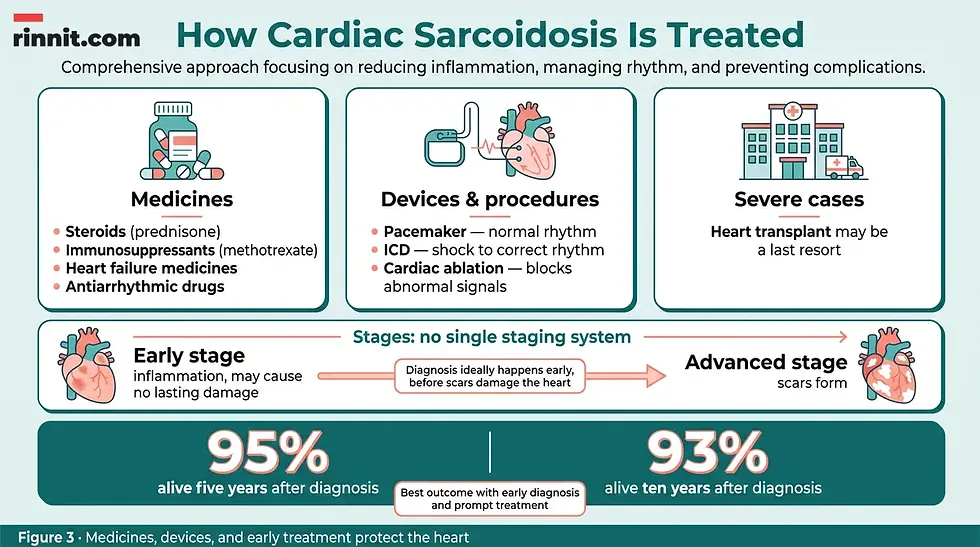
Medicines
Steroids to reduce inflammation, like prednisone.
Immunosuppressants to calm your immune response, like methotrexate (providers may prescribe these along with prednisone).
Heart failure medicines to help your heart work better.
Antiarrhythmic drugs to help your heart beat in a normal rhythm.
Devices and Procedures
Pacemaker to help your heart beat in a normal rhythm.
Implantable cardioverter defibrillator (ICD) to send a shock, when needed, to correct an abnormal rhythm.
Cardiac ablation to block abnormal electrical signals.
When Should I See My Healthcare Provider?
Your provider will tell you how often you need follow-up appointments and imaging tests. Follow the schedule they give you. Call your provider anytime you have new symptoms, side effects from medicines, or questions about your treatment plan.
If possible, seek care at a hospital that has a sarcoidosis center. There, you can receive care from a team of experts in this condition. You may work with heart doctors, lung doctors, and other specialists depending on where the granulomas are building up.
When Should I Go to the ER?
Cardiac sarcoidosis needs emergency care if you have chest pain, lasting palpitations, dizziness, fainting, a racing or erratic pulse, or shortness of breath.
Call 911 or your local emergency number if you have any of these signs of a dangerous arrhythmia:
Chest pain
Heart palpitations that are not going away
Dizziness
Fainting
A racing or erratic pulse
Shortness of breath
What Is the Prognosis?
You will typically have the best outcome if your healthcare provider diagnoses your cardiac sarcoidosis early and starts treatment right away. Your outlook may not be as good without prompt treatment. But each person’s experience is a little different. Your provider can tell you what to expect in your situation.
People who only have sarcoidosis in their hearts have a worse prognosis than those who have sarcoidosis throughout their bodies. This is because they have a higher risk of ventricular arrhythmias — abnormal heart rhythms in the lower chambers of your heart.
How Long Can You Live With Cardiac Sarcoidosis?
Your life expectancy depends on many things, including how early you are diagnosed and treated. One study showed that 95% of people with cardiac sarcoidosis were alive five years after their diagnosis, and 93% were alive 10 years after their diagnosis. Your healthcare provider can help you understand more.
Conclusion
Cardiac sarcoidosis is a less common but serious form of sarcoidosis in which your immune system triggers inflammation that harms your heart. Clumps of immune cells (granulomas) form in the heart and can leave scars that damage the heart muscle and disrupt its electrical system — leading to abnormal rhythms and, without treatment, potentially life-threatening complications. Up to 1 in 4 people with sarcoidosis have heart involvement, and many have no symptoms at all, which is why screening matters.
Treatment is a combination of medicines (steroids, immunosuppressants, heart failure drugs, antiarrhythmics) and devices or procedures (pacemakers, ICDs, cardiac ablation), with heart transplant reserved for severe cases. The outlook is encouraging when the condition is caught early. If you have sarcoidosis or a family history of it, talk to your provider about whether your heart should be checked, and get care from a center with sarcoidosis experts whenever possible.
Frequently Asked Questions
What is cardiac sarcoidosis?
Cardiac sarcoidosis is a condition in which your immune system triggers inflammation that harms your heart. Clumps of immune cells called granulomas form in your heart, and over time they may cause scarring that can damage your heart muscle, interfere with your heart’s electrical activity, and cause abnormal heart rhythms.
How is cardiac sarcoidosis different from regular sarcoidosis?
Cardiac sarcoidosis is a less common form of sarcoidosis that specifically affects your heart. Most people with sarcoidosis have granulomas in their lungs, but it is possible to have them in your heart too, and not know until testing reveals them.
How common is heart involvement in sarcoidosis?
Experts believe that up to 1 in 4 people with sarcoidosis have heart involvement.
What are the symptoms of cardiac sarcoidosis?
Chest pain or tightness, coughing, fainting, fatigue, heart palpitations, shortness of breath, and swelling in your legs. It is also possible to feel no symptoms at all — it depends on where the granulomas form and how much inflammation they cause.
What causes cardiac sarcoidosis?
Experts do not fully understand the cause, but they believe it is likely a mix of your genes and your environment. Certain genes may make your immune system more likely to overreact to triggers like mold, insecticides, silica dust, or bacteria, causing immune cells to cluster in your heart.
Am I at higher risk if sarcoidosis runs in my family?
Yes. You have a higher risk of cardiac sarcoidosis if someone in your biological family has the condition.
What complications can cardiac sarcoidosis cause?
Atrial fibrillation, heart block, heart failure, ventricular fibrillation, ventricular tachycardia, and sudden cardiac death. Without treatment, these issues can be life-threatening.
Why can cardiac sarcoidosis be life-threatening?
Inflammation or scars may block electrical signals from getting where they need to be, causing your heart to beat out of sync, or your heart may be unable to pump enough blood to meet your body’s needs.
How is cardiac sarcoidosis diagnosed?
Your provider will do a physical exam, review your symptoms and health history (including any family history of sarcoidosis), and order tests to check for heart inflammation or scarring and to rule out other conditions.
What tests will I need?
Possible tests include blood tests, a chest X-ray, an electrocardiogram (EKG), an echocardiogram, a heart MRI, a Holter monitor, and a heart PET scan. The exact tests vary. Providers usually do not use biopsies to diagnose cardiac sarcoidosis.
Should I be screened even if I have no heart symptoms?
If you have already been diagnosed with sarcoidosis elsewhere in your body, your provider may want to screen for it in your heart even without heart symptoms. If you do have symptoms, you will need more extensive testing.
Are there stages of cardiac sarcoidosis?
There is no single staging system, but providers may use terms like “early stage” or “advanced stage” to describe how much tissue damage they see. Ideally, the condition is diagnosed in the early stages, before scars damage your heart.
How is cardiac sarcoidosis treated?
With medicines to reduce inflammation (steroids like prednisone), calm your immune response (immunosuppressants like methotrexate), help your heart work better (heart failure medicines), and keep a normal rhythm (antiarrhythmic drugs). You may also need a pacemaker, an implantable cardioverter defibrillator (ICD), or cardiac ablation. In severe cases, a heart transplant may be a last resort.
When should I go to the ER?
Call 911 or your local emergency number for signs of a dangerous arrhythmia: chest pain, heart palpitations that are not going away, dizziness, fainting, a racing or erratic pulse, or shortness of breath.
What is the prognosis for cardiac sarcoidosis?
You will typically have the best outcome if the condition is diagnosed early and treatment starts right away. One study showed that 95% of people with cardiac sarcoidosis were alive five years after diagnosis and 93% were alive 10 years after. People with sarcoidosis only in their hearts have a worse prognosis than those with sarcoidosis throughout their bodies, because of a higher risk of ventricular arrhythmias.
Related Reading
Cardiac PET Scan: Heart Blood Flow Imaging, Prep and Results explains the nuclear scan that shows blood flow to the heart muscle.
References
Zhou Y, Lower EE, Li HP, et al. Cardiac sarcoidosis: the impact of age and implanted devices on survival. Chest. 2017;151(1):139-148. PMID 27614001. https://doi.org/10.1016/j.chest.2016.08.1457
Kafil TS, Shaikh OM, Fanous Y, et al. Risk stratification in cardiac sarcoidosis with cardiac positron emission tomography: a systematic review and meta-analysis. JACC: Cardiovascular Imaging. 2024;17(9):1079-1097. PMID 39115497. https://doi.org/10.1016/j.jcmg.2024.05.013
Ahmed R, Ahsan A, Ahmed M, et al. Outcomes of definite vs probable/presumed cardiac sarcoidosis: a systematic review and meta-analysis. Current Problems in Cardiology. 2024;49(12):102820. PMID 39191361. https://doi.org/10.1016/j.cpcardiol.2024.102820
Cleveland Clinic. Cardiac Sarcoidosis: Symptoms & Treatment. Cleveland Clinic. Last updated July 22, 2025. https://my.clevelandclinic.org/health/diseases/23485-cardiac-sarcoidosis
Harshaw-Ellis KS. Cardiac Sarcoidosis. American College of Cardiology. May 20, 2021. https://www.acc.org/latest-in-cardiology/articles/2021/05/20/13/01/cardiac-sarcoidosis
Cheng RK, Kittleson MM, Beavers CJ, et al. Diagnosis and management of cardiac sarcoidosis: a scientific statement from the American Heart Association. Circulation. 2024;149(21):e1197-e1216. PMID 38634276. https://doi.org/10.1161/CIR.0000000000001240
Markatis E, Afthinos A, Antonakis E, et al. Cardiac sarcoidosis: diagnosis and management. Reviews in Cardiovascular Medicine. 2020;21(3):321-338. PMID 33070538. https://doi.org/10.31083/j.rcm.2020.03.102
Okada DR, Bravo PE, Vita T, et al. Isolated cardiac sarcoidosis: a focused review of an under-recognized entity. Journal of Nuclear Cardiology. 2018;25(4):1136-1146. PMID 27613395. https://doi.org/10.1007/s12350-016-0658-1
Ribeiro Neto ML, Jellis CL, Joyce E, et al. Update in cardiac sarcoidosis. Annals of the American Thoracic Society. 2019;16(11):1341-1350. PMID 31322914. https://doi.org/10.1513/AnnalsATS.201902-119CME
Tan JL, Fong HK, Birati EY, et al. Cardiac sarcoidosis. The American Journal of Cardiology. 2019;123(3):513-522. PMID 30503798. https://doi.org/10.1016/j.amjcard.2018.10.021
Tan JL, Tan BE, Cheung JW, et al. Update on cardiac sarcoidosis. Trends in Cardiovascular Medicine. 2023;33(7):442-455. PMID 35504422. https://doi.org/10.1016/j.tcm.2022.04.007
Medical disclaimer
This article is for informational purposes only and is not a substitute for professional medical advice, diagnosis, or treatment. Always seek the advice of your physician or other qualified health provider with any questions you may have regarding a medical condition. Never disregard professional medical advice or delay seeking it because of something you have read on Rinnit.



Comments