Bullous Myringitis: The Painful Ear Blister Condition That Colds Can Cause

Updated: 3 days ago
Medically reviewed by Dr. Baraa Alnahhal, MD · Last reviewed: October 2026
Quick answer
Bullous myringitis is an infection that forms painful, fluid-filled blisters on the eardrum, most often in children ages 5 to 8 [1]. It is caused by viruses and bacteria from colds and ear infections [1]. The main symptom is sudden severe ear pain [4], with fever and hearing loss [1]. Treatment includes antibiotics and pain medication, and draining the blisters often relieves pain quickly [1] [5].
What the research says
According to PubMed:
Bullous myringitis is a rarer, more symptomatic form of ear infection in toddlers. In a Finnish cohort of 2,028 children aged 7–24 months, there were 86 office visits for bullous myringitis (92 ears) compared with 1,876 visits for acute otitis media (2,683 ears). Earache occurred in 58% and fever in 62% of bullous myringitis cases, both more often than with acute otitis media, and symptoms eased within 1–2 days in most cases. (Kotikoski et al., Int J Pediatr Otorhinolaryngol, 2003 [4]).
Hearing loss is common in bullous myringitis, so a hearing test matters. In a case series of 81 patients, 50 (62%) had measurable hearing loss, although only 39 reported it when asked. Pooling the series with a systematic review, sensorineural and mixed hearing loss made up 27% and 55% of the 139 patients with confirmed hearing loss. (Ungar et al., Otol Neurotol, 2021 [6]).
Study details are from PubMed abstracts.
What Is Bullous Myringitis?
Bullous myringitis (pronounced BUH-lus myr-in·GI-tis) is an infection that causes painful blisters on your eardrum [1]. The eardrum is the thin membrane that separates your ear canal from your middle ear and plays a key role in hearing. When it becomes infected, small blisters form on the membrane itself.
You may also see this condition called bullous hemorrhagic myringitis or myringitis bullosa — different names for the same condition [1]. Fungal myringitis is a separate condition.
The condition usually starts after a cold or a middle ear infection (acute otitis media) [1] [5]. It most often affects children ages 5 to 8, but younger children and adults can get it too [1].

What Are the Symptoms of Bullous Myringitis?
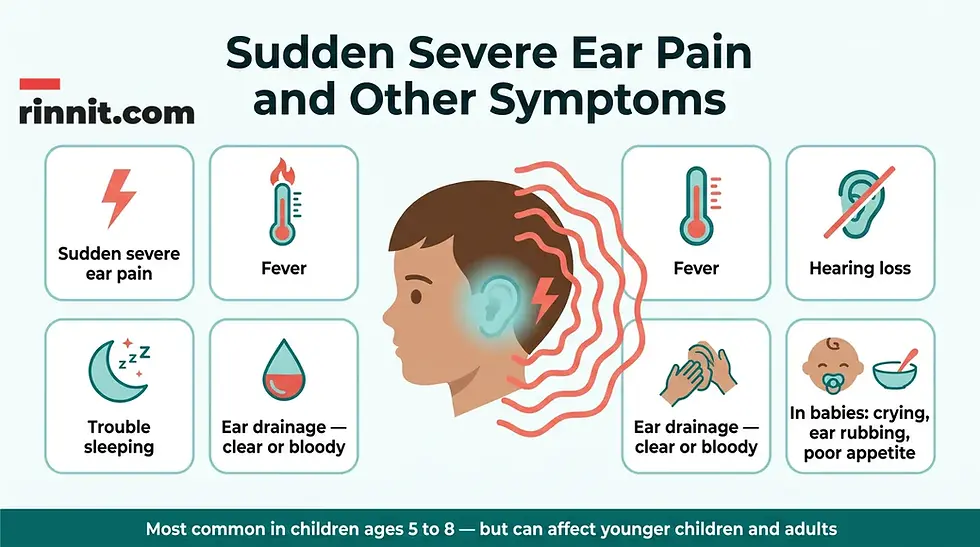
The hallmark symptom is severe ear pain that comes on suddenly [1]. Beyond the pain, the condition can cause several other signs.
Symptom | What it looks like |
Sudden severe ear pain | Sharp, intense pain that starts quickly |
Fever | Elevated body temperature |
Hearing loss | Trouble hearing as clearly as usual |
Trouble sleeping | Pain keeps you (or your child) awake |
Ear drainage | Fluid leaking from the affected ear — clear, bloody, or both [1] |
Signs in small children | Crying, rubbing the ear, and poor appetite |
In babies and toddlers, who cannot describe pain, watch for crying, ear rubbing, and eating less than usual [4].
What Causes Bullous Myringitis?
You develop bullous myringitis when viruses or bacteria infect your eardrum. The eardrum reacts to the infection by becoming irritated and inflamed. That inflammation produces small, fluid-filled blisters (bullae) between the eardrum's middle and outer layers [1].
The same bacteria and viruses that cause colds and related ear infections cause this condition. RSV (respiratory syncytial virus) and other viruses likely cause most cases [1]. Bacteria — including Streptococcus pneumoniae (pneumococcus) and mycoplasma — may also cause it [1] [5].
Is it the same as a middle ear infection?
No — and this is one of the most common points of confusion. In a typical middle ear infection, germs infect and trap fluid behind the eardrum, making it swell and hurt. Bullous myringitis is different: the germs infect the eardrum itself, although in young children fluid often collects behind the eardrum as well [1] [4]. The symptoms overlap, but bullous myringitis usually causes more severe pain than a middle ear infection [1] [2].
Does every ear infection turn into bullous myringitis?
No. For every 20 children under 2 years old with a middle ear infection, only 1 develops bullous myringitis [1].
What Increases the Risk of Bullous Myringitis?
Bullous myringitis is made more likely by a number of different risk factors.
Risk factor | How it plays a role |
Winter months | Cold air thickens the mucus around the eustachian tubes — the structures that drain fluid from the middle ear. Thickened mucus can block these tubes, trapping fluid and germs inside [1]. |
Age 5 to 8 | The condition most often affects children in this age range [1]. |
Sex | In older children and adults, it is more common in females. In younger children, it is more common in males [1]. |
Colds and ear infections | The viruses and bacteria that cause these illnesses are what trigger the condition. |
How Is Bullous Myringitis Diagnosed?
A healthcare provider can usually spot the condition with a simple exam. They use an instrument called an otoscope — a lighted magnifier — to look inside your ear for blisters on the eardrum [1] [5].
If hearing loss is a concern, the provider may order a pure-tone hearing test [1]. This is the most common type of hearing test, and audiologists perform it. Here is how it works: you sit in a sound-treated room wearing headphones or insert earphones; an audiologist uses a machine called an audiometer to play sounds at different frequencies and loudness levels; you signal when you hear each sound; and your responses are recorded on an audiogram, a chart that shows the pattern and degree of any hearing loss.
How Is Bullous Myringitis Treated?
Treatment targets the infection and the pain.
Placing a warm compress on the outside of your ear can also help with ear pain while you heal [1].
When to contact your provider: Reach out if your symptoms continue or get worse after treatment [1].
How Quickly Does Bullous Myringitis Heal?
The outlook is very good. Treatment cures bullous myringitis [1]. One study measuring recovery in children found that 95% felt better within three days, and ear drainage stopped within five days [1]. With pain medication and antibiotics, most people feel better within a few days [1].

Can Bullous Myringitis Be Prevented?
The best prevention is protecting yourself and your child from the infections that cause it. You cannot dodge every cold, but these steps help.
Prevention step | Why it helps |
Wash your hands | Cold viruses spread from your hands to your eyes, nose, and mouth |
Use alcohol-based hand sanitizer | A backup when soap and water are not available |
Clean frequently touched surfaces | Viruses can live on doorknobs and other commonly touched places [1] |
Strengthen your immune system | Enough sleep, nutritious foods, and exercise ready your body to fight germs |
Stay home when sick | Keep sick children home from school or daycare |
Avoid smoke exposure | Secondhand smoke raises ear infection risk [1]; keep smoking away from your child |
Manage allergies | Allergy inflammation and mucus can block the eustachian tube, leading to ear infections [1] |
Get vaccinated | Vaccinations reduce the risk of colds that could lead to this condition [1] |
When Should You Get Medical Help?
Contact a healthcare provider if you or your child has sudden severe ear pain — it may be a sign of bullous myringitis [1]. The experience is unpleasant, but it does not have to be long-lasting. Treatments are available that can ease the pain and restore your hearing [1].
Conclusion: Fast-Treating Pain, Lasting Relief
Bullous myringitis may be one of the more painful ear conditions, but it is also one of the most treatable. The condition strikes quickly with severe ear pain when a cold virus or ear-infection bacteria infects the eardrum and raises small blisters on it. Antibiotics and pain medication get most people — and most children — feeling better within days, and draining the blisters can bring fast relief. Simple infection-prevention habits, from handwashing to avoiding smoke, lower your risk.
Want more clear, trustworthy health guidance? Explore our complete library of human-readable medical guides at Rinnit.com.
Frequently asked questions
What is bullous myringitis?
Bullous myringitis is an infection that forms painful, fluid-filled blisters on the eardrum, between its middle and outer layers.
What does it feel like?
Severe ear pain that comes on suddenly, along with fever, hearing loss, trouble sleeping, and ear drainage that may be clear, bloody, or both.
What causes the blisters to form?
When viruses or bacteria infect the eardrum, inflammation creates small fluid-filled bullae between the eardrum's middle and outer layers.
Which germs cause it?
The same germs that cause colds and ear infections — most likely RSV (respiratory syncytial virus) and other viruses, though bacteria such as pneumococcus and mycoplasma can also cause it.
Who is most likely to get bullous myringitis?
Children ages 5 to 8 are affected most often, but younger children and adults can get it too.
Is it contagious?
The condition itself is not "caught" from someone; the cold viruses and bacteria that trigger it spread between people, which is why handwashing matters.
How is it different from a middle ear infection?
A middle ear infection traps fluid behind the eardrum. Bullous myringitis infects the eardrum itself and usually causes more severe pain.
How is it diagnosed?
A provider uses an otoscope to look for blisters on the eardrum, and may order a pure-tone hearing test if hearing loss is a concern.
What is a pure-tone hearing test?
The most common hearing test, performed by an audiologist in a sound-treated room, where you respond to tones played at different frequencies and volumes; results appear on an audiogram.
How is bullous myringitis treated?
With antibiotics, pain medication, nasal decongestants, and sometimes draining the blisters with a small knife — a step that often relieves the pain.
Does draining the blisters hurt or help?
Draining the blisters often relieves the pain.
How long does recovery take?
One study found 95% of children felt better in three days, and ear drainage stopped in five days.
Will my hearing go back to normal?
Most people recover, but bullous myringitis can also affect the inner ear (sensorineural hearing loss), which may not resolve on its own, so a hearing test is important and prompt treatment may be needed. If hearing doesn't return to normal, a provider can order a hearing test to see what is going on.
Can it be prevented?
Partially — preventing colds and ear infections through handwashing, vaccinations, allergy management, smoke avoidance, and cleaning frequently touched surfaces reduces the risk.
When should I call the doctor?
If you or your child has sudden severe ear pain, or if symptoms continue or worsen after treatment.
Related reading
This article is for general informational purposes only and is not a substitute for professional medical advice, diagnosis, or treatment. Always seek the advice of your physician or qualified health provider with any questions you may have regarding a medical condition. Never disregard professional medical advice or delay in seeking it because of something you have read here. If you think you may have a medical emergency, call your doctor or 911 immediately.
References
Cleveland Clinic. Bullous Myringitis: Symptoms, Causes & Treatment. Cleveland Clinic. Updated November 12, 2025. https://my.clevelandclinic.org/health/diseases/25018-bullous-myringitis
Devaraja K. Myringitis: an update. Journal of Otology. 2019;14(1):26-29. PMID 30936899. https://doi.org/10.1016/j.joto.2018.11.003
Kasinathan S, Kondamudi NP. Bullous Myringitis. Updated August 12, 2023. In: StatPearls [Internet]. Treasure Island (FL): StatPearls Publishing; 2023 Jan-. PMID 31971705. https://www.ncbi.nlm.nih.gov/books/NBK553029/
Kotikoski MJ, et al. The symptoms and clinical course of acute bullous myringitis in children less than two years of age. International Journal of Pediatric Otorhinolaryngology. 2003;67(2):165-172. PMID 12623153. https://doi.org/10.1016/s0165-5876(02)00366-x
Jan TA. Myringitis. Merck Manual Professional Edition. Updated June 2026. https://www.merckmanuals.com/professional/ear,-nose,-and-throat-disorders/middle-ear-and-tympanic-membrane-disorders/myringitis
Ungar OJ, et al. The actual incidence and types of hearing losses in bullous myringitis: case series and systematic review. Otology & Neurotology. 2021;42(7):1008-1013. PMID 33883520. https://doi.org/10.1097/MAO.0000000000003160



Comments