Body Tissue: The Fundamental Building Blocks of Human Anatomy

Updated: 3 days ago
Medically reviewed by Dr. Baraa Alnahhal, MD · Last reviewed: October 2026
Quick Answer: What is body tissue?
Body tissue is a group of cells with similar jobs that work together to form organs and run the body. [1] The four main types are epithelial, connective, muscle and nervous. [1] Connective tissue, including bone and blood, is the most abundant, while muscle and nervous tissues are unique for their electrical reactivity. [1] Healthy tissue is vital for overall bodily function.
What the research says
The body contains about 30 trillion human cells, and blood-forming cells make up about 90% of them. A quantitative analysis for a 70 kg "reference man" estimated 3.0 x 10^13 human cells, with the hematopoietic lineage accounting for about 90% of the total. It also found that bacteria number about 3.8 x 10^13, roughly the same order as human cells, which revises the widely cited 10:1 ratio (PubMed: Sender et al., PLoS Biol, 2016) [2].
Needle biopsies of tissue are highly accurate for lung lesions. A meta-analysis of 12 studies (3,830 procedures) of ultrasound-guided core-needle biopsy for peripheral lung lesions found a pooled sensitivity of 0.93 (95% CI 0.91 to 0.94) and specificity of 0.99 (95% CI 0.96 to 1.00), with an overall complication rate of 3.6%, mostly self-limited bleeding or asymptomatic pneumothorax (PubMed: Li et al., Clin Radiol, 2023) [3].
The same approach works for lymph tissue. A meta-analysis of ultrasound-guided core needle biopsy in people with suspected lymphoma found a pooled sensitivity of 94% (95% CI 89% to 96%), specificity of 100% (95% CI 94% to 100%), and a complication rate of 1% (95% CI 0% to 3%), mostly self-limiting (PubMed: Kwon and Lee, Cancer Med, 2025) [4].
What are the four main types of body tissue?
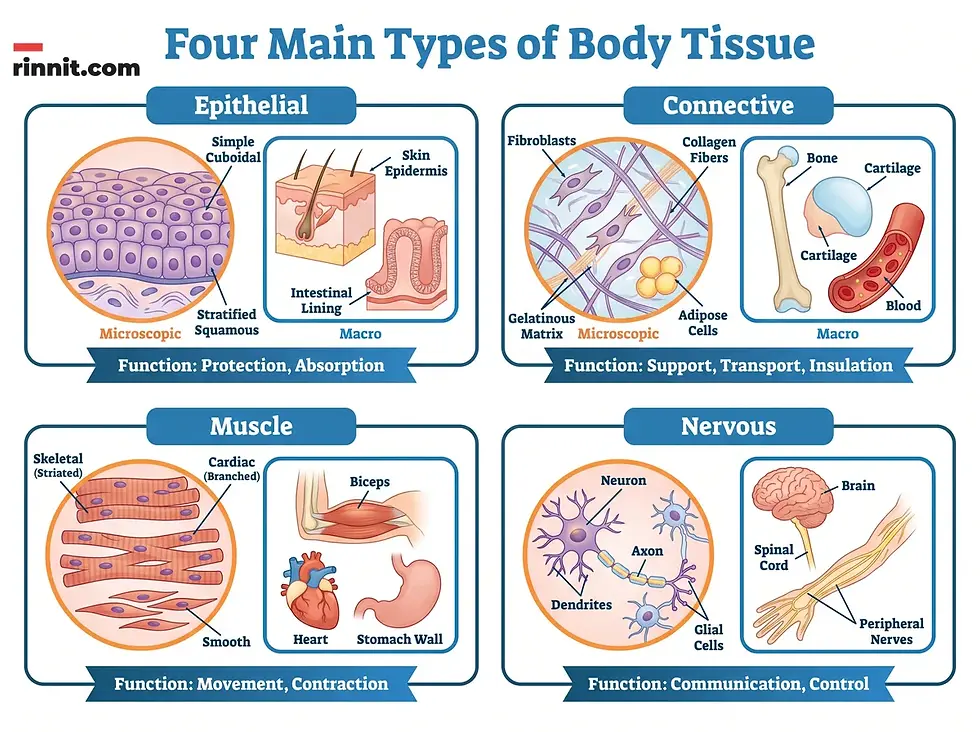
Every structure in the human body is composed of at least one of these four fundamental tissue types, each serving a distinct purpose. [1]
Tissue Type | Primary Function | Structural Characteristics |
Epithelial | Forms protective boundaries, separations, and acts as a gatekeeper. | Neatly arranged layers with little to no space between cells. |
Connective | Holds the body together and links different parts and systems. | Cells separated by a matrix that determines density and hardness. |
Muscle | Enables internal and external movement through contraction. | Intertwined fibers bundled together for increased strength. |
Nervous | Facilitates communication via electrical and chemical signals. | Fibers forming complex connections; includes neurons and glial cells. |
How does body tissue fit into the levels of biological organization?

Tissues occupy a central role in the hierarchical organization of the human body.
Cells: The basic unit of life, with at least 200 different types in the body. [1]
Tissues: Groups of cells with similar functions that take on larger tasks. [1]
Organs: Distinct structures, like the heart or stomach, made of at least two tissue types. [1]
Organ systems: Complexes of multiple organs working together on complicated jobs.
The body: The full "corporation" where all levels work together for proper function.
What roles and unique properties do body tissues have?

Each tissue type possesses specialized properties that enable its specific contributions to health.
Epithelial boundaries: These tissues, such as the skin's epidermis or the cornea's epithelium, protect internal structures from the external environment. [1]
Connective abundance: As the most widespread tissue, connective tissue includes diverse structures like bones, blood, lymph, and deep skin layers. [1]
Electrically reactive tissues: Both muscle and nervous tissues react to electrical signals. Muscle tissue responds by tensing or flexing, while nervous tissue relays or stops signals to facilitate communication. [1]
Signal relaying: Nervous tissue uses neurons and glial cells to send chemical and electrical messages at enormous speeds across the body. [1]
Why is body tissue clinically important?
Understanding tissue types is essential in medical settings, particularly when diagnosing disease. Healthcare providers often refer to informal terms like "soft tissue" or "brain tissue" when discussing health concerns. [1] A common clinical procedure is the collection of a tissue sample, known as a biopsy, which allows providers to examine cells and tissues for abnormalities. This process helps in identifying diseases that may specifically target one type of tissue over others.
Conclusion
Body tissue is the literal "stuff" that makes up the human form, providing the structural and functional framework for every life process. From the protective layers of the epithelium to the supportive matrix of connective tissue and the reactive fibers of muscle and nervous systems, tissues are indispensable. Recognizing their roles not only deepens our understanding of anatomy but also clarifies the importance of medical diagnostics in maintaining tissue health.
Concerned about a specific health symptom or upcoming diagnostic test? Understanding the tissue types involved can help demystify clinical terms. Consult with a healthcare professional to learn more about how your body's tissues are functioning and what a tissue sample might reveal about your overall health.
Frequently Asked Questions
1. What are body tissues?
Body tissues are groups of cells with similar or related jobs that work together as part of larger structures, like organs, to run the body.
2. What are the four main types of body tissue?
The four main types are epithelial, connective, muscle, and nervous tissue.
3. Which tissue type is the most abundant?
Connective tissue is the most abundant and widespread type in the body, encompassing bones, blood, and most skin layers.
4. What is the job of epithelial tissue?
Epithelial tissue forms boundary layers or separations, protecting internal tissues and acting as a gatekeeper for what can pass through.
5. How does muscle tissue work?
Muscle tissue consists of intertwining fibers that flex and twist together. It is electrically reactive, meaning it tenses or flexes in response to signals.
6. What is the role of nervous tissue?
Nervous tissue sends and relays electrical and chemical signals between different parts of the body to facilitate communication.
7. Are blood and bone considered tissue?
Yes, both blood and bone are technically classified as connective tissue, despite their different physical properties.
8. What are glial cells?
Glial cells are part of nervous tissue that provide support to neurons, which are the primary signaling cells of the nervous system.
9. What is a biopsy?
A biopsy is a medical procedure where a healthcare provider takes a tissue sample to examine it for signs of disease or abnormalities.
10. What is the hierarchy of body organization?
The body is organized from cells to tissues, then organs, organ systems, and finally the entire body.
Related Reading
Connective Tissue Diseases: Types, Symptoms, and Treatment Options explains conditions that affect the body's supporting tissues.
Understanding Muscles: The Engines of Human Movement describes the three types of muscle tissue and how they work.
Understanding Nerves: The Body's Electrical Communication Network explains how nerve tissue sends signals through the body.
Cartilage: Complete Guide to Types, Function, and Joint Health covers the flexible connective tissue found in joints.
References
Cleveland Clinic. Body Tissue Types, Structure & Function. Cleveland Clinic. Apr. 1, 2025. https://my.clevelandclinic.org/health/body/body-tissue
Sender R, Fuchs S, Milo R. Revised estimates for the number of human and bacteria cells in the body. PLoS Biol. 2016;14(8):e1002533. PMID 27541692. https://doi.org/10.1371/journal.pbio.1002533
Li S, Yu LL, Li L, et al. Ultrasound-guided core-needle biopsy for peripheral pulmonary lesions: a systematic review and meta-analysis. Clin Radiol. 2023;78(10):755-762. PMID 37558538. https://doi.org/10.1016/j.crad.2023.07.005
Kwon Y, Lee MK. Diagnostic performance and safety of ultrasound-guided core needle biopsy for diagnosing lymphoma: a systematic review and meta-analysis. Cancer Med. 2025;14(1):e70414. PMID 39757781. https://doi.org/10.1002/cam4.70414
Medical Disclaimer
This article is for informational purposes only and does not constitute medical advice. Always seek the advice of your physician or other qualified health provider with any questions you may have regarding a medical condition. Never disregard professional medical advice or delay in seeking it because of something you have read here.



Comments