Bacillary Dysentery: The Bloody Diarrhea Infection Caused by Common Bacteria, and How to Treat and Prevent It

Updated: 2 days ago
Medically reviewed by Dr. Baraa Alnahhal, MD. Last reviewed October 13, 2026. This content is for educational purposes and is not medical advice.

Quick Answer
Bacillary dysentery is a bacterial infection that causes severe inflammation of the small and large intestines, producing diarrhea with blood or mucus [1]. Bacteria such as Shigella or Salmonella spread when infected stool reaches another person's mouth [1]. Fever and stomachache are common [1]. Most cases pass in a few days [1], while severe cases need antibiotics and IV fluids [1].
What the research says
Antibiotics shorten Shigella dysentery. A Cochrane review of 16 trials (1,748 participants) concluded that antibiotics reduce the duration of Shigella dysentery. In one three-armed trial of people with moderately severe illness, fewer people still had diarrhea at follow-up with furazolidone (risk ratio 0.21, 95% CI 0.09 to 0.48; 73 participants) or cotrimoxazole (risk ratio 0.30, 95% CI 0.15 to 0.59; 76 participants) than with no drug, and none of the antibiotics studied raised safety concerns (Christopher et al., Cochrane Database Syst Rev, 2010) [6].
Antibiotic resistance is a growing problem, and toddlers are hit hardest. Across more than 3 million probable cases in China from 2004 to 2014, yearly incidence fell from 38.03 to 11.24 cases per 100,000 person-years, but infants under 1 year had an incidence of 228.59 per 100,000, and the share of Shigella isolates resistant to ciprofloxacin rose from 8.53% in 2005 to 44.65% in 2014, so the authors stress checking an isolate's susceptibility before choosing treatment (Chang et al., BMC Infect Dis, 2016) [3].
What Is Bacillary Dysentery?
Bacillary dysentery (pronounced "BAS-uh-ler-ee" "DIS-uhn-ter-ee") is a gastrointestinal (GI) disease, which means it affects your digestive system (GI tract) [1]. The name breaks down into two parts: "bacillary" refers to bacteria, and "dysentery" is severe diarrhea that contains blood or mucus [1] [4].
When you have bacillary dysentery, a bacterial infection grows more severe and causes inflammation (swelling and irritation) in your small and large intestines [1]. Symptoms range from mild to life-threatening [1].
Anyone can get bacillary dysentery, and the bacteria that cause it spread easily [1]. It is more common in areas that don't have water sanitation [1]: facilities that prevent diseases that spread through drinking water.
What Are the Symptoms of Bacillary Dysentery?
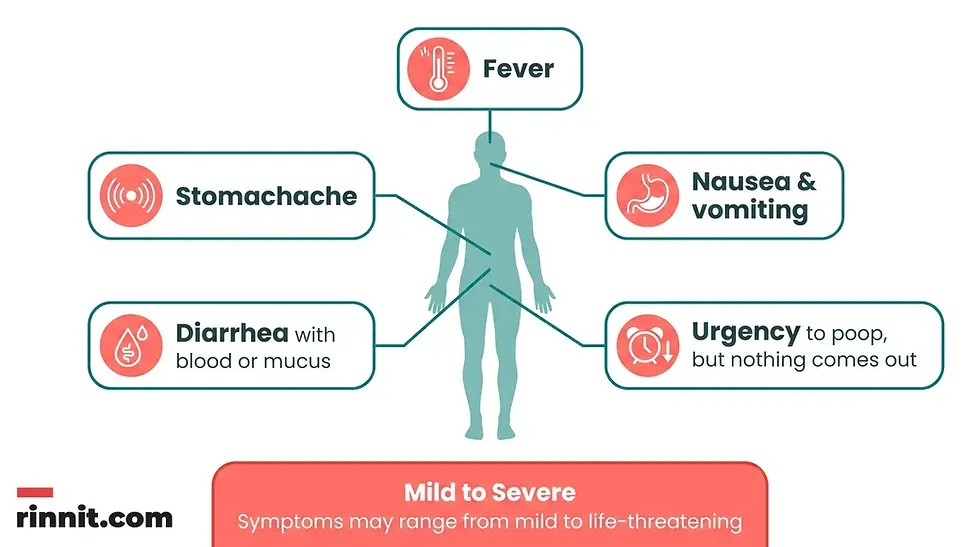
Bacillary dysentery can cause a range of symptoms, which may be mild or severe.
Symptom | What You May Notice |
Bloody or mucousy diarrhea | Diarrhea containing blood or mucus, the hallmark sign |
Tenesmus | Feeling an urgency to poop, but nothing comes out |
Fever | Elevated body temperature |
Nausea and vomiting | Feeling sick to your stomach |
Stomachache | Pain in the belly |
Your symptoms may be mild or severe.
What Causes Bacillary Dysentery?
Bacillary dysentery is caused by several common bacteria that usually pass from person to person through the fecal-oral route [1].
Bacterium | Infection It Causes |
Shigella | Shigellosis |
Salmonella | Salmonella (salmonellosis) |
Campylobacter | Campylobacteriosis |
Escherichia coli (E. coli) | E. coli infection |
These bacteria usually pass from person to person when poop from an infected person gets into another person's mouth, called the fecal-oral route [1]. Common examples include:
Making and/or serving food without washing your hands
Not washing your hands after using the restroom or changing diapers
Drinking contaminated water
Anal sex, including rimming (analingus) and other sexual contact involving the anus
Touching contaminated objects or surfaces

What Is the Incubation Period for Bacillary Dysentery?
The incubation period for the bacteria that can lead to bacillary dysentery can be from one day to a week [1]. An incubation period is the amount of time between exposure to a germ and the appearance of symptoms.
What Are the Complications of Bacillary Dysentery?
Bacillary dysentery can lead to complications that may be life-threatening, so it is important to get medical care right away if you have symptoms.
These complications may be life-threatening. It's important to get medical care right away if you have symptoms.
How Do Doctors Diagnose Bacillary Dysentery?
Healthcare providers will review your medical history, ask about your symptoms, and conduct a physical exam. If they think you have bacillary dysentery, they'll recommend a stool culture [1]. A stool culture is a type of bacterial culture test. It checks a sample of your poop for the presence of bacteria that can cause bacillary dysentery.
How Is Bacillary Dysentery Treated?
Many people with bacillary dysentery don't need medical treatment and can manage their symptoms with fluids and self-care [1]. Symptoms often get better in a few days to a week [1]. In these cases, you should:
Avoid over-the-counter antidiarrhea medications like loperamide (Imodium A-D, K-Pek II) and bismuth subsalicylate (Pepto-Bismol, Bismatrol), which can make your symptoms worse [1] [4]
Avoid people for at least two full days (48 hours) after the last time you have diarrhea to prevent spreading bacillary dysentery to others [1]
Take over-the-counter nonsteroidal anti-inflammatory drugs (NSAIDs) to reduce pain and fever [1]
In severe cases that require medical attention, treatment often includes:
When Should I See My Healthcare Provider?
Visit a healthcare provider if your symptoms don't go away after a few days or if they get worse [1].
Go to the nearest urgent care or emergency room if you have signs of moderate or severe dehydration, like:
Dehydration Sign | What You May Notice |
Confusion | Trouble thinking clearly |
Dark-colored pee or difficulty peeing | Changes in urine color or flow |
Dizziness or lightheadedness | Feeling faint |
Dry cough | Cough without phlegm |
Dry mouth | Lack of saliva |
Headache | Pain in the head |
Lack of tears in your eyes | Especially noticeable in infants |
Muscle cramps | Painful muscle tightening |
Swollen feet (edema) | Fluid buildup in the feet |
What's the Outlook?
The outlook for bacillary dysentery is usually good, as most people feel better in a few days without medical treatment [1]. But some people are at a greater risk of developing dehydration. Dehydration complications may cause:
Heart attack
Kidney failure
Stroke
In severe cases, dehydration can also be fatal [1].
How Can I Prevent Bacillary Dysentery?
The best way to prevent bacillary dysentery is to prevent the spread of germs. Wash your hands with soap and clean water after using the restroom and before handling food [1] [4].
You can also help reduce your risk of infection by:
Not sharing personal items with others, like towels
Not using water unless you know it's germ-free (sterile): boil water, use chlorine tablets, or use bottled water for drinking, making ice, cooking, and brushing your teeth
Staying away from people who are sick
Thoroughly cooking all food
Washing all fresh fruits and vegetables with clean water or peeling them before eating
How Can I Avoid Spreading It?
If you have bacillary dysentery, for the first 48 hours after your last symptoms [1], you should avoid:
Being around others
Having sexual intercourse
Preparing food
Swimming
It's also a good idea to:
What Is the Difference Between Bacillary Dysentery and Amoebic Dysentery?
Bacteria cause bacillary dysentery [1]. A single-celled parasite (amoeba) causes amoebic dysentery (amoebiasis) [1].
What is the bottom line on bacillary dysentery?
Stomach pain and diarrhea with blood or mucus are some of the telltale signs of bacillary dysentery. It's a common condition, and it usually goes away on its own without treatment [1]. The bacteria behind it (Shigella, Salmonella, Campylobacter, and E. coli) spread easily through unwashed hands, contaminated food and water, and close contact, which is why handwashing is your first line of defense. In the meantime, isolate yourself from others if you can (even better if you have a second bathroom to use by yourself) to keep the germs from spreading, and drink fluids to help prevent dehydration. If your symptoms linger (or get worse) and you can't hold down water, get to the nearest urgent care or ER for treatment.
How can you start recovering from bacillary dysentery?
Most cases of bacillary dysentery pass in a few days with rest, fluids, and NSAIDs for pain and fever, but the wrong move, like reaching for an antidiarrhea pill, can make things worse. Explore Rinnit.com's library of infection guides for more plain-language answers you can act on.
Frequently Asked Questions
What are the symptoms of bacillary dysentery?
Symptoms may include diarrhea containing blood or mucus, feeling an urgency to poop but not being able to (tenesmus), fever, nausea and vomiting, and stomachache. Symptoms may be mild or severe.
What causes bacillary dysentery?
Common bacteria including Shigella (shigellosis), Salmonella (salmonellosis), Campylobacter (campylobacteriosis), and Escherichia coli (E. coli infection). They spread through the fecal-oral route, when poop from an infected person gets into another person's mouth.
How does bacillary dysentery spread?
Through making or serving food without washing hands, not washing hands after using the restroom or changing diapers, drinking contaminated water, anal sex including rimming (analingus), and touching contaminated objects or surfaces.
How long is the incubation period?
The incubation period, the time between exposure to a germ and the appearance of symptoms, can be from one day to a week.
How is bacillary dysentery diagnosed?
A healthcare provider reviews your medical history, asks about symptoms, conducts a physical exam, and often recommends a stool culture, a bacterial culture test that checks a sample of your stool for the bacteria that can cause bacillary dysentery.
How is bacillary dysentery treated?
Many people don't need medical treatment and feel better in a few days to a week. Drink plenty of fluids, take OTC NSAIDs for pain and fever, avoid OTC antidiarrhea medications (loperamide and bismuth subsalicylate can make symptoms worse), and avoid people for at least 48 hours after your last diarrhea. Severe cases need antibiotics, IV fluids, and sometimes a blood transfusion.
Why should I avoid antidiarrhea medications?
Over-the-counter antidiarrhea medications like loperamide (Imodium A-D, K-Pek II) and bismuth subsalicylate (Pepto-Bismol, Bismatrol) can make your symptoms worse.
What are the complications of bacillary dysentery?
Complications may include extreme inflammation, dehydration (infants, people 65+, and immunocompromised people are at greater risk), sudden (acute) kidney disease, and widening (dilation) of the large intestine. These complications may be life-threatening.
When should I go to the ER?
Go to urgent care or the ER for signs of moderate or severe dehydration: confusion, dark-colored pee or difficulty peeing, dizziness or lightheadedness, dry cough, dry mouth, headache, lack of tears in your eyes, muscle cramps, or swollen feet (edema).
What's the outlook?
Most people feel better in a few days without medical treatment. But dehydration complications can lead to heart attack, kidney failure, or stroke, and in severe cases, dehydration can be fatal.
Can bacillary dysentery be prevented?
Yes. Wash hands with soap and clean water after using the restroom and before handling food; don't share personal items like towels; only use germ-free water for drinking, ice, cooking, and brushing teeth; stay away from sick people; cook food thoroughly; and wash or peel fresh fruits and vegetables.
How do I avoid spreading it to others?
For the first 48 hours after your last symptoms, avoid being around others, having sexual intercourse, preparing food, and swimming. Also clean toilets, sinks, handles, and surfaces with disinfectant wipes or sprays, and wash laundry including bedding in hot water.
Is bacillary dysentery different from amoebic dysentery?
Yes. Bacteria cause bacillary dysentery. A single-celled parasite (amoeba) causes amoebic dysentery (amoebiasis).
Who is most at risk of complications?
Infants, people 65 and older, and people with a compromised immune system (immunocompromised) are at a greater risk of developing dehydration.
What should I do if my symptoms linger or get worse?
If you can't hold down water, get to the nearest urgent care or ER for treatment. Isolate yourself from others if you can, and drink fluids to help prevent dehydration.
Related Reading on Rinnit.com
Shigella Infection (Shigellosis): Symptoms, Causes, and Treatment: the Shigella infection that most commonly causes bacillary dysentery.
Dehydration: Symptoms, Causes, Risk Groups & Treatment — Complete Guide: the complication that makes severe cases life-threatening.
E. coli Infection: Symptoms, Causes, and Treatment: one of the four main bacterial culprits behind bacillary dysentery.
References
Cleveland Clinic. Bacillary Dysentery. Cleveland Clinic. Last updated June 30, 2025. https://my.clevelandclinic.org/health/diseases/22617-bacillary-dysentery
Akhondi H, et al. Bacterial Gastroenteritis. In: StatPearls [Internet]. StatPearls Publishing. Last updated January 21, 2025. PMID 31869107. https://www.ncbi.nlm.nih.gov/books/NBK551643/
Chang Z, et al. The changing epidemiology of bacillary dysentery and characteristics of antimicrobial resistance of Shigella isolated in China from 2004-2014. BMC Infect Dis. 2016;16(1):685. PMID 27863468. https://doi.org/10.1186/s12879-016-1977-1
National Health Service. Dysentery. NHS. Page last reviewed July 17, 2024. https://www.nhs.uk/conditions/dysentery/
Cleveland Clinic. Shigellosis (Shigella Infection). Cleveland Clinic. Last updated August 11, 2025. https://my.clevelandclinic.org/health/diseases/17826-shigellosis
Christopher PR, et al. Antibiotic therapy for Shigella dysentery. Cochrane Database Syst Rev. 2010;2010(8):CD006784. PMID 20687081. https://doi.org/10.1002/14651858.CD006784.pub4
Medical disclaimer
This article is for general informational purposes only and is not a substitute for professional medical advice, diagnosis, or treatment. Always seek the advice of your physician or other qualified health provider with any questions you may have regarding a medical condition. Never disregard professional medical advice or delay in seeking it because of something you have read here. If you cannot hold down water, have signs of severe dehydration, or experience confusion or bloody diarrhea that worsens, seek urgent medical care immediately.



Comments