Augmentation of Labor: Methods, Risks and What to Expect

Updated: 2 days ago
Written and medically reviewed by Dr. Baraa Alnahhal, MD · Last reviewed: November 2026 · How we review
Quick Answer
Augmentation of labor is a way to speed up labor that's slow or stalled, used after labor has already begun. Methods include breaking the water, oxytocin through an IV, misoprostol and a balloon catheter. Your care team monitors you and your baby throughout. It's generally safe; risks include overly strong contractions and infection.
What the research says
Higher oxytocin doses may lower C-section rates: a Cochrane review of 4 trials with 644 women in slow labor found high-dose oxytocin lowered C-section rates (risk ratio 0.62) and raised spontaneous vaginal births compared with low-dose, but the difference faded when a lower-quality study was removed (Kenyon S et al., Cochrane Database of Systematic Reviews, 2013) [2]
Early amniotomy plus oxytocin shortened labor: a Cochrane review of 14 trials with 8,033 women found early amniotomy with oxytocin shortened labor by about 1.28 hours and modestly reduced C-sections when used to prevent delay (Wei S et al., Cochrane Database of Systematic Reviews, 2013) [3]
Key takeaways
Augmentation speeds up labor that has already started.
It's used for weak, irregular or stopped contractions.
Methods include amniotomy, oxytocin, misoprostol and a balloon catheter.
You and your baby are monitored throughout.
It may help you avoid a C-section.
What is augmentation of labor?
"Augmenting" means "adding to." Treatments make contractions stronger and closer together and help open, soften and thin the cervix. It uses methods similar to labor induction. Learn about the stages of labor. Sources: [1]
Why it's done
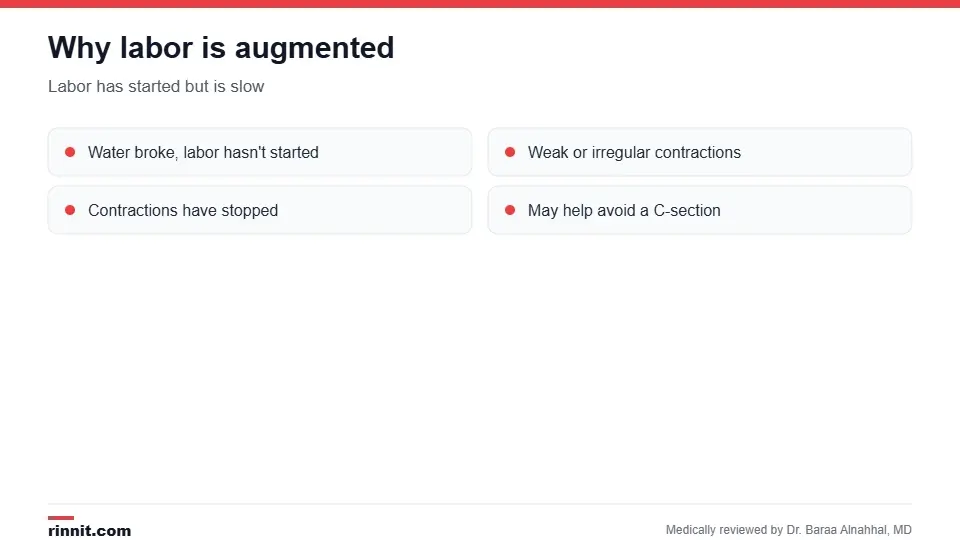
Prolonged labor can cause complications for you and your baby.
Your water has broken, but labor hasn't started.
Contractions are weak or irregular.
Contractions have stopped. Sources: [1]
Prolonged labor can cause complications, and augmentation may help avoid a C-section. Sources: [1, 2]
Methods of augmentation

Your provider chooses the method based on your labor.
Method | How it works |
Breaking the amniotic sac to add pressure on the cervix | |
Oxytocin | A hormone through an IV to strengthen contractions |
Misoprostol | A small pill in the vagina to soften the cervix; not used after a past C-section |
Inflated in the cervix to widen it; stays 2 to 12 hours |
When the balloon falls out, most people are about 4 centimeters dilated. Sources: [1, 3]
What to expect

Some people respond quickly; others take longer.
Your care team explains what's happening and why.
They choose a method or combination.
You and your baby are monitored throughout.
Treatment is adjusted as labor progresses.
The team keeps you updated on progress and any concerns. Sources: [1]
Some people respond quickly; others take longer. Ask questions and tell your team how you feel. Sources: [1]
Risks
Very strong or frequent contractions (uterine tachysystole), mostly from IV oxytocin, which may stress the baby.
A higher risk of uterine rupture, especially after a past C-section.
Infection inside the uterus (chorioamnionitis), which may follow amniotomy or balloon use. Sources: [1]
Who shouldn't have it
When the baby isn't headfirst (breech or sideways).
With Asherman's syndrome (scar tissue inside the uterus). Also with placenta previa, active genital herpes, or a past vertical (classical) C-section or certain uterine surgeries. Sources: [1]
Outlook
Augmentation is generally safe, and its benefits usually outweigh the risks. It can help labor progress and may help you avoid a C-section. Sources: [1, 2, 3]
Talking with your care team
Tell your team how you're feeling throughout labor. They'll keep you updated on your progress and any concerns. Sources: [1]
Conclusion
Augmentation of labor helps a slow or stalled labor move forward with close monitoring of you and your baby. Asking questions helps you understand each step.
Keep learning: read about labor induction and cervical ripening.
Frequently asked questions
What is augmentation of labor?
Speeding up labor that has already started but is slow or stalled.
How is it different from induction?
Induction starts labor; augmentation speeds it up.
Why is it done?
For weak, irregular or stopped contractions.
What methods are used?
Amniotomy, oxytocin, misoprostol and a balloon catheter.
What is oxytocin?
A hormone given by IV to strengthen contractions.
What is a Foley bulb?
A balloon placed in the cervix to widen it.
Is augmentation safe?
Generally yes; benefits usually outweigh risks.
What are the risks?
Overly strong contractions, uterine rupture and infection.
Can it prevent a C-section?
It may help you avoid one.
Who shouldn't have it?
People whose baby isn't headfirst or who have Asherman's syndrome.
Related Reading
Understanding Labor Induction: A Comprehensive Patient Guide starting labor.
Understanding Amniotomy: Procedure, Risks, and Benefits breaking the water.
Foley Bulb Induction: A Mechanical Approach to Labor Preparation widening the cervix.
Understanding the Three Stages of Labor how labor progresses.
C-Section (Cesarean Delivery): Reasons, Procedure, Risks, and Recovery a surgical birth.
References
Cleveland Clinic. Augmentation of Labor: Purpose, Risks & Results. Cleveland Clinic. Last updated June 15, 2026. https://my.clevelandclinic.org/health/treatments/24221-augmentation-of-labor
Kenyon S, Tokumasu H, Dowswell T, et al. High-dose versus low-dose oxytocin for augmentation of delayed labour. Cochrane Database of Systematic Reviews. 2013;2013(7):CD007201. PMID 23853046. https://doi.org/10.1002/14651858.CD007201.pub3
Wei S, Wo BL, Qi HP, et al. Early amniotomy and early oxytocin for prevention of, or therapy for, delay in first stage spontaneous labour compared with routine care. Cochrane Database of Systematic Reviews. 2013;2013(8):CD006794. PMID 23926074. https://doi.org/10.1002/14651858.CD006794.pub4
Medical disclaimer
This article is for general education only and does not replace advice from a qualified healthcare professional. Talk to your doctor about your own diagnosis and treatment, and seek emergency care right away for severe or sudden symptoms.



Comments