ATTR-CM (Transthyretin Amyloid Cardiomyopathy): The Rare Heart Condition Caused by Protein Clumps — Explained in Plain English

Updated: 3 days ago
Medically reviewed by Dr. Baraa Alnahhal, MD · Last reviewed: October 2026
Quick Answer
ATTR-CM (transthyretin amyloid cardiomyopathy) is a rare, progressive condition in which clumps of irregular TTR proteins build up in the heart muscle and stiffen it [1]. It is either hereditary or wild-type, the aging-related, most common type [1] [2]. Symptoms include shortness of breath and leg swelling [1]. There is no cure, but medications can slow the disease and manage symptoms [1] [2].
What the research says
ATTR-CM is under-recognized, especially in older adults with heart failure. A JACC State-of-the-Art Review reports that up to 10% to 15% of older adults with heart failure may have unrecognized wild-type ATTR, that carpal tunnel syndrome and lumbar spinal stenosis can raise suspicion and allow earlier diagnosis, and that the diagnosis can often be made with noninvasive nuclear imaging when there's no monoclonal protein. It also notes that therapy that slows or halts progression is now available, and that early recognition is essential to get the best treatment effect (Ruberg et al., J Am Coll Cardiol, 2019) [2].
What Is ATTR-CM?
ATTR-CM, or transthyretin amyloid cardiomyopathy, happens when clumps of irregular proteins build up in your heart muscle. These protein deposits — called amyloid fibrils — replace healthy heart cells and stiffen your whole heart [1]. That stiffness makes it harder for your heart to pump blood throughout your body [1].
Over time, ATTR-CM can lead to life-threatening complications like heart failure and arrhythmias (abnormal heart rhythms) [1].
ATTR-CM is a complication of transthyretin amyloidosis (ATTR), a broader condition in which the same protein clumps can affect several other parts of your body — not just your heart. This includes your limb nerves, ligaments, and tendons [1].
Term | What It Means |
ATTR-CM | Transthyretin amyloid cardiomyopathy — the heart-muscle version of the disease |
Amyloid fibrils | Clumps of misfolded proteins that stiffen the heart |
TTR (transthyretin) | A protein that, when faulty or unstable, forms the damaging clumps |
Cardiomyopathy | Disease of the heart muscle that reduces its ability to pump blood |
ATTR | Transthyretin amyloidosis — the broader condition ATTR-CM comes from |

What Are the Types of ATTR-CM?
ATTR-CM comes in two types that differ in their causes and in who they tend to affect.
Type | What Causes It | Who It Affects |
Hereditary ATTR-CM (hATTR-CM) | A genetic change; can run in biological families | Symptoms can start as early as your 30s, but often show up in your 50s or later |
Wild-type ATTR-CM (wATTR-CM) | Aging-related changes; does not run in families | Most commonly affects males over age 65 — this is the most common type of ATTR-CM |
What Are the Symptoms of ATTR-CM?
Symptoms are similar to those of heart failure. The most common include shortness of breath — especially when lying down [1] — and swelling in your legs, ankles, and feet (a condition called edema, where fluid pools in your tissues) [1].
Other symptoms include:
Symptom | What It Looks Like |
Bloated stomach | A swollen or puffy belly from fluid |
Confusion or difficulty thinking | Trouble concentrating or feeling mentally foggy |
Dizziness or passing out | Feeling lightheaded or losing consciousness |
Coughing or wheezing | Especially when lying down |
Fatigue | Feeling unusually worn out |
Heart palpitations | Awareness of your heartbeat, like fluttering |
Irregular or fast heart rate (arrhythmia) | Especially atrial fibrillation — a chaotic, fast rhythm in the heart's upper chambers |
Because ATTR-CM develops from transthyretin amyloidosis (ATTR), you may also have other symptoms of ATTR outside the heart — for example, carpal tunnel syndrome or lumbar spinal stenosis (chronic lower back pain) [1] [2].

What Causes ATTR-CM?
ATTR-CM happens when transthyretin (TTR) proteins build up in your heart muscle. Here's the chain of events: the proteins break apart and fold up on themselves, forming clumps of amyloid fibrils [1]. Your blood carries these fibril clumps throughout your body. When the clumps build up in your heart muscle, they cause damage — this heart-muscle damage is the "cardiomyopathy" in ATTR-CM.
What sets the clumping in motion differs by type:
Type | How the Clumping Starts |
Hereditary ATTR-CM | A change to the TTR gene causes your body to make faulty TTR proteins |
Wild-type ATTR-CM | An aging-related disease — normal TTR proteins become structurally unstable and build up in your heart |
Who Is at Higher Risk?
Risk depends on the type. Hereditary ATTR-CM is most likely to affect Black males in the United States [1]: the most common gene variant in the U.S. that causes it occurs in 3% to 4% of all Black people [1]. It's also more common in parts of Portugal, Brazil, Sweden, and Japan [1].
Wild-type ATTR-CM is most likely to affect males over the age of 65 [1].
What Are the Complications?
Without treatment, ATTR-CM can cause worsening complications, including heart failure, arrhythmias, and conduction system diseases like heart block (when the heart's electrical signals are slowed or blocked) [1].
These conditions can lead to sudden cardiac death or a stroke [1].
How Is ATTR-CM Diagnosed?
Doctors diagnose ATTR-CM with several tests, although diagnosis can be challenging because the condition can mimic other heart diseases or go undetected.
Test | What It Checks |
Electrocardiogram (EKG) | The heart's electrical activity |
Echocardiogram | Heart imaging using sound waves |
Cardiac MRI | Detailed heart imaging with magnets |
Cardiac PYP scan | Checks for TTR amyloid deposits in your heart |
Heart biopsy | A tiny heart tissue sample examined for protein deposits |
Genetic testing | Looks for the TTR gene change that causes the hereditary type |
Diagnosis can be challenging. The hereditary type can mimic heart disease caused by chronic high blood pressure or hypertrophic cardiomyopathy (an inherited thickening of the heart muscle), so you may get an incorrect diagnosis at first [1]. And because the wild type doesn't always cause symptoms, it can go undetected until severe problems like heart failure occur [1].
How Is ATTR-CM Treated?
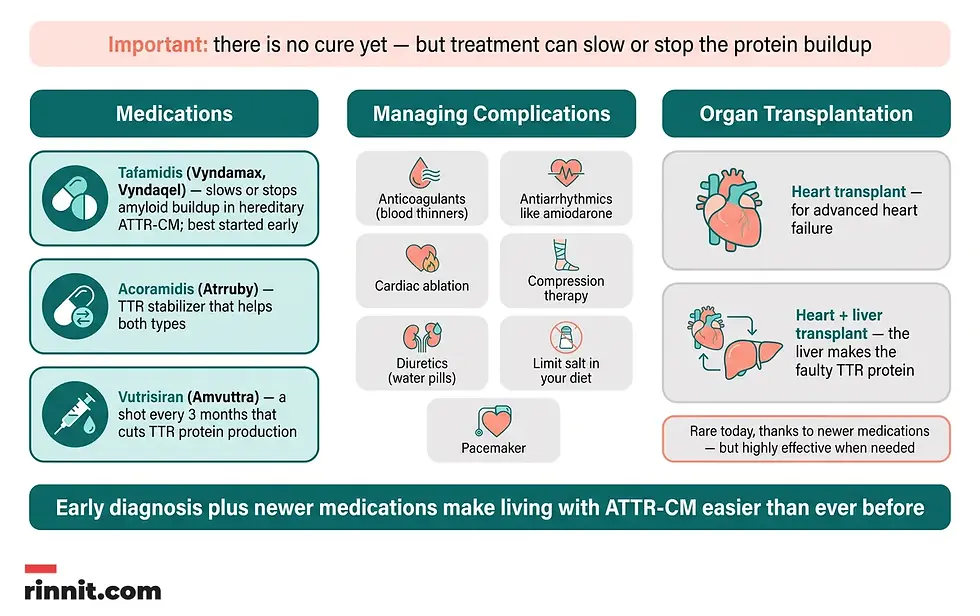
ATTR-CM has no cure [1], but treatment may slow or stop amyloid buildup and help manage complications such as heart failure and arrhythmias [1]. Treatment may involve three approaches working together: medications to slow or stop the production or buildup of amyloid deposits, managing complications like heart failure and arrhythmias, and — in some cases — organ transplantation.
Medications for ATTR-CM
Three newer medications are the cornerstone of treatment:
Medication | Brand Name(s) | What It Does |
Tafamidis | Vyndamax, Vyndaqel | Slows or stops the buildup of amyloid deposits in hereditary ATTR-CM; works best if started early |
Acoramidis | Atrruby | A TTR stabilizer that can help with both types of ATTR-CM |
Vutrisiran | Amvuttra | The latest approved medication; a shot every three months that decreases the production of TTR proteins altogether, reducing buildup in your heart; also treats hereditary TTR polyneuropathy |
Researchers are currently studying other medications that target the underlying cause of this condition [1]. Ask your healthcare provider if you can join a clinical trial.
Managing Complications
Therapies that may help manage heart failure and arrhythmias related to ATTR-CM include:
Therapy | What It Addresses |
Anticoagulants | Blood thinners that help prevent clots and strokes |
Antiarrhythmic medications (like amiodarone) | Help restore and maintain a normal rhythm |
Cardiac ablation | A procedure that targets the heart tissue causing abnormal rhythms |
Compression therapy | Helps reduce swelling in the legs |
Diuretics | "Water pills" that help your body shed extra fluid |
Limiting salt in your diet | Reduces fluid retention |
Pacemaker | A device that helps regulate slow or blocked heart rhythms |
Organ Transplantation
In cases of advanced heart failure, a heart transplant may be an option [1]. Your liver makes the abnormal transthyretin protein in ATTR-CM, so some people may get both a heart and liver transplant [1]. Healthcare providers haven't recommended this option as much in recent years because of the newer therapies available.
Overall, organ transplantation is a rare treatment for ATTR-CM — but it's highly effective when needed [1].
What's the Outlook?
ATTR-CM is a progressive disease — it gets worse over time [1]. Early diagnosis and treatment are key to a better outlook (prognosis) [1] [2]. Living with ATTR-CM is easier than it used to be, thanks to advancements in diagnostic tests and medications like tafamidis, acoramidis, and vutrisiran.
Because the disease progresses, you'll need to see your cardiologist (a heart specialist) regularly to make sure your treatment is working [1].
It may help to ask your provider the following questions:
Question | Why It Helps |
What type of ATTR-CM do I have? | The two types have different causes and treatment paths |
What treatments do you suggest? | Helps you understand your options |
What are the benefits and risks of my treatment options? | Supports informed decisions |
Should I look out for signs of complications? | Early warning signs matter with a progressive disease |
Should my family members get testing for the condition? | The hereditary type can run in biological families |
When Should I See My Healthcare Provider?
See your provider promptly if you develop heart-failure-like symptoms that are new or worsening — shortness of breath, swelling in your legs and feet, unexplained fatigue, or irregular heartbeats. ATTR-CM can be mistaken for other heart conditions, so if you have a family history of ATTR-CM or a diagnosis that doesn't quite fit, ask whether ATTR-CM could be considered and whether a cardiac PYP scan or genetic testing is appropriate.
Conclusion
ATTR-CM is a rare condition, but it's no longer untreatable. When clumps of misfolded TTR proteins stiffen your heart muscle, the heart gradually loses its ability to pump blood well — leading to heart failure, arrhythmias, and other serious complications. The condition comes in a hereditary form and an aging-related (wild-type) form, and it can be challenging to diagnose correctly at first.
The good news: newer medications like tafamidis, acoramidis, and vutrisiran can slow or stop the protein buildup, and a range of therapies can manage the complications. Because early diagnosis is the key to a better outlook, don't brush off persistent shortness of breath, swelling, or an irregular heartbeat — especially if you're over 65, if ATTR-CM runs in your family, or if you also have carpal tunnel syndrome or chronic lower back pain alongside heart symptoms. Talk to your provider.
Frequently Asked Questions
What is ATTR-CM?
ATTR-CM (transthyretin amyloid cardiomyopathy) is a rare, progressive condition in which clumps of irregular transthyretin proteins — called amyloid fibrils — build up in your heart muscle, replacing healthy cells and stiffening the heart so it can't pump blood as well.
What does the name ATTR-CM stand for?
"ATTR" stands for transthyretin amyloidosis — the broader condition where transthyretin protein clumps form. "CM" stands for cardiomyopathy, meaning heart-muscle disease. Together it describes the heart-muscle version of transthyretin amyloidosis.
What are the two types of ATTR-CM?
Hereditary ATTR-CM (hATTR-CM), caused by a genetic change in the TTR gene that can run in biological families, and wild-type ATTR-CM (wATTR-CM), an aging-related form that doesn't run in families.
Which type is more common?
Wild-type ATTR-CM is the most common type. It most often affects males over age 65.
Who is most at risk for the hereditary type?
Hereditary ATTR-CM is most likely to affect Black males in the United States. The most common U.S. gene variant that causes it occurs in 3% to 4% of all Black people. It's also more common in parts of Portugal, Brazil, Sweden, and Japan.
Why do proteins clump in ATTR-CM?
Transthyretin (TTR) proteins break apart and fold up on themselves, forming clumps called amyloid fibrils. In the hereditary type, a TTR gene change makes faulty proteins. In the wild type, normal proteins become structurally unstable with age and build up in the heart.
What are the symptoms of ATTR-CM?
Symptoms mirror heart failure: shortness of breath (especially when lying down), swelling in the legs, ankles, and feet (edema), a bloated stomach, confusion or difficulty thinking, dizziness or passing out, coughing or wheezing (especially lying down), fatigue, heart palpitations, and irregular or fast heart rate — especially atrial fibrillation.
Can ATTR-CM affect parts of the body other than the heart?
Yes. ATTR-CM is a complication of transthyretin amyloidosis (ATTR), which can also affect your limb nerves, ligaments, and tendons. You may have symptoms like carpal tunnel syndrome or lumbar spinal stenosis (chronic lower back pain).
What complications can ATTR-CM cause?
Without treatment, it can cause heart failure, arrhythmias, and conduction system diseases like heart block. These can lead to sudden cardiac death or a stroke.
How is ATTR-CM diagnosed?
Tests include an electrocardiogram (EKG), echocardiogram, cardiac MRI, cardiac PYP scan (which checks for TTR amyloid deposits in the heart), heart biopsy, and genetic testing.
Why is ATTR-CM hard to diagnose?
The hereditary type can mimic heart disease caused by chronic high blood pressure or hypertrophic cardiomyopathy, so an incorrect diagnosis can happen at first. The wild type doesn't always cause symptoms and can go undetected until heart failure occurs.
Is there a cure for ATTR-CM?
No. But newer treatments can slow or stop the protein buildup, although they can't reverse heart damage that already exists.
What medications treat ATTR-CM?
Tafamidis (Vyndamax, Vyndaqel) slows or stops amyloid buildup in hereditary ATTR-CM and works best when started early. Acoramidis (Atrruby) is a TTR stabilizer that can help with both types. Vutrisiran (Amvuttra) is the latest approved medication — a shot every three months that decreases TTR protein production altogether.
How are complications like heart failure and arrhythmias managed?
Options include anticoagulants, antiarrhythmic medications like amiodarone, cardiac ablation, compression therapy, diuretics, limiting salt in your diet, and a pacemaker.
When is organ transplantation used?
In advanced heart failure, a heart transplant may be an option. Since the liver makes the abnormal TTR protein, some people get both a heart and liver transplant. It's rare today because of newer therapies, but highly effective when needed.
Related Reading
Cardiac PYP Scan: Testing for ATTR Cardiac Amyloidosis explains the nuclear scan used to diagnose ATTR cardiac amyloidosis.
Heart Failure: Symptoms, Causes, and Treatment Guide — the main complication ATTR-CM can lead to
Atrial Fibrillation (Afib): Complete Guide — the arrhythmia most associated with ATTR-CM
Heart MRI (Cardiac MRI): What It Shows, How to Prepare, What Happens and Results explains the imaging test used to assess the heart muscle and its lining.
Medical Disclaimer
This article is for general informational purposes only and is not a substitute for professional medical advice, diagnosis, or treatment. Always seek the advice of your physician or other qualified health provider with any questions you may have regarding a medical condition. Never disregard professional medical advice or delay seeking it because of something you have read here.
References
Cleveland Clinic. ATTR-CM (Transthyretin Amyloid Cardiomyopathy). Cleveland Clinic. Updated September 12, 2025. https://my.clevelandclinic.org/health/diseases/attr-cm
Ruberg FL, et al. Transthyretin Amyloid Cardiomyopathy: JACC State-of-the-Art Review. J Am Coll Cardiol. 2019;73(22):2872-2891. PMID 31171094. https://doi.org/10.1016/j.jacc.2019.04.003



Comments